Start Writing a Parenting Plan That Reduces Conflict
Writing a parenting plan starts with putting the child’s routine first and making each agreement specific. List where the child will be on school days, weekends, holidays, and breaks; assign responsibility for major decisions; and set clear rules for exchanges, communication, travel, and resolving disagreements.
A strong plan should be detailed enough that neither parent has to guess what happens next. Use exact days, times, pickup locations, notice periods, and responsibilities. This creates consistency for your child and can prevent small misunderstandings from becoming expensive legal disputes.
In New Jersey, the terms used and the court process can affect how an agreement is written and enforced. A child-focused plan should account for the child’s age, school routine, health needs, activities, relationships with both parents, and any safety concerns. The goal is not to “win” a schedule. It is to build a workable structure that supports your child as life changes.
I am Kenneth White, Esq., a New Jersey Supreme Court Certified Matrimonial Law Attorney with decades of family-law experience, including mediation and court-appointed work involving parenting disputes. I help families approach writing a parenting plan with clear terms, practical expectations, and the child’s best interests at the center.
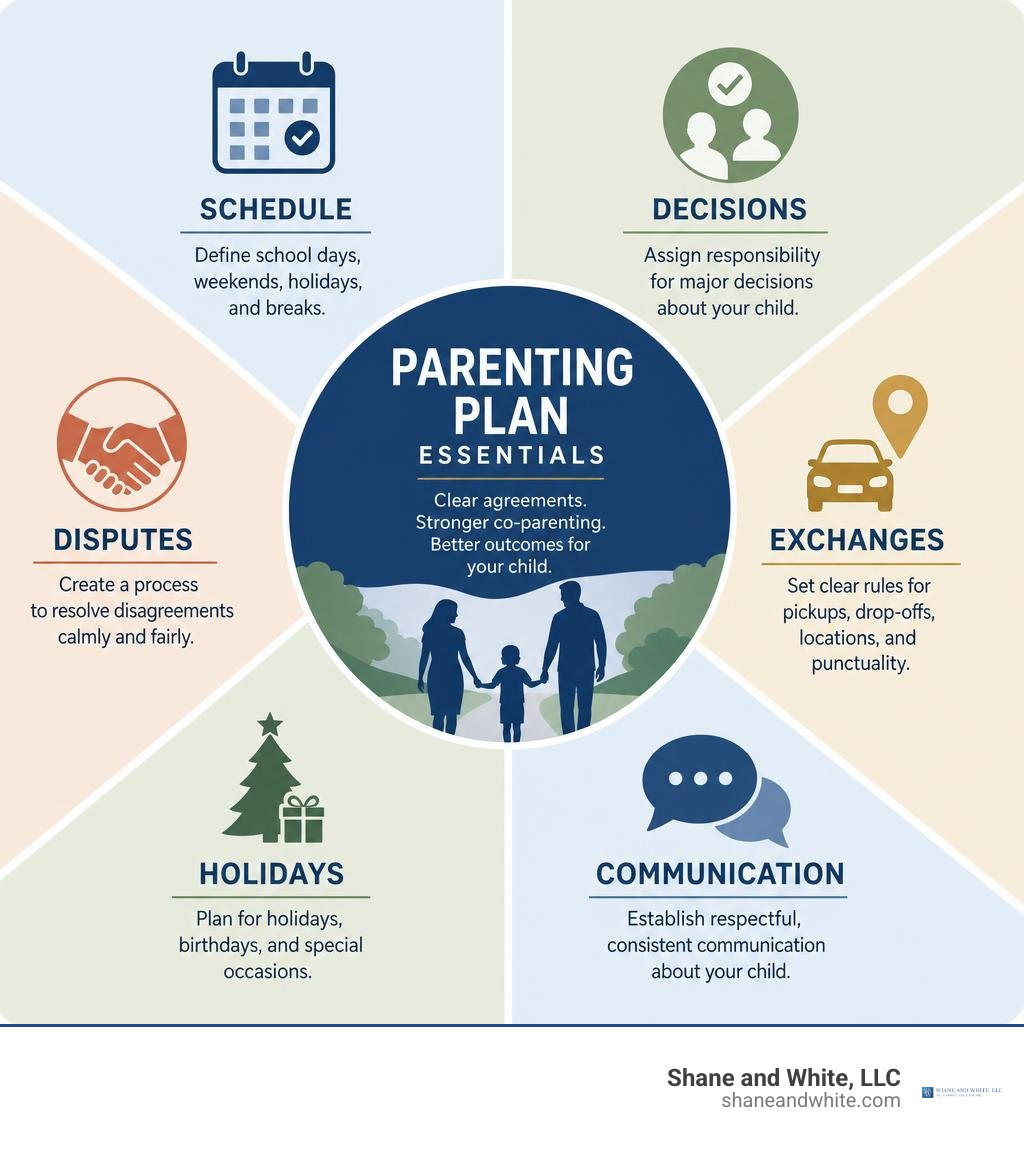
Handy writing a parenting plan terms:
Understanding Legal Custody, Physical Custody, and Decision-Making
When creating an effective agreement in New Jersey, understanding the legal terminology is vital. Parents often mix up the authority to make major life choices with the physical schedule of where children sleep. Knowing What Are The Different Types Of Custody And How Do They Work provides the foundation for setting up a balanced agreement.
Custody is divided into two primary categories:
- Legal Custody: This refers to the legal authority to make major, long-term decisions impacting your child’s life. These core areas typically include non-emergency healthcare treatments, choice of school or specialized educational programs, and religious upbringing. In New Jersey, joint legal custody is heavily favored by the courts, meaning both parents share equal input on significant issues regardless of where the child primarily resides. Sole legal custody is rare and generally reserved for situations involving severe parental unfitness or safety concerns.
- Physical (Residential) Custody: This defines where the child lives on a day-to-day basis. One parent may be designated the Parent of Primary Residence (PPR), while the other is the Parent of Alternate Residence (PAR). Alternatively, parents may share equal or near-equal joint physical custody, splitting residential time across the week or month.
| Custody Type | Joint Arrangement | Sole Arrangement |
|---|---|---|
| Legal Custody | Both parents consult and agree on major education, healthcare, and religious decisions. | One parent retains exclusive authority to make major decisions without required consent. |
| Physical Custody | The child divides residential time between both homes (e.g., 50/50 or alternating schedules). | The child lives primarily with one parent; the other exercises scheduled parenting time. |
Day-to-day decisions—such as bedtime routines, daily homework tracking, and standard meal choices—are managed by whichever parent currently has physical custody during their scheduled parenting time. However, emergency healthcare decisions should always be handled immediately by the supervising parent, with mandatory notice provided to the other parent as soon as practically possible.
Step-by-Step Guide to Writing a Parenting Plan
Drafting an agreement requires moving from high-level intentions to concrete details. When parents collaborate on a structured plan, it eliminates future guesswork and protects the child from being caught in parental disputes. Reviewing state guidelines on Child Support, Child Custody, and Parenting Time helps ensure your proposal aligns with New Jersey statutory standards.

To draft an effective agreement, follow this practical process:

- Information Gathering: Compile all school calendars, activity schedules, and work routines.
- Framework Selection: Choose a residential schedule model that reflects geographic proximity and your child’s age.
- Logistics Definition: Spell out precise transition times, pickup locations, and transportation responsibilities.
- Drafting Clauses: Detail decision-making procedures, holiday rotations, communication rules, and dispute resolution mechanisms.
- Review and Legal Submission: Review with counsel and submit the agreement to the court to make it an enforceable court order.
Essential Checklists Before Writing a Parenting Plan
Before you sit down to negotiate or draft clauses, organize key information about your children and daily schedules. Using a comprehensive Parenting Plan Checklist: Information to help you get started ensures no critical developmental needs or logistical obligations are overlooked.
Make sure to collect and evaluate:
- Child’s Daily & School Routine: Exact start and dismissal times, bus routes, after-school care programs, and academic district boundaries.
- Healthcare & Special Needs: Primary care providers, ongoing therapies, prescription management, health insurance coverage, and emergency contacts.
- Extracurricular Activities & Expenses: Sports schedules, music lessons, equipment costs, and registration deadlines.
- Parent Work Schedules & Commutes: Weekly work hours, travel commitments, and geographic distance between households in Middlesex County or surrounding New Jersey communities.
Structuring Time-Sharing Schedules, Holidays, and Transitions
A functional residential schedule minimizes mid-week chaos. Depending on your work flexibility, living distance, and child’s age, popular options include:
- 2-2-3 Rotation: The child spends 2 days with Parent A, 2 days with Parent B, and 3 days (the weekend) with Parent A, alternating the following week. This works well for younger children needing frequent contact with both parents.
- 2-2-5-5 Schedule: Parent A always has Monday/Tuesday, Parent B always has Wednesday/Thursday, and weekends alternate. This provides consistent weekday routines for school-age children.
- Week-On/Week-Off (Alternating Weeks): The child spends 7 consecutive days with each parent, often with a mid-week dinner visit. This suits older children and teens by reducing frequent transitions.
Your plan must explicitly address holiday and vacation schedules, which always take priority over the standard weekly rotation:
- Alternating Major Holidays: Rotate Thanksgiving, Memorial Day, Labor Day, and winter breaks by odd and even years.
- Fixed Annual Days: Mother’s Day with mother, Father’s Day with father, and clear rules for the child’s birthday.
- Summer Vacation Blocks: Specify how many uninterrupted vacation weeks each parent receives in the summer, along with a firm written notification deadline (such as April 1st or May 1st).
- Exchange Protocols: Detail exact curb-to-curb handoff locations or neutral pickup spots, specify which parent provides transportation, and establish a reasonable grace period (e.g., 15–20 minutes) for unexpected traffic delays.
Establishing Communication Protocols and Dispute Resolution
Parenting agreements should govern how adults interact, keeping adult conversations away from the children. When navigating stressful transitions, consulting Navigating Tough Times Your Guide To East Windsor Family Court Attorneys can provide guidance on maintaining healthy legal boundaries.
To avoid unnecessary conflicts, incorporate these modern communication and dispute standards:
- Designated Channels: Mandate communication via written text, email, or secure co-parenting applications (such as OurFamilyWizard or TalkingParents) to maintain clear, timestamped records of expenses, schedules, and approvals.
- Response Windows: Establish that non-emergency messages must be acknowledged within 24 to 48 hours, while urgent medical or safety matters require immediate contact.
- Right of First Refusal: If a parent cannot care for the child during their scheduled time for an extended period (e.g., more than 4 or 6 hours), they must offer the other parent the opportunity to care for the child before hiring a third-party babysitter.
- Tiered Dispute Resolution: Mandate that if a disagreement arises regarding a major decision or schedule interpretation, parents must attend a minimum of one or two mediation sessions with a qualified neutral professional before filing contested motions in family court.
Modifying and Enforcing Your Custody Agreement
Even the most meticulously drafted plan may need adjustments as life evolves. Children grow into new school districts, extracurricular commitments shift, or a parent may face career changes. In New Jersey, understanding the process for Updating Support And Custody Orders In East Windsor ensures your formal agreements remain compliant with state standards.

To legally modify an existing, court-ordered parenting plan, a parent must demonstrate a “substantial and permanent change in circumstances” that affects the best interests of the child. Informal, unwritten verbal agreements between parents are not legally enforceable; if both parties agree to an updated schedule, the modification should be formally drafted into a consent order, signed by both parents, and submitted to a family court judge for signature.
Furthermore, New Jersey law strictly governs parental relocation. A parent seeking to move out of state or relocate within New Jersey in a way that disrupts the other parent’s parenting time must obtain written consent from the co-parent or secure court authorization by demonstrating that the move serves the child’s best interests.
Common Mistakes to Avoid When Writing a Parenting Plan
Drafting errors can lead to avoidable post-divorce litigation. Working closely with an experienced team focused on Putting Kids First With An East Windsor Child Custody Attorney helps eliminate costly oversights.
Common pitfalls include:
- Vague Language: Phrases like “reasonable visitation,” “parenting time as agreed,” or “sharing holidays equally” create confusion. Always name exact days, pickup times (e.g., “6:00 PM Sunday”), and specific drop-off locations.
- Unassigned Transportation Responsibilities: Failing to state who drives for pickups, drop-offs, and activity drop-offs leads to recurring weekend tension.
- Missing Decision-Making Tiebreakers: In joint legal custody, parents must outline a clear protocol (such as consulting a designated pediatrician or mediator) when they reach an impasse on educational or healthcare choices.
- Ignoring Social Media and Digital Boundaries: Failing to set guidelines regarding children’s smart devices, screen time, and posting images on social media platforms can create modern co-parenting friction.
When Courts Appoint an Evaluator or Factfinder
In high-conflict situations where parents cannot reach common ground on custody schedules or safety concerns, the New Jersey family court may intervene. Understanding Why New Jersey Courts Appoint An Independent Factfinder For Children helps parents navigate these specialized evaluations.
The court may appoint a Guardian ad Litem (GAL), an independent custody expert, or a mental health evaluator to conduct home inspections, interview teachers and pediatricians, speak with the children in an age-appropriate manner, and submit a formal report to the judge. The primary objective is always to uphold the statutory “best interests of the child” standard, ensuring decisions promote stability, safety, and emotional well-being.
Frequently Asked Questions About Parenting Plans
Does a parenting plan have to be approved by a judge to be enforceable?
Yes. While parents can privately write and sign an informal agreement, it only becomes legally enforceable once it is submitted as a stipulated settlement agreement and incorporated into a court order or judgment of divorce signed by a Superior Court judge. Without a formal court order, law enforcement and the court system cannot enforce schedule compliance or hold a non-compliant party in contempt.
How specific should our holiday and vacation schedule be?
Your holiday and vacation provisions should be exact. The plan should clearly outline odd- and even-year rotations, specify start and end times for major holidays (e.g., “Thanksgiving begins Wednesday at 5:00 PM and ends Friday at 12:00 PM”), set deadlines for choosing summer vacation weeks, and include clear protocols for out-of-state or international travel notifications and passport handling.
What happens if my co-parent refuses to follow our agreed schedule?
If a co-parent persistently violates a court-ordered schedule, keep a detailed, objective written log of all missed handoffs, late arrivals, and denied parenting time. You can attempt to resolve the matter through your agreed-upon mediation process. If violations continue, you can file a formal enforcement motion with the court seeking remedies such as compensatory parenting time, economic sanctions, or court-ordered modifications.
Conclusion
A well-crafted parenting plan provides your children with stability, predictability, and emotional security as your family transitions into separate households. By focusing on clear, specific terms, practical routines, and constructive communication, you can prevent future misunderstandings and build a healthy co-parenting environment for the long term.
At Shane and White, LLC, our team brings more than 40 years of dedicated family-law experience to families across Edison, East Brunswick, New Brunswick, Woodbridge, and throughout Middlesex County. We take pride in offering personalized attention, responsive communication, and seasoned legal guidance to help you protect what matters most.
If you are preparing to establish or modify your custody arrangements, contact us today for professional legal support for divorce and child custody matters.