


Understanding the Role of a Guardian Ad Litem NJ in Custody Disputes
When a custody dispute escalates into bitter conflict, parents often present entirely contradictory versions of reality to the judge. One parent claims the other is neglectful, while the other insists those claims are fabricated. In such contentious situations, judges cannot simply guess who is telling the truth. The Superior Court of New Jersey, Chancery Division, Family Part relies on specialized mechanisms to uncover the facts, and one of the most effective tools is appointing a guardian ad litem (GAL).
Under Rule 5:8B governing appointment of a guardian ad litem, the court may designate an independent expert whenever child custody & visitation issues warrant objective evaluation. The GAL acts as the “eyes and ears” of the court. Rather than serving as an advocate for either parent or acting as the child’s traditional attorney, the GAL serves the court on behalf of the child’s best interests.
In high-conflict divorce proceedings across Middlesex County—from Edison and Woodbridge to East Brunswick and Piscataway—the appointment of a GAL brings a neutral perspective into an emotionally charged environment. Knowing how to handle divorce when children are involved requires parents to understand that an appointed GAL will independently examine living conditions, interview collateral contacts, review confidential records, and provide a balanced assessment directly to the judge.
Key Differences Between a Law Guardian and a Guardian Ad Litem NJ
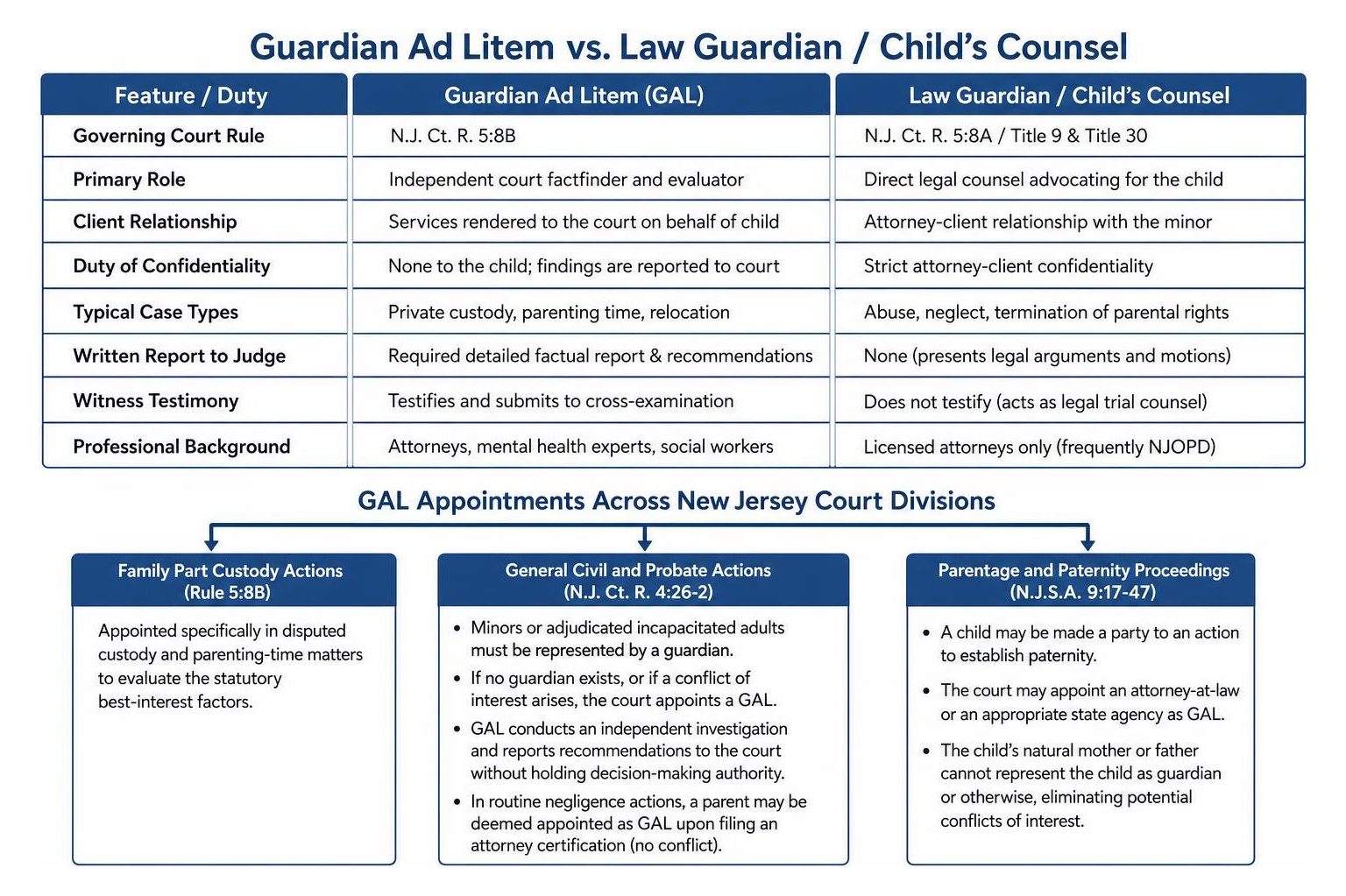
A common source of confusion for parents in New Jersey is the distinction between a Guardian Ad Litem and a Law Guardian (or court-appointed attorney for a child under Rule 5:8A). While their titles sound similar, their legal duties, operational rules, and ethical obligations are completely different.
Under Rule 5:8A, the court appoints an attorney to provide direct legal representation to the child. In child welfare proceedings initiated by the Division of Child Protection and Permanency (DCP&P) involving allegations of abuse, neglect, or termination of parental rights, children are represented by the Office of Law Guardian (OLG) within the New Jersey Office of the Public Defender (NJOPD). A Law Guardian forms an attorney-client relationship with the minor, maintains strict client confidentiality, and is ethically obligated to advocate for the child’s expressed wishes in court.
In contrast, a GAL appointed under Rule 5:8B in private matrimonial or custody litigation owes loyalty to the court’s search for truth rather than the child’s subjective wishes. If a ten-year-old child insists they want to live exclusively with one parent because that parent has no bedtime rules and serves ice cream for dinner, a Law Guardian would be bound to advocate for the child’s stated preference. A Guardian Ad Litem, however, would evaluate the underlying parenting environment, determine whether that arrangement genuinely supports the child’s long-term development, and report their objective findings to the judge.
| Feature / Duty | Guardian Ad Litem (GAL) | Law Guardian / Child’s Counsel |
|---|---|---|
| Governing Court Rule | N.J. Ct. R. 5:8B | N.J. Ct. R. 5:8A / Title 9 & Title 30 |
| Primary Role | Independent court factfinder and evaluator | Direct legal counsel advocating for the child |
| Client Relationship | Services rendered to the court on behalf of child | Attorney-client relationship with the minor |
| Duty of Confidentiality | None to the child; findings are reported to court | Strict attorney-client confidentiality |
| Typical Case Types | Private custody, parenting time, relocation | Abuse, neglect, termination of parental rights |
| Written Report to Judge | Required detailed factual report & recommendations | None (presents legal arguments and motions) |
| Witness Testimony | Testifies and submits to cross-examination | Does not testify (acts as legal trial counsel) |
| Professional Background | Attorneys, mental health experts, social workers | Licensed attorneys only (frequently NJOPD) |
Understanding these distinctions helps parents work constructively with the appointed professional. Recognizing the role of a family lawyer in resolving custody disputes ensures you can protect your parental rights while cooperating fully with the court’s factfinding process.
GAL Appointments Across Civil, Family, and Paternity Actions
The term “guardian ad litem” appears throughout several areas of New Jersey law, each carrying distinct procedural requirements:
- Family Part Custody Actions (Rule 5:8B): Appointed specifically in disputed custody and parenting-time matters to evaluate the statutory best-interest factors.
- General Civil and Probate Actions: In broader civil litigation, a minor or an adult who has been adjudicated incapacitated must be represented by a guardian. If no guardian exists, or if a conflict of interest arises between the guardian and the ward, the court appoints a GAL. Under Rule 4:26-2(c)(2), a GAL for an alleged incapacitated person conducts an independent investigation and reports recommendations to the court without holding independent decision-making authority over the individual’s legal rights. In routine negligence actions, a parent may be deemed appointed as GAL without a formal court order upon filing an attorney certification confirming their parental relationship and lack of conflict.
- Parentage and Paternity Proceedings (N.J.S.A. 9:17-47): Under the New Jersey Parentage Act, a child may be made a party to an action to establish paternity. When made a party, the court may appoint an attorney-at-law or an appropriate state agency as GAL. Crucially, the statute explicitly mandates that the child’s natural mother or father cannot represent the child as guardian or otherwise, eliminating potential conflicts of interest among presumed, acknowledged, and alleged biological fathers.
Investigative Powers and Core Responsibilities Under Rule 5:8B
When a New Jersey Family Part judge appoints a GAL, the formal Order Appointing Guardian ad Litem for Minor(s) Pursuant to R. 5:8B (promulgated under Administrative Directive #03-25) outlines the exact parameters of the investigation.
The GAL is vested with broad investigative powers to gather an unvarnished view of the family dynamics. Under Rule 5:8B(a), the GAL is authorized to:
- Conduct face-to-face interviews with the child (mandatory for children over age three) and each parent or caregiver.
- Interview collateral witnesses, including teachers, doctors, therapists, neighbors, and extended family members.
- Perform unannounced or scheduled home inspections to observe the child’s living conditions.
- Act as the child’s authorized representative under HIPAA to review medical, psychological, psychiatric, and therapeutic records.
- Obtain school records, standardized test scores, attendance files, and disciplinary histories.
- Access confidential records from DCP&P and local law enforcement agencies regarding domestic incidents.
- Confer with legal counsel for both parents and, when necessary, request permission from the court to retain independent medical or psychological experts.
- Recommend to the court whether independent legal counsel should be appointed for the child under Rule 5:8A.
Navigating this level of comprehensive evaluation is why your child custody plans need early legal guidance. A misstep during a home visit or witness interview can significantly affect the GAL’s ultimate recommendations.
Fact-Finding, Child Interviews, and Record Access
The GAL’s fact-finding process is thorough and deliberate. When interviewing children, experienced GALs use age-appropriate methods to evaluate emotional maturity, parent-child bonding, and developmental needs without placing the child in the uncomfortable position of “choosing” between parents.
To protect the integrity of the investigation, the court order strictly prohibits both parents from coaching, pressuring, or interrogating the children about what to say to the GAL. Attempting to influence a child’s statements is viewed harshly by New Jersey family judges and will be documented in the GAL’s report as potential parental alienation or misconduct.
Confidentiality is managed through strict protective orders under Rule 1:38 and Rule 5:8(e). Because the GAL’s files often contain sensitive psychiatric records, child therapy notes, and law enforcement reports, these materials are shielded from public disclosure. Understanding what are the different types of custody and how do they work helps parents recognize why the GAL investigates both legal decision-making capacity and physical residential schedules.
Report Recommendations and Best-Interest Standards Under N.J.S.A. 9:2-4
At the conclusion of the investigation, the GAL compiles a detailed written report containing factual findings, an analysis of the evidence, and formal recommendations. The statutory framework guiding every GAL report is New Jersey’s best-interest standard codified at N.J.S.A. 9:2-4. Under this statute, the GAL and the court must consider:
- The parents’ ability to agree, communicate, and cooperate in matters relating to the child.
- The parents’ willingness to accept custody and any history of unreasonable denial of parenting time.
- The interaction and relationship of the child with parents and siblings.
- Any history of domestic violence or physical abuse.
- The safety of the child and the safety of either parent from physical abuse by the other.
- The preference of the child when of sufficient age and capacity to reason.
- The needs of the child and the stability of the home environment offered.
- The quality and continuity of the child’s education.
- The fitness of the parents and the geographical proximity of the parents’ homes.
- The extent and quality of the time spent with the child prior to or subsequent to the separation.
- The parents’ employment responsibilities and the age and number of the children.
The GAL’s written report addresses specific contested issues, such as whether joint legal custody is viable, proposed weekly parenting schedules, holiday allocations, and disputes involving school districts or proposed out-of-state relocations under New Jersey’s framework for moving with your child in the state of New Jersey.
If the case proceeds to a plenary hearing, the GAL submits the report into evidence, takes the witness stand under oath, and is subject to cross-examination by attorneys for both sides. If family circumstances change substantially years after divorce, the GAL’s baseline findings often serve as the foundation when parents consider revisiting your custody arrangements.
The Appointment Process, Qualifications, and Fee Allocation

A Guardian Ad Litem is not appointed automatically in every divorce. Under Rule 5:8B, the court may appoint a GAL either sua sponte (on the judge’s own motion) or upon the formal application of either party. Appointments are reserved for cases involving substantial conflict, complex allegations of parental unfitness, substance abuse, severe alienation, or special medical needs.
The court selects an individual based on the specific complexities of the case. Qualified GALs include:
- Supreme Court-certified matrimonial attorneys or experienced family law practitioners.
- Licensed clinical psychologists and psychiatrists.
- Licensed clinical social workers (LCSWs) and child development specialists.
Working with experienced counsel can help clarify whether an appointment is necessary and whether an alternative path, such as mediation or negotiation, could resolve the dispute. In many instances, can a family lawyer help you avoid a custody battle altogether through early intervention.
How to Request a Guardian Ad Litem NJ in Contested Cases
If you believe a GAL is essential to protect your child, your attorney must file a formal motion with the Family Part supported by a detailed certification demonstrating good cause. The motion must set forth specific facts illustrating why the court requires independent expert assistance.
Under New Jersey motion practice, notice of the application must be served on the opposing party at least 10 days before the return date. If the court proposes appointing a specific professional whom one party believes has a conflict of interest, that party has the right to file a written objection demonstrating good cause.
Our approach emphasizes putting kids first with an East Windsor child custody attorney to ensure court filings remain focused on the child’s welfare rather than inflammatory rhetoric. Keeping the best interests of your children and your divorce centered throughout the litigation prevents unnecessary delays and helps establish credibility with the court.
Retainers, Hourly Rates, and Financial Obligations
A Guardian Ad Litem is an independent professional entitled to reasonable compensation. The financial mechanics of a GAL appointment under Rule 5:8B are strictly regulated:
- Initial Retainer and Hourly Rate: The judge’s appointment order establishes the GAL’s authorized hourly rate and specifies an initial retainer amount (often divided 50/50 between the parents initially, or allocated proportionally based on respective incomes).
- Monthly Billing: The GAL must provide itemized monthly informational billing statements to both parties and their counsel to ensure financial transparency.
- Fee Notice and Certification of Services: When seeking formal court approval for fees, the GAL must file an Affidavit or Certification of Services and serve a 7-day written notice on all parties prior to the hearing.
- Final Fee Reallocation: While retainers are paid pendente lite without prejudice, the judge retains ultimate discretion to reallocate the entire cost of the GAL at trial. If the court finds that one parent acted in bad faith, made baseless accusations, or prolonged the investigation unreasonably, that parent may be ordered to reimburse the other for the GAL fees incurred.
- Indigency Considerations: In cases where both parties demonstrate complete indigency, the court may explore whether court-appointed volunteer professionals or alternative dispute resources are available, though private GALs under Rule 5:8B are typically compensated by the litigants.
Transitioning Minors and Guardianship Under Senate Bill 2332
Beyond custody disputes in divorce, New Jersey guardianship law addresses another critical scenario: minors with severe developmental, intellectual, or physical disabilities who are transitioning into adulthood.
Under standard New Jersey law, parents are the natural guardians of their children until age 18. However, when a child turns 18, they are legally presumed to be competent adults with full authority over medical, financial, and educational decisions—even if their cognitive disabilities prevent them from understanding those choices.
To address this administrative hurdle, the New Jersey Legislature introduced Senate Bill 2332 legislative text. This legislation permits parents and legal guardians to file a complaint for guardianship up to 180 days (six months) before the minor reaches their 18th birthday.
The advance filing mechanism ensures that capacity evaluations, physician affidavits, court reviews, and hearings can be completed ahead of time, with the final judgment of guardianship taking effect precisely on the young adult’s 18th birthday. This prevents dangerous gaps in legal authority regarding critical medical care and residential placements.
The legislation also clarifies the distinction between general guardianship (full authority over all decisions for a completely incapacitated individual) and limited guardianship (where the individual retains rights in areas where they have decision-making capacity, such as voting or specific vocational tasks).
Once appointed, the legal guardian’s responsibilities mirror the established powers and duties of a guardian of a minor under N.J.S.A. 3B:12-52, which includes managing personal effects, facilitating healthcare and social development, and managing support funds received for the ward’s care.
Frequently Asked Questions About New Jersey Guardian Ad Litem Proceedings
Can parents object to the appointment or report of a Guardian Ad Litem?
Yes. Parents have clear procedural rights under New Jersey court rules. When a judge proposes appointing a specific GAL, either party may file a formal objection for good cause (such as a prior professional relationship, personal bias, or financial conflict of interest).
Once the GAL issues their final report, neither parent is forced to accept its findings as absolute truth. While judges give significant weight to a GAL’s recommendations, the report is an evidentiary submission.
Through counsel, a parent can depose the GAL, cross-examine them vigorously at trial, highlight factual omissions or flawed investigative methods, and introduce independent expert evaluations to rebut the GAL’s conclusions.
What happens if a parent coaches a child prior to a GAL interview?
Coaching a child is one of the most damaging mistakes a parent can make in a custody dispute. Under Directive #03-25 and standard Rule 5:8B orders, parties are expressly barred from coaching, rehearsing, or interrogating children regarding the investigation. Experienced GALs and child psychologists are trained to detect rehearsed language and adult phrasing in young children.
If coaching is uncovered, the GAL is required to document the behavior in their report to the judge. The court may impose severe evidentiary sanctions, order the offending parent to pay attorney and GAL fees, or adjust parenting time schedules to protect the child from psychological pressure.
In severe cases where coaching escalates into harassment or emotional intimidation, parties may need to seek judicial intervention through temporary and final restraining orders in New Jersey to establish clear boundaries.
Does a Guardian Ad Litem continue to represent a child after the case settles?
No. Under Rule 5:8B, the term of a Guardian Ad Litem is coextensive with the pending application. The appointment automatically terminates upon the entry of a final Judgment of Divorce, final custody order, or dismissal of the underlying litigation.
Furthermore, if the parties reach a comprehensive settlement agreement before trial, the court notifies the GAL, who must immediately cease all investigative work and refrain from submitting a written report.
A GAL does not participate in post-judgment appeals or ongoing parenting enforcement unless the court enters a new, separate order reappointing them for a specific post-judgment motion.
Conclusion
When family disputes reach an impasse, the appointment of a Guardian Ad Litem serves as an essential safeguard for your child’s future. Navigating a GAL investigation requires honesty, structured preparation, and an unwavering commitment to your child’s best interests. Understanding the legal rules governing Rule 5:8B appointments allows you to approach the process with clarity rather than fear.
At Shane and White, LLC, our team brings more than 40 years of combined family law experience to clients across Edison, Metuchen, Woodbridge, New Brunswick, North Brunswick, Sayreville, and throughout Middlesex County. As a Supreme Court-certified matrimonial attorney who has served as a court-appointed Guardian Ad Litem, Kenneth White provides parents with the clear, strategic insight needed to navigate complex custody investigations.
If you are facing a contested custody dispute or require skilled East Brunswick family law representation, contact our office today to schedule a confidential consultation. Our team is here to protect your parental rights and help secure a safe, stable future for your family.


