
What You Need to Know About Alimony After 25 Years of Marriage
Alimony after 25 years of marriage is one of the most significant financial issues you’ll face in a late-life divorce — and the stakes are high on both sides.
Here’s the short answer:
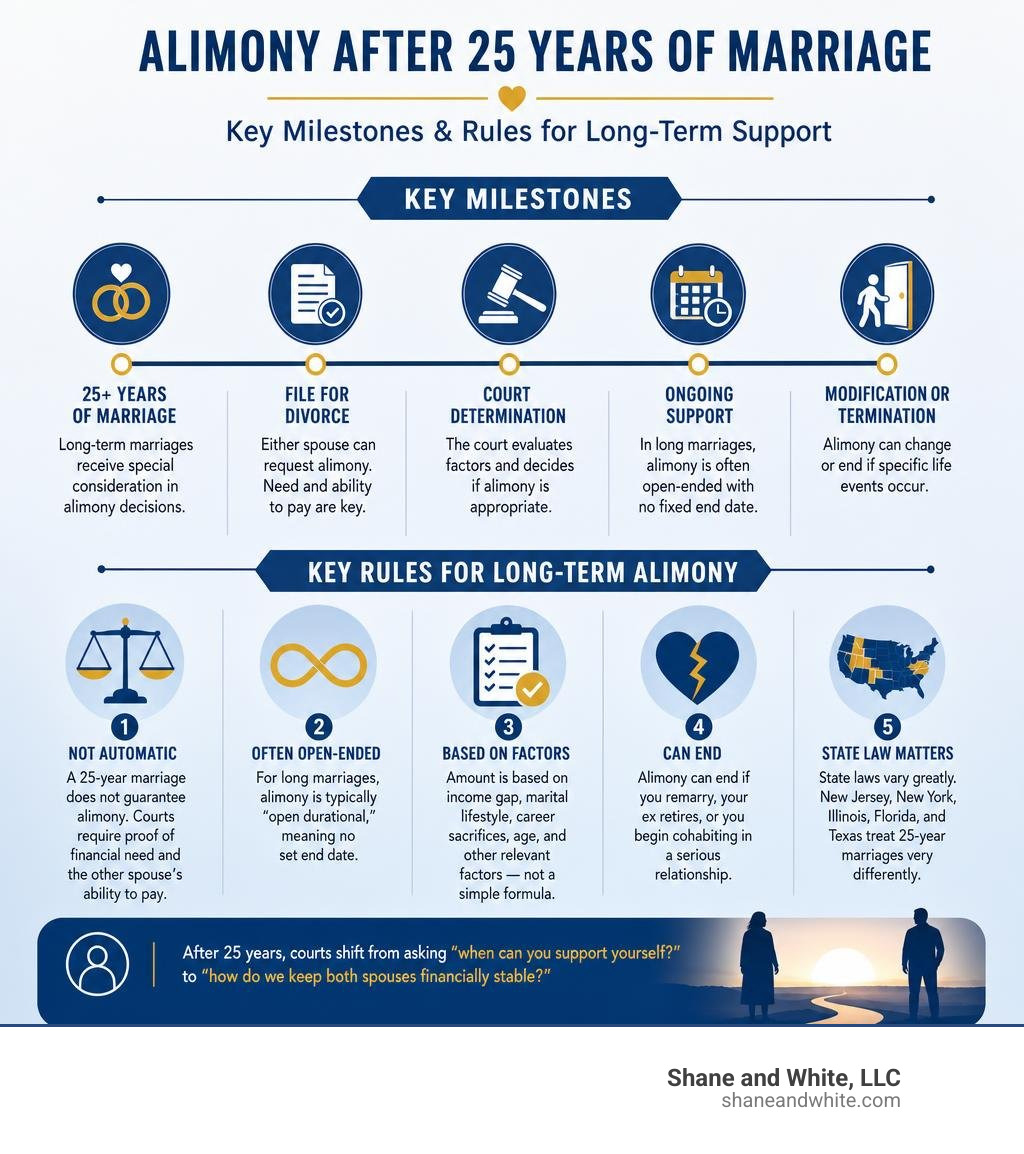
- A 25-year marriage does not automatically guarantee alimony. Courts still require proof of financial need and the other spouse’s ability to pay.
- Duration is often open-ended for long marriages — in New Jersey, this is called “open durational alimony,” with no fixed end date.
- The amount is based on factors like income gap, marital lifestyle, career sacrifices, and age — not a simple formula.
- Alimony can end if you remarry, your ex retires, or you begin cohabiting in a serious relationship.
- State law matters enormously. New Jersey, New York, Illinois, Florida, and Texas all treat 25-year marriages very differently.
After 25 years, courts shift away from asking “when can you support yourself?” and start asking “how do we keep both spouses financially stable?” That’s a fundamentally different standard — and it changes everything about how support is calculated and how long it lasts.
This guide breaks down exactly what to expect, state by state, factor by factor.
I’m Kenneth A. White, Esq., a New Jersey Supreme Court Certified Matrimonial Attorney with decades of experience handling alimony after 25 years of marriage and other complex spousal support matters, including serving as an Early Settlement Panelist in Middlesex County Family Court. I’ll walk you through everything you need to know so you can approach your case with confidence.
Does a 25-Year Marriage Automatically Guarantee Alimony?
It is one of the most common misconceptions we hear in our Edison office: “We’ve been married for over two decades, so I’m automatically guaranteed lifetime alimony, right?” Or, from the paying side: “Am I automatically on the hook for the rest of my life?”
The short answer is no. There is no such thing as an automatic guarantee when it comes to spousal support.
Even in a marriage that has lasted a quarter of a century, a judge will not simply look at the marriage certificate, stamp “Approved,” and order a monthly check. Instead, the court relies heavily on judicial discretion. Alimony is an equitable remedy, not an automatic right. To learn more about the strategic realities of how courts view these cases, you can read about the Secrets Alimony Attorneys Know About Spousal Support to understand how judges approach these determinations.
Before a judge orders a single dollar of support, they must first establish two foundational pillars:
- A genuine financial need on the part of the dependent spouse.
- A clear ability to pay on the part of the supporting spouse.
If both spouses have spent the last 25 years climbing their respective corporate ladders in Middlesex County and earn comparable, high-level salaries, a court is highly unlikely to award alimony. Why? Because neither spouse has a demonstrated “need” to be supported by the other, as both can comfortably maintain the marital standard of living on their own.
The Core Legal Standard: Need vs. Ability to Pay
When we strip away the emotional weight of a gray divorce, the legal system views alimony through a purely economic lens. The primary goal of long-term spousal support is to address the economic dependence that naturally occurs when two lives are intertwined for 25 years.
Over a quarter of a century, couples make joint decisions. One partner might focus on maximizing their earning potential, while the other takes a step back from their career to manage the household, raise children, or support the other’s business endeavors. This creates a structural income disparity.
To evaluate this disparity, the court requires exhaustive financial disclosures from both parties. This is done through a comprehensive document called a Case Information Statement (CIS) in New Jersey. In this document, you must list every monthly expense, asset, debt, and source of income.
Getting these numbers right is critical. If you ask for too much without backing it up, you lose credibility with the judge. If you offer too little, you risk facing aggressive litigation or court-ordered sanctions. For a deeper dive into finding this delicate balance, see our guide on Alimony: Don’t Pay Too Much and Don’t Ask for Too Little.
Earning Capacity and the Stay-at-Home Spouse
For marriages of 25 years or longer, courts usually try to put the parties in an equal financial position for the remainder of their lives, or at least until both parties retire. The law recognizes that a stay-at-home spouse has made immense non-monetary career sacrifices and homemaker contributions that allowed the other spouse to earn a high income.
However, this doesn’t mean the court assumes the dependent spouse cannot work at all. During the divorce process, the court will evaluate each spouse’s earning capacity.
If a spouse has a college degree but has been out of the workforce for 20 years, the court will look at the feasibility of workforce reentry. Can they realistically get a job in today’s market? What would it cost to retrain them?
Because of the long career gap, a judge will rarely expect an older homemaker to suddenly achieve complete self-sufficiency. If the court determines that a spouse is capable of working but is choosing not to, they may “impute” income to that spouse. This means the court calculates alimony based on what the spouse should be earning, rather than what they currently earn.
Understanding Alimony After 25 Years of Marriage: Types and Duration

When a marriage crosses the 20-year mark, the legal guidelines governing how long alimony lasts change dramatically. In shorter marriages, support is typically durational — meaning it has a strict expiration date. In long-term marriages, the durational caps that limit shorter marriages disappear entirely.
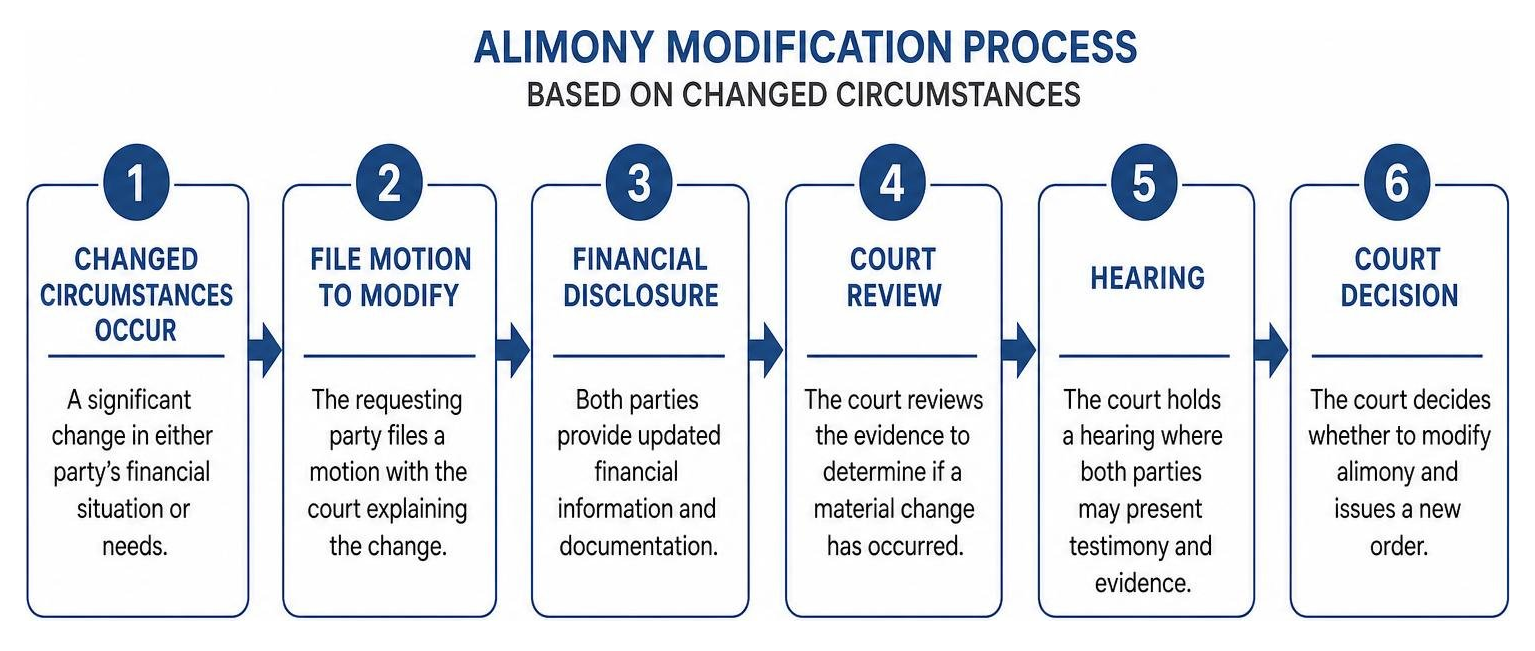
To help you visualize how these rules apply, let’s look at the process of establishing and adjusting long-term support:
Open Durational vs. Indefinite Alimony after 25 Years of Marriage
If you have been married for 20 years or longer, there is no statutory limit to how long you can receive alimony.
In New Jersey, the 2014 alimony reform eliminated the term “permanent alimony” and replaced it with Open Durational Alimony in New Jersey.
What is the difference? While “permanent” alimony sounded like it could never be changed, open durational alimony has no predetermined end date but is explicitly subject to modification or termination under certain statutory triggers, such as the paying spouse reaching full retirement age.
Other states use different terminology. For instance, under Massachusetts law (governed by the Massachusetts Alimony Reform Act), the standard durational caps disappear entirely for marriages exceeding 20 years, allowing the court to order support for an indefinite term. Similarly, in Minnesota, a marriage of 20 years or more carries a rebuttable presumption that indefinite maintenance should be awarded.
Regardless of the term used — open durational or indefinite — the core concept remains the same: the law recognizes that after 25 years of joint economic life, a clean break is rarely possible or fair, and support may continue as long as the recipient needs it and the payer has the ability to pay.
State-by-State Variations in Alimony After 25 Years of Marriage
Alimony laws are entirely state-specific. If you are divorcing in New Jersey, your outcome will look vastly different than if you were divorcing in Florida or Texas.
Here is a comparative look at how different states handle alimony duration for a 25-year marriage in 2026:
| State | Statutory Alimony Terminology | Duration Rules for a 25-Year Marriage |
|---|---|---|
| New Jersey | Open Durational Alimony | No predetermined end date; presumptively terminates when the payor reaches full Social Security retirement age (usually 67). |
| New York | Spousal Maintenance | Advisory schedule suggests a duration of 35% to 50% of the marriage length (8.75 to 12.5 years for a 25-year marriage), though courts can award non-durational support for older/disabled spouses. Effective March 1, 2026, the income cap is $241,000. Learn more in the How Long Does Alimony Last in New York? 2026 Duration Guide. |
| Illinois | Spousal Maintenance | 750 ILCS 5/504(b-1)(1)(B) directs the court to order maintenance either for a period equal to the length of the marriage (25 years) or for an indefinite term. Read more in the How Long Does Alimony Last in Illinois? 2026 Duration Guide & Formula. |
| Florida | Durational Alimony | Under Fla. Stat. § 61.08, permanent alimony is abolished. A 20-year or longer marriage produces a maximum cap of 15 years of durational alimony. |
| Texas | Spousal Maintenance | Under Tex. Fam. Code § 8.054, Texas imposes a hard statutory maximum duration of 7 years for marriages of 20 to 30 years. |
As you can see, New Jersey remains a state that strongly protects the economic security of long-term spouses, refusing to place a hard, arbitrary cap on support for marriages that cross the 20-year threshold.
How Courts Determine the Amount and Factors of Long-Term Support
Once the court decides that alimony is appropriate, the next major hurdle is determining the monthly or yearly amount.
Unlike child support, which relies on a strict mathematical formula in New Jersey, alimony amounts are determined by a holistic evaluation of statutory factors. Because of this, having a skilled legal advocate is essential to presenting your financial reality clearly. Before choosing your advocate, it is helpful to know What Questions to Ask Your NJ Alimony Attorney Before Hiring to ensure they have the specific experience needed for a long-term marriage case.
In New Jersey, judges must weigh 14 statutory factors under N.J.S.A. § 2A:34-23, which include:
- The actual need and ability of the parties to pay.
- The duration of the marriage.
- The age, physical, and emotional health of the parties.
- The standard of living established in the marriage and the likelihood that each party can maintain a reasonably comparable standard.
- The earning capacities, educational levels, vocational skills, and employability of the parties.
- The parental responsibilities for any shared children.
- The non-financial contributions of each spouse to the marriage.
The ultimate goal in a 25-year marriage is to maintain, as closely as possible, the marital standard of living for both parties.
When Both Spouses Worked: Dual-Income Long Marriages
What happens when both spouses worked throughout the entire 25-year marriage? This is an increasingly common scenario in Middlesex and Mercer Counties.
If both spouses have comparable incomes, alimony is typically off the table. However, if there is still a significant income disparity — for example, if one spouse earns $250,000 per year while the other earns $75,000 per year — alimony may still be awarded to bridge the gap.
The court’s focus remains on lifestyle maintenance. The lower-earning spouse should not be forced to drastically downgrade their life if the higher-earning spouse has the financial capacity to prevent that outcome.
Every financial detail matters in these cases. Working with a dedicated professional can dramatically shift how these factors are presented to the court. For more details on this, see How an Alimony Attorney Can Change Your Case Outcome.
Non-Financial Contributions and Career Sacrifices
A long-term marriage is legally viewed as an equal economic partnership. When one spouse steps out of the workforce to focus on child-rearing, domestic management, and supporting the other’s education or business, they are investing in the family’s collective future.
As noted by financial experts in Can You Expect Alimony in a Later-in-Life Divorce?, the law values these non-financial contributions just as highly as monetary earnings. The court recognizes that by sacrificing their own professional advancement, the homemaking spouse directly enabled the other spouse to achieve higher career success. Alimony serves, in part, to balance this scales after the partnership dissolves.
Modifying or Terminating Alimony in a Gray Divorce

Life does not stand still after a divorce. Over the course of an open durational alimony term, both parties will experience major life transitions. In New Jersey, the landmark case of Lepis v. Lepis established that alimony orders can be modified or terminated upon a showing of a “substantial change in circumstances.”
If you are facing issues with an ex-spouse who is refusing to pay or is falling behind on their obligations, it is important to understand your legal recourses under Alimony Enforcement in New Jersey: What You Need to Know.
The Impact of Retirement on Long-Term Alimony
Retirement is the single most heavily litigated modification trigger in gray divorces. Under New Jersey’s 2014 alimony reform, there is a rebuttable presumption that alimony terminates when the paying spouse reaches their full Social Security retirement age (which is currently 67 for anyone born in 1960 or later).
This means that once the paying spouse turns 67 and actually retires, the burden shifts to the receiving spouse to prove why support should continue. If the paying spouse wishes to retire early (before age 67), they must file a motion with the court and prove that their early retirement is reasonable and made in good faith, rather than an attempt to dodge their support obligations.
Additionally, many divorcing spouses wonder how retirement assets and government benefits interact. A common question is: But I Paid Alimony. Why Should My Former Spouse Be Able to Collect My Social Security?
The simple answer is that an ex-spouse’s collection of divorced spousal Social Security benefits does not reduce your own benefit amount or affect your alimony obligations directly — it is an independent right granted by the federal government to spouses of long-term marriages.
How Cohabitation and Remarriage Affect Payments
Alimony in New Jersey automatically terminates upon the remarriage of the recipient spouse. However, cohabitation is a different story.
Under N.J.S.A. § 2A:34-23(n), alimony may be suspended or terminated if the paying spouse can prove that the recipient is cohabiting with another person in a mutually supportive, intimate personal relationship.
Crucially, cohabitation does not require the couple to live under the same roof 100% of the time. The court will look at several factors, including:
- Intertwined finances (e.g., shared bank accounts or joint purchases).
- Sharing responsibility for living expenses.
- Recognition of the relationship in their social circles.
- Sharing household chores.
If you suspect your former spouse is living with a partner but hiding it to keep receiving support, you must build a strong, evidentiary case. Read our detailed guide on I Want to Terminate My Alimony Payments Because My Ex-Spouse Has a Significant Other to learn how to approach this process legally.
Job Changes and Income Fluctuations
In today’s economic climate, job losses, corporate downsizings, and career shifts are incredibly common. If the paying spouse suffers involuntary unemployment, they can petition the court for a temporary or permanent reduction in alimony.
Under New Jersey law, if you are self-employed or an employee who loses their job, you generally must wait 90 days before filing an application to modify support, during which you must document an exhaustive, good-faith job search.
If you are the one changing careers or looking at a new opportunity, it is vital to know how the court will view this transition. Explore our resources on:
- How Changing Jobs Affects Your Alimony
- FAQ: Will a New Job Change My Alimony?
- What Your New Job Means for Continued Receipt of Alimony (Edit)
Frequently Asked Questions About Long-Term Alimony
Can alimony be modified if the paying spouse loses their job?
Yes. If the paying spouse experiences involuntary unemployment or a severe, long-term reduction in income, they can file a motion for a temporary reduction or termination of alimony. The court will require proof of the job loss, severance details, and a documented, extensive job search. In New Jersey, the 2014 reform law specifically allows individuals who have been unemployed for 90 days or more to apply for a modification.
Does adultery affect alimony after a 25-year marriage?
Generally, no. New Jersey is primarily a no-fault divorce state. While marital misconduct can technically be considered in extreme cases, courts almost never use adultery as a basis to deny or increase alimony. The court’s focus is strictly economic. The only time fault heavily impacts alimony is if one spouse wastefully dissipated marital assets to support an affair (e.g., buying luxury gifts or trips for a lover), in which case the court may adjust the equitable distribution of property to compensate the other spouse.
Is alimony taxable under current 2026 tax laws?
No. Under the federal Tax Cuts and Jobs Act (TCJA), for any divorce finalized after December 31, 2018, alimony is entirely tax-neutral. This means:
- The paying spouse cannot deduct alimony payments on their federal tax return.
- The receiving spouse does not pay federal income tax on the alimony they receive.
(Note: If you have a pre-2019 divorce agreement, your payments are likely grandfathered under the old tax rules, meaning they remain deductible for the payer and taxable for the recipient, unless you formally modify the agreement to adopt the new tax treatment.)
Conclusion
Divorcing after a quarter-century of marriage is an emotional and financial crossroads. The decisions you make today regarding spousal support will shape your financial security for the rest of your life. Whether you are seeking the support you need to rebuild your life, or protecting yourself against an unsustainable and unreasonable alimony demand, you should not navigate this complex process alone.
At Shane and White, LLC, we bring over 40 years of dedicated family law experience to clients throughout Edison, East Windsor, Middlesex County, and Mercer County, New Jersey. We pride ourselves on providing personalized attention, empathetic representation, and clear, honest communication every step of the way.
Let us help you protect your future. Schedule a consultation with our New Jersey alimony attorneys today, and let’s discuss how we can secure the best possible outcome for your case.