
What You Need to Know About NJ Child Support Emancipation Laws
NJ child support emancipation laws work differently than most people expect — and getting them wrong can cost you money or land you in contempt of court.
Here is the short answer:
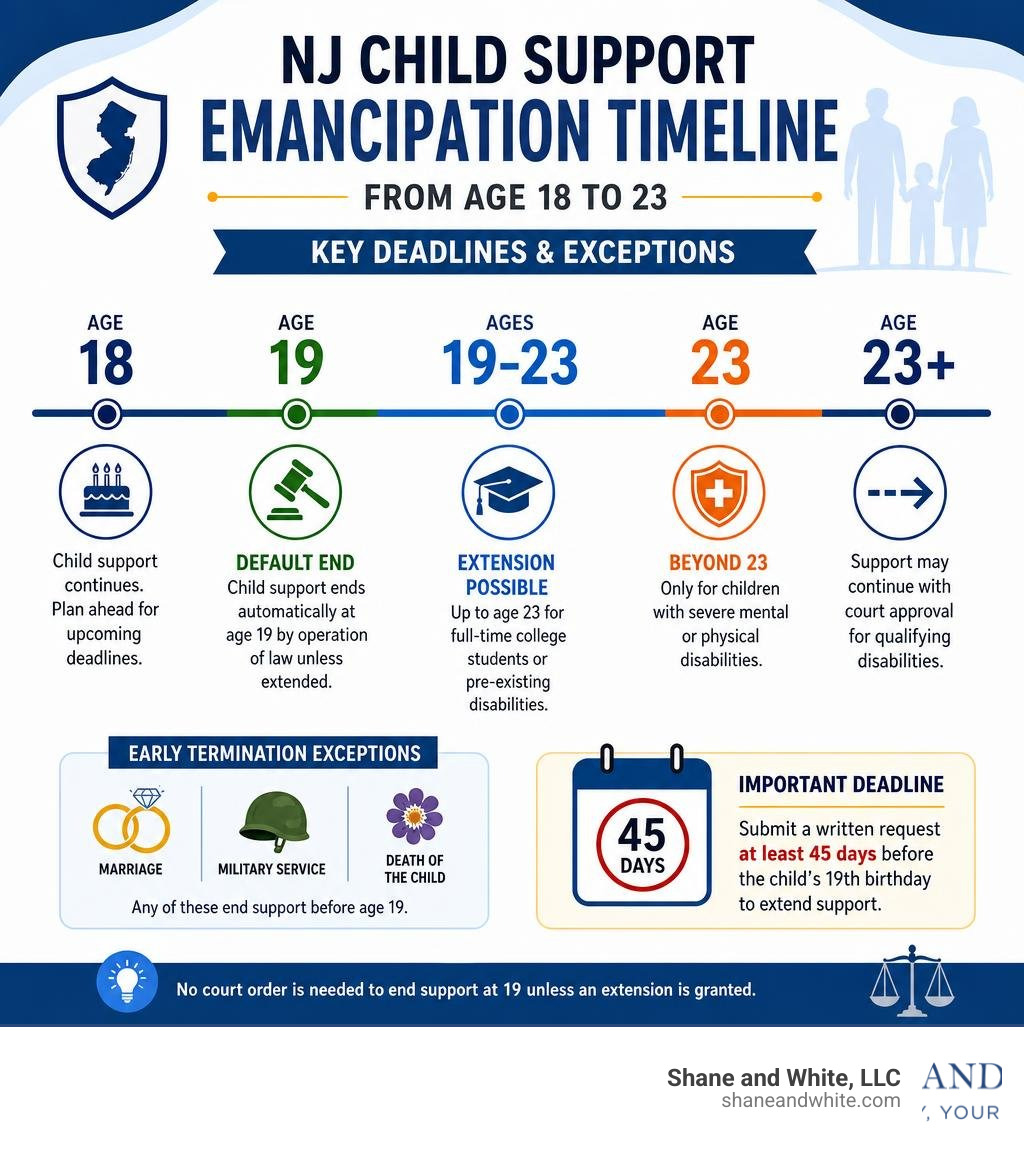
| Key Rule | Details |
|---|---|
| Default end age | Child support ends automatically at age 19 |
| Early termination | Marriage, military service, or death end support before 19 |
| Extension allowed | Up to age 23 for full-time college students or pre-existing disabilities |
| Beyond age 23 | Only for children with severe mental or physical disabilities |
| Deadline to request extension | Submit a written request at least 45 days before the child’s 19th birthday |
| Do you need a court order to terminate? | No — support ends by operation of law at 19 unless extended |
New Jersey’s rules are not the same as other states. Before 2017, New Jersey had no fixed age for child support to end — making it one of only four states where courts decided case by case, sometimes extending support well into a child’s mid-20s. The 2017 statute (N.J.S.A. 2A:17-56.67) changed everything by setting age 19 as the presumptive cutoff.
That shift sounds simple. But the exceptions, deadlines, and court procedures trip up a lot of parents — both those who want to end support and those who need to extend it.
I’m Kenneth A. White, Esq., a Supreme Court of New Jersey Certified Matrimonial Law Attorney at Shane and White, LLC, and I have spent decades guiding New Jersey families through every aspect of NJ child support emancipation laws — from routine terminations to complex disability and college-extension disputes. In this guide, I’ll walk you through exactly how these laws work and what steps you need to take.
Understanding the 2017 NJ Child Support Emancipation Laws (N.J.S.A. 2A:17-56.67)
To truly understand how child support ends in the Garden State, we have to look closely at the landmark legislation that reshaped family law here. On February 1, 2017, New Jersey implemented N.J.S.A. 2A:17-56.67. This law fundamentally shifted the landscape of child support by establishing a clear, presumptive age of 19 for the automatic termination of child support and medical support obligations.
Before this statutory change, New Jersey was an outlier. We were one of only four states without a fixed statutory age for child support termination. This meant that paying parents often had to file formal, expensive court motions just to prove their adult child was self-sufficient, leading to highly unpredictable, case-by-case judicial decisions that sometimes stretched child support deep into a child’s twenties.
The 2017 law reversed the burden of proof. Under the current framework, child support terminates by operation of law when a child turns 19. The paying parent no longer has to drag their ex into court simply because their child reached adulthood. Instead, the burden now sits squarely on the receiving parent (the custodial parent) to proactively demonstrate why child support should continue past the child’s 19th birthday.
For a detailed look at the statutory language itself, you can read the 2024 New Jersey Revised Statutes Title 2A – Administration of Civil and Criminal Justice Section 2A:17-56.67 – Termination of obligation to pay child support, medical support. .
Emancipation vs. Termination of Child Support
One of the most common points of confusion for parents in Middlesex County and Mercer County is the difference between “emancipation” and the “termination of child support.” While they sound like the same thing, they are distinct legal concepts in New Jersey.
- Emancipation is a broad legal status change. It occurs when a child moves entirely beyond the “sphere of parental influence” and obtains independent status as an adult. When a child is emancipated, the parental relationship is legally altered; the parents no longer have legal custody, decision-making authority, or a general duty to support the child. To learn more about this standard, check out our article on When is Your Child Deemed Emancipated?.
- Termination of child support, on the other hand, is a specific financial event governed by N.J.S.A. 2A:17-56.67. Under the statute, the financial obligation to pay child support ends automatically at age 19 unless a legal exception applies.
Crucially, a child can have their child support terminated by operation of law at age 19 without being formally declared emancipated by a judge. Conversely, a parent can request a court order to declare a child emancipated before age 19 if the child has achieved complete financial independence.
Automatic Termination Events Before Age 19
While age 19 is the default statutory milestone, New Jersey law recognizes that certain life events signify a child has entered adulthood early. Regardless of the child’s age, child support obligations terminate automatically by operation of law if the child:
- Marries: A married child is legally presumed to have established a new family unit, moving beyond the parental sphere of influence.
- Enters Active Military Service: Joining the military provides the child with housing, income, and independent status, ending the parents’ support duties.
- Passes Away: Regrettably, the death of a child immediately terminates any ongoing current support obligations (though outstanding arrears remain due).
If any of these events occur before the child turns 19, the paying parent can notify the Probation Division (for cases administered through the state) or file an application to stop payments. For more information on how support is initially calculated and structured, read our guide on Child Support in a Divorce.
Extending Child Support Beyond Age 19: The Exceptions

The law does not simply abandon children who still legitimately need parental support at age 19. Under N.J.S.A. 2A:17-56.67, a custodial parent can request that child support continue past age 19 if the child meets specific statutory exceptions.
To qualify for an extension, the child must be:
- Still enrolled in a high school or other secondary educational program;
- Enrolled full-time in a college, university, post-secondary school, or vocational/trade school;
- Suffering from a physical or mental disability that existed before the child turned 19; or
- In the custody of the Division of Child Protection and Permanency (DCPP).
If you are wondering how these exceptions apply to your family, you can explore the statewide legal resources on When Does Child Support End? .
The College Exception and the Age 23 Hard Cap
For most families in Edison, NJ, and East Windsor, NJ, the most common reason to extend child support is higher education. If a child graduates high school and immediately enrolls as a full-time student in college, university, or a trade school, child support can continue.
But what exactly does “full-time” mean? New Jersey courts look to the specific institution’s definition. Generally, this means carrying the minimum number of credit hours (usually 12 credits per semester) that the school considers to be full-time attendance during some part of any five calendar months of the year.
However, this educational extension is not infinite. New Jersey imposes an absolute hard cap at age 23 for traditional child support. By operation of law, all child support obligations terminate on the child’s 23rd birthday, regardless of whether they are still in college, graduate school, or medical school.
During this extension period, child support is calculated using the New Jersey Rules of Court Appendix IX-A, though courts may deviate from the standard guidelines if the child lives away from home at college.
The Disability Exception: Financial Maintenance Past Age 23
The sole exception to the age 23 hard cap involves adult children with severe mental or physical disabilities. If a child has a pre-existing disability that prevents them from achieving self-sufficiency, the financial duty does not simply vanish when they turn 23.
Under a December 2020 amendment to New Jersey law, if a child has a severe mental or physical incapacity that was established before they turned 19, a parent can petition the court to convert the child support obligation into financial maintenance past the age of 23.
This distinction is highly technical but incredibly important:
- Child Support ends by operation of law at 23.
- Financial Maintenance is an ongoing, court-ordered adult dependent support obligation that can continue indefinitely while the adult child remains disabled and dependent.
When structuring financial maintenance for an adult child with special needs, extreme care must be taken. Direct child support or maintenance payments are treated as unearned income by the government, which can inadvertently reduce or entirely disqualify the child from receiving crucial public benefits like Supplemental Security Income (SSI) or Medicaid. In these situations, we often help families establish a Special Needs Trust to shield these funds and preserve government benefit eligibility.
The Newburgh Factors and College Contribution Decisions
In New Jersey, child support and college expense contributions are treated as two separate financial obligations. While child support covers day-to-day living expenses (housing, food, clothing), college contribution deals with tuition, room and board, books, and fees.
The seminal New Jersey Supreme Court case governing college contributions is Newburgh v. Arrigo. Under Newburgh, the court established that divorced parents have a legal duty to contribute to their children’s higher education costs if the child has the aptitude and the parents have the financial means.
Applying Newburgh Factors to NJ Child Support Emancipation Laws
When a parent files a motion to terminate child support at age 19 or 23, or when a custodial parent requests college contributions, the court will evaluate the request using the 12 Newburgh Factors:
- Whether the parent, if still living with the child, would have contributed toward the costs of the requested higher education.
- The effect of the background, values, and goals of the parent on the reasonableness of the expectation of the child for higher education.
- The amount of the contribution sought by the child for the cost of higher education.
- The ability of the parent to pay that cost.
- The relationship of the requested academy or course of study to any prior training and to the overall long-range goals of the child.
- The financial resources of both parents.
- The commitment to and aptitude of the child for education.
- The financial resources of the child, including assets owned individually or held in trust.
- The ability of the child to earn income during the school year or vacation periods.
- Availability of financial aid in the form of grants and loans.
- The child’s relationship to the paying parent, including whether there is mutual affection and shared goals as well as whether the child has rejected the relationship (estrangement).
- The relationship of education to any prior training and the child’s long-range career goals.
Factor 10 (financial aid) and Factor 11 (the parent-child relationship) are heavily litigated. If a child has completely and voluntarily estranged themselves from a parent, refusing all contact, New Jersey courts may relieve that parent of their obligation to contribute to college costs.
For an example of how strictly family courts interpret these agreements and family dynamics, look at the appellate decision in S.K v. N.L :: 2021 :: New Jersey Superior Court, Appellate Division – Unpublished Opinions Decisions :: New Jersey Case Law :: New Jersey Law :: U.S. Law :: Justia . In that case, the court enforced a consent order that automatically emancipated a child who refused to participate in court-ordered family therapy, demonstrating that clear, written agreements regarding behavioral conditions and therapy compliance can directly impact ongoing support obligations.
The Procedural Roadmap: How to Request Continuation or File for Emancipation
If your child support case is administered through the New Jersey Probation Division, the state handles the initial notification process automatically.
The Probation Division will mail out a Notice of Proposed Child Support Termination to both parents at two key intervals:
- First notice: 180 days (6 months) before the child’s 19th birthday.
- Second notice: 90 days (3 months) before the child’s 19th birthday.
If the custodial parent does nothing, child support will terminate automatically on the child’s 19th birthday. To prevent this, the custodial parent must complete and return the Request for Continuation of Support form, along with written, official supporting documentation (such as a college registrar letter proving full-time enrollment, or medical documentation of a disability), at least 45 days before the child’s 19th birthday.
Filing a Motion to Terminate or Modify Support
If your child support case is not administered by the Probation Division (e.g., you pay your ex directly), or if you disagree with the Probation Division’s decision to extend support, you must file a formal motion in the Family Division.
The process depends on your case’s docket prefix:
- FM Docket (Divorce Cases): If your child support order was established as part of a divorce, you must file a Post-Judgment Motion to terminate support. The filing fee is $50 (as of March 2026).
- FD Docket (Non-Divorce Cases): If the parents were never married, you must file an Application to terminate or modify support. The filing fee is $25 (as of March 2026).
To file, you must obtain the Post-Judgment Motion Kit (Form CN 10483) from the New Jersey Courts website, complete a detailed Certification explaining the factual basis for emancipation, serve the papers on the other parent at least 16 days before the scheduled hearing (24 days if serving by mail), and appear before a Family Part judge. To understand this process more deeply, you can read about our Practice: Child Support services.
How Emancipation Affects Multi-Child Orders and Arrears
If you have multiple children on a single child support order, the emancipation of one child does not mean your child support payment is automatically cut in half or reduced proportionally. How the order is modified depends entirely on whether the original order was allocated or unallocated.
| Order Type | Definition | What Happens at Emancipation? |
|---|---|---|
| Allocated Order | Specifies a distinct amount of child support for each individual child (e.g., “$150/week for Child A, $150/week for Child B”). | The portion for the emancipated child terminates automatically, and the order is reduced to the remaining child’s allocated amount. |
| Unallocated Order | Provides a single, lump-sum payment for all children combined (e.g., “$300/week for two children”). | Nothing happens automatically. The paying parent must file a motion or application to have child support recalculated under the guidelines for the remaining minor child. |
Even after a child support order is officially terminated, any accumulated child support arrears (back payments) do not disappear. Arrears remain fully enforceable by law. If a parent owes $5,000 in arrears when the child turns 19, the Probation Division will continue to garnish wages or intercept tax refunds until that debt is paid in full, even though the ongoing “current” support obligation has dropped to $0. If you are struggling with unpaid support or enforcement issues, you can review our guidance on What to Do if Your Ex Stops Paying Child Support?.
Special Jurisdictional Rules: UIFSA and Interstate Orders
What happens if your child support order was established in New Jersey, but the custodial parent and child moved to New York or Florida? Or what if you live in Edison, NJ, but your child support order was originally issued by a court in Texas?
Interstate child support disputes are governed by a federal law called the Uniform Interstate Family Support Act (UIFSA). Under UIFSA, the state that issued the controlling order retains “continuing, exclusive jurisdiction” over the modification of that order, as long as at least one of the parties (the paying parent, the receiving parent, or the child) continues to reside in that state.
Crucially, the law of the state that issued the original order governs the duration of the child support obligation.
If your child support order was established in New Jersey, New Jersey’s termination laws (automatic termination at 19, hard cap at 23) apply, even if the child now lives in a state where child support normally ends at 18 or 21. Conversely, if your child support order was established in a state where support runs until age 21, New Jersey courts cannot prematurely terminate that support at age 19, even if all parties have moved to New Jersey.
Frequently Asked Questions About NJ Child Support Emancipation Laws
At what age does support end under nj child support emancipation laws?
Under nj child support emancipation laws, child support terminates automatically by operation of law on the child’s 19th birthday, unless the custodial parent submits a timely request for continuation based on high school enrollment, full-time college attendance, or a pre-existing disability. If an extension is granted, all traditional child support obligations end permanently on the child’s 23rd birthday. For further details, you can visit the official FAQs – NJ Child Support .
Can child support continue if a child takes a gap year?
It depends entirely on the facts. Generally, a child must maintain continuous, full-time enrollment in an educational institution to remain unemancipated. However, New Jersey courts have held that a brief hiatus or a temporary transition period (such as a recent high school graduate working full-time for a few months to save money specifically for upcoming college tuition) does not automatically result in emancipation. The court will look at whether the child has truly moved beyond parental influence or is simply taking a reasonable, temporary step toward their degree.
Does alimony affect child support termination?
Yes, the termination of child support can be a “changed circumstance” that warrants a review of other financial obligations, including alimony. When child support ends, the overall financial landscape of both households changes, which may allow either parent to request a modification of existing alimony payments depending on the language in their original Marital Settlement Agreement. To see how these two support systems interact, read our analysis on Does Alimony Affect Child Support?.
Conclusion
Navigating the complexities of nj child support emancipation laws requires a precise understanding of statutory deadlines, procedural rules, and financial calculations. Missing a filing deadline by even a few days can result in the automatic termination of needed support, while failing to file a motion for an unallocated multi-child order can leave a paying parent overpaying for months or years.
At Shane and White, LLC, we have spent more than 40 years helping families in Edison, East Windsor, Middlesex County, and Mercer County protect their rights and secure their financial futures. We pride ourselves on providing the highly personalized attention, clear communication, and seasoned legal advocacy you need to navigate these pivotal transitions.
If you have questions about whether your child is legally emancipated, need to file for a support extension, or want to terminate an outdated support order, we are here to help. Contact us today to schedule a consultation with an experienced New Jersey family law attorney, and learn more about our philosophy by reading our guide on When is Your Child Deemed Emancipated?.