


How to Protect and Split Your Savings: Navigating Divorce and Retirement Accounts
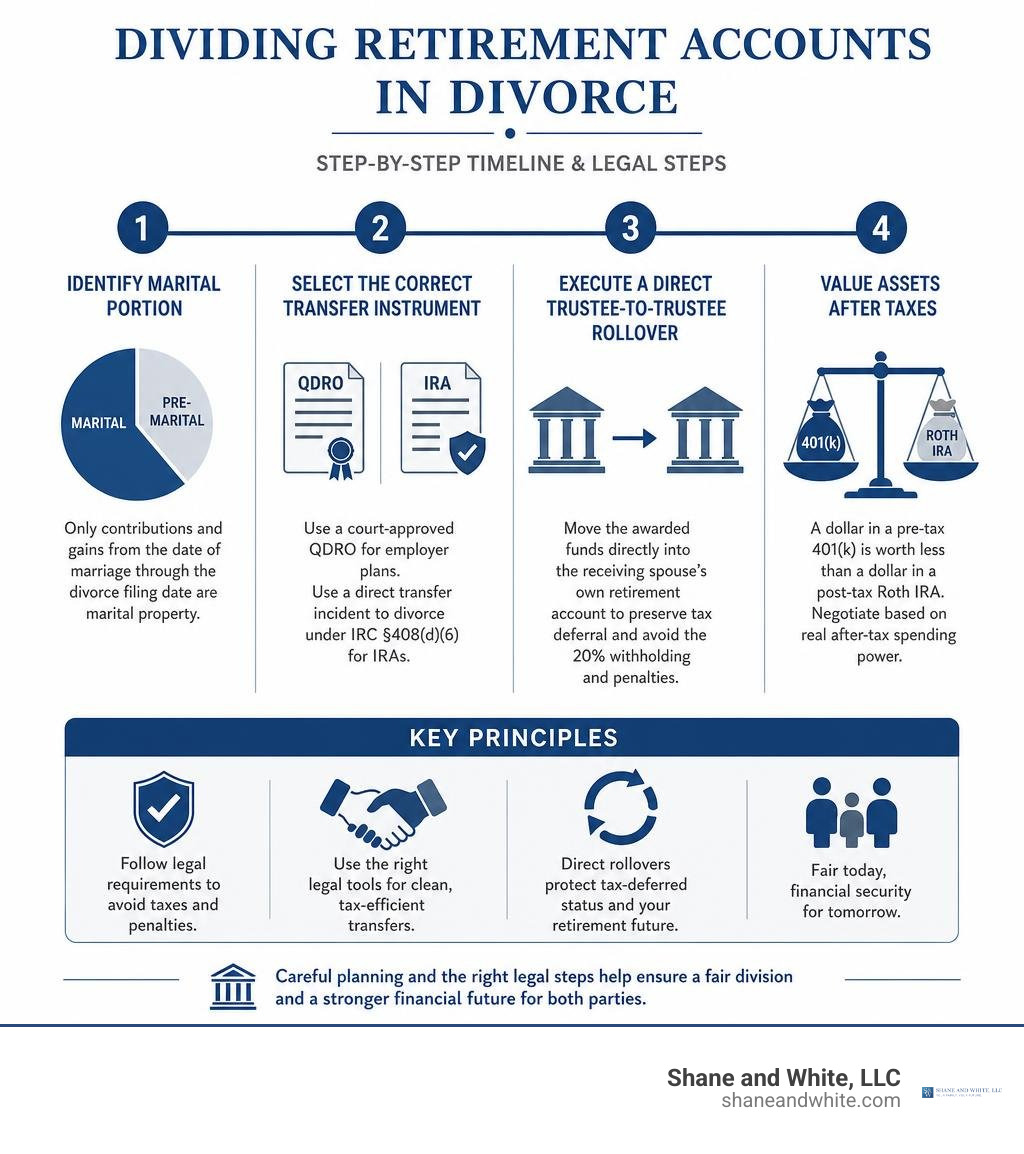
To divide retirement funds cleanly in a divorce without triggering surprise taxes or early withdrawal penalties, follow this core process:
- Separate marital from pre-marital balances: Only contributions and gains earned from the date of marriage through the divorce filing date qualify as marital property subject to equitable distribution.
- Select the correct transfer instrument: Split employer plans like 401(k)s, 403(b)s, and defined benefit pensions using a court-approved Qualified Domestic Relations Order (QDRO). Split IRAs through a direct transfer incident to divorce under IRC §408(d)(6).
- Execute a direct trustee-to-trustee rollover: Move the awarded funds straight into the receiving spouse’s own retirement account to preserve tax deferral and prevent mandatory 20% tax withholding.
- Value assets after taxes: A dollar in a pre-tax 401(k) carries future income tax liability, making it worth less than a dollar in a post-tax Roth IRA. Always negotiate based on real after-tax spending power.
I am Kenneth White, Esq., a Supreme Court of New Jersey Certified Matrimonial Law Attorney and Middlesex County Early Settlement Panelist with decades of experience guiding clients through complex issues surrounding divorce and retirement accounts. Below, I will walk you through the exact legal rules, valuation strategies, and filing steps required to protect your financial future.
Essential divorce and retirement accounts terms:
Legal Framework for Divorce and Retirement Accounts Under Equitable Distribution

In the United States, roughly 670,000 to 700,000 divorces are finalized each year. For the vast majority of couples, retirement accounts represent either the largest or second-largest financial asset on the marital balance sheet, often exceeding the equity in the family home. In New Jersey, dividing these accounts is governed by the statutory framework of equitable distribution rather than a strict 50/50 community property mandate.
Under the practice of equitable distribution, courts allocate marital assets based on fairness, statutory criteria, and the economic circumstances of each spouse. “Equitable” does not automatically mean equal. When family courts across Middlesex County—including Edison, New Brunswick, Woodbridge, and East Brunswick—evaluate marital estates, they assess factors such as the length of the marriage, the age and physical health of both parties, the income or earning capacity of each spouse, and the contributions made by each party to the acquisition and preservation of marital wealth.
Retirement assets are not liquid cash. They come wrapped in federal regulations, deferred tax burdens, and strict withdrawal rules. Navigating this framework requires an exact legal distinction between what belongs to the marital estate and what remains individual, separate property.
Identifying Marital Property in Divorce and Retirement Accounts
Determining what assets get shared in a divorce begins with establishing the marital coverture period. In New Jersey, the marital estate generally includes all assets acquired from the date of marriage up to the date a formal Complaint for Divorce is filed in Superior Court.
- Separate Property: Any balance accumulated in a 401(k), traditional IRA, Roth IRA, or pension prior to the date of the marriage remains the separate property of the participating spouse, provided those funds were not commingled.
- Marital Property: All contributions made by either spouse during the marriage—along with employer matching funds, profit-sharing allocations, and active growth on those contributions—constitute marital property subject to division.
- Passive vs. Active Appreciation: Passive appreciation (growth driven strictly by market gains on a pre-marital balance) generally remains separate property. However, if pre-marital funds were commingled with regular marital contributions or actively managed during the marriage, tracing the separate portion requires careful financial analysis and forensic accounting.
- Post-Complaint Accruals: Contributions and salary deferrals made after the divorce complaint filing date are typically classified as individual post-marital property, effectively freezing the marital portion as of the cutoff date.
Guarding Against Asset Dissipation and Unauthorized Withdrawals
A major fear during marital litigation is that an estranged partner might secretly liquidate or borrow against retirement funds before the court finalizes property division. Unilateral withdrawals not only drain the marital estate but can also trigger devastating immediate income tax liabilities and early withdrawal penalties.
When dealing with secretive spouses when dealing with finances, experienced counsel takes immediate proactive measures. Under New Jersey court rules, filing a divorce action places both parties under automatic financial restraints. If there is a legitimate threat of improper liquidation, attorneys can seek an emergency Temporary Restraining Order (TRO) or special freeze order to prohibit plan administrators and financial custodians from processing loans, distributions, or beneficiary changes.
If an unapproved withdrawal has already occurred, courts address spending assets before a divorce under the doctrine of marital asset dissipation. In these instances, the court can credit the full dissipated amount—including the associated tax hit—back to the innocent spouse’s share of the remaining estate during final distribution.
How to Divide 401(k) Plans and Defined Benefit Pensions Using a QDRO

You cannot divide an employer-sponsored retirement account—such as a 401(k), 403(b), or defined benefit pension—simply by handing a signed divorce judgment to a human resources department or financial institution. Federal law, specifically the Employee Retirement Income Security Act of 1974 (ERISA), contains strict “anti-alienation” provisions that make it illegal for plan administrators to assign or pay retirement benefits to anyone other than the employee.
The sole legal exception to this rule is a Qualified Domestic Relations Order (QDRO). A QDRO is a specialized court order that assigns all or a portion of a participant’s retirement benefits to an “alternate payee” (the former spouse or dependent). Because ERISA preempts state domestic relations law, a state divorce decree is legally ineffective against a retirement plan until the plan administrator officially certifies the order as “qualified.”
| Plan Type | Governing Law / Mechanism | Legal Instrument Required | 10% Early Penalty Exception for Cash Out? | Typical Approval Timeline |
|---|---|---|---|---|
| Traditional 401(k) / 403(b) | ERISA / IRC §414(p) | Qualified Domestic Relations Order (QDRO) | Yes (under IRC §72(t)(2)(C) direct distribution) | 60–180 days |
| Traditional / Roth IRA | IRC §408(d)(6) / IRC §1041 | Divorce Decree / Transfer Incident to Divorce | No (standard 10% penalty applies if under 59½) | 14–30 days |
| Defined Benefit Pension | ERISA / Coverture Fraction | QDRO (Separate or Shared Interest) | N/A (Paid as monthly annuity stream) | 90–180 days |
| NJ Public Pension (PERS/TPAF/PFRS) | NJ State Statutory Rules | Court Order / Direct State Withholding Order | N/A (Paid upon member retirement) | 60–120 days |
Navigating QDRO mechanics and drafting requirements requires strict technical precision. Drafting errors often lead to administrative rejections, delayed disbursements, and unnecessary litigation expenses.
Essential Requirements for Qualified Domestic Relations Orders
Under Section 206(d)(3) of ERISA and Internal Revenue Code (IRC) §414(p), a valid QDRO must explicitly contain:
- The exact legal name, last known mailing address, and Social Security number of the participant and alternate payee.
- The precise legal name of each retirement plan to which the order applies.
- The exact dollar amount or percentage of the participant’s benefit to be transferred to the alternate payee.
- The exact valuation date (cutoff date) and explicit instructions on how market investment gains and losses must be applied from the cutoff date until the actual date of distribution.
- Clear provisions addressing outstanding participant loans and pre-retirement death benefits.
A QDRO may never require a plan to provide any type or form of benefit, or any option, not otherwise provided under the plan, nor can it require payments to an alternate payee that are already assigned to another alternate payee under a previously filed order.
Drafting costs can range from $500 to $1,500 for a straightforward model-form 401(k) QDRO, up to $2,500 to $7,500 for a custom-drafted order handling a complex corporate pension. Plan administrators maintain an 18-month statutory determination period under IRC §414(p)(7)(A) to review and approve orders, making it crucial to understand how QDROs protect retirement assets from early penalties through prompt submission and pre-approval procedures.
Dividing Defined Benefit Pensions and Coverture Fractions
Unlike defined contribution plans (such as 401(k)s) that hold a distinct cash balance, a defined benefit pension promises a guaranteed monthly payment for life upon retirement. Dividing a pension involves calculating the marital portion of that future income stream using the coverture fraction formula:
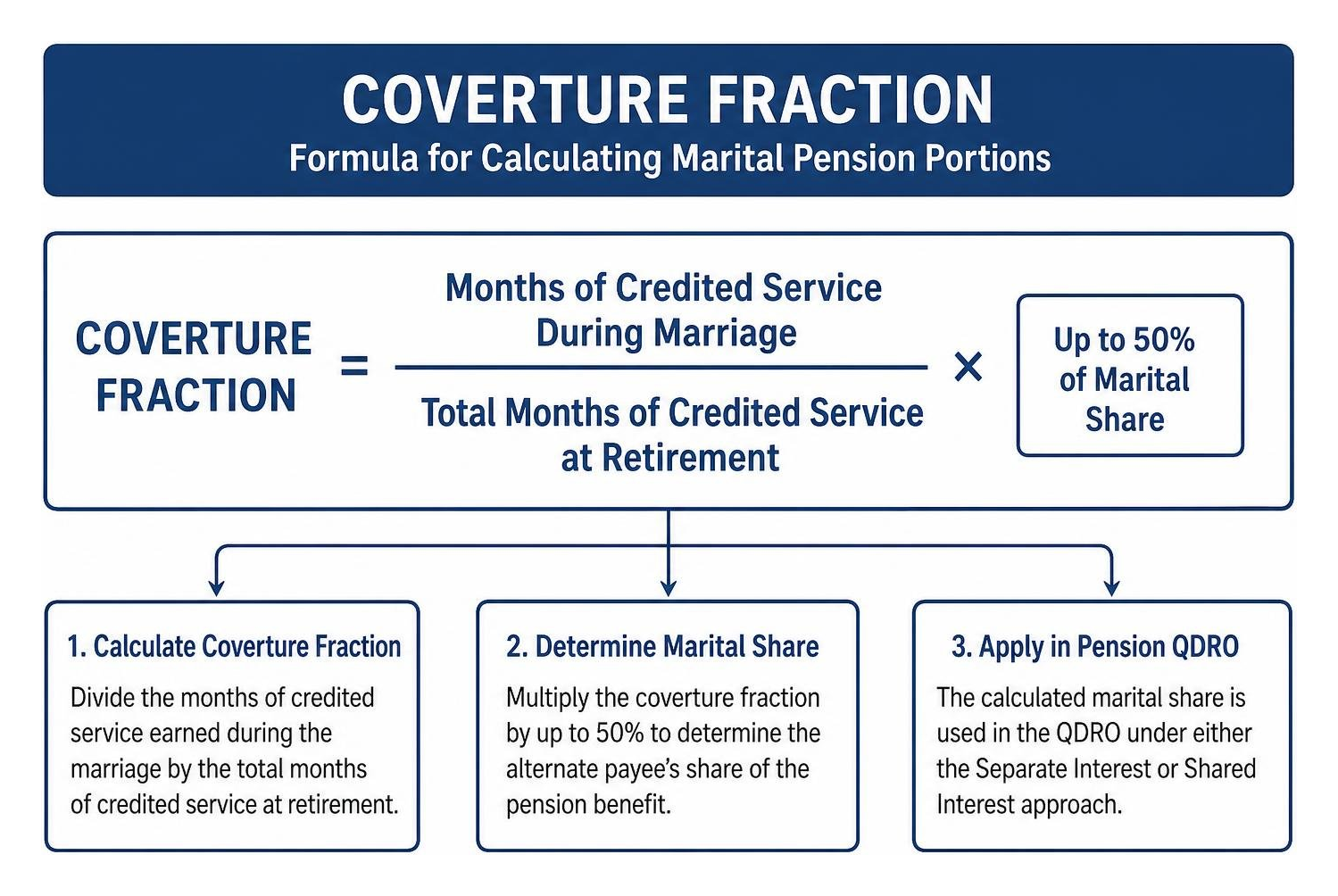
$$\text{Coverture Fraction} = \frac{\text{Months of Credited Service During Marriage}}{\text{Total Months of Credited Service at Retirement}}$$
The alternate payee is typically awarded up to 50% of the calculated marital share. When drafting a pension QDRO, spouses must choose between two distinct mechanisms:
- Separate Interest Approach: This divides the accrued benefit into two independent pieces. The alternate payee’s monthly benefit is calculated using their own life expectancy and can often begin as soon as the participant reaches the plan’s earliest retirement age, regardless of whether the employee has actually retired. This approach completely unhooks the alternate payee’s lifetime benefit from the participant’s date of death.
- Shared Interest Approach: The alternate payee receives a specified portion of each monthly check only when the participant actually retires and begins receiving payments. If the participant dies without a Qualified Pre-Retirement Survivor Annuity (QPSA) or Joint and Survivor Annuity (QJSA) in place, payments to the alternate payee may cease immediately.
If you are dealing with government or corporate pensions, understanding your rights to garnish or divide an ex-spouse’s pension is essential to securing continuous survivor annuity protections.
Step-by-Step Guide to Splitting IRAs, Rollovers, and Tax Considerations
Individual Retirement Accounts (IRAs) and Roth IRAs are not employer plans covered by ERISA. Consequently, IRAs do not use a QDRO.
Instead, IRAs are divided under Internal Revenue Code §408(d)(6) through a process known as a transfer incident to divorce. This transfer is authorized directly by the final Judgment of Divorce (JOD) and Marital Settlement Agreement (MSA). Handled correctly, moving IRA funds between ex-spouses is completely non-taxable under IRC §1041. Managing these divisions properly is especially critical when understanding rights in a high-net-worth divorce involving complex multi-account portfolios.
Step-by-Step Guide to Dividing Divorce and Retirement Accounts Through Rollovers
To execute a clean, penalty-free division of retirement accounts, adhere to the following sequence:
- Obtain Certified Court Documents: Secure a certified copy of your final Judgment of Divorce containing the Marital Settlement Agreement, along with the judge-signed QDRO (for 401(k)s/pensions).
- Open the Receiving Retirement Account: The non-employee spouse must establish a new Traditional IRA (or Roth IRA, depending on the source funds) in their own name at a financial custodian.
- Submit Plan Administrator Distribution Elections: Complete the plan administrator’s formal distribution paperwork, electing a direct trustee-to-trustee rollover (reported under IRS Form 1099-R Code G).
- Avoid Indirect 60-Day Rollovers: Never request a check made out payable directly to yourself. Doing so triggers mandatory 20% federal tax withholding under IRC §3405(c) and starts a rigid 60-day rollover clock that can easily turn into an accidental taxable distribution.
- Evaluate Cash Distribution Needs Before Rolling Over: Under IRC §72(t)(2)(C), an alternate payee receiving a distribution from an ERISA qualified plan under a QDRO can take an immediate cash payout without paying the standard 10% early withdrawal penalty, even if under age 59½. However, ordinary income taxes still apply. Reviewing IRC §72(t)(2)(C) penalty exemptions and rollover rules reveals a critical catch: once funds are rolled into an IRA, this 10% penalty exception is permanently extinguished. Any subsequent withdrawal from the IRA before age 59½ incurs both regular income tax and the 10% penalty.
- Confirm Account Funding and Execution: Within 30 days of transfer, verify that the receiving custodian correctly credited the full transfer balance without tax withholding deductions. Working with a skilled attorney ensures no steps are missed, illustrating how a divorce attorney helps protect your rights and assets during asset execution.
Comparing Pre-Tax 401(k) Dollars and After-Tax Roth IRA Assets
One of the most expensive blunders during divorce settlement negotiations is treating every dollar on a financial balance sheet as equal. A $200,000 traditional 401(k) is not worth the same as a $200,000 Roth IRA or $200,000 in liquid home equity.
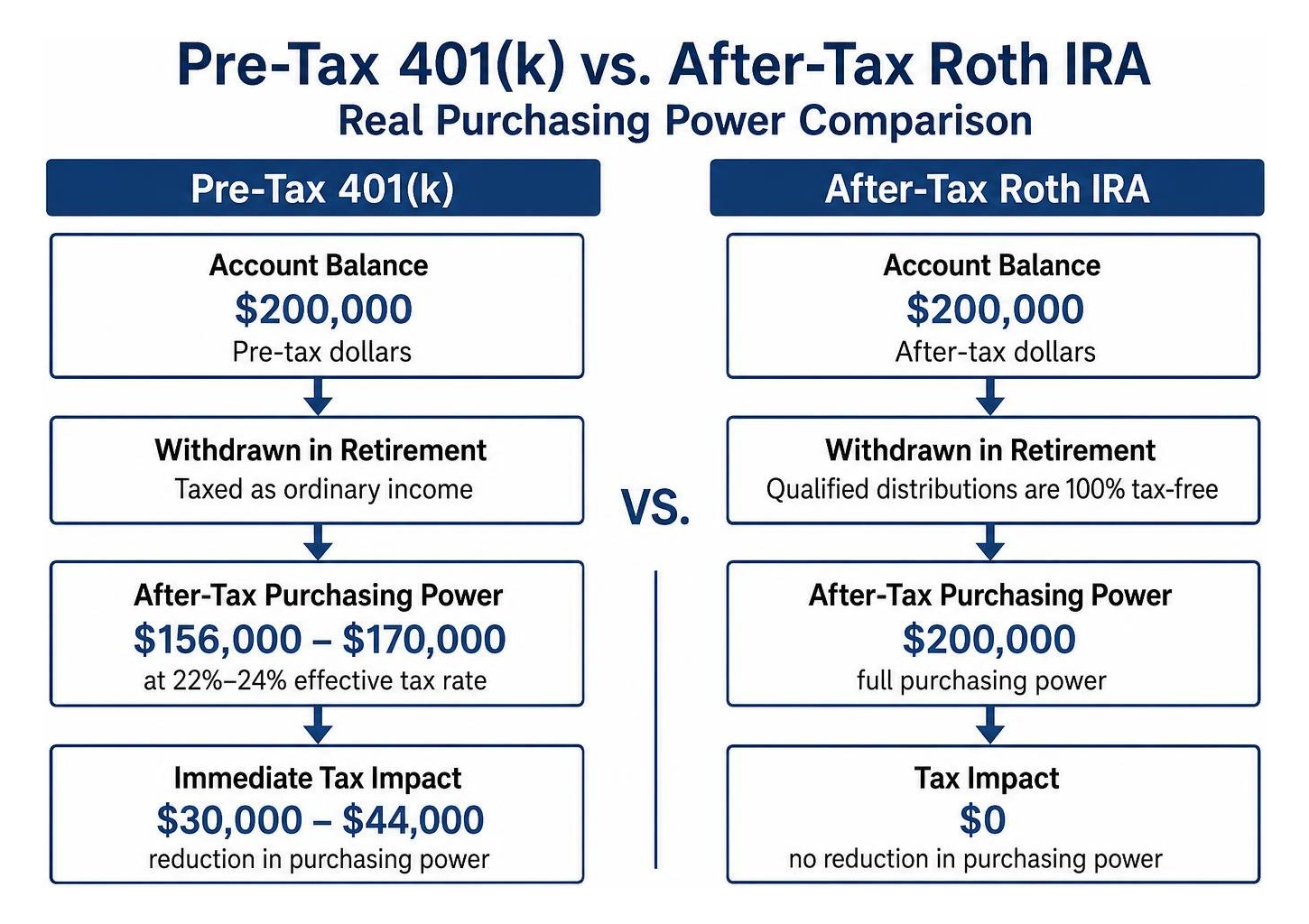
- The Pre-Tax Reality: Funds in a traditional 401(k) or traditional IRA have never been taxed. When withdrawn in retirement, every dollar is taxed as ordinary income. At a modest effective federal tax rate of 22% to 24%, a $200,000 traditional 401(k) balance represents only $156,000 to $170,000 in actual purchasing power—an immediate $30,000 to $44,000 haircut.
- The Post-Tax Advantage: A Roth IRA is funded with after-tax contributions. Qualified distributions in retirement are 100% tax-free. Therefore, a $200,000 Roth balance yields the full $200,000 in spendable capital.
As explored in detail within after-tax value comparisons of Roth vs traditional accounts, failing to tax-affect assets during settlement negotiations leaves one spouse significantly poorer. If you negotiate to keep $300,000 in a traditional 401(k) while your spouse walks away with $300,000 in home equity, you have accepted an unequal settlement loaded with deferred tax liability.
Division Rules for Social Security, Military Retirement, and Executive Benefits
Certain retirement benefits follow unique federal statutory regimes that completely bypass state court discretion:
- Social Security Spousal Benefits: Social Security benefits cannot be divided, traded, or offset in a divorce decree under federal law (42 U.S.C. § 407). However, if a marriage lasted at least 10 consecutive years, a divorced spouse aged 62 or older who is currently unmarried is entitled to claim spousal retirement benefits based on their ex-spouse’s earnings record (up to 50% of the primary earner’s full retirement benefit). Claiming this benefit does not reduce the ex-spouse’s monthly payout or impact their current spouse’s benefits in any way.
- Military Retired Pay: Governed federally by the Uniformed Services Former Spouses’ Protection Act (USFSPA, 10 U.S.C. § 1408). To receive direct monthly pension distributions from the Defense Finance and Accounting Service (DFAS), the couple must meet the “10/10 Rule”—at least 10 years of marriage overlapping with 10 years of creditable military service. If the marriage lasted fewer than 10 overlapping years, the state court can still award a percentage of the military pension, but the service member must pay the former spouse directly each month.
- Executive Compensation & Non-Qualified Plans: Supplemental Executive Retirement Plans (SERPs), deferred compensation plans (IRC §409A), restricted stock units (RSUs), and stock options are not qualified ERISA plans. They cannot be divided via a standard QDRO. These executive assets require structured constructive trusts or offsetting cash distributions from other liquid marital property.
Frequently Asked Questions About Dividing Retirement Accounts in Divorce
Can an alternate payee withdraw cash immediately from a 401(k) without an early withdrawal penalty?
Yes. Under IRC §72(t)(2)(C), an alternate payee who receives an award from an ERISA qualified defined contribution plan (like a 401(k) or 403(b)) via a QDRO can elect to receive an immediate cash distribution without incurring the 10% IRS early withdrawal penalty, regardless of their age.
However, ordinary federal and state income taxes still apply, and the plan administrator is legally required to withhold 20% for mandatory federal income taxes under IRC §3405(c). For example, if a 55-year-old alternate payee receives a $220,000 QDRO award and takes it as cash, they will incur approximately $48,400 in federal income tax (at a 22% effective bracket), netting $171,600 in cash. Rolling the full $220,000 directly into an IRA preserves the entire tax-deferred balance.
What common drafting mistakes lead to QDRO rejections or tax penalties?
Plan administrators reject thousands of QDROs annually due to preventable drafting oversights:
- Omitting Cutoff Dates: Failing to state the exact marital valuation date.
- Ignoring Market Fluctuations: Not specifying whether the alternate payee’s share increases or decreases with investment gains and losses between the cutoff date and distribution date.
- Overlooking Outstanding 401(k) Loans: Failing to state whether an existing loan balance is included or excluded from the divisible balance.
- Vague Pension Benefit Types: Omitting specific Pre-Retirement Survivor Annuity (QPSA) designations, which can cause the alternate payee to lose all benefits if the employee passes away prior to retirement.
- Using Generic Templates: Failing to obtain and adhere to the specific plan administrator’s pre-approved model QDRO language.
What happens if beneficiary designations are not updated after the divorce is finalized?
Under the U.S. Supreme Court precedent Kennedy v. Plan Administrator for DuPont Savings and Investment Plan, ERISA mandates that plan administrators pay death benefits strictly to the beneficiary listed on the official plan documents, regardless of what a state court divorce decree or will specifies.
If you divorce and neglect to submit an official change-of-beneficiary form with your plan administrator, your ex-spouse could legally inherit your entire 401(k) upon your death. Updating primary and contingent beneficiary designations immediately after the divorce judgment is signed is essential.
Conclusion
Dividing retirement assets during a divorce requires far more than splitting account balances down the middle on paper. From understanding ERISA preemption and drafting air-tight QDROs to navigating coverture fractions and after-tax valuations, every step demands legal accuracy to prevent unnecessary taxes, early withdrawal penalties, or the loss of lifetime benefits. Divorced individuals, particularly women, face increased risks of financial hardship in retirement when these assets are mishandled during settlement negotiations.
At Shane and White, LLC, our legal team brings over 40 years of dedicated family law experience to every case. Serving clients throughout Edison, Metuchen, Woodbridge, East Brunswick, New Brunswick, North Brunswick, Monroe, Piscataway, Sayreville, and all of Middlesex County, we provide the personalized attention and strategic clarity you need to safeguard your wealth.
To ensure your financial security remains fully protected during property division, schedule a confidential consultation with our experienced Middlesex County family law attorneys today.


