


When a Divorce Puts Your Family Business at Risk
Divorce and a family business rarely mix well — and if you own one, you already know how much is at stake.
Before we get into the details, here is a quick overview of what you need to know right now:
How to protect your family business in a divorce:
- Classify your business correctly — determine whether it is marital property, separate property, or a mix of both
- Get a professional valuation — use a certified appraiser to establish a defensible business value
- Use legal agreements — prenuptial, postnuptial, buy-sell, or operating agreements can all limit your exposure
- Keep finances separate — commingled funds can turn a separate business into a shared marital asset
- Explore division options — buyouts, structured payments, and co-ownership are often better than a forced sale
- Hire the right team — a matrimonial attorney and forensic accountant working together can protect your interests
A family business is often the most valuable — and most complicated — asset in a divorce. It represents years of work, personal sacrifice, and financial risk. Yet when a marriage ends, that business can become the center of a long, expensive legal fight.
Family-owned businesses make up a large share of the U.S. economy. Many of them are built by couples who worked side by side — which means ownership, finances, and personal relationships are often deeply tangled together. That makes untangling them in a divorce especially hard.
The stakes are high. Get the process wrong, and you could lose partial control of your business, face a forced sale, or end up locked in a dispute with your ex-spouse for years.
But with the right strategy, you can protect what you’ve built.
I’m Kenneth White, Esq., a Certified Matrimonial Attorney with over 50 attorney endorsements and decades of experience handling complex divorce and family business matters across New Jersey. Below, I’ll walk you through exactly what you need to know — and do — to protect your business through this process.
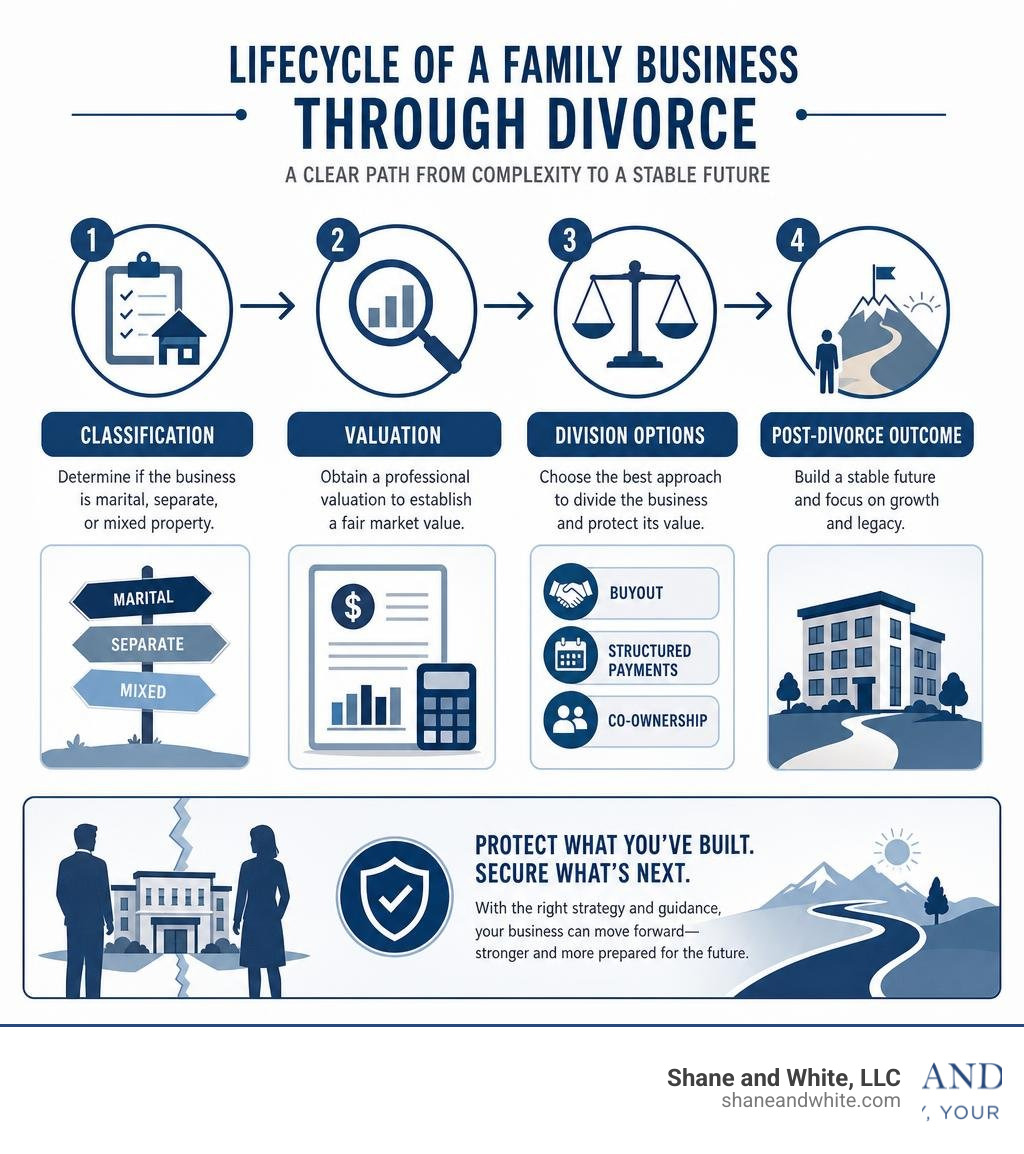
Classification: Is Your Business Marital, Separate, or Mixed Property?
Before a court can divide any assets, it must first determine what actually belongs in the marital estate. In New Jersey, this process is governed by the principles of equitable distribution, which means marital assets must be divided fairly — though not always in a strict 50/50 split.
To understand how your business will be treated, you must first understand what assets get shared in a divorce? Generally, assets are classified into three categories:
- Marital Property: If the business was started or acquired during the marriage, it is almost always considered marital property. It does not matter if only one spouse’s name is on the registration or if only one spouse ran the daily operations.
- Separate Property: If you started the business before you walked down the aisle, or if you inherited it individually during the marriage, the initial business interest is generally separate property.
- Mixed Property (Active vs. Passive Appreciation): This is where things get complicated. If your separate business grew in value during your marriage, that increase in value might be subject to distribution. New Jersey courts look at whether this growth was “active” or “passive”:
- Active Appreciation: If the increase in the business’s value resulted from your direct efforts, hard work, or financial investment during the marriage, that appreciation is considered a marital asset. Even if your spouse did not work in the business, their indirect contributions — such as managing the household or caring for children so you could focus on the company — can entitle them to a share of that active appreciation.
- Passive Appreciation: If the business grew purely due to market forces, inflation, or the work of independent third parties, that increase remains separate property.
The biggest threat to a separate business is the commingling of funds. If you used marital bank accounts to pay business expenses, or if you paid personal bills directly out of the business’s operating account, you have commingled your finances. Over time, this can blur the lines so thoroughly that a court may rule your separate business has transformed into a marital asset.
Valuation Challenges in a Divorce and Family Business Dispute
Once we determine that a business (or a portion of it) is marital property, we must figure out what it is worth. This is often the most highly contested phase of a divorce and family business dispute.

A proper business valuation requires hiring a neutral, certified business appraiser or forensic accountant. Depending on the complexity of your business, experts will typically use one of three primary valuation approaches:
- The Asset Approach: This method calculates the business’s net asset value by subtracting total liabilities from the total value of all tangible and intangible assets. It is most commonly used for asset-heavy businesses like real estate holding companies.
- The Income Approach: This method focuses on the business’s ability to generate future economic benefits. It looks at historical cash flows, normalizes the owner’s compensation, and applies a capitalization or discount rate to determine present value.
- The Market Approach: This method compares your business to similar companies that have recently been sold in your industry.
In New Jersey, courts use the standard of “Fair Value” rather than “Fair Market Value” when valuing a closely held business for equitable distribution. This is a critical legal distinction that can heavily impact the final settlement.
Comparing Fair Value vs. Fair Market Value
| Valuation Feature | Fair Market Value | Fair Value (NJ Divorce Standard) |
|---|---|---|
| Basic Definition | The price a willing buyer would pay to a willing seller on the open market. | The intrinsic value of the business interest to the current owner. |
| Marketability Discount | Often applied to account for the difficulty of selling a private business quickly. | Generally not applied, as the owner is not actually selling the business. |
| Minority Interest Discount | Applied if the spouse owns a non-controlling minority share of the business. | Typically not applied, preventing the majority owner from artificially lowering the value. |
| Primary Beneficiary | Often favors the spouse keeping the business (by lowering the appraised value). | Protects the non-owner spouse (by reflecting the true ongoing economic benefit to the owner). |
When dealing with a high-value enterprise, a detailed technical analysis of asset allocation is essential. If a valuation is artificially inflated or deflated, it can lead to an inequitable division of the remaining marital estate, leaving one spouse with an illiquid asset and the other with a disproportionate share of cash and real estate.
Distinguishing Personal Goodwill from Enterprise Goodwill
When valuing service-oriented businesses — such as medical practices, law firms, consulting agencies, or highly owner-dependent retail shops — “goodwill” is often the most valuable asset. Goodwill represents the expectation of continued patronage from customers or clients. However, for the purposes of asset division, goodwill must be split into two distinct categories:
- Enterprise Goodwill: This is the value associated with the business itself. It is built on the company’s brand name, physical location, reputation, operating systems, and customer database. Enterprise goodwill exists independently of any single individual. If you sold the business, this goodwill would transfer to the new owner. Enterprise goodwill is a marital asset subject to equitable distribution.
- Personal (Professional) Goodwill: This value is tied directly to the individual owner’s personal reputation, unique skills, relationships, and specialized qualifications. If the owner retires or leaves, the clients go with them. In New Jersey, personal goodwill is considered part of an individual’s future earning capacity, not a transferable business asset. Therefore, personal goodwill is excluded from equitable distribution.
Understanding this distinction is vital. If your professional practice is valued, your legal team must ensure that personal goodwill is carved out of the equation. Furthermore, the evolving legal landscape surrounding restrictive covenants can complicate this. As non-compete agreements face stricter regulatory hurdles, the line between personal and enterprise goodwill becomes even more critical because competition and the value of a business are closely tied. If a key employee or former spouse can easily walk away and open a competing shop next door, the enterprise value of the business may be significantly lower than initially appraised.
Forensic Accounting: Uncovering Hidden Assets and Commingled Funds
In many family businesses, one spouse handles the day-to-day operations and financial books, while the other has little to no visibility into the company’s actual performance. This dynamic can create a severe information imbalance. If you find yourself in this situation, it is common to feel anxious that your spouse is downplaying the business’s success or actively hiding assets.
This is particularly true in a divorce in New Jersey: when one spouse controls the money. To level the playing field, we often bring in forensic accountants to conduct a thorough financial investigation.
A forensic accountant will carefully analyze business records, bank statements, and tax returns to uncover discrepancies. Key areas of focus include:
- Schedule C (Form 1040): For sole proprietorships, this schedule can reveal undisclosed business assets, personal expenses run through the business, or unusual depreciation write-offs.
- Schedule E (Form 1040): This schedule is used to report income or losses from partnerships, S corporations, estates, and trusts, helping to identify hidden ownership stakes.
- Suppressed Income: In cash-heavy businesses, owners may fail to report the true cash flow of the company. Forensic accountants can reconstruct actual revenue by analyzing inventory purchases, industry average margins, and lifestyle spending patterns.
- Phantom Expenses: Some business owners attempt to lower their reported net income by paying personal expenses (like car leases, family vacations, or personal cell phones) out of the business account, or by putting non-existent “ghost employees” on the payroll.
By conducting detailed asset tracing, a forensic accountant helps ensure that the court has an accurate, transparent picture of the marital estate. This steps are vital to protecting your rights and assets during the financial discovery phase.
Legal Safeguards: Agreements That Protect Your Business
The absolute best time to protect your family business from a divorce is before the marriage even begins — or at least while the marriage is still strong. Waiting until a divorce complaint is filed makes asset protection far more difficult and expensive.
Several legal agreements can serve as a shield for your business, including protecting inheritance: New Jersey divorce law and estate planning strategies.
How Marital Agreements Shield a Divorce and Family Business
- Prenuptial Agreements: A prenuptial agreement is the gold standard of business protection. It can explicitly state that your pre-marital business, any future business ventures, and all active and passive appreciation of those businesses will remain your sole, separate property in the event of a divorce.
- Postnuptial Agreements: If you did not sign a prenup but your business is now growing rapidly, you can negotiate a postnuptial agreement while your marriage is healthy. To be enforceable in New Jersey, postnuptial agreements must be completely fair and equitable to both parties, require full asset disclosure, and must be entered into voluntarily with both spouses having access to independent legal counsel.
- Sunset Provisions: Some marital agreements include “sunset clauses” where certain protections expire or change after a designated number of years (e.g., the spouse receives an increasing percentage of the business’s value for every year the marriage lasts). This can incentivize long-term commitment while still protecting the business’s core structure.
Corporate Governance and the Divorce and Family Business
In addition to marital agreements, your company’s internal legal documents can protect the enterprise from being disrupted by an owner’s personal divorce:
- LLC Operating Agreements & Shareholder Agreements: These agreements can contain specific “divorce clauses” that govern what happens if an owner divorces. For example, the agreement can state that a divorcing spouse’s interest in the company is automatically deemed a “transfer event,” triggering a buy-sell provision.
- Transfer Restrictions: You can include strict clauses that prohibit any shareholder or member from transferring ownership shares to a non-family member or non-partner (including an ex-spouse) without the unanimous consent of the other partners.
- Shotgun Clauses (Buy-Sell Provisions): A shotgun clause allows one partner to offer to buy out the other partner at a specific price. The other partner must either accept the offer or buy out the offering partner at that exact same valuation. This ensures that the valuation remains fair and prevents deadlock if ex-spouses find themselves as co-owners.
Options for Dividing or Retaining the Business
If your business is determined to be a marital asset, you do not necessarily have to close your doors or sell the company. There are several ways to structure a settlement that preserves business continuity while ensuring a fair division of assets.

When navigating business owners and divorce, the most common options include:
1. The Buyout (Offsetting Assets)
This is the most common resolution. One spouse retains 100% ownership of the business, and in exchange, the other spouse receives marital assets of equal value — such as the marital home, retirement accounts, or cash. If there are not enough liquid assets to offset the business’s value, the buyout can be structured as a series of payments over time (often secured by a promissory note or a constructive trust).
2. Post-Divorce Co-Ownership
In some cases, ex-spouses choose to continue running the business together as partners. This is rare and requires a high degree of trust and professional respect. If you choose this path, you must establish clear post-divorce business co-ownership safeguards. This includes rewriting your operating agreement to define clear management roles, establishing dividend distribution schedules to cover tax liabilities, and setting up an independent mediation process to resolve deadlocks.
3. Selling the Business
If neither spouse has the liquidity to buy out the other, and co-ownership is impossible, the court may order the sale of the business. The net proceeds are then divided equitably between the spouses. This is typically treated as a last resort because of the transaction costs, tax implications, and disruption to employees.
Before making any decisions, you must also be mindful of spending assets before a divorce or making hasty transfers. Intentionally devaluing or transferring business assets to third parties to keep them out of a divorce settlement is considered “dissipation of assets” and can result in severe financial penalties from the court.
Understanding how to structure these buyouts is a core part of protecting your financial future, which we discuss in detail in our guide on understanding your rights in a high net worth divorce.
Frequently Asked Questions About Divorce and Family Businesses
Can my spouse force me to sell my family business in a divorce?
Generally, no. New Jersey courts understand that a family business is a productive, income-generating asset that supports both parties and their children. Forcing a sale can destroy commercial value and eliminate jobs.
Instead of ordering a sale, courts strongly prefer to award the business to the operating spouse and use offsetting assets (like equity in the family home or retirement portfolios) to compensate the non-operating spouse. A forced sale is typically only ordered if there is no other way to achieve an equitable distribution, or if the business cannot function without both spouses and they refuse to work together.
What is the “double-dip” problem in business owner divorces?
The “double-dip” is a common financial pitfall in high net worth divorces involving business owners. It occurs when the same business income stream is used twice in the divorce calculations: first, to value the business as an asset for equitable distribution, and second, to calculate the owner’s income for spousal support (alimony).
For example, if a business’s normalized cash flow is capitalized to establish a high business valuation (which the ex-spouse receives a share of via a buyout), and that same cash flow is then used to calculate high alimony payments without adjustment, the owner is effectively paying the spouse twice from the exact same dollar. Resolving this requires careful coordination of alimony and equitable distribution calculations to ensure fairness.
How do third-party partners protect their interests if a co-owner divorces?
If you own a business with partners, shareholders, or other family members, they have a vested interest in keeping your divorce from disrupting the company. Third-party partners can protect themselves by:
- Requiring all partners to sign buy-sell agreements with strict transfer restrictions.
- Including clauses that allow the remaining partners to buy out a divorcing partner’s shares before they can be transferred to an ex-spouse.
- Utilizing a legal process called “joinder,” where the business entity itself or the other partners are joined as parties to the divorce action to protect corporate assets from being distributed by the court.
Conclusion
Protecting your family business during a divorce requires proactive planning, meticulous financial documentation, and a highly strategic legal approach. Because New Jersey uses the standard of equitable distribution, the court has broad discretion in how assets are divided. Having an experienced legal team in your corner is the single best way to ensure your business survives the transition.
At Shane and White, LLC, we have over 40 years of combined experience guiding business owners and their spouses through complex asset divisions. We understand the unique economic landscape of New Jersey and provide personalized, clear, and aggressive advocacy to protect what you’ve spent a lifetime building.
If you are facing a divorce and want to protect your business interests in Edison, East Windsor, or the surrounding Mercer and Middlesex County areas, do not leave your financial future to chance.
Contact our experienced Middlesex County divorce lawyers or our legal team in Mercer County to schedule a consultation today. Let us help you find a fair, enforceable path forward that keeps your business running strong.


