


The Costly Mistakes Middlesex County Divorce Lawyers See Every Day
Hiring a Middlesex County divorce lawyer is one of the most important decisions you’ll make during one of the hardest times of your life. The right attorney can protect your finances, your relationship with your children, and your future. The wrong move — or no lawyer at all — can cost you far more than legal fees.
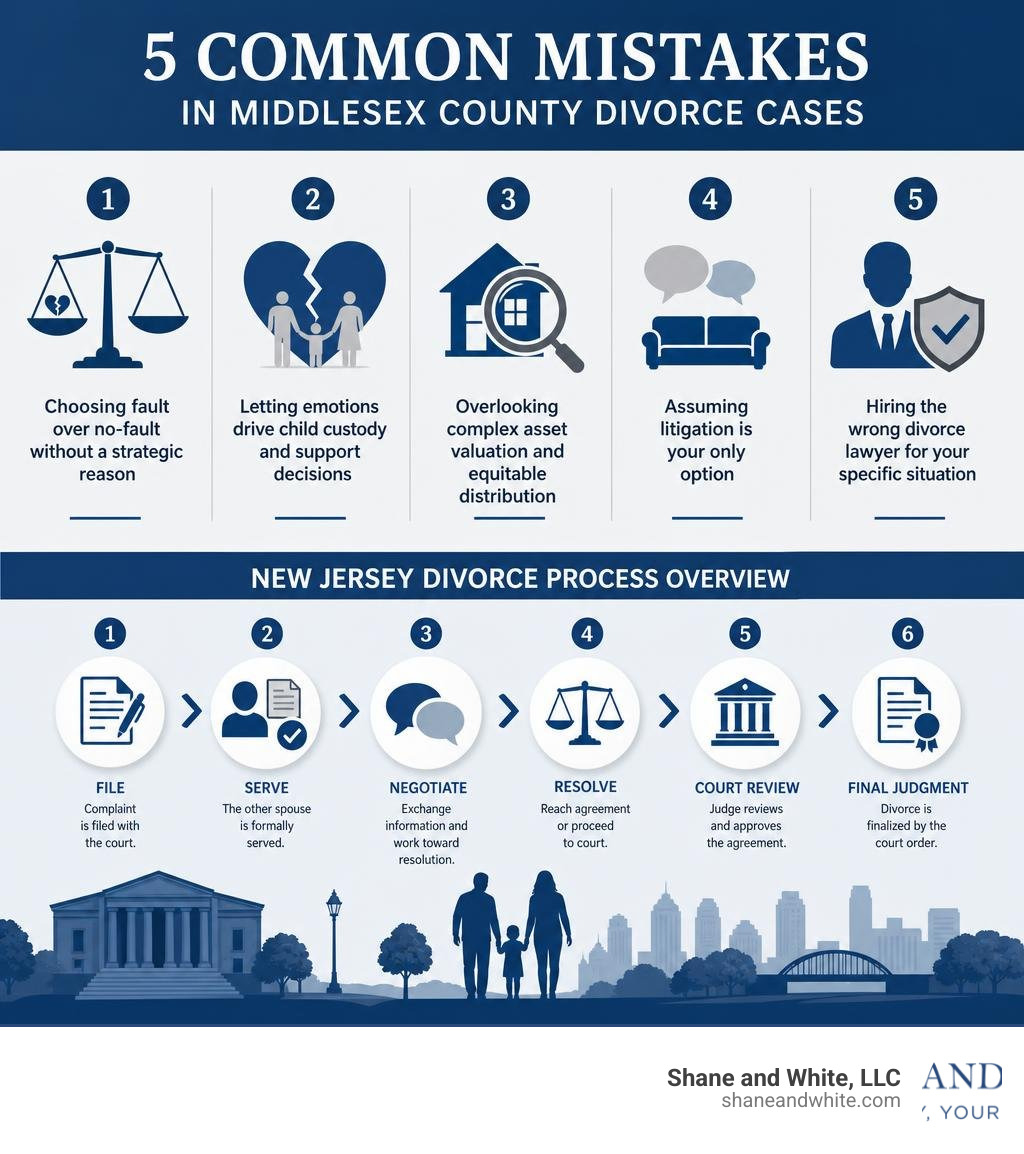
Here’s a quick look at the five mistakes this article covers:
- Choosing fault over no-fault divorce without a strategic reason
- Letting emotions drive child custody and support decisions
- Overlooking complex asset valuation and equitable distribution
- Assuming litigation is your only option
- Hiring the wrong divorce lawyer for your specific situation
Divorce in New Jersey is rarely simple. Cases can involve child custody disputes, high-value assets, spousal support, and a court system with its own local procedures and customs in New Brunswick. Even small missteps early in the process can have lasting consequences.
I’m Kenneth White, Esq., a Certified Matrimonial Law Attorney by the New Jersey Supreme Court with decades of experience as a Middlesex County divorce lawyer — including serving on the county’s Early Settlement Panel and the Assignment Judge’s Family Law Committee. In the sections below, I’ll walk you through the five most costly mistakes I see clients make, and how to avoid them.
Mistake 1: Choosing Fault Over No-Fault Without Strategic Reason
When couples decide to end their marriage, there is often a lot of hurt, anger, and blame. It is incredibly tempting to want the legal record to show exactly who did what to cause the split. However, in our decades of practicing family law, we have found that filing for a fault-based divorce out of anger is almost always a costly mistake.
In New Jersey, you have the option to file for a no-fault divorce or a fault-based divorce.
- No-Fault Divorce: This is typically based on irreconcilable differences that have lasted for at least six months, with no reasonable prospect of reconciliation. Alternatively, you can file for a no-fault divorce if you and your spouse have lived separate and apart in different residences for at least 18 consecutive months.
- Fault-Based Divorce: This requires you to prove specific grounds in court, such as extreme cruelty, adultery, desertion (for at least 12 months), drug or alcohol addiction, or imprisonment.
Some people believe that proving extreme cruelty or adultery will automatically translate into a massive financial windfall or a more favorable child custody arrangement. In reality, New Jersey courts rarely punish a spouse financially for marital misconduct unless that misconduct directly impacted the family’s finances (such as “dissipation of assets,” where a spouse spent marital funds on an affair or gambling).
Filing on fault grounds raises the emotional temperature of the case immediately. It forces your spouse to hire an aggressive attorney to defend their reputation, turning what could have been a straightforward negotiation into a multi-year courtroom battle.
To learn more about what it takes to initiate this process, you can read our detailed guide on What Are the Requirements to File for Divorce in New Jersey? or explore our comprehensive overview of Divorce in New Jersey. Choosing the path of least resistance — usually a no-fault filing based on irreconcilable differences — is often the smartest strategic move you can make to protect both your peace of mind and your wallet.
Mistake 2: Letting Emotions Dictate Child Custody and Support Negotiations
There is nothing more emotionally charged than the safety, well-being, and future of your children. Because of this, child custody and parenting time negotiations can quickly devolve into battlegrounds. When parents let anger or resentment guide their legal strategy, the children are the ones who pay the price.

In New Jersey, all custody determinations are guided by a single legal standard: the best interests of the child. The court does not care about getting even; it cares about ensuring your children have a stable, loving, and safe environment.
When navigating custody, you must understand the two distinct types of custody under New Jersey law:
- Legal Custody: This refers to the authority to make major, life-altering decisions for your child, such as those regarding education, medical care, and religious upbringing. The state of New Jersey strongly presumes that joint legal custody is in the child’s best interest, meaning both parents must consult and agree on these major decisions unless there is a history of domestic violence, abuse, or neglect.
- Physical (or Residential) Custody: This determines where the child primarily resides. One parent may have primary residential custody, while the other has parenting time (visitation). Alternatively, parents may share joint physical custody.
Your parenting time arrangement has a direct, mathematical impact on child support. New Jersey utilizes specific Child Support Guidelines to calculate support payments based on parental incomes, health insurance costs, and the number of overnights the child spends with each parent.
If the non-custodial parent has 105 or more overnights per year (which amounts to approximately 28% of the year), the court must apply the Shared Parenting Guidelines rather than the Sole Parenting Guidelines. This shift can substantially alter the child support calculation. We frequently see parents fight aggressively over a single overnight not because they want the extra time, but because they are trying to manipulate the child support numbers. Courts see through this tactic quickly, and it can seriously damage your credibility with the judge.
To keep your case on track and protect your children from unnecessary conflict, we recommend reviewing the Common Mistakes to Avoid During a Divorce. Keeping your emotions in check and focusing on practical, workable parenting schedules is the best way to secure a favorable and lasting outcome.
Mistake 3: Overlooking Complex Asset Valuation and Equitable Distribution
New Jersey is an equitable distribution state. This means that all marital assets and debts — property acquired by either spouse from the date of the marriage to the date the divorce complaint is filed — must be divided fairly. It is vital to note that “equitable” does not automatically mean a 50/50 split. The court looks at numerous factors, including the length of the marriage, the economic circumstances of each spouse, and each party’s contribution to the acquisition of the marital property.
One of the most devastating mistakes you can make is failing to properly identify, value, and trace assets. This is especially true in complex or high-net-worth divorces. Marital estates often consist of much more than a family home and a basic bank account. They frequently include:
- Retirement accounts (such as 401ks, IRAs, and pensions), which require specialized court orders called Qualified Domestic Relations Orders (QDROs) to divide without tax penalties.
- Stock options, restricted stock units (RSUs), and deferred compensation packages.
- Closely-held family businesses or professional practices.
- Hidden accounts, offshore assets, or transferred funds.
Determining the true value of these assets, as well as calculating appropriate spousal support (alimony), requires deep legal and financial expertise. Often, we must collaborate with forensic accountants to perform asset tracing, value businesses, and determine a spouse’s true earning capacity (especially if they are self-employed or underemployed).
How a Middlesex County Divorce Lawyer Protects Your Assets
When financial stakes are high, you cannot rely on guesswork or your spouse’s self-reported financial disclosures. An experienced attorney knows how to use the formal legal process of “discovery” to uncover hidden assets, trace marital funds that may have been inappropriately spent, and accurately project the tax implications of your property settlement.
For instance, a house worth $500,000 is not financially equivalent to a retirement account worth $500,000 once you factor in future capital gains taxes and early withdrawal penalties. If you suspect your spouse is hiding assets, controlling all the money, or if you are dealing with a complex financial portfolio, you should read our guide on the Signs You Need a Divorce Attorney for Your Case to ensure your financial future is fully protected.
Mistake 4: Assuming Litigation is Your Only Option
When people think of divorce, they often picture dramatic courtroom scenes with pointing fingers and banging gavels. But the truth is, going to trial is incredibly expensive, emotionally draining, and highly unpredictable. In New Jersey, the vast majority of divorce cases are settled out of court long before a trial ever begins.
If you and your spouse can put aside your personal differences long enough to negotiate, you have several highly effective alternatives to traditional litigation:
- Mediation: A voluntary, confidential process where a neutral third-party mediator helps you and your spouse communicate, resolve disputes, and draft a mutually acceptable agreement. The mediator does not make decisions for you; they facilitate compromise so you retain complete control over the outcome.
- Collaborative Law: An amicable approach where both spouses hire specially trained collaborative attorneys. All parties sign an agreement committing to resolve all issues without going to court. If the process breaks down and litigation becomes necessary, both attorneys must withdraw, giving everyone a strong financial incentive to reach a fair settlement.
- Arbitration: A private trial where you hire a neutral third party (often a retired family law judge) to hear evidence and make a binding decision. This is faster and more private than a public court trial, though it still involves formal presentations of evidence.
Choosing an alternative dispute resolution method can save you thousands of dollars, protect your privacy, and allow you to craft creative solutions that a judge simply wouldn’t have the time or authority to implement.
To help you compare your options, here is a breakdown of how these methods stack up against traditional litigation:
| Feature | Mediation | Collaborative Law | Traditional Litigation |
|---|---|---|---|
| Control Over Outcome | High (You and your spouse decide) | High (You and your spouse decide) | Low (The judge decides) |
| Privacy Level | High (Confidential & private) | High (Confidential & private) | Low (Public court records) |
| Average Cost | Low to Moderate | Moderate | Very High |
| Timeline | Flexible (weeks to months) | Flexible (months) | Rigid (often 12+ months) |
| Tone | Cooperative | Cooperative | Adversarial |
Mistake 5: Hiring the Wrong Middlesex County Divorce Lawyer
The attorney you choose to represent you will have a massive impact on the trajectory of your case. Unfortunately, many people make the mistake of hiring a “general practitioner” who handles traffic tickets, real estate closings, and slip-and-falls, thinking they will save money. Family law in New Jersey is incredibly nuanced, constantly changing, and highly localized. You need a specialist.
When evaluating potential attorneys, consider these key credentials and statistics:
- Board Certification: Only a tiny fraction of practicing attorneys in New Jersey are certified as matrimonial law attorneys by the New Jersey Supreme Court. In fact, out of thousands of active lawyers across the state, only 186 are certified matrimonial attorneys. This certification requires rigorous testing, peer reviews, and a demonstrated track record of trial expertise.
- Local Court Familiarity: Family law is local. The procedures, court customs, and judicial preferences at the Middlesex County Family Court (located at 120 New Street in New Brunswick) can vary significantly from those in other counties. A local attorney who regularly appears before the 10 to 11 Family Division judges in New Brunswick understands how those specific judges view issues like alimony, custody, and co-parenting schedules.
- Professional Ratings: Look for independent validation of an attorney’s skill, such as high ratings on legal directories like Justia, or selection to lists like Super Lawyers (which represents fewer than 5% of family law attorneys in the state). Justia lists 72 top-rated New Jersey attorneys serving Middlesex County for divorce matters, giving you a good starting point for your research.
To guide your search, we highly recommend reading our articles on How to Choose Your Family Law Attorney and How a Local Divorce Attorney Can Save Time and Stress.
What to Expect in Your Consultation with a Middlesex County Divorce Lawyer
When you schedule an initial consultation, it isn’t just an opportunity for the attorney to evaluate your case — it’s an interview for you to evaluate them.

During this meeting, you should expect to discuss:
- The Facts of Your Case: Be prepared to provide a high-level overview of your assets, debts, income, and any children involved.
- Fee Structures: Ask for a clear explanation of how you will be billed. Most divorce attorneys charge an hourly rate and require an upfront financial deposit known as a “retainer fee.” Make sure you understand how billing works, what expenses are covered, and how often you will receive invoices.
- Communication Styles: Ask who will be handling your daily file. At some high-volume firms, you may meet with a senior partner during the consultation only to have your case handed off to an inexperienced associate. You want a firm that offers a direct, personal partnership.
- Affordable Options: If resources are extremely tight, ask about flat-fee options for simple uncontested divorces or check if you qualify for local legal aid programs.
Frequently Asked Questions about Middlesex County Divorces
Navigating the family division of the Middlesex County Superior Court in New Brunswick can feel like learning a foreign language. Here are some of the most common questions we hear from local residents.
How long does a divorce take in New Jersey?
The timeline for a divorce depends entirely on the complexity of your assets and how well you and your spouse can cooperate.
An uncontested divorce — where both parties agree on every single issue, including asset division, custody, and support — can often be completed in as little as 4 to 8 weeks once the paperwork is filed.
A contested divorce, where there are disagreements that require court intervention, discovery, and mediation, typically takes much longer. While the New Jersey court system aims to resolve all divorce cases within one year of filing, complex cases involving extensive financial discovery or custody battles can easily stretch from 12 to 18 months.
For a deeper look at what to expect, read our guide: How Long Does It Take to Get Divorced in New Jersey?.
What is the difference between contested and uncontested divorce?
The primary difference lies in whether the court has to make decisions for you.
- In an uncontested divorce, you and your spouse resolve your issues privately and write them into a comprehensive Marital Settlement Agreement. The court’s role is simply to review the agreement, ensure it was entered into voluntarily, and issue a Final Judgment of Divorce.
- In a contested divorce, you cannot agree on one or more key issues. This triggers a formal litigation process, including case management conferences, financial discovery, mandatory settlement panels, and potentially a public trial.
If your case does head toward litigation, proper preparation is key. You can learn how we guide our clients through every phase of this process by reading Court Prep 101: How a Family Law Attorney in East Brunswick Guides You Every Step.
Do I need a local attorney if my case is in New Brunswick?
Technically, any attorney licensed in the state of New Jersey can represent you in New Brunswick. However, hiring a local attorney who is physically based in Middlesex County offers a massive strategic advantage.
Local attorneys know the specific administrative staff, the local court filing systems, and the individual temperaments of the Middlesex County family court judges. They understand which judges prefer highly detailed written arguments and which ones prefer concise, oral presentations in court. This intimate local knowledge can save you time, reduce your stress, and keep your case moving smoothly through the system.
If you live in or near towns like East Brunswick, Edison, or Woodbridge, working with a local firm ensures you have a legal advocate who is highly accessible and deeply embedded in your local community.
Conclusion
Divorce is undeniably one of the most challenging transitions you will ever face, but you do not have to navigate it alone. By avoiding these five common mistakes — and by securing the help of a dedicated legal team — you can protect your rights, your children, and your financial future.
At Shane and White, LLC, based in Edison, New Jersey, we have spent more than 40 years helping families across Middlesex and Mercer Counties successfully navigate the complexities of family law. We pride ourselves on providing the personalized attention, deep local court expertise, and clear, honest communication you need to move forward with confidence.
Ready to take the first step toward your new life? Schedule a consultation with Shane and White, LLC today, and let us help you build a brighter, more secure tomorrow.


