


What Are the Different Types of Custody? A Quick Answer
Understanding the different types of custody is one of the first steps any parent needs to take when facing a separation or divorce in New Jersey. The decisions made now will shape your child’s daily life for years to come — where they sleep, who picks them up from school, and who has a say in their medical care.
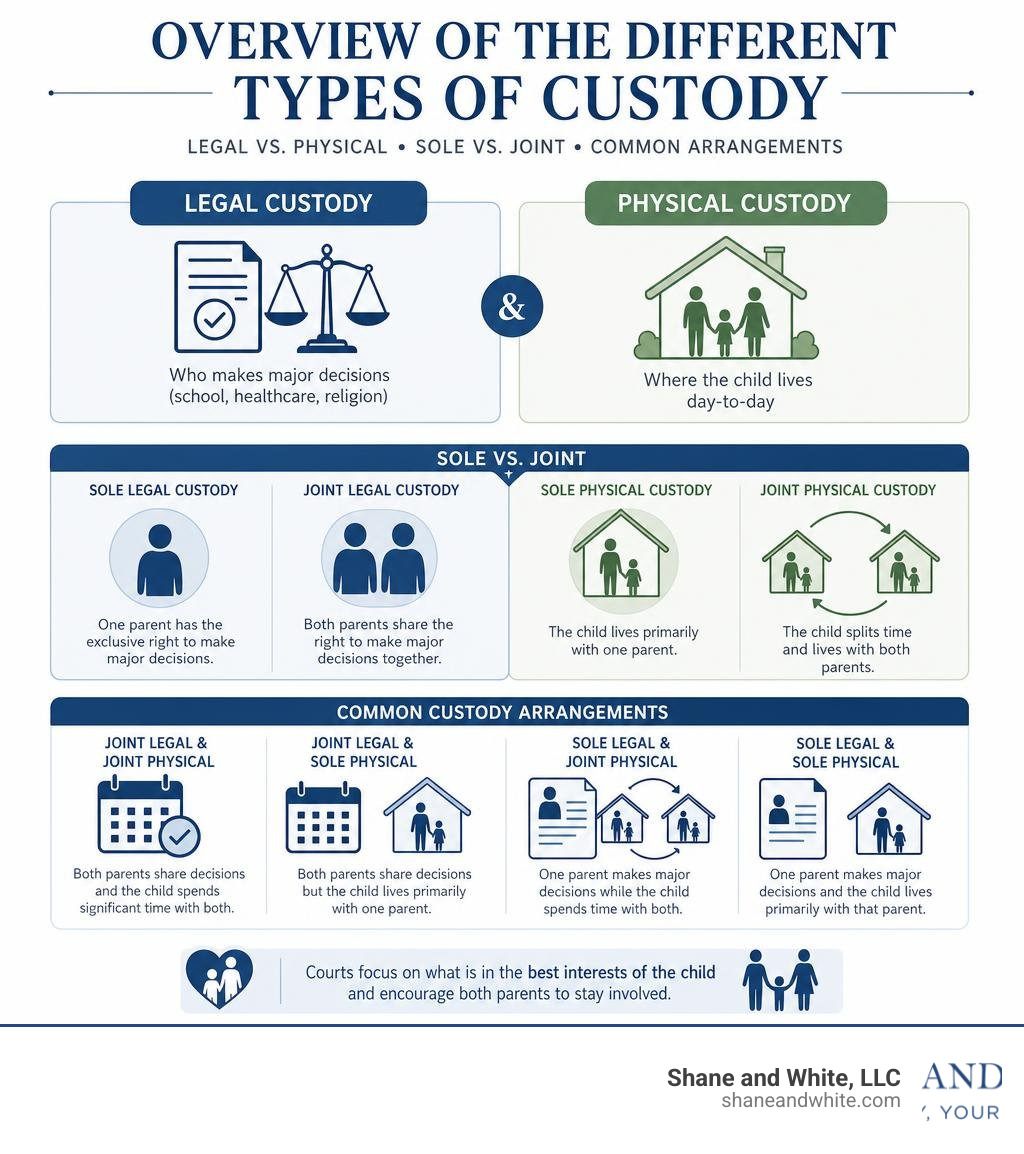
There are two main categories of custody, and each one can be awarded as either sole or joint:
| Custody Type | What It Controls | Sole vs. Joint |
|---|---|---|
| Legal Custody | Who makes major decisions (school, healthcare, religion) | Sole = one parent decides; Joint = both parents decide together |
| Physical Custody | Where the child lives day-to-day | Sole = child lives primarily with one parent; Joint = child splits time between both homes |
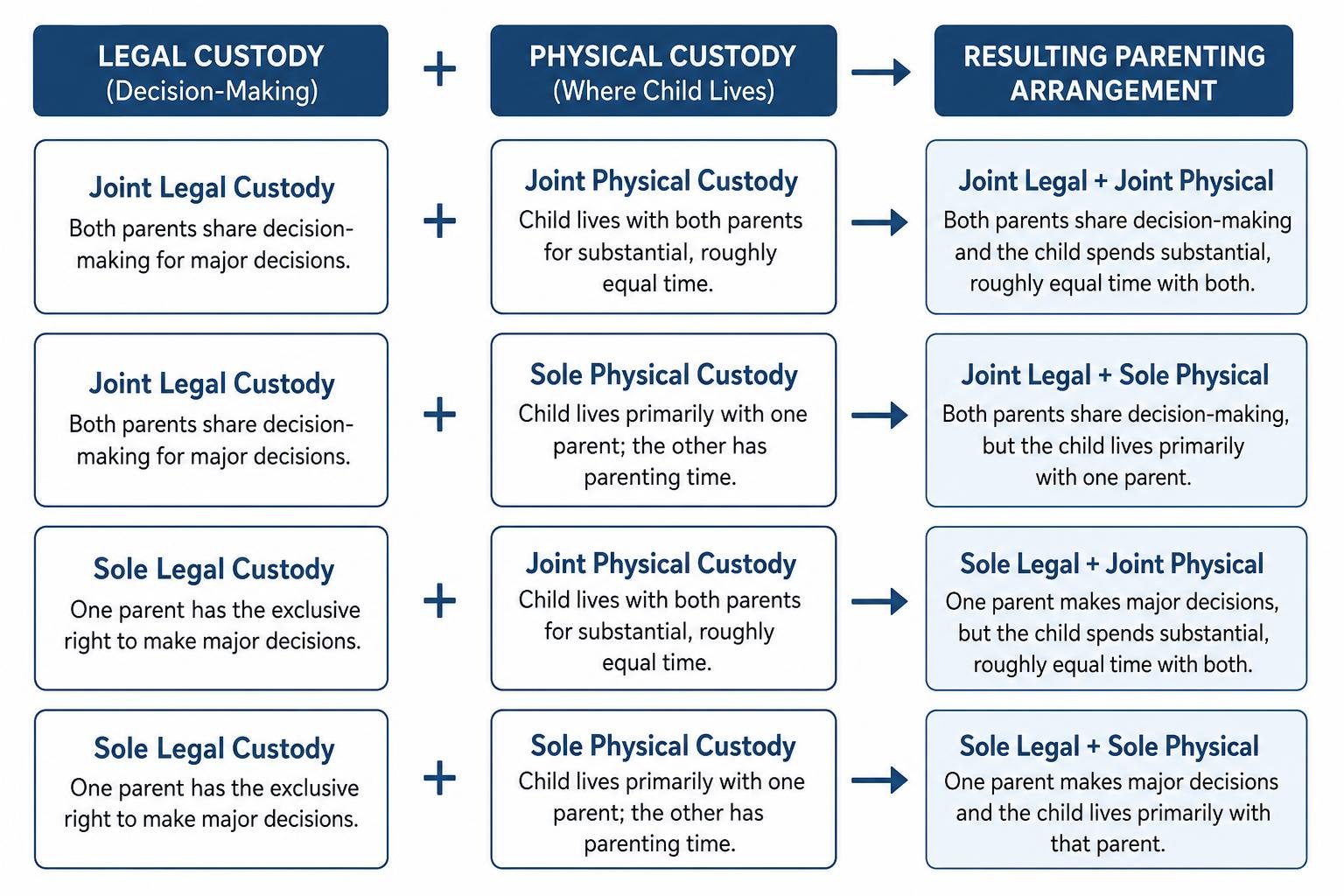
These two types combine to create your actual custody arrangement. For example, you might have joint legal custody (both parents share decisions) but sole physical custody (the child lives mostly with one parent).
In roughly 80–90% of U.S. custody cases, courts award joint legal custody so both parents stay involved in key decisions. Physical custody arrangements vary much more widely depending on each family’s situation.
New Jersey recognizes both legal and physical custody, and each can be structured in several ways — from a 50/50 shared parenting schedule to supervised visitation with strict conditions.
I’m Kenneth A. White, Esq., a Certified Matrimonial Attorney with over 30 years of experience guiding New Jersey families through the different types of custody arrangements and helping them reach outcomes that protect their children. As a member of the Middlesex County Assignment Judge’s Family Lawyers Committee and a court-appointed Guardian Ad Litem and Mediator, I’ve seen how the right custody structure can make a real difference in a child’s stability and well-being. In the sections below, I’ll walk you through every custody type clearly — so you can make informed decisions for your family.
Legal vs. Physical: Understanding the Different Types of Custody
When you begin exploring Child Custody, it is common to feel overwhelmed by the legal terminology. Many parents assume “custody” simply refers to where the children sleep at night. In reality, New Jersey law separates custody into two completely distinct rights: legal custody and physical custody.
To help you visualize how these two concepts interact, we have broken down the core differences in the table below:
| Feature | Legal Custody | Physical Custody |
|---|---|---|
| Primary Focus | Decision-making authority | Day-to-day residence and care |
| Key Decisions | Education, medical care, religious upbringing | Bedtimes, meals, daily chores, homework help |
| NJ Designations | Joint Legal Custody / Sole Legal Custody | Parent of Primary Residence (PPR) / Parent of Alternate Residence (PAR) |
| Key Benefit | Keeps both parents active in major life choices | Establishes a stable physical home base for the child |
It is entirely possible — and actually very common — for a parent to have joint legal custody without having equal physical custody. For a detailed breakdown of how states define these core rights, you can read more about how to Learn about the types of child custody arrangements | Mass.gov .
Sole vs. Joint Legal Custody
Legal custody dictates which parent has the right to make major, life-altering decisions for the child. These decisions generally fall into three major buckets:
- Education: Choosing public vs. private school, enrolling in special education programs, or tutoring.
- Healthcare: Selecting doctors, consenting to surgeries, starting therapy, or deciding on vaccinations. For a deeper look at how medical choices can spark parental disagreements, see our article on To Vaccinate Your Children or Not That Is Part of the Question.
- Religion: Choosing a place of worship, religious schooling, or major initiation ceremonies.
In joint legal custody, both parents must consult with each other and reach a mutual agreement before making any major decisions. Neither parent has a “tie-breaker” vote unless specifically designated by a court order. If you have joint legal custody and your co-parent makes a major decision without your input, they may be in violation of your court order.
Conversely, sole legal custody grants one parent the exclusive right to make these major decisions without consulting the other. New Jersey courts rarely award sole legal custody unless there is clear evidence that one parent is completely unfit, incarcerated, incapacitated, or entirely absent from the child’s life.
Sole vs. Joint Physical Custody
Physical custody (often referred to as residential custody) dictates where the child physically lives on a day-to-day basis.
In sole physical custody (or primary physical custody), the child lives with one parent the vast majority of the time. The parent with whom the child lives is designated the Parent of Primary Residence (PPR). The other parent, designated the Parent of Alternate Residence (PAR), typically receives parenting time (visitation), which may include alternating weekends, midweek dinners, and a split holiday schedule.
In joint physical custody, the child splits their residential time relatively equally between both parents’ homes (often a 50/50 or 60/40 split). For this to work, both parents must live in close geographic proximity so the child can maintain a consistent school schedule. For a broader look at parenting plans and physical custody schedules, the California Courts offer a helpful Child custody and parenting time | California Courts | Self Help Guide .
How Courts Combine Custody Options and Other Arrangements

Now that we have established the difference between legal and physical custody, we can look at how they combine. These are not standalone choices; they fit together like puzzle pieces to create a customized arrangement that fits your family’s unique dynamics. Because these choices are so critical, we always emphasize Why Your Child Custody Plans Need Early Legal Guidance to ensure you do not inadvertently agree to a schedule that does not work for your lifestyle.
Below is a visual representation of how these legal and physical components combine to form standard parenting arrangements:
Joint Legal and Joint Physical Custody
This is the true “shared parenting” model. Under this arrangement, both parents share equal decision-making power, and the child splits their physical time between both households.
Common schedules for joint physical custody include:
- The Alternating Week (7 on, 7 off): The child spends one full week with Parent A, then switches to Parent B.
- The 2-2-3 Schedule: The child spends 2 days with Parent A, 2 days with Parent B, and 3 days (the weekend) back with Parent A. The following week, the order rotates.
- The 3-4-4-3 Schedule: The child spends 3 days with one parent, 4 days with the other, then rotates.
While this arrangement keeps both parents highly involved, it requires an exceptional level of co-parenting cooperation. If parents struggle to communicate or live far apart, a 50/50 physical split can cause unnecessary stress and instability for the child.
Joint Legal and Sole Physical Custody
This is the most common custody arrangement in New Jersey. Under this structure, one parent handles the day-to-day residential care (the PPR), while both parents share equal authority on major decisions like schooling and medical care.
The Parent of Alternate Residence (PAR) is granted a regular parenting time schedule. A standard schedule might include alternating weekends, one or two midweek evening visits, and shared holidays. To learn more about how New Jersey structures these schedules, review the official resources on Custody/Visitation | NJ Courts .
Split Custody and Bird’s Nest Arrangements
There are a few less common custody arrangements that families sometimes utilize depending on their unique circumstances:
- Split Custody: This occurs when there are multiple children, and one child lives primarily with Parent A while the other lives primarily with Parent B. New Jersey courts strongly disfavor split custody because keeping siblings together is generally considered to be in their best interest. However, courts may permit it in rare cases involving older teenagers with strong, differing preferences.
- Bird’s Nest Custody: Instead of the child moving back and forth between two houses, the child remains permanently in the family home. The parents are the ones who rotate in and out of the home on a weekly basis, maintaining separate apartments or shared secondary spaces for their “off” weeks. While this minimizes disruption for the child, it is financially demanding and requires a high level of parental cooperation.
You can read a detailed breakdown of these and other unique arrangements in the guide on Types of Child Custody – FindLaw .
Supervised Visitation and Partial Custody
When a court has safety concerns regarding a parent’s ability to care for their child unsupervised, it may order supervised visitation. This means the parent is only permitted to spend time with the child in the presence of a court-approved third party, such as a grandparent, a social worker, or a professional supervisor at a designated facility.
Supervised visitation is typically ordered in cases involving:
- A history of domestic violence or child abuse.
- Active drug or alcohol addiction.
- Severe, unmanaged mental health conditions.
- A risk of parental abduction.
- A long period of estrangement where the parent and child need to slowly rebuild their relationship.
For parents seeking to understand their protective rights under these circumstances, the resources on New Jersey Custody provide critical legal guidance.
How New Jersey Courts Determine the Best Interest of the Child

If parents cannot agree on a custody arrangement, a judge in the Family Division of the Superior Court will make the decision for them. New Jersey courts do not favor mothers over fathers, nor do they favor fathers over mothers. Instead, every single custody decision is guided by a single, overriding legal standard: the best interest of the child.
Navigating this process can be highly emotional and legally complex, which is why understanding The Role of a Family Lawyer in Resolving Custody Disputes is so important to protecting your parental rights.
Key Factors in New Jersey Custody Decisions
Under New Jersey statute N.J.S.A. 9:2-4, judges must evaluate a specific set of factors to determine what arrangement will best serve the child’s physical, emotional, and developmental needs. These factors include:
- The parents’ ability to agree, communicate, and cooperate in matters relating to the child.
- The parents’ willingness to accept custody and any history of unwillingness to allow parenting time.
- The interaction and relationship of the child with their parents and siblings.
- Any history of domestic violence (New Jersey courts take domestic violence allegations very seriously, creating a strong presumption against awarding custody to an abusive parent).
- The safety of the child and the safety of either parent from physical abuse by the other.
- The preference of the child, if the child is of sufficient age and capacity to make an intelligent decision.
- The stability of the home environment offered by each parent.
- The quality and continuity of the child’s education.
- The fitness of the parents (including any history of substance abuse or neglect).
- The geographical proximity of the parents’ homes.
- The extent and quality of the time spent with the child prior to or subsequent to the separation.
- The parents’ employment responsibilities and work schedules.
To learn more about how courts define these custody terms and weigh these factors, you can explore What Does Custody Status Mean? Types and Legal Rights – LegalClarity .
Creating Your Own Agreement to Avoid a Custody Battle
The best custody agreement is almost always the one you and your co-parent design yourselves. New Jersey courts strongly encourage parents to negotiate a customized parenting plan outside of the courtroom.
When you draft your own agreement, you maintain control over your family’s schedule. If you leave the decision to a judge, you are putting your daily life into the hands of a third party who only knows your family through court documents. Working with a mediator or a collaborative family lawyer can help you find common ground. For more insights on how to negotiate peacefully, read our guide on how to Can a Family Lawyer Help You Avoid a Custody Battle.
Once you and your co-parent reach an agreement, your attorneys will submit it to the court as a consent order. A judge will review it to ensure it serves the child’s best interests and, once approved, it becomes a legally binding court order.
Modifying Custody Orders and Managing Financial Impacts
A custody order that works perfectly when your child is five years old may no longer work when they enter high school. As children grow, their schedules, extracurricular activities, and emotional needs change. Fortunately, custody orders are not permanently set in stone. If you need to make updates to your current parenting plan, our guide on Revisiting Your Custody Arrangements outlines the legal steps required to seek an adjustment.
Relocation and Moving with Your Child
One of the most common reasons parents seek to modify a custody order is relocation. In New Jersey, if you share joint legal custody, you cannot move your child out of the state of New Jersey without either the written consent of the other parent or a court order.
Under New Jersey law (N.J.S.A. 9:2-2), if the non-relocating parent objects to the move, the parent wishing to relocate must file a motion with the court. The court will evaluate whether the move is in the child’s best interest, looking closely at the reasons for the move, the quality of education in the new location, and how the move will impact the non-custodial parent’s ability to maintain a meaningful relationship with the child.
Because relocation cases are incredibly difficult and highly litigated, we recommend reading our detailed resource on Moving with Your Child in the State of New Jersey before making any major moving plans.
Financial Impacts of Different Types of Custody
Your custody arrangement has a direct, major impact on your financial obligations, particularly when it comes to child support and taxes.
- Child Support: In New Jersey, child support is calculated using the New Jersey Child Support Guidelines. The formula heavily factors in the number of overnights the child spends at each parent’s home. If a parent has the child for more than 104 overnights per year (which is about 28% of the year), the child support calculation shifts from a “sole parenting” worksheet to a “shared parenting” worksheet, which can significantly lower their child support obligation.
- Taxes: By default, the IRS defines the custodial parent as the parent with whom the child spent the greater number of nights during the tax year. This parent is typically entitled to claim the child as a dependent and access valuable tax credits. However, the custodial parent can choose to waive this right and release the dependency exemption to the non-custodial parent by signing IRS Form 8332. Many parents write a rotating tax schedule directly into their custody agreements (e.g., Parent A claims the child in even years, Parent B in odd years).
Managing these overlapping emotional and financial decisions is one of the hardest parts of a divorce. For practical tips on how to protect your children and your finances during this transition, see our article on How to Handle Divorce When Children Are Involved.
Frequently Asked Questions About Child Custody
What are the different types of custody recognized in New Jersey?
New Jersey recognizes two primary categories of custody: legal custody (the right to make major decisions regarding education, health, and religion) and physical custody (where the child resides). Each of these can be structured as either joint (shared) or sole (held by one parent).
In physical custody arrangements, the parent with whom the child lives most of the time is designated the Parent of Primary Residence (PPR), while the other is the Parent of Alternate Residence (PAR).
Can a parent have physical custody without legal custody?
While it is theoretically possible, it is incredibly rare. If a parent is deemed fit enough to handle the daily, hands-on physical care of a child, the court almost always grants them joint legal custody as well.
The only scenarios where a parent might have physical residency without legal decision-making power are highly unique cases where a parent is capable of providing day-to-day shelter but lacks the capacity or judgment to make major medical or educational decisions.
How does custody affect child support and taxes?
In New Jersey, child support is calculated using a formula that looks at both parents’ incomes and the number of overnights the child spends at each home. More overnights with the non-custodial parent generally reduces their child support obligation.
For tax purposes, the IRS defaults the dependency claim to the parent who has the most overnights, but parents can agree to split or rotate this benefit by filing IRS Form 8332.
Conclusion
Determining the right custody arrangement is one of the most important decisions you will ever make for your children. Whether you are aiming for a collaborative 50/50 shared parenting plan or need to fight for sole custody to protect your child’s safety, having the right legal support makes all the difference.
At Shane and White, LLC, we have spent over 40 years helping families in Edison, East Windsor, Middlesex County, and Mercer County navigate the complexities of New Jersey family law. We pride ourselves on providing the personalized attention, clear communication, and compassionate guidance you need to secure a stable, positive future for your children.
If you are ready to discuss your child custody options, we are here to help. Child Custody matters require careful, experienced advocacy — contact our Edison, New Jersey office today to schedule a consultation.


