


What to Expect During a Divorce
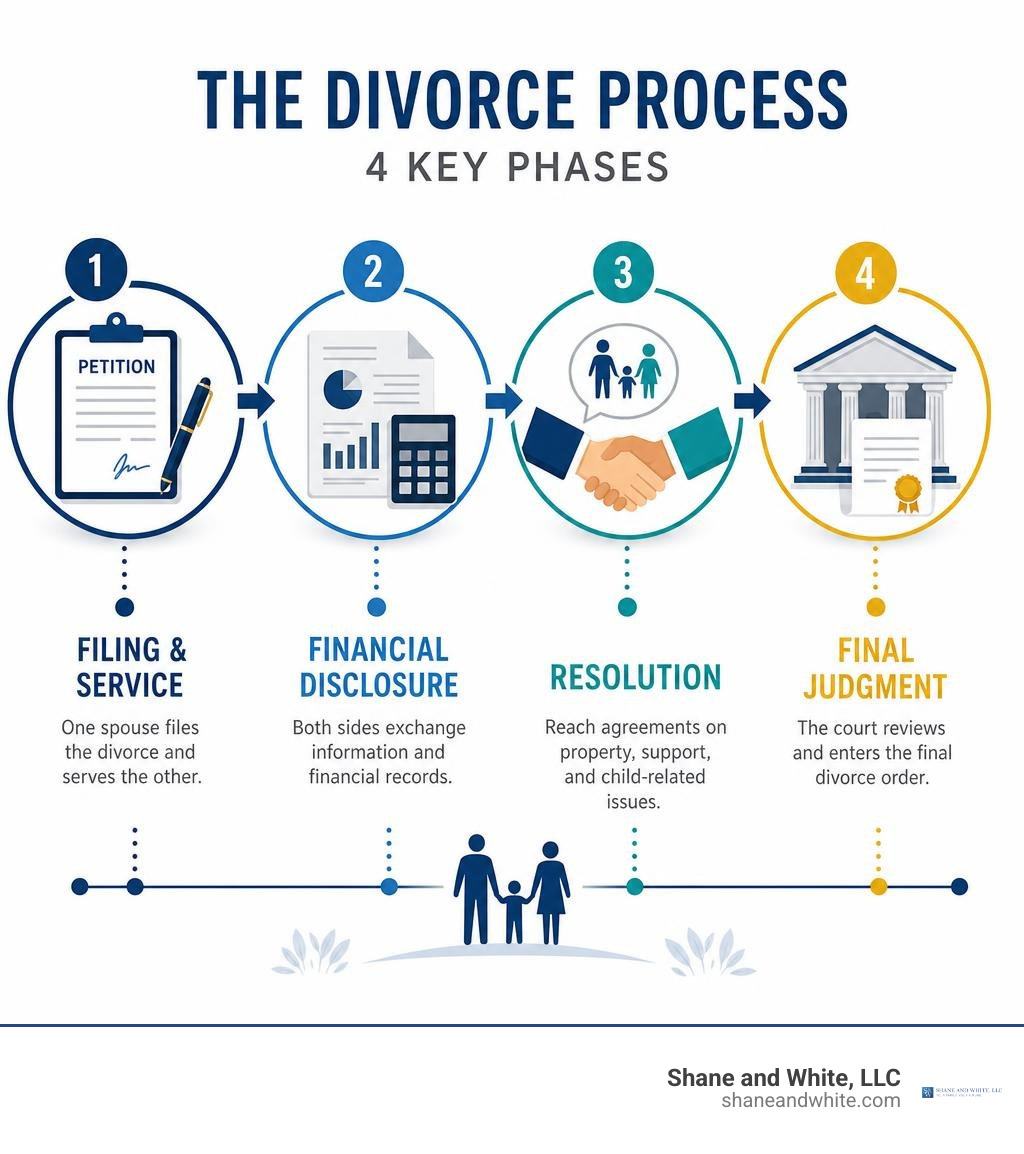
What to expect divorce can feel overwhelming, but the process usually follows a clear path: file and serve the divorce papers, exchange financial information, work toward agreements on property, support, and children, then obtain a final court order.
- Starting the case: One spouse files a complaint for divorce and formally serves the other spouse.
- Responding and sharing information: Both sides address the claims and provide financial records.
- Making decisions: The spouses negotiate or ask the court to decide issues involving assets, debts, alimony, child custody, parenting time, and child support.
- Finalizing the divorce: A judge reviews and enters the final judgment, whether the parties settle or proceed to trial.
The timeline depends on the facts of the case, the county, and whether you and your spouse agree. An uncontested case can move more efficiently, while a contested divorce involving major financial disputes or parenting issues can take much longer. In New Jersey, divorce is not only a legal process; it is also a major financial and personal transition.
I am Kenneth White, Esq., a New Jersey Supreme Court Certified Matrimonial Law Attorney who has represented and guided clients through the issues involved in what to expect divorce, from settlement discussions to contested court matters. My experience as a family-law attorney, court-appointed mediator, Guardian Ad Litem, and Early Settlement Panelist informs the practical guidance that follows.
Quick what to expect divorce definitions:
Legal Framework: What to Expect Divorce Requirements and Grounds
Before you dive into paperwork or start picking out a new apartment, it helps to understand the baseline legal rules in New Jersey. To file for divorce in our state, at least one spouse must meet the statutory residency requirement: living in New Jersey for at least 12 consecutive months immediately prior to filing the divorce complaint (with a narrow exception for adultery).
When it comes to grounds for ending a marriage, New Jersey offers both fault-based and no-fault options. Fault grounds include physical or mental cruelty, desertion, or adultery. However, the vast majority of spouses opt for no-fault grounds—specifically “irreconcilable differences” that have existed for at least six months with no reasonable prospect of reconciliation. Filing under no-fault grounds keeps sensitive personal matters out of the public spotlight and helps minimize unnecessary courtroom drama.
To review official state documentation or court forms, check out the Official New Jersey Courts Divorce Resources. For a deeper breakdown of jurisdiction, filing locations across Middlesex County, and statutory rules, visit our guide on Divorce Requirements in New Jersey.
What to Expect Divorce Pathways: Contested vs. Uncontested
No two divorces are carbon copies of each other, but most fall into one of two categories: uncontested or contested.
In an uncontested divorce, both spouses agree on every single major terms—including equitable distribution of property, allocation of debt, alimony, child custody, and support schedules—before or shortly after filing. Because there are no unresolved issues for a judge to decide, court appearances are brief (or eliminated entirely), court filing fees remain manageable, and the case can be finalized relatively quickly.
In a contested divorce, the parties disagree on one or more core issues. This pathway requires formal discovery, court status conferences, settlement panels, and potentially a full trial if negotiations stall.
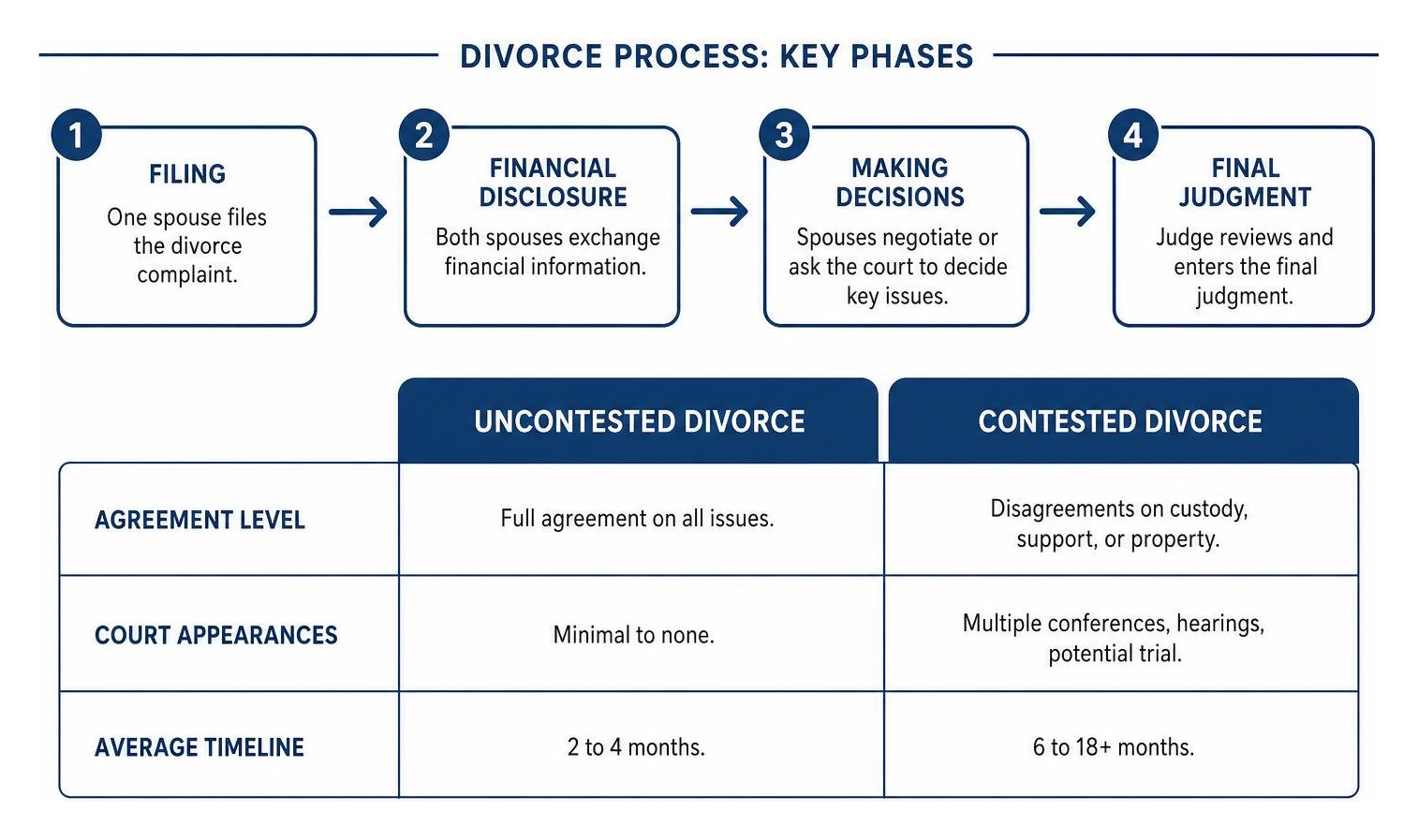
| Aspect | Uncontested Divorce | Contested Divorce |
|---|---|---|
| Agreement Level | Full agreement on all issues | Disagreements on custody, support, or property |
| Court Appearances | Minimal to none | Multiple conferences, hearings, potential trial |
| Average Timeline | 2 to 4 months | 6 to 18+ months |
| Cost & Expense | Lower legal fees and minimal court filings | Higher due to litigation, experts, and discovery |
| Level of Privacy | High (handled via private settlement) | Lower (disputes entered into court record) |
Understanding where your situation lands can help you set realistic expectations. To learn more about how case complexity impacts your schedule, read How Long Does It Take to Get Divorced in New Jersey.
Responding to a Divorce Complaint and Default Judgments
Once a Complaint for Divorce is filed in Superior Court, it must be formally served on the other spouse along with a Summons. If you are the responding party (the defendant), pay close attention to the clock. In New Jersey, you generally have 35 days from the date you receive the summons to file a formal response with the court clerk.
When responding, you have a few options:
- File an Answer: Acknowledge or contest the allegations in the complaint.
- File an Answer and Counterclaim: File your own claims for divorce against your spouse, requesting specific relief regarding custody, asset division, or support.
- File an Appearance: Indicate that you do not contest the divorce grounds but want to participate in settlement negotiations regarding property, financial support, or child custody.
What happens if a spouse simply ignores the divorce papers? If no response is submitted within 35 days, the filing spouse can request a default judgment. In a default scenario, the court may grant the divorce and rule on property and custody based solely on the filing spouse’s requests—without the non-responsive party having a say. Taking swift action protects your legal rights.
The Step-by-Step Divorce Process
Understanding the procedural roadmap removes much of the anxiety surrounding court actions. From the moment initial paperwork is drafted to the day a final decree is signed, family court proceedings follow a structured series of phases. To see how each milestone fits together, read Understanding the New Jersey Divorce Process.
What to Expect Divorce Financial Discovery and Disclosure
Transparency is mandatory in family court. Neither spouse can hide assets, pad debts, or underreport income without risking severe judicial sanctions, including paying the other party’s legal fees or forfeiting asset claims.
During the financial discovery phase, both parties must complete a detailed court document known as a Case Information Statement (CIS). The CIS outlines your current financial life, including:
- Income stubs (12 months of consecutive pay stubs)
- Federal and state tax returns (typically 3 to 5 years)
- Bank, investment, and brokerage statements
- Real estate deeds, mortgages, and appraisal values
- Retirement account statements (401k, IRA, pension details)
- Business ownership valuations and tax filings
- Itemized monthly budget expenses (housing, utilities, transportation, child expenses)
Gathering these items early prevents delays during negotiations and saves you thousands of dollars in attorney hours that would otherwise be spent hunting down missing statements.
Alternative Dispute Resolution and Settlement Options
Courts strongly encourage couples to resolve their disputes out of court whenever possible. Litigation is expensive and stressful; alternative dispute resolution (ADR) offers a faster, more collaborative way forward.
Key settlement options include:
- Court-Sponsored & Private Mediation: A neutral third-party mediator helps both spouses discuss options and reach mutually acceptable compromises.
- Matrimonial Early Settlement Panel (ESP): Experienced family law attorneys volunteer to review your financial disclosures and recommend fair settlement terms based on state legal precedents.
- Collaborative Divorce: Both spouses and their attorneys sign an agreement pledging to resolve all issues through open negotiations without threatening court action.
For an in-depth comparison of negotiated settlements versus courtroom trials, explore Collaborative Divorce vs Litigation Options.
Court Hearings and Trial Proceedings
If spouses cannot settle through mediation or negotiation, the case moves into formal litigation.
Before reaching trial, parties may attend an Interim Hearing (or pendente lite motion) to establish temporary ground rules. These temporary court orders address urgent issues like who lives in the marital home, who pays monthly bills, temporary spousal support, and interim parenting time schedules while the case remains open.
If disputes persist, the court schedules a Trial Management Conference to set deadlines for witness lists, expert testimony (such as property appraisers or forensic accountants), and exhibit submissions. During the trial itself, both sides present evidence and testimony before a judge, who issues a final, binding Divorce Decree.
Key Financial Issues: Asset Division, Debt, and Support

Money matters are often the most contentious part of any divorce. New Jersey follows the principle of equitable distribution, which means marital property and joint debts are divided fairly—though not necessarily on a strict 50/50 basis.
The court considers several factors when determining what is “equitable,” including the length of the marriage, each spouse’s economic status, physical and emotional health, financial contributions to the household, and future earning potential. For detailed insights, consult Financial Issues in Alimony and Asset Division.
Division of Property, Debts, and the Marital Home
A crucial step in financial planning is distinguishing between marital property and non-marital (separate) assets:
- Marital Property: Assets acquired by either spouse during the marriage—such as real estate, vehicles, joint bank accounts, investments, and retirement benefits accumulated while married.
- Separate Property: Assets acquired prior to the marriage, or individual inheritances and gifts received from third parties during the marriage, provided they were kept separate and not commingled with joint funds.
Dividing complex assets like the marital home often requires deciding whether one party buys out the other’s home equity, or if the home is sold and net proceeds divided. Retirement accounts accumulated during the marriage, such as 401(k) plans or pensions, are typically split using a legal instrument called a Qualified Domestic Relations Order (QDRO). Additionally, all joint liabilities—credit cards, auto loans, mortgages—must be allocated fairly. Read How Assets Get Divided in Divorce for a full breakdown.
Determining Spousal Maintenance and Alimony
Spousal maintenance (commonly called alimony) provides financial support to an economically dependent spouse following a divorce. Alimony is not designed as a reward or punishment; its goal is to assist the lower-earning spouse in maintaining a lifestyle reasonably comparable to the one enjoyed during the marriage.
Types of alimony in New Jersey include:
- Open Durational Alimony: Typically reserved for marriages lasting longer than 20 years.
- Limited Duration Alimony: Paid for a fixed term, usually corresponding to marriages under 20 years (cannot exceed the length of the marriage except in exceptional circumstances).
- Rehabilitative Alimony: Short-term support to pay for education or job training so a spouse can re-enter the workforce.
- Reimbursement Alimony: Awarded if one spouse financially supported the other through advanced education or professional licensing with the expectation of future joint benefit.
Judges evaluate statutory factors—such as actual earning capacity, education level, parental obligations, and financial contributions—to calculate fair alimony awards.
Resolving Child Custody and Support Matters

When minor children are involved, their emotional and physical well-being takes priority over every other issue. Courts focus entirely on the best interests of the child when establishing custody structures and parenting time schedules. To navigate co-parenting decisions smoothly, check our guide on Handling Divorce with Children.
Legal Custody, Physical Custody, and Parenting Schedules
Custody is divided into two distinct legal concepts:
- Legal Custody: The right to make major life decisions regarding a child’s health care, education, religious training, and overall welfare. Joint legal custody is standard in New Jersey, giving both parents equal decision-making authority.
- Physical Custody (Residential Custody): Refers to where the child sleeps and spends day-to-day time. One parent may serve as the Primary Residential Parent, while the other is designated as the Parent of Alternate Residence with established overnight parenting time.
Parents are required to create or agree upon a practical Parenting Plan. Furthermore, parents in New Jersey must attend a court-mandated parenting workshop designed to help minimize the emotional impact of divorce on children.
Child Support Calculation Guidelines
Child support ensures that both parents share financial responsibility for raising their children. New Jersey calculates child support using a standardized Income Shares Model. This state computer model factors in:
- The combined net monthly income of both parents
- The percentage of overnight parenting time spent with each parent
- Health insurance premium costs for the child
- Mandatory work-related childcare or daycare costs
- Extracurricular activities and special medical needs
In general, child support obligations continue until the child reaches age 19, or until age 23 if the child remains enrolled full-time in post-secondary college or vocational education.
Strategic Preparation and Legal Representation
Navigating a divorce successfully requires preparation across every facet of your life. A proven framework organizes your readiness into four interconnected pillars:
- Financial Readiness: Cataloging assets, gathering bank records, checking credit, establishing individual bank accounts, and building a post-divorce budget.
- Legal Readiness: Consulting with qualified legal counsel, understanding state statutes, and setting realistic goals.
- Emotional Readiness: Setting up mental health support, working with a therapist, and keeping personal grief out of legal negotiations.
- Practical Readiness: Arranging housing logistics, setting up personal email accounts, and coordinating child routines.
For complete guidance on getting ready before taking legal action, read The 4 Pillars of Divorce Preparation Guide.
Protecting Credit and Financial Security
During a divorce, taking steps to secure your credit is essential. Creditors generally do not care what a divorce decree says—if both your names are on a credit card or auto loan, you remain personally liable to the lender regardless of court orders.
Protect your credit score during divorce by taking these steps:
- Request a free credit report from annualcreditreport.com to identify all active joint debts.
- Pay off and close joint credit card accounts, or freeze them to prevent new charges.
- Open separate checking, savings, and credit accounts in your name alone.
- Establish a realistic post-divorce single-income monthly budget.
- Update billing addresses with utility companies and service providers.
Hiring a Family Law Attorney vs. Self-Representation
While individuals have the legal right to represent themselves (pro se), attempting to handle a complex divorce without legal counsel carries major risks. Misunderstanding filing procedures, missing response deadlines, or agreeing to unfair asset division can cause long-term financial damage that is difficult or impossible to undo later.
Furthermore, state ethics rules strictly forbid a single lawyer from representing both spouses in a divorce due to obvious conflicts of interest. Each party needs independent legal representation to protect their individual rights.
When interviewing family law attorneys, ask about their experience in local county courts, retainer fees, hourly billing rates, and negotiation philosophy. To evaluate if professional representation is necessary for your situation, review Signs You Need a Divorce Attorney.
Post-Divorce Steps and Finalizing Orders
Once all settlement terms are agreed upon (or decided by a judge at trial), a final Judgment of Divorce is formally executed by the court. In some jurisdictions, statutory waiting periods—such as a nisi period—apply before orders become administrative finalities, though in New Jersey the entry of the final judgment immediately ends the marriage.
After your divorce decree is signed, don’t forget these essential follow-up tasks:
- Maiden Name Restoration: If requested in your pleadings, execute official name changes with the Social Security Administration, Motor Vehicle Commission, and passport offices.
- Update Beneficiaries: Revise beneficiary designations on life insurance policies, retirement plans, wills, and powers of attorney (divorce qualifies as an insurance life event allowing plan adjustments outside open enrollment).
- Transfer Assets & QDROs: Ensure property titles, car registrations, and retirement account QDRO splits are fully executed.
- Post-Decree Modifications: If circumstances change substantially in the future—such as job loss, income changes, or relocation—either party can petition the court for a formal modification of alimony, child support, or custody orders.
Frequently Asked Questions About Divorce
How long does a typical divorce take from start to finish?
The duration depends on whether the case is uncontested or contested. An uncontested divorce with a signed property settlement agreement can take anywhere from 2 to 4 months to finalize once filed. A contested divorce involving valuation experts, financial discovery disputes, or custody trials can take anywhere from 6 to 18 months or longer.
Can a single lawyer represent both spouses in a divorce?
No. Legal ethics rules prohibit one attorney from representing both parties in a divorce due to an inherent conflict of interest. Even in a completely amicable, uncontested divorce, a lawyer can legally represent only one spouse. The other spouse may choose to represent themselves or hire separate counsel.
What happens if my ex-spouse violates the final divorce decree?
If an ex-spouse fails to comply with court-ordered alimony, child support, debt payment, or parenting time schedules, you can file a Motion for Enforcement of Litigant’s Rights with the court. Judges have wide authority to enforce orders, including wage garnishments, monetary sanctions, revoking driver’s licenses, or assessing legal fees against the non-compliant party.
Conclusion
Understanding what to expect divorce turns a confusing legal ordeal into an organized, step-by-step process. By preparing across all four pillars—financial, legal, emotional, and practical—you safeguard your rights, your finances, and your children’s future.
Every family situation presents unique challenges that require knowledgeable, personalized strategy. At Shane and White, LLC, our firm brings over 40 years of specialized family law experience to clients across Middlesex County and surrounding New Jersey communities, including Edison, Metuchen, Woodbridge, East Brunswick, New Brunswick, North Brunswick, Monroe, Piscataway, and Sayreville. We provide direct communication and tailored legal representation to guide you smoothly into your next chapter.
If you are preparing for a divorce or need clear answers regarding your rights, contact our team today to schedule a confidential consultation for Experienced Divorce Legal Representation.


