


What a Divorce Attorney in Mercer County Can Do for You
Finding a qualified divorce attorney in Mercer County is often the single most important step you can take when facing the end of a marriage in New Jersey. Here is a quick overview of what you need to know:
Quick answers for Mercer County divorce:
- Where to file: Superior Court, Family Part, 175 South Broad Street, Trenton, NJ
- Residency requirement: At least one spouse must have lived in NJ for 12 consecutive months before filing
- Grounds for divorce: No-fault (irreconcilable differences for 6+ months, or 18-month separation) or fault-based (adultery, extreme cruelty, desertion, and others)
- How to file: Electronically through the New Jersey Judiciary’s electronic filing system (JEDS)
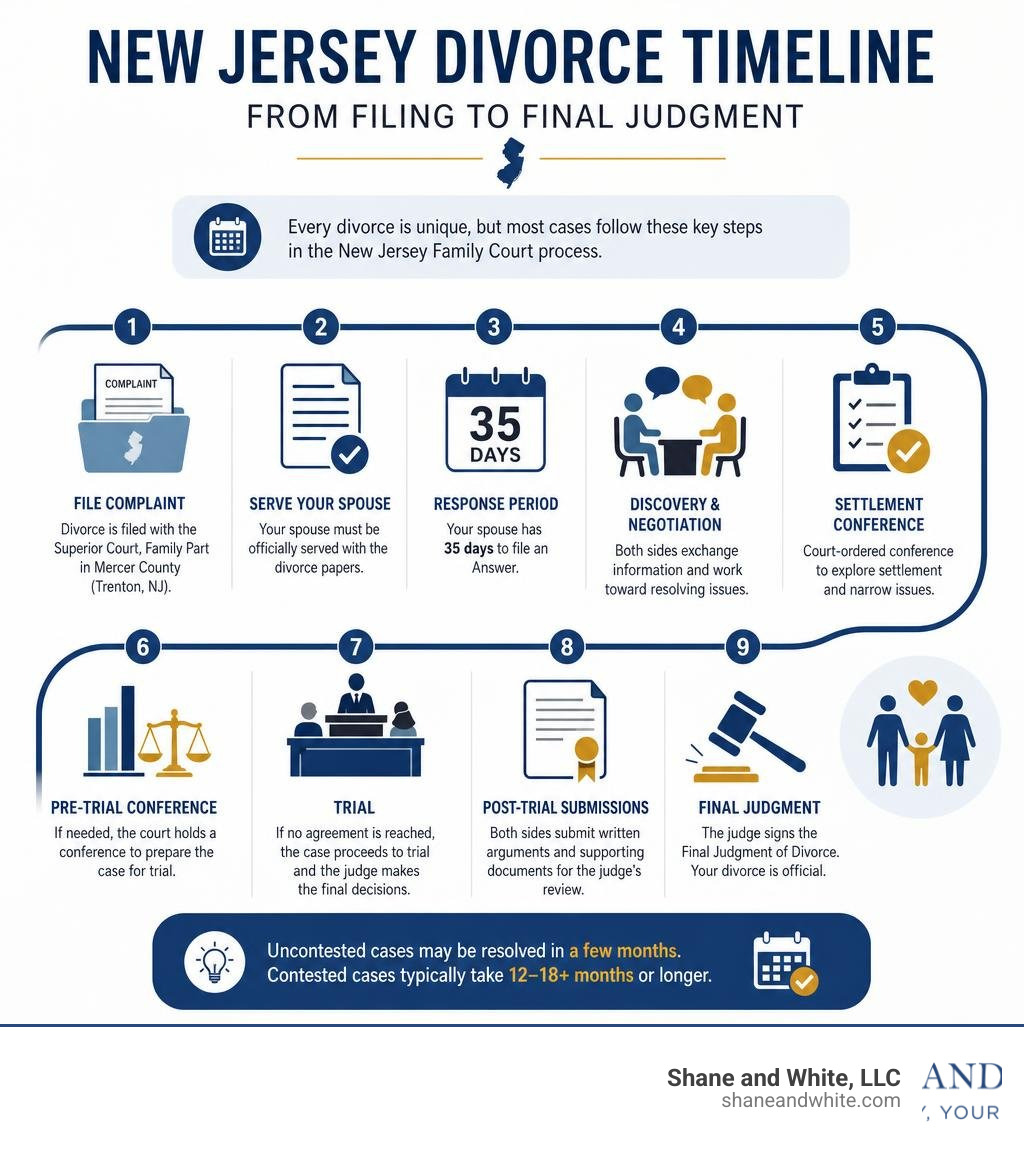
- Response window: Your spouse has 35 days to respond after being served
- Property division: New Jersey uses equitable distribution — fair, but not automatically 50/50
- Typical timeline: A few months for uncontested; 12–18+ months for contested cases
Mercer County — known as “The Capital County” — is home to Trenton, Princeton, and a highly educated population, with a median household income of $96,333 and 43.5% of residents holding a bachelor’s degree or higher. Despite that prosperity, fewer than half of Mercer County residents are married couples living together. And with roughly half of all marriages ending in divorce, the Family Court in Trenton stays busy.
Divorce is rarely just a legal matter. It touches your finances, your children, and your daily life all at once. The stakes are high — and the process is more complex than most people expect.
I’m Kenneth White, Esq., a New Jersey Supreme Court Certified Matrimonial Law Attorney with extensive experience serving as an Early Settlement Panelist, Guardian Ad Litem, and Mediator in the Family Courts — making me a deeply knowledgeable divorce attorney in Mercer County and the surrounding region. In the sections below, I’ll walk you through everything you need to know to protect your rights and make informed decisions.
Understanding New Jersey Divorce Grounds and Residency Requirements
Before we can draft a single page of your divorce paperwork, we have to establish that New Jersey has the legal authority (jurisdiction) to dissolve your marriage.
To file for divorce in the Garden State, you or your spouse must have been a continuous resident of New Jersey for at least 12 consecutive months immediately preceding the filing of the Complaint. The only exception to this 12-month residency rule is if you are filing on the grounds of adultery, in which case you can file as soon as the residency is established, provided at least one spouse lives in the state. For a detailed breakdown of these foundational rules, you can read our guide on What Are the Requirements to File for Divorce in New Jersey.
Once the residency requirement is met, we must select the legal “grounds” (the statutory reason) for your divorce. New Jersey allows for both no-fault and fault-based divorces.
No-Fault Divorce Grounds
Most couples in Mercer County opt for a no-fault divorce because it is generally less contentious, faster, and far more cost-effective. You do not have to point fingers or air dirty laundry in public court records. The two no-fault options are:
- Irreconcilable Differences: You must show that you and your spouse have experienced irreconcilable differences for a period of at least six months, that these differences have caused the breakdown of the marriage, and that there is no reasonable prospect of reconciliation.
- Separation: You and your spouse must have lived in separate habitations for at least 18 consecutive months prior to filing, with no reasonable prospect of getting back together.
Fault-Based Divorce Grounds
If you choose to file a fault-based divorce, you must legally prove specific misconduct. The statutory fault grounds in New Jersey include:
- Extreme Cruelty: This is defined as any physical or mental cruelty that makes it improper or unreasonable to expect you to continue cohabitating with your spouse.
- Adultery: When one spouse has a sexual relationship outside of the marriage.
- Desertion: When a spouse willfully abandons the marriage and lives apart for 12 or more consecutive months.
- Other Grounds: Habitual drunkenness, narcotic addiction, imprisonment, deviant sexual behavior, or institutionalization.
While alleging fault might feel emotionally satisfying, it rarely gives you a financial advantage in court. Proving fault requires extensive evidence, which drives up litigation costs and emotional stress. In almost all cases, a strategic divorce attorney in Mercer County will advise filing under irreconcilable differences to keep the focus on what truly matters: resolving your asset division and protecting your children.
How a Strategic Divorce Attorney Mercer County Can Protect Your Rights
The actual mechanics of getting divorced in Mercer County require strict adherence to local court rules. The process officially begins when we draft and file a Complaint for Divorce with the Superior Court, Family Part, located at 175 South Broad Street in Trenton.
Today, in July 2026, all divorce filings in New Jersey are submitted electronically through the Judiciary Electronic Document Submission (JEDS) portal. This system allows for fast, 24/7 processing, but it requires that every single document be formatted, signed, and uploaded as an individual file. A single administrative mistake can delay your case by weeks.
Once the Complaint is filed and the state’s $300 filing fee is paid, the papers must be formally served to your spouse. In Mercer County, this is usually handled by the Mercer County Sheriff’s Office or a licensed private process server. Once served, your spouse has exactly 35 days to file an Answer, a Counterclaim, or a general Appearance. If they fail to respond, we can move for a default judgment.

Whether your divorce proceeds smoothly or turns into a long battle depends on whether your case is categorized as contested or uncontested.
| Feature | Uncontested Divorce | Contested Divorce |
|---|---|---|
| Definition | Both spouses agree on all major issues (assets, custody, support) before or during early filing. | Spouses disagree on one or more key issues, requiring court intervention or extensive negotiation. |
| Average Timeline | 2 to 4 months | 6 to 18+ months |
| Cost | Low to moderate (minimal court appearances, lower legal fees) | Moderate to high (discovery, expert valuations, potential trial) |
| Control | High (you and your spouse write your own agreement) | Low (a judge may ultimately decide your future) |
| Stress Level | Manageable | High |
For a step-by-step walkthrough of what to expect as your case moves forward, explore The Divorce Process Guide and our comprehensive roadmap, Your Divorce Start to Finish.
When to Hire a Dedicated Divorce Attorney Mercer County
If you and your spouse are completely aligned on how to split your assets and handle custody, you might be tempted to try a “do-it-yourself” divorce. However, even seemingly simple divorces can quickly go off the rails. It is critical to recognize the Signs You Need a Divorce Attorney for Your Case.
An experienced attorney acts as your strategist, negotiator, and shield. We help you navigate alternative dispute resolution methods like mediation and negotiation, which can resolve your case in a fraction of the time and reduce your overall costs by 40% to 60% compared to full-blown litigation.
If negotiations stall, Mercer County utilizes the Early Settlement Panel (ESP). This is a mandatory program where experienced local family law attorneys review your financial disclosures and recommend a fair settlement. If you are searching for qualified local representation to guide you through this process, you can research options via the directory of the Best Divorce Lawyers in Mercer County, NJ. Working with a local advocate who understands the specific preferences of Mercer County judges can make a massive difference in how your case is managed. Learn more about How a Local Divorce Attorney Can Save Time and Stress.
Finding the Right Divorce Attorney Mercer County for Complex Estates
Mercer County has a unique professional and economic landscape. It is home to Princeton University, major pharmaceutical headquarters, and over 20,000 state government employees in the Trenton region. This means divorces here frequently involve complex, high-asset estates.
If you or your spouse hold any of the following assets, a standard “cookie-cutter” approach to divorce will not work:
- State Government Pensions: Dividing a state pension requires utilizing a specific legal formula known as the coverture fraction and drafting a Qualified Domestic Relations Order (QDRO).
- Academic Tenure and University Benefits: Princeton University professors and researchers often have complex deferred compensation packages, specialized housing arrangements, and intellectual property rights that require precise valuation.
- Executive Compensation: Pharmaceutical and corporate executives in the Princeton-Rutgers corridor often receive restricted stock units (RSUs), stock options, and performance bonuses that must be carefully analyzed.
- Trusts and Inheritances: While inheritances are generally considered separate property, they can easily become “commingled” if funds were deposited into a joint bank account or used to renovate a marital home.
When high-value assets are on the line, or if you find yourself facing Divorce in New Jersey When One Spouse Controls the Money, you need sophisticated representation. Take the time to read our advice on Finding the Right New Jersey Family Law and Divorce Attorney to ensure your legal team has the financial intelligence required for your case.
Key Financial Decisions: Equitable Distribution and Alimony

New Jersey is an equitable distribution state. This means the court will divide all marital assets and liabilities in a manner that is fair and equitable — but “equitable” does not necessarily mean an exact 50/50 split.
The court distinguishes between:
- Marital Property: Any assets, real estate, bank accounts, business interests, or debts acquired by either spouse from the date of the marriage to the date the Divorce Complaint is filed.
- Separate Property: Assets acquired prior to the marriage, or inheritances and gifts received individually during the marriage, provided they were kept strictly separate and never commingled.
To determine a fair distribution, courts evaluate factors such as the length of the marriage, the economic circumstances of each spouse, the contribution of each party to the education or earning power of the other, and the physical and emotional health of both parties.
Alimony (Spousal Support) in New Jersey
Alimony is not an automatic right, nor is it a punishment. It is designed to help the lower-earning spouse maintain a lifestyle reasonably comparable to the one enjoyed during the marriage. Under New Jersey law, there are four primary types of alimony:
- Open Durational Alimony: Typically reserved for marriages lasting 20 years or more. There is no set end date, though it generally terminates when the paying spouse reaches full retirement age.
- Limited Duration Alimony: Awarded for marriages under 20 years. The duration of the payments cannot exceed the length of the marriage itself, except under extraordinary circumstances.
- Rehabilitative Alimony: Short-term support designed to help a spouse obtain the education or training necessary to become self-sufficient.
- Reimbursement Alimony: Awarded when one spouse supported the other through advanced education or professional licensing, expecting to share in the future financial rewards.
Note on Alimony and Taxes: Following major federal tax reforms, alimony is no longer tax-deductible for the paying spouse, nor is it considered taxable income for the receiving spouse for all agreements finalized after December 31, 2018. This change significantly impacts how we calculate support and negotiate settlement agreements. For more context on how these financial negotiations impact your case timeline, read about How Long Does It Take to Get Divorced in New Jersey.
Child Custody, Support, and Post-Divorce Modifications

When children are involved, the legal standard is simple: the best interests of the child. New Jersey courts do not favor mothers over fathers; instead, they evaluate which arrangement will provide the most stable, supportive environment for the child’s development.
We must address two types of custody:
- Legal Custody: The right to make major life decisions regarding the child’s education, healthcare, and religious upbringing. Most cases result in joint legal custody, meaning both parents must consult and agree on these decisions.
- Physical (Residential) Custody: Where the child physically resides. One parent may be designated as the Parent of Primary Residence (PPR), while the other is the Parent of Alternate Residence (PAR) with a structured parenting time schedule. Alternatively, parents may share joint physical custody.
Child Support Guidelines
Child support in New Jersey is calculated using a strict statutory formula that factors in both parents’ net incomes, the number of overnights the child spends with each parent, health insurance premiums, and work-related childcare costs.
However, the standard New Jersey Child Support Guidelines only apply up to a combined net yearly income of $187,200. For high-earning households in wealthier Mercer County enclaves like Princeton, Hopewell, or West Windsor, the court has the judicial discretion to award supplemental child support based on the child’s actual, detailed needs (such as private school tuition, specialized sports, or therapy).
Post-Divorce Modifications
Life does not stand still after a divorce is finalized. If you experience a permanent, substantial, and involuntary change in your circumstances, you can file a post-judgment motion to modify your custody, parenting time, child support, or alimony arrangements.
Common grounds for modification include:
- A permanent job loss or severe reduction in income.
- A serious, long-term illness or disability.
- A proposed out-of-state relocation with the children.
- Cohabitation: Under the landmark New Jersey Supreme Court ruling in Cardali v. Cardali (2023), if a paying spouse can present prima facie evidence that the receiving spouse is cohabitating with a romantic partner, the court may suspend or terminate alimony payments.
Whether you need to file a modification or defend against one, working with a local professional is essential. If you live or work near our primary locations, consulting a Middlesex County Divorce Lawyer or a Mercer County specialist will ensure your application meets the strict evidentiary standards required by New Jersey Family Courts.
Frequently Asked Questions About Mercer County Divorces
How long does a divorce take in New Jersey?
An uncontested divorce, where both parties agree on all terms from the start, can be finalized in as little as 2 to 4 months. A contested divorce, however, typically takes anywhere from 6 to 18 months, depending on the complexity of the assets, custody disputes, and the current backlog of the Mercer County Family Court in Trenton.
Can I date someone new during my divorce?
While dating during a pending divorce is not illegal in New Jersey, it is highly discouraged. Introducing a new partner can escalate emotional tension, making settlement negotiations much harder. Furthermore, if you spend marital funds on gifts, dinners, or trips for a new partner, your spouse can accuse you of “dissipation of marital assets” and demand that you reimburse those funds during property division.
What are the most common mistakes to avoid during a divorce?
The three most damaging mistakes we see clients make are:
- Hiding Assets: Attempting to conceal bank accounts or transfer funds to family members is easily uncovered during the discovery phase and will destroy your credibility with the judge, often resulting in heavy financial penalties.
- Ventilating on Social Media: Venting about your spouse or posting photos of expensive purchases on platforms like Facebook or Instagram can and will be used against you in custody and financial negotiations.
- Ignoring Court Orders: Failing to pay temporary support (pendente lite) or violating temporary parenting schedules can lead to you being held in contempt of court.
Conclusion
Divorce is the closing of one chapter, but it is also the beginning of a new, successful era of your life. Navigating this transition successfully requires a legal team that combines decades of courtroom experience with a compassionate, highly personalized approach.
At Shane and White, LLC, we have spent over 40 years protecting families and assets across Edison, East Windsor, Middlesex County, Mercer County, and throughout New Jersey. We pride ourselves on clear communication, strategic negotiation, and aggressive advocacy when your future is on the line.
Do not leave your children’s future or your hard-earned assets to chance. Contact us today to schedule a confidential consultation at Shane and White, LLC Divorce Practice and let us help you take the first confident step toward your new life.


