


What Every Incarcerated Parent Needs to Know About Child Support
Child support for an incarcerated parent is one of the most misunderstood areas of family law — and the confusion can cost thousands of dollars.
Here is the quick answer most people are looking for:
Does child support stop when a parent goes to jail or prison?
- Generally, no — child support orders remain in effect unless a court or agency formally changes them
- Arrears keep building — unpaid support accumulates even if you cannot work or earn income
- You must take action — support does not automatically pause in most states; you need to file for a modification
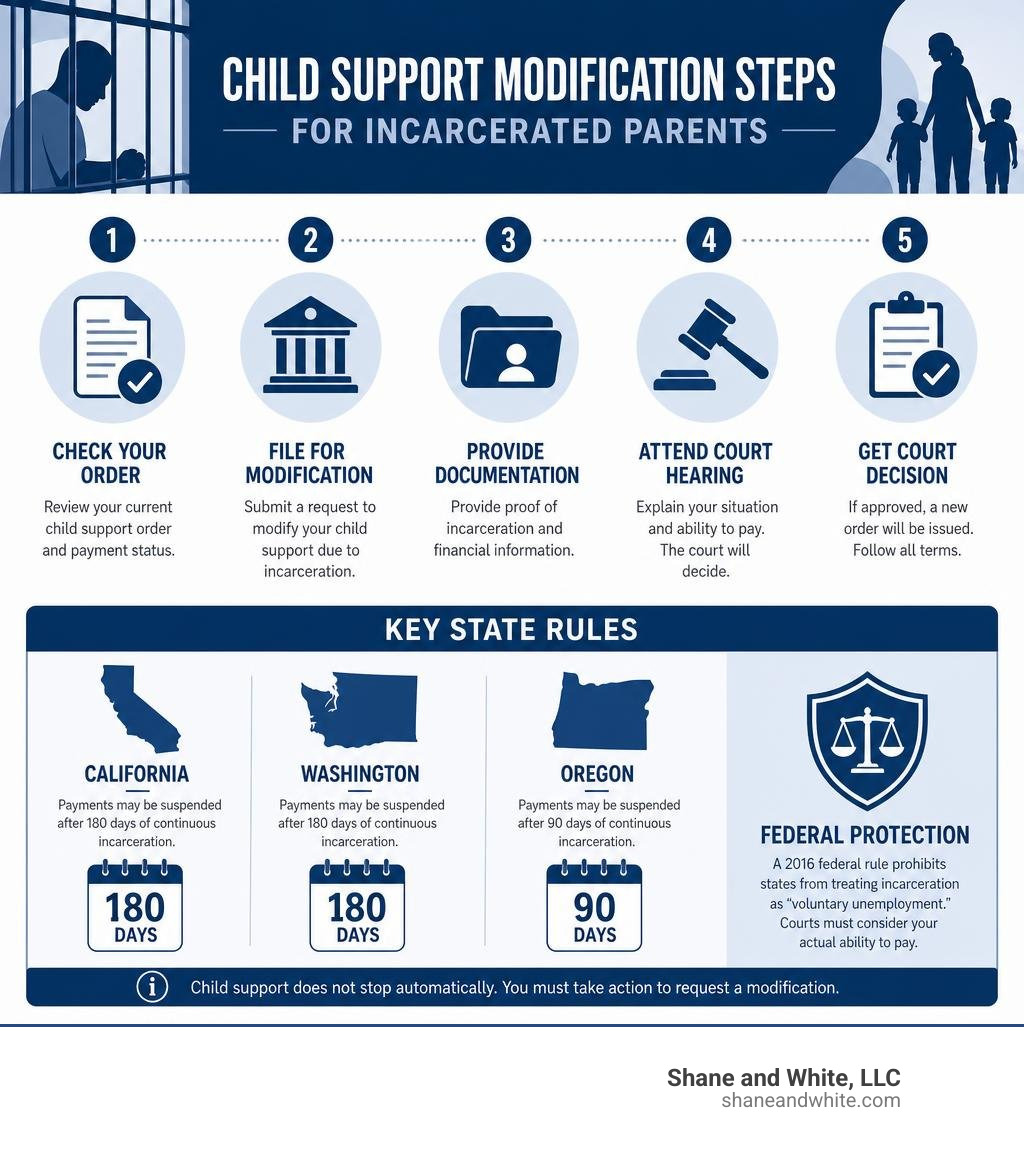
- Some states offer relief — California, Washington, and Oregon have specific laws that can suspend or reduce payments after a set period of incarceration (90 to 180 days, depending on the state)
- Federal rules protect you — a 2016 federal rule prohibits states from treating incarceration as “voluntary unemployment,” which means courts must consider your actual ability to pay
As of 2018, roughly 440,000 parents in U.S. prisons and jails had an active child support obligation. Many of them watched their debt grow every month simply because they did not know they could ask for a modification.
The stakes are real. Interest on unpaid support can reach 6% annually in some states. By the time a parent is released, the debt can be overwhelming — and it does not disappear on its own.
This guide breaks down exactly how the system works, what rights you have, and what steps to take — whether you are the incarcerated parent, a family member helping from the outside, or the custodial parent waiting on payments.
I’m Kenneth White, Esq., a New Jersey Supreme Court Certified Matrimonial Law Attorney with decades of experience handling complex family law matters, including child support for incarcerated parents and post-incarceration modifications. As a member of the Assignment Judge’s Family Lawyers Committee and a longtime Early Settlement Panelist in Middlesex County, I have seen how quickly unpaid support can spiral into unmanageable debt when families do not get the right guidance early.
Does Child Support Automatically Stop When a Parent Is Incarcerated?
One of the most persistent and dangerous myths in family law is that entering a jail or prison cell automatically hits the “pause” button on your financial obligations. It does not.
Unless a court order specifically states otherwise, your child support obligation remains an active, legally binding debt. Every month you are confined, the bill comes due. When payments are missed, they turn into arrears (past-due child support), which accumulate rapidly.
Historically, many courts across the country treated incarceration as “voluntary unemployment.” The logic—as flawed as it was—argued that because the parent committed a crime, they chose to go to prison, and therefore chose to lose their income. Under this outdated framework, courts routinely denied requests to lower child support payments, leaving inmates to accumulate tens of thousands of dollars in unpayable debt.
Today, the legal landscape has shifted, but the core rule remains: the obligation does not stop on its own. If you do not take proactive steps to modify your order, the state will continue to bill you as if you were still earning your pre-prison wages.
If you are a custodial parent wondering what steps to take if payments have abruptly stopped due to an arrest, you can learn more about your options in our guide on What to Do If Your Ex Stops Paying Child Support.

Legal Rights of a Child Support Incarcerated Parent
For decades, the lack of uniformity across states created a chaotic system where an incarcerated parent in one state could get their payments lowered, while a parent in a neighboring state accrued lifetime debt.
Two major legal milestones changed this:
- Turner v. Rogers (2011): The U.S. Supreme Court ruled that the Due Process Clause of the Fourteenth Amendment protects parents facing civil contempt charges for non-payment of child support. Specifically, the court must determine a parent’s actual “ability to pay” before incarcerating them for contempt.
- The 2016 Federal Final Rule (Flexibility, Efficiency, and Modernization in Child Support Enforcement Programs): This landmark federal rule prohibited states from legally defining incarceration as “voluntary unemployment.” The rule recognized that saddling individuals with insurmountable debt while they have zero earning capacity makes successful re-entry nearly impossible and ultimately harms children by preventing future compliance.
In New Jersey, these federal rules are closely integrated into the NJ Child Support Guidelines. If you are navigating these issues during a broader family transition, understanding how support is calculated is essential; see our breakdown of Child Support in a Divorce for more context.
Exceptions Where Obligations Continue Unchanged
While federal and state laws have made it easier to modify child support during incarceration, there are critical exceptions where your obligation will not be reduced:
- Independent Assets: If you have investment accounts, real estate, trust funds, or other significant assets, the court expects you to use those resources to pay child support, regardless of your lack of active wage income.
- Incarceration for Non-Payment: If you are in jail specifically because of civil contempt for failing to pay child support, your obligation will not be reduced or suspended.
- Domestic Violence: In some jurisdictions, if your incarceration is a direct result of domestic violence perpetrated against the custodial parent or the children, the courts may deny equitable relief or modifications.
Additionally, other financial variables may still be factored into your household’s overall legal structure. For instance, you might wonder, Does Alimony Affect Child Support? The answer is yes, and these overlapping obligations require careful legal analysis.
Managing Obligations as a Child Support Incarcerated Parent
If you or a loved one is facing incarceration, the most important step is immediate communication with the local child support agency. You must notify them of the confinement, the facility location, and the expected length of the sentence.
Most state agencies provide specific tools for this, such as an Inquiry Form for Incarcerated Parents or an Incarcerated Non-Custodial Parent Affidavit of Income/Assets. Filing these documents alerts the agency to your change in circumstances and initiates the review process.
Step-by-Step Modification for a Child Support Incarcerated Parent
To successfully modify your child support order from prison, you must follow a precise legal process:
- Identify the Enforcing Agency: Determine if your case is managed by a local county agency (like the probation department in New Jersey) or if it is a direct court-ordered arrangement.
- Request a Review: Submit a written request or formal motion for a modification. You must provide proof of your incarceration (such as your inmate ID number and sentencing documents) and proof of your lack of income.
- File Quickly to Avoid Retroactive Limits: Under federal law (the Bradley Amendment), courts cannot retroactively reduce child support debt that has already accrued. Your modification can only date back to the day you formally filed your motion. Waiting to file until after you are released means you will be legally responsible for every dollar of debt accrued during your prison sentence.
For step-by-step forms and court resources, you can consult the NJ Courts Self-Help portal. If you are a father seeking to protect your parental rights and financial stability during this process, read about How a Child Support Lawyer Supports Fathers Rights.
Overcoming Barriers to Modification from Prison
Filing court papers from behind bars is incredibly difficult. Incarcerated parents routinely face structural barriers:
- Mail Delays: Institutional mail can take weeks to process, causing parents to miss strict court response deadlines.
- Lack of Legal Counsel: Most inmates do not have access to a private attorney and must rely on limited prison law libraries.
- Notary Access: Many court documents must be notarized, but finding a notary public inside a correctional facility can be a slow, frustrating process.
To overcome these hurdles, you can authorize a family member or trusted friend to act as your liaison. By signing an Authorization for Release of Information, your liaison can speak directly with the child support agency, collect paperwork, and help track your case.
If you are facing complex family dynamics, you might also wonder, Can a Child Support Lawyer Help with Custody Issues? While child support and custody are legally distinct, a skilled attorney can help you navigate both systems simultaneously.
State-by-State Rules: How Different Jurisdictions Handle Inmate Obligations
Because child support is governed primarily by state law, where your order was issued matters immensely. Some states have progressive “automatic” suspension rules, while others require a manual petition.
| State | Threshold for Action | Relief Provided | Reinstatement Timeline |
|---|---|---|---|
| New Jersey | Case-by-case review | Modification based on actual income | Immediate review post-release |
| California | 90 consecutive days | Automatic suspension of support | 1st day of the 10th month post-release |
| Washington | 6-month sentence | Abatement to $10/month per order | Graduated scale starting month 4 |
| Oregon | 180 consecutive days | Rebuttable presumption of inability to pay | 120 days post-release (at 50%) |
| Texas | 90 consecutive days | Substantial change for modification | Immediate review post-release |
Automatic Suspension and Abatement Laws
Some states have recognized that requiring incarcerated parents to file complex court papers is highly inefficient.
In California, under California Code, FAM 4007.5, child support obligations are suspended by operation of law if a parent is confined for more than 90 consecutive days against their will. For more details on this process, you can view the Guide to child support for incarcerated parents \| California Courts \| Self Help Guide.
Similarly, Washington State implemented an abatement law allowing eligible incarcerated parents sentenced to at least six months to have their support temporarily reduced to $10 per month. You can review the details of this program in the Washington DSHS Guide.
Rebuttable Presumptions and Agency Reviews
Other states use a “rebuttable presumption” framework.
In Oregon, under Oregon ORS 25.247, a parent incarcerated for 180 or more consecutive days is legally presumed unable to pay child support. No arrears accrue during this time unless the custodial parent rebuts the presumption by proving the inmate has independent assets.
Wisconsin child support agencies are required to initiate a review within 15 business days of learning a parent will be incarcerated for more than 180 days, as outlined in the Wisconsin DCF Bulletin.
In Texas, a 2015 law established that incarceration for over 90 days constitutes a “substantial change in circumstances,” allowing the court to modify the order based on actual earnings rather than projected earning capacity. The Texas OAG Guide provides comprehensive details on how these rules are applied.
Re-Entry and Restarting Child Support After Release
Re-entering society after incarceration is a major transition. The last thing a returning citizen needs is to be immediately arrested or lose their driver’s license due to child support debt.
Upon release, your child support obligation will resume. If your payments were suspended or abated, you must understand exactly when and how much you will be expected to pay.
Reinstatement Timelines and Graduated Payments
States handle the restart of child support differently to give parents time to find employment:
- California: Support automatically restarts at the original court-ordered amount on the first day of the 10th month after your release.
- Oregon: Support reinstates automatically at 50% of the prior amount on the first day of the month following the 120th day after release.
- Washington: Washington uses a graduated scale. Payments resume at 50% of the original amount (minimum $50 per child) starting in the fourth month post-release, returning to the full amount after one year.
In New Jersey, there is no automatic delay. It is crucial to contact your child support caseworker immediately upon release to negotiate a manageable payment plan and prevent immediate enforcement actions like driver’s license suspension. For local guidance on New Jersey prisoners, refer to the LSNJ Law Guide.
Managing Accumulated Arrears and Debt Forgiveness
If you accrued significant debt while incarcerated, you may have options to manage or reduce it:
- State-Owed vs. Custodial-Owed Debt: If the custodial parent received public assistance (welfare) while you were incarcerated, your child support debt may be owed directly to the state. States have the authority to compromise or forgive state-owed debt. However, if the debt is owed directly to the custodial parent, the state cannot forgive it without that parent’s explicit consent.
- Successful State Programs: Michigan’s Arrears REDUCED program discharged an average of $11,517 in state-owed arrears for nearly 5,000 participating parents. In Texas, the Noncustodial Parent Choices program helped returning citizens find stable employment, resulting in a 51% increase in consistent child support collections.
- Payment Plans: Working with your caseworker to establish a consistent, even if small, monthly payment plan is the best way to prevent wage garnishments and keep your driver’s license active.
Frequently Asked Questions About Child Support and Incarceration
Does child support automatically stop when you go to jail?
In New Jersey, no. You must file a motion to modify your child support order based on a change of circumstances. Some states, like California, do automatically suspend support after 90 days of confinement, but in New Jersey, you must take active legal steps to protect yourself.
Can family members handle child support issues for an incarcerated parent?
Yes, but only if the incarcerated parent signs an official Authorization for Release of Information form. This allows a family member to act as a liaison, obtain case details, and help file necessary paperwork.
What happens to unpaid child support while in prison?
It accumulates as arrears (past-due debt). In addition, interest may accrue on the unpaid balance (up to 6% annually in some states). This debt cannot be discharged through bankruptcy and will remain active until paid or otherwise resolved through an official state program.
Conclusion
Navigating child support for an incarcerated parent requires quick action and a clear understanding of the law. Allowing child support arrears to accumulate unchecked during a prison sentence can create an insurmountable financial barrier to successful re-entry.
At Shane and White, LLC, we bring over 40 years of family law experience to clients throughout Middlesex County, Mercer County, and the surrounding New Jersey areas. We provide personalized attention, clear communication, and strategic advocacy to help families protect their rights and plan for a stable future.
If you or a family member needs assistance modifying a child support order due to incarceration or preparing for re-entry, contact us today to schedule a consultation with our experienced legal team at Shane and White Child Support Services.


