


When Family Comes First: Finding a Child Custody Lawyer in East Windsor, NJ
If you’re looking for a child custody lawyer in East Windsor, NJ, here’s what you need to know right away:
- Where to file: Child custody cases in East Windsor are handled in Mercer County Family Court
- Most common outcome: New Jersey courts award joint legal custody in roughly 85% of contested cases
- Faster resolution: About 65% of custody cases settle through mediation or negotiation — no trial needed
- What courts decide on: All custody decisions are based on the best interests of the child
- Who can help: A local family law attorney guides you through filings, parenting plans, mediation, and court hearings
Custody decisions are some of the hardest moments a parent can face. Where will your child live? Who makes decisions about their school, their doctor, their future? The answers affect your family for years to come.
East Windsor sits in Mercer County, where family court filings involving custody and parenting time have grown by 12% between 2021 and 2023. That means more families are navigating this process — and more parents need clear, reliable legal guidance.
The good news? Most custody disputes don’t end up in a courtroom battle. With the right attorney, many families reach agreements that work for everyone — especially the children.
I’m Kenneth White, Esq., a New Jersey Supreme Court Certified Matrimonial Law Attorney with decades of experience helping East Windsor families resolve child custody matters — a credential held by fewer than 3% of active attorneys in the state. As a member of the Assignment Judge’s Family Lawyers Committee and a longtime Early Settlement Panelist in Middlesex County, I bring the kind of insider knowledge of how local family courts operate that directly benefits clients searching for a child custody lawyer in East Windsor, NJ.
Understanding Child Custody Laws in New Jersey

When you begin navigating the legal landscape of divorce or separation, the terminology can quickly feel overwhelming. In New Jersey, “custody” is not a single, all-or-nothing concept. Instead, the law divides custody into two distinct categories: legal custody and physical custody. Understanding the differences between these two concepts is the first step toward crafting an arrangement that protects your children and your parental rights.
Legal Custody: Decision-Making Authority
Legal custody refers to the legal right and responsibility to make major, life-altering decisions for your child. These decisions typically revolve around three main areas:
- Education: Choosing schools, tutoring, or addressing special educational needs.
- Healthcare: Selecting doctors, deciding on major medical treatments, surgeries, and mental health care.
- Religious Upbringing: Determining the child’s religious training and practices.
In New Jersey, there is a strong legal presumption that children benefit when both parents remain active decision-makers. Because of this, New Jersey courts awarded joint legal custody in approximately 85% of contested child custody cases between 2018 and 2022. Under a joint legal custody arrangement, both parents must consult with one another and agree before making major decisions. Sole legal custody, where only one parent has the authority to make these decisions without consulting the other, is incredibly rare and typically only ordered when one parent is deemed unfit or completely unavailable.
Physical Custody: Residential Arrangements
Physical custody (sometimes called residential custody) addresses where the child actually lives on a day-to-day basis.
- Joint Physical Custody: The child spends substantial, though not necessarily equal, time living with both parents. This requires a high degree of cooperation and geographical proximity between the parents’ homes.
- Sole Physical Custody: The child resides primarily with one parent (the Parent of Primary Residence, or PPR), while the other parent (the Parent of Alternate Residence, or PAR) enjoys regular parenting time (visitation).
| Custody Type | Joint Arrangement | Sole Arrangement |
|---|---|---|
| Legal Custody (Decision-Making) | Both parents must consult and agree on education, healthcare, and religion. | One parent makes all major decisions without needing the other’s consent. |
| Physical Custody (Residential) | Child splits time between households (not always a perfect 50/50 split). | Child lives primarily with one parent; the other has scheduled parenting time. |
Understanding these distinctions allows parents to approach negotiations with clarity. For more background on why establishing these boundaries early matters, read about Why Your Child Custody Plans Need Early Legal Guidance.
The Best Interests of the Child Standard
If parents cannot agree on a custody arrangement, a New Jersey family court judge will step in to decide. When doing so, the court is legally bound by a single guiding light: the best interests of the child. Under New Jersey statute N.J.S.A. 9:2-4, judges do not favor mothers over fathers, nor do they default to a rigid 50/50 split. Instead, they evaluate a wide range of factors to determine what environment will best support the child’s safety, happiness, physical and mental development, and emotional well-being.
The factors evaluated by courts in East Windsor and across Mercer County include:
- The parents’ ability to agree, communicate, and cooperate in matters relating to the child.
- The parents’ willingness to accept custody and any history of unwillingness to allow parenting time (unless safety concerns exist).
- The interaction and relationship of the child with their parents and siblings.
- The history of domestic violence, if any, and the safety of the child and safety of either parent from physical abuse by the other.
- The preference of the child, when the child is of sufficient age and capacity to reason so as to form an intelligent decision.
- The stability of the home environment offered by each parent.
- The quality and continuity of the child’s education.
- The fitness of the parents (including any history of substance abuse or severe mental health challenges).
- The geographical proximity of the parents’ homes.
- The extent and quality of the time spent with the child prior to or subsequent to the separation.
- The parents’ employment responsibilities and the age and number of the children.
Because these factors are subjective, having an experienced child custody lawyer in East Windsor, NJ is crucial. We help you gather the necessary evidence—such as school records, communication logs, and witness testimonies—to present a compelling case that aligns your goals with your child’s best interests.
Creating and Enforcing Parenting Plans in Mercer County

A parenting plan is the practical roadmap for your family’s future. It is a detailed, written document that outlines how you and your co-parent will share the responsibilities of raising your children. In Mercer County family courts, judges highly encourage parents to submit a mutually agreed-upon parenting plan. A well-crafted plan reduces ambiguity, prevents future arguments, and provides the structure and consistency children need to thrive.
A comprehensive parenting plan should address:
- The Weekly Schedule: Specifying which days and overnights the child spends with each parent.
- Holidays and Vacations: A rotating schedule for major holidays (Thanksgiving, Christmas, Hanukkah, Easter, etc.), school breaks, birthdays, and summer vacations.
- Transitions and Transportation: Detailing where exchanges will take place and who is responsible for driving.
- Extracurricular Activities: How activities are chosen, paid for, and who attends them.
- Communication Protocols: How parents will communicate with each other (e.g., via co-parenting apps like OurFamilyWizard) and how the child will communicate with the non-residential parent.
- Dispute Resolution: A step-by-step process for handling future disagreements before running back to court.
To understand how structured planning can keep your family out of the courtroom, see our article on how to Can a Family Lawyer Help You Avoid a Custody Battle.
Negotiated Agreements vs. Court-Ordered Custody
There are two primary paths to establishing a custody arrangement in New Jersey: a negotiated settlement or a court-ordered judgment.
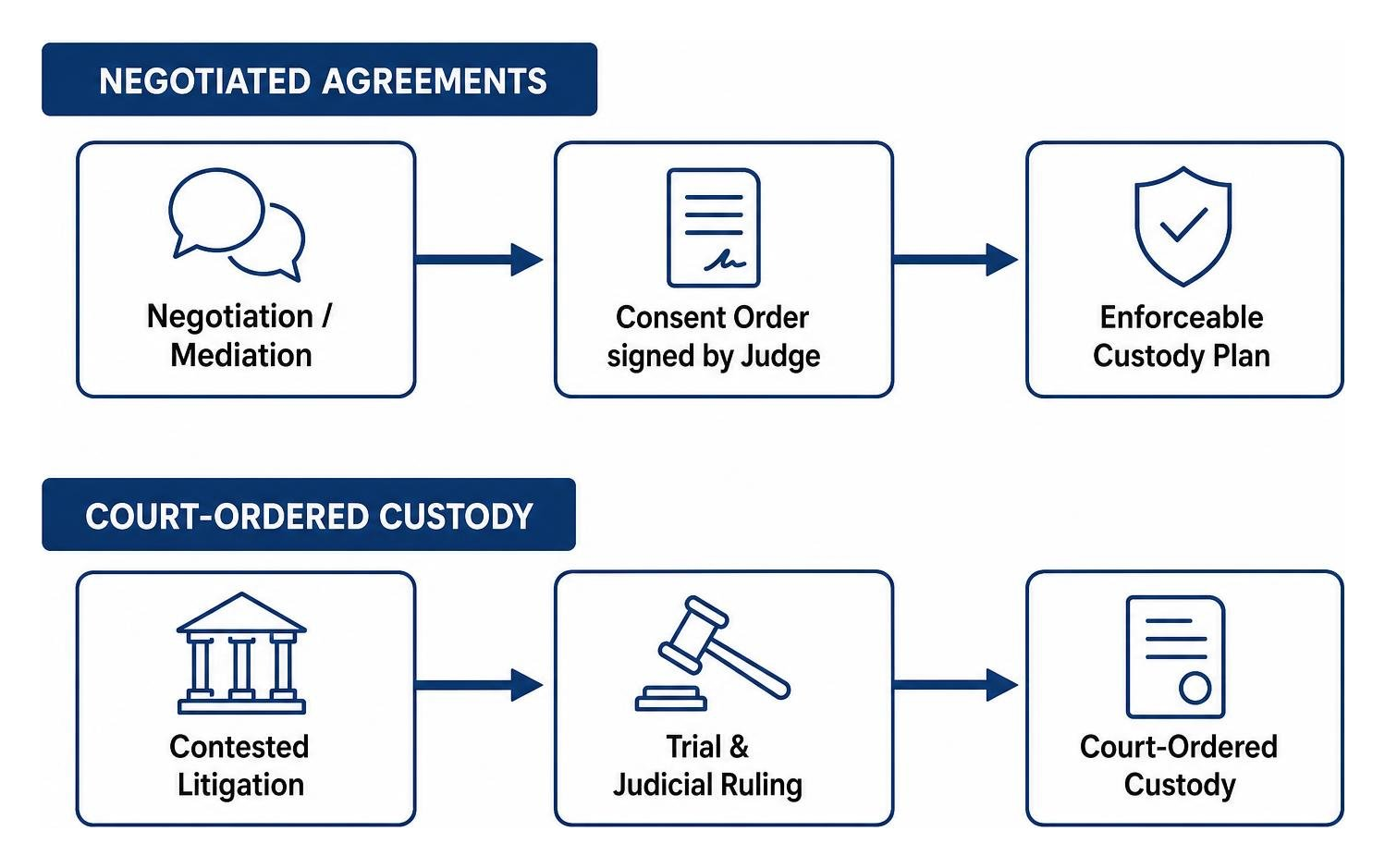
- Negotiated Agreements: This is almost always the preferred route. Approximately 65% of New Jersey child custody cases are resolved through settlement or mediation rather than a trial. Parents work together—often with the help of their attorneys or a professional mediator—to negotiate terms. Once an agreement is reached, it is drafted into a formal Consent Order and submitted to a judge. Because both parents had a hand in creating the plan, compliance rates are significantly higher, and the emotional toll on the children is minimized.
- Court-Ordered Custody: If negotiations break down completely, your case will proceed to a trial. A judge will hear arguments, review evidence, listen to witness testimonies, and issue a binding custody order. This process is financially costly, emotionally draining, and strips control away from the parents, placing life-altering decisions in the hands of a third party who does not know your child personally.
Supervised Visitation and Sole Custody Protections
While New Jersey courts operate under the assumption that children deserve relationships with both parents, safety always comes first. If a parent poses a risk to the child’s physical safety or emotional well-being, the court will step in with restrictive measures.
Supervised visitation may be ordered in East Windsor family courts under circumstances involving:
- Active substance abuse or severe, untreated mental health conditions.
- A history of domestic violence, physical abuse, or emotional abuse toward the child or the other parent.
- Severe neglect or abandonment.
- A high risk of parental abduction.
Under a supervised visitation order, the parent is only permitted to spend time with the child in the presence of a court-approved supervisor, such as a professional agency, a social worker, or a trusted family member. In extreme cases, the court may award sole physical and legal custody to one parent and temporarily suspend the other’s parenting time entirely until they complete court-mandated rehabilitation, anger management, or parenting classes. Learn more about how we handle these delicate situations on our Child Custody & Visitation practice page.
Modifying Custody Orders and the Role of Child Support
As children grow, their needs change. A parenting plan that worked perfectly for a toddler may become completely impractical once that child enters high school, joins sports teams, or when a parent’s work schedule changes. Fortunately, child custody orders in New Jersey are not set in stone.
To legally modify an existing custody or parenting time order, the parent seeking the change must file a motion with the court. However, the court will not grant a modification simply because a parent wants one. The moving party must meet a strict legal standard known as a “substantial, permanent, and unanticipated change in circumstances” that directly impacts the child’s welfare.
Common examples of a valid change in circumstances include:
- Relocation: One parent needs to move out of state or a significant distance away for a new job or family support, which would disrupt the current parenting time schedule.
- Parental Unfitness: The development of drug or alcohol dependency, or neglectful behavior by one parent.
- The Child’s Changing Needs: As children mature, their academic, social, or medical requirements may require a shift in residency.
- Work Schedule Changes: A permanent shift in a parent’s working hours that makes the current exchange schedule impossible.
Once a change in circumstances is proven, the court will re-evaluate the custody arrangement using the “best interests of the child” standard to determine if a modification is warranted.
The Role of Child Support in Custody Cases
In New Jersey, child support and child custody are legally intertwined, yet distinct. Child support is calculated using the New Jersey Child Support Guidelines, a complex mathematical formula designed to ensure children receive the same proportion of parental income as they would if their parents lived together.
A critical variable in this formula is the number of overnight visits the child spends with each parent.
- If a parent has the child for more than 104 overnights per year (approximately two nights per week), the guidelines transition from a “Sole Parenting” worksheet to a “Shared Parenting” worksheet.
- This shift recognizes that the parent with more overnights is directly paying for housing, food, and daily expenses, which typically reduces their child support obligation or increases the support they receive.
It is important to remember that child support and parenting time are independent legal rights. A parent cannot refuse to pay child support because they are being denied parenting time, nor can a parent block visitation because the other parent is behind on child support. Both issues must be addressed through appropriate legal channels with the help of an experienced family law attorney who understands how local courts handle these overlapping matters.
Why You Need a Child Custody Lawyer in East Windsor, NJ for Modifications
Attempting to modify a custody order or child support obligation without legal representation can lead to costly mistakes. The legal threshold for proving a change in circumstances is high, and family court judges expect motions to be backed by clear, organized evidence rather than emotional accusations.
A local child custody lawyer in East Windsor, NJ will ensure your motion is drafted correctly, filed in the correct venue (Mercer County), and supported by the necessary documentation—such as pay stubs, tax returns, school calendars, or medical records. Our team helps you navigate post-judgment motions efficiently, saving you time and protecting your children from prolonged legal disputes. To understand how we step in to resolve these conflicts, read about The Role of a Family Lawyer in Resolving Custody Disputes.
Partnering with a Child Custody Lawyer in East Windsor, NJ
The legal process surrounding child custody can feel intimidating, especially when navigating the Mercer County family court system. In 2022, family courts across New Jersey handled over 48,000 custody-related motions, with Mercer County accounting for roughly 1,850 of those filings. Knowing what to expect can help ease your anxiety and allow you to focus on what matters most: your children.
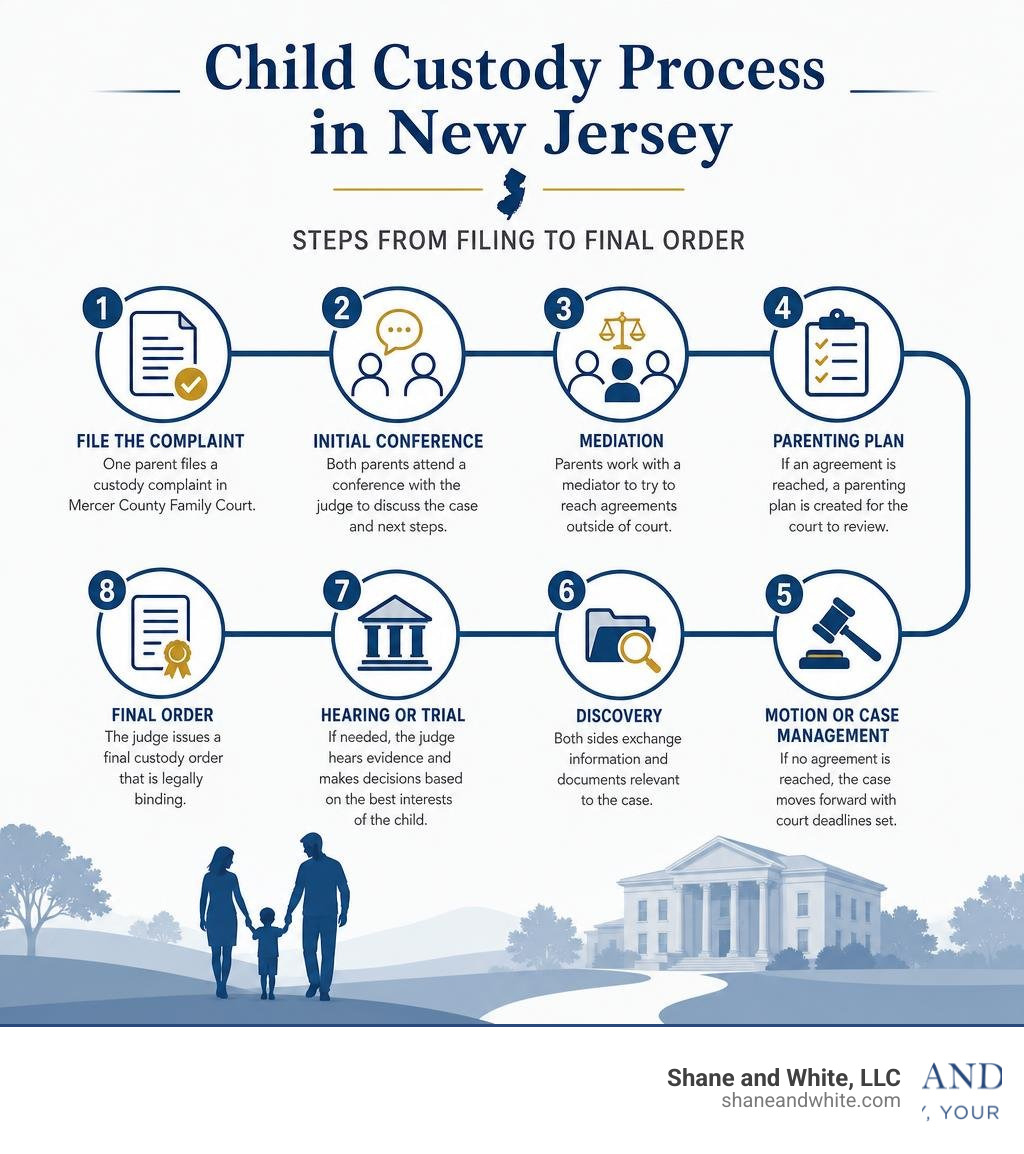
When you file for custody or divorce in Mercer County, your case will generally follow a structured path:
- Filing the Complaint or Motion: The legal process officially begins when your attorney files a complaint (in a new case) or a motion (in an existing case) outlining your custody requests.
- Child Custody Mediation: If custody is contested, New Jersey courts will refer you and your co-parent to court-ordered mediation. A neutral, court-appointed facilitator will work with both of you to help resolve your differences and draft a parenting plan. This is a private, confidential process.
- Custody Evaluations: If mediation fails, the court may order a professional custody evaluation. A licensed psychologist or social worker will interview both parents, observe them with the children, conduct home visits, and review school and medical records. They will then submit a comprehensive report with custody recommendations to the judge.
- Plenary Hearing (Trial): If a settlement still cannot be reached, your case will proceed to a trial, where a judge will make the final determination.
For a deeper dive into choosing the right legal advocate for this journey, explore our guide on Navigating Tough Times: Your Guide to East Windsor Family Court Attorneys.
How a Child Custody Lawyer in East Windsor, NJ Protects Your Parental Rights
Your relationship with your child is too precious to leave to chance. While the court aims to protect the child’s best interests, judges only know what is presented to them. Without a skilled advocate, your voice, your concerns, and your perspective can easily get lost in a crowded court docket.
An experienced child custody attorney protects you by:
- Developing a Tailored Legal Strategy: Every family is unique. We listen to your goals and build a strategy designed to achieve them, whether that means securing joint physical custody or protecting your child through supervised visitation.
- Gathering Compelling Evidence: We know what Mercer County judges look for. We help you compile communication logs, school reports, medical records, and expert testimonies that clearly demonstrate your fitness and dedication as a parent.
- Providing Objective, Calm Guidance: Custody disputes are highly emotional. We serve as your buffer, helping you make rational, long-term decisions rather than reacting to short-term frustrations.
- Skillful Courtroom Representation: If your case must go to trial, we will aggressively advocate for your rights, cross-examine witnesses, and present your case clearly and persuasively before the judge.
To learn more about finding the right fit for your legal team, read our guide on How to Choose Your Family Law Attorney.
Frequently Asked Questions About East Windsor Child Custody
Can grandparents seek visitation rights in New Jersey?
Yes. Under New Jersey statute N.J.S.A. 9:2-7.1, grandparents (and siblings) can petition the court for visitation rights. However, the legal burden of proof is high. The grandparent must prove by a preponderance of the evidence that denying them visitation would cause actual harm to the child’s physical or emotional well-being. The court will evaluate factors such as the historical relationship between the grandparent and the child, the parents’ wishes, and any history of abuse.
How do Mercer County courts handle child custody mediation?
In Mercer County, when parents cannot agree on a custody arrangement, the court automatically schedules them for mandatory, free mediation. A neutral court mediator works with both parents in a confidential setting to find common ground. The mediator does not have the authority to force an agreement or make a ruling; their job is simply to facilitate communication. If you reach an agreement, the mediator drafts a “Memorandum of Understanding” which is reviewed by your attorneys and turned into an enforceable court order. If mediation fails, the case moves back to the litigation track.
What happens if a parent violates a custody order in East Windsor?
If a parent repeatedly violates a court-ordered parenting schedule—such as refusing to return the child on time, canceling visits without notice, or making unilateral decisions—you can file an enforcement motion (a Motion to Enforce Litigant’s Rights). Mercer County courts take custody order violations very seriously. If the court finds a parent in violation, the judge can issue various sanctions, including:
- Awarding makeup parenting time to the non-violating parent.
- Modifying the custody order to reduce the violating parent’s time.
- Ordering the violating parent to pay the other’s attorney fees.
- Ordering family counseling or parenting classes.
- Imposing financial fines or community service.
If you are dealing with a co-parent who refuses to follow court orders, or if your child is facing legal issues of their own, consulting an experienced family law attorney can help clarify your options and protect your family’s rights.
Conclusion
At Shane and White, LLC, we understand that nothing is more important to you than the safety, happiness, and future of your children. For over 40 years, our family law firm has served clients in Middlesex County, Mercer County, and throughout New Jersey, providing the compassionate, personalized attention and clear communication that families need during life’s most challenging transitions.
As noted in national legal press releases, Shane and White, LLC is well-known as a Child Custody Lawyer based in Metuchen and surrounding communities, bringing a reputation for dedicated advocacy and balanced conflict resolution to every case we handle. We work tirelessly to help you craft parenting plans that put your kids first, protect your parental rights, and give your family a stable foundation for the future.
Don’t navigate this emotional and complex process alone. Schedule a consultation with our New Jersey divorce lawyers today, and let us help you find a path forward.


