


Who Pays Attorney Fees in Divorce — and What It Means for You
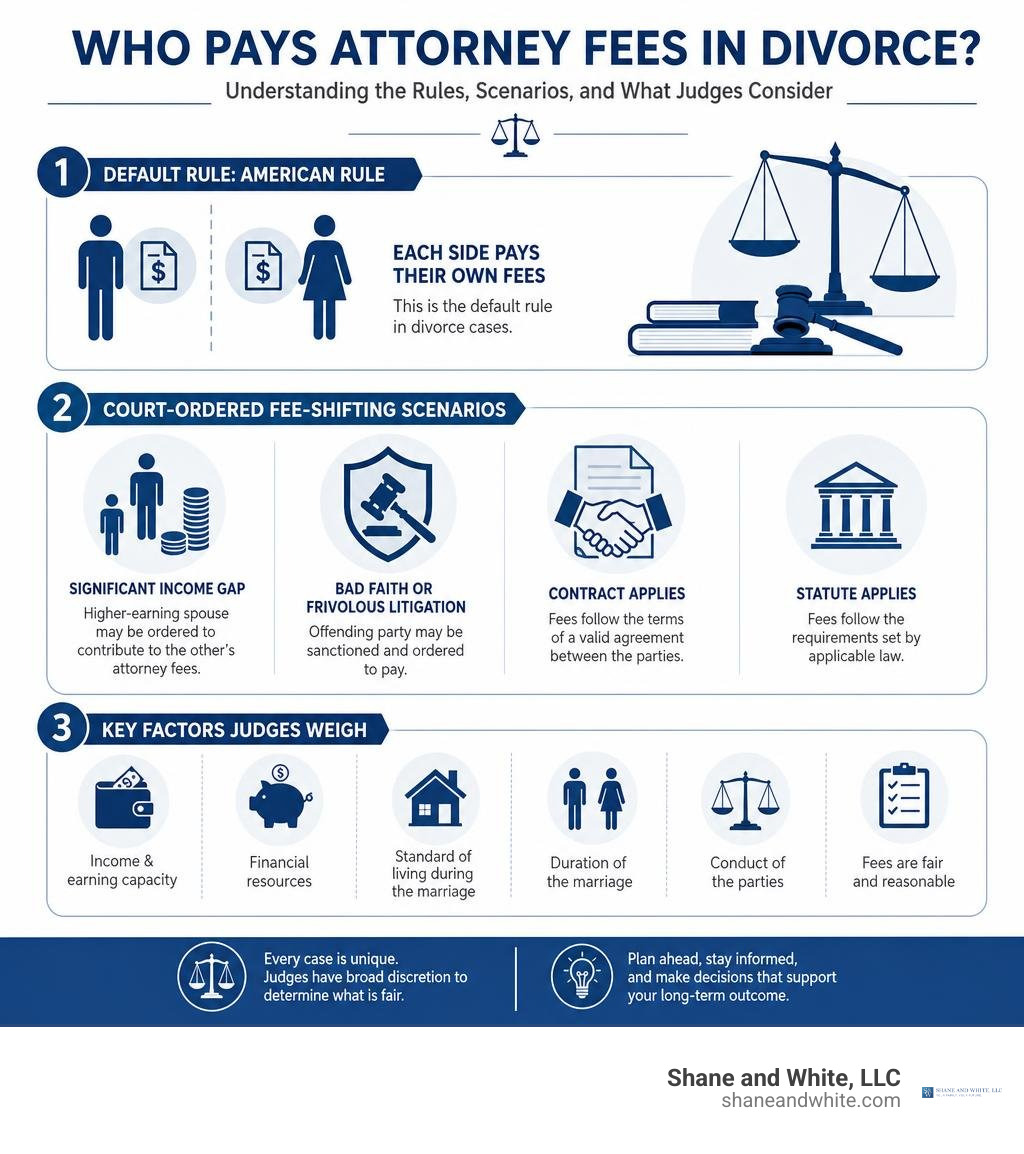
Who pays attorney fees in a divorce is one of the first questions people ask — and the answer is rarely simple. Here is a quick overview before we dive deeper:
The short answer:
| Situation | Who Pays |
|---|---|
| Default rule (American Rule) | Each side pays their own attorney fees |
| Court orders fee-shifting | One spouse pays part or all of the other’s fees |
| Significant income gap between spouses | Higher-earning spouse may be ordered to contribute |
| Bad faith or frivolous litigation | Offending party may be sanctioned and ordered to pay |
| Contract or statute applies | Fees follow the terms of the agreement or law |
Divorce is already one of the most stressful experiences a person can go through. Then the legal bills start arriving — and suddenly the financial pressure can feel just as overwhelming as the emotional strain. Many people assume the “losing” spouse automatically picks up the tab. That is a common misconception, and acting on it without understanding the real rules can be costly.
The truth is that who pays depends on a mix of factors: your income compared to your spouse’s, how both sides behave during the case, and whether the court decides fee-shifting is fair. Knowing this upfront helps you plan — and avoid surprises.
I am Kenneth White, Esq., a Certified Matrimonial Law Attorney certified by the Supreme Court of New Jersey, with decades of experience navigating the precise question of who pays attorney fees in divorce and family law matters across New Jersey courts. In the sections below, I will walk you through everything you need to know — from the basic legal rules to what judges actually look at when deciding who foots the bill.
Key terms for who pays attorney fees:
The American Rule Baseline: Who Pays Attorney Fees in Civil Litigation?
To understand how family courts handle legal fees, we first have to look at the broad framework governing all civil litigation in the United States. In American courtrooms, the foundational legal default is known as the American Rule.
Under the traditional American Rule, each party in a civil lawsuit is responsible for paying their own attorney fees and legal costs, regardless of who wins or loses the case. Established in late 18th-century jurisprudence, this legal principle was created to prevent wealthy litigants from using the threat of massive fee-shifting awards to intimidate opponents and block less affluent citizens from accessing justice.
Because legal fees represent the single largest expense in civil litigation, understanding this default baseline is essential. Whether you are negotiating a settlement in Middlesex County or proceeding through formal discovery, the starting assumption is always that you pay your own lawyer—unless a specific exception shifts that burden.
How U.S. Practice Compares to International “Loser Pays” Rules
The United States stands out globally in its approach to legal costs. Most international civil law jurisdictions operate under the “English Rule” or a variation of a “loser pays” system:
- The English Rule: Followed in the United Kingdom and many common law nations, the losing party must reimburse the prevailing party’s reasonable legal fees.
- Germany’s Statutory Tariffs: German courts mandate that the losing party cover court proceedings and a portion of opposing attorney fees, strictly calculated according to pre-set statutory schedules tied to the monetary value of the claim.
- Brazil’s Percentage Caps: In Brazilian civil litigation, the losing party is legally required to pay a portion of the prevailing party’s legal counsel fees, typically set between 10% and 20% of the total claim value.
Proponents of international “loser pays” rules argue that they deter frivolous suits. However, U.S. lawmakers have largely maintained the American Rule baseline so that everyday individuals are not afraid to enforce their legal rights out of fear of facing a devastating fee order if they lose. For more details on the evolution of this principle, you can read about the American Rule Explained.
Three Main Exceptions to the General Legal Fee Rule
While the American Rule is the default baseline, it is far from absolute. Courts can move away from this standard through three main exceptions:
- Statutory Provisions: Lawmakers frequently write specific “fee-shifting” provisions into legislation. Today, over 200 federal laws and dozens of New Jersey state statutes allow prevailing parties to recover legal fees to encourage public interest litigation, consumer protection, or civil rights enforcement.
- Contractual Fee Clauses: Private contracts—such as prenuptial agreements, property settlement agreements, commercial contracts, or leases—often contain explicit terms stating that if a dispute arises, the losing side must pay the winning side’s reasonable attorney fees.
- Court Sanctions for Misconduct: Judges possess inherent judicial authority (and statutory tools like Federal Rule of Civil Procedure 11 or state equivalents) to penalize parties who act in bad faith, file frivolous motions, or deliberately obstruct proceedings.
To explore how these civil exceptions operate across broader litigation, review this guide on Attorney Fees: Does the Losing Side Have to Pay?
How Divorce Courts Determine Who Pays Attorney Fees
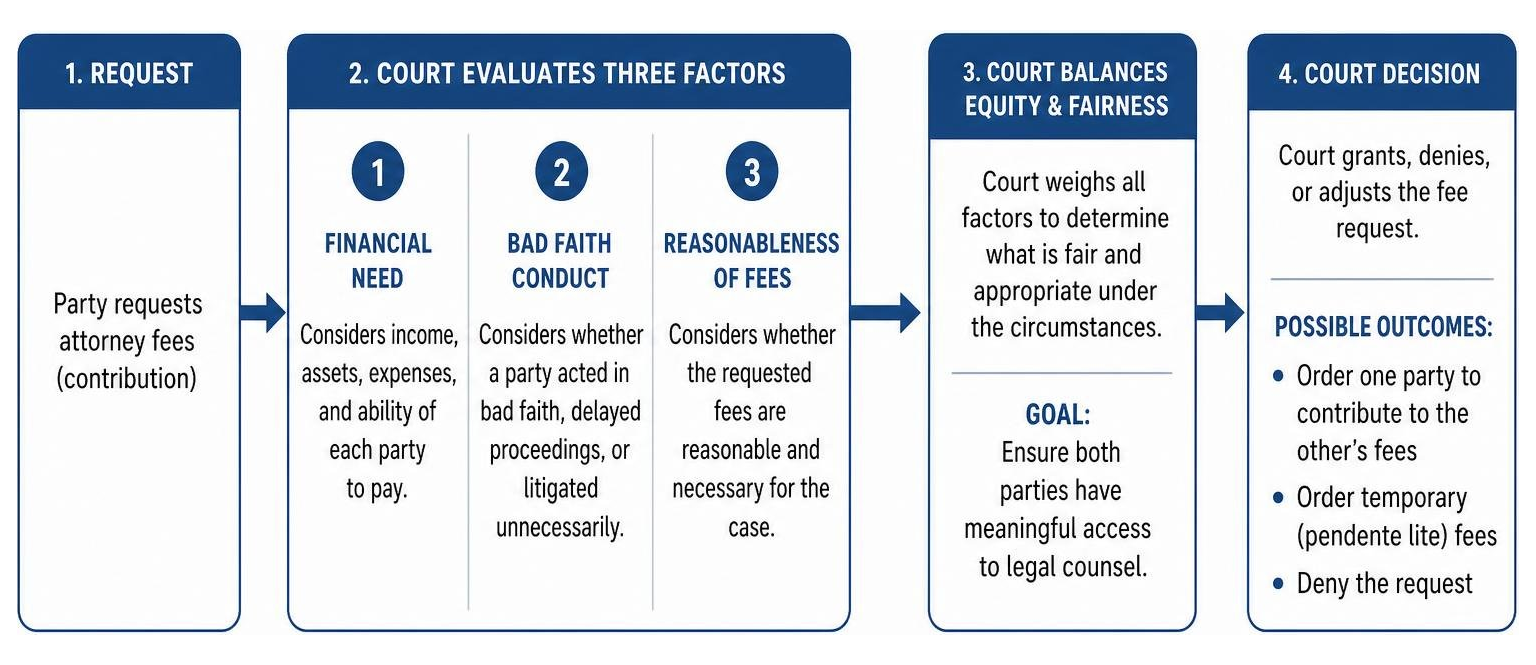
While civil commercial disputes strictly enforce the American Rule default, family law operates differently. Divorce courts are courts of equity. Equity means fairness, and fairness requires ensuring that both spouses have meaningful, equal access to qualified legal counsel—even when one spouse controls all the household income or marital assets.
When evaluating who pays attorney fees in a matrimonial action, New Jersey judges weigh financial disparities alongside the good faith conduct of both parties.
Who Pays Attorney Fees in Family Law and Divorce Cases?
In a divorce, child custody battle, or post-judgment modification, a judge can order one party to contribute toward the other’s legal expenses. This financial support often comes in the form of pendente lite fee awards—temporary relief orders granted while the divorce is actively pending.
When evaluating a request for legal fee contributions, family court judges closely analyze several factors:
- Income Disparity and Financial Need: If one spouse earns $250,000 annually while the other spouse stayed home to raise children and has no independent earnings, the court will often order the higher earner to pay a substantial portion of the lower-earning spouse’s legal counsel fees.
- Access to Liquid Assets: Judges examine who controls liquid bank accounts, brokerage funds, or line-of-credit facilities that can fund ongoing representation.
- Good Faith Positions: Parties who assert reasonable claims in good faith are protected, ensuring that a lower-earning spouse is not forced to accept an unfair settlement simply because they cannot afford trial.
- Custody and Child Support Disputes: In contested custody or modification matters, courts ensure that financial hardship does not prevent a parent from presenting a thorough case regarding the best interests of the child.
Understanding these dynamics is vital when learning How a Divorce Attorney Helps Protect Your Rights and Assets. If you need court intervention for temporary financial assistance, you can learn more about how When You Need the Judge to Decide an Issue File a Motion works.

Bad Faith and Sanctions in Matrimonial Litigation
Beyond financial need, judicial discretion in family law heavily penalizes litigation misconduct. If a spouse uses the legal process as a weapon—filing baseless motions, hiding financial records during discovery, refusing to comply with court orders, or intentionally dragging out proceedings to run up the other side’s bill—the court can step in.
When bad faith is demonstrated, a judge can order the offending spouse to pay 100% of the reasonable attorney fees incurred by the other side to respond to those improper actions. In family court, bad-faith fee shifting serves both to compensate the innocent party and to punish uncooperative behavior.
Types of Legal Fee Structures and Additional Litigation Expenses
Before launching into litigation or signing an agreement with a family law firm, it is critical to understand how legal services are billed and what total representation actually costs.
| Fee Arrangement Type | How It Works | Typical Application | Client Expense Responsibility |
|---|---|---|---|
| Hourly Rate Billing | Attorney bills for exact time spent in decimal increments (e.g., 0.1 hour = 6 mins) based on hourly rates. | Complex litigation, family law, divorce, contested custody. | Client pays billed hours plus all out-of-pocket litigation costs. |
| Advance Deposit Retainer | Client deposits funds into a trust account, which the lawyer draws down as work is completed. | Ongoing civil defense, divorce actions, estate disputes. | Billed against hourly rates; must be replenished when trust balance drops. |
| Contingency Fee Structure | Lawyer receives an agreed percentage (usually 33% to 40%) of financial recovery if successful. | Personal injury suits, wage claims, commercial collections. | Client pays no upfront attorney fees; out-of-pocket costs vary by agreement. |
| Fixed / Flat Fees | One-time predetermined payment covering a defined legal service scope. | Simple wills, uncontested divorces, real estate closings. | Covers legal fee only; court filing fees are billed separately. |
| Statutory Fees | Legal fee amounts or fee formulas explicitly established by state or federal law. | Probate proceedings, specific statutory administrative claims. | Determined by statutory tables or judicial approval. |
How Fee-Shifting Clauses and Statutes Impact Who Pays Attorney Fees
When evaluating contracts or statutes, word choice determines whether fee recovery is mandatory or optional:
- Mandatory Fee Shifting (“Shall”): If a marital settlement contract or state law dictates that the prevailing party “shall be awarded reasonable attorney’s fees,” the court is required to order the losing party to pay those fees. For instance, under the Illinois Wage Payment and Collection Act, a successful plaintiff shall receive reasonable attorney fees.
- Permissive Fee Shifting (“May”): If a contract or law states the court “may award reasonable attorney fees” (such as under the Illinois Residential Real Property Disclosure Act), fee shifting is discretionary. The judge decides whether an award is appropriate based on fairness and case facts.
In general civil matters, fee-shifting statutes are structured by lawmakers to enable individuals to pursue public interest or consumer claims against well-funded defendants. For more context on how general civil litigation costs are allocated, see this analysis on What Are Litigation Costs, And Who Pays Legal Fees in Civil Cases?
Extra Out-of-Pocket Costs Beyond Legal Counsel Fees
A common surprise for litigants is realizing that attorney billing rates only represent part of total legal expenditures. Even if you win your case, you may still be responsible for out-of-pocket litigation expenses:
- Court Filing and Motion Fees: Mandatory administrative fees paid directly to the court clerk to open a file or present motions.
- Court Reporters and Transcripts: Fees for stenographers who document depositions and trial testimony, plus page rates for official written transcripts.
- Expert Witness Fees: Forensic accountants, real estate appraisers, child custody evaluators, and medical experts often charge retainer deposits and hourly fees ranging from $300 to $800+ per hour.
- Third-Party Payor Retainers: Sometimes family members (like parents funding an adult child’s divorce) pay legal retainers. Under legal ethics guidelines, such as those addressed in the California Ethics Opinion on Third-Party Fee Payments.pdf), the lawyer’s ethical duty remains entirely to the client, and any unused trust funds must generally be returned to the original payor unless contractually agreed otherwise.
Managing Legal Bills and Avoiding Financial Strain During Divorce
Navigating the financial demands of a divorce requires active planning, clear documentation, and open communication with your legal team.
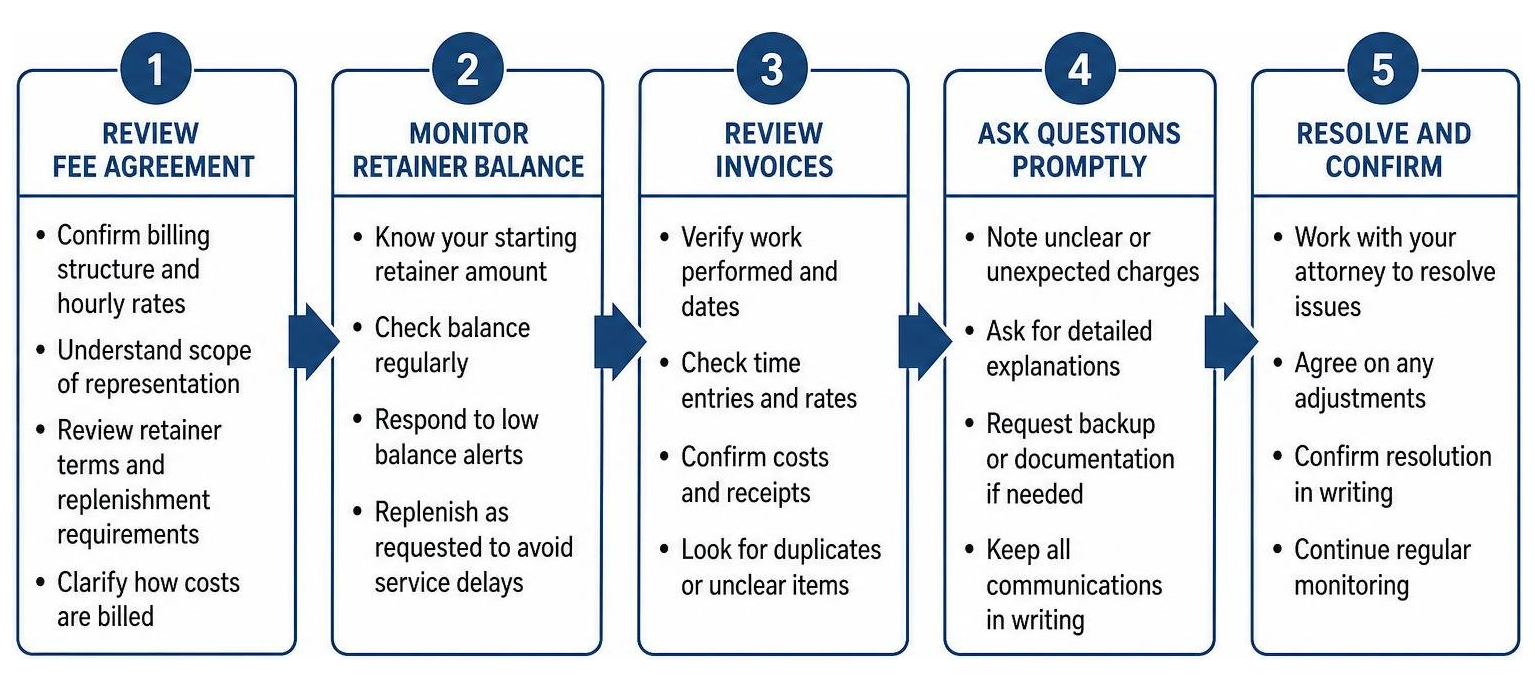
Consumer protection rules and legal practice standards require attorneys to provide formal written fee agreements whenever total fees and costs are expected to reach or exceed $1,000. These written contracts must clearly state:
- The hourly billing rates for all attorneys, paralegals, and legal assistants assigned to your matter.
- The scope of representation and how advance retainers are maintained in trust accounts.
- How out-of-pocket expenses (like expert appraisers and filing fees) are billed and approved.
Reviewing your monthly billing statements promptly allows you to track expenses in real time, ask questions about specific line items, and maintain control over your legal budget. For strategies on keeping your costs manageable, read How to Reach a Fair Divorce Settlement Without Going Broke.

Practical Steps If You Cannot Afford Your Lawyer’s Bill
If you run into financial difficulties during your case and cannot pay an incoming legal invoice or replenish your retainer trust balance, do not ignore the bill. Taking prompt action can help keep your representation intact:
- Request a Formal Payment Plan: Most law firms will work with clients to establish manageable monthly payment schedules for outstanding balances.
- Temporarily Postpone Non-Essential Work: Speak with your lawyer about pausing non-urgent depositions, discovery requests, or motion filings to give you time to catch up financially.
- Review Billed Line Items Immediately: If you spot an accounting error or do not understand a charge, contact your law firm’s billing administrator right away for clarification.
- Explore Pendente Lite Relief: If your financial hardship stems from your spouse cutting off access to joint bank accounts or marital income, ask your attorney to file an emergency motion requesting that your spouse pay temporary suit money.
For more practical guidance on maintaining a productive, cost-effective relationship with your legal team, see these Tips for Working With a Family Law Attorney During Divorce.
Frequently Asked Questions About Legal Fee Responsibility
Can legal fee judgments be wiped out through personal bankruptcy?
In standard civil lawsuits (such as contract disputes or personal injury claims), money judgments awarded for attorney fees or court sanctions can generally be discharged through Chapter 7 or Chapter 13 bankruptcy proceedings.
However, family law matters carry strict statutory exceptions. Under federal bankruptcy law, attorney fee awards ordered in divorce, child custody, or spousal support proceedings that are classified as “Domestic Support Obligations” (DSOs) or domestic relations debt are non-dischargeable. You cannot eliminate court-ordered family law fee obligations simply by filing for bankruptcy.
Does a client in a contingency fee case still pay expenses if they lose?
Yes, in most instances. While contingency fee arrangements dictate that you pay no attorney fees unless your lawyer secures a financial settlement or verdict, the client typically remains responsible for reimbursing hard out-of-pocket litigation expenses (such as expert witness fees, court reporter charges, and filing fees).
Always check your written retainer agreement to verify whether out-of-pocket expenses are advanced by the law firm and whether you are required to repay those expenses if the case is unsuccessful.
What factors do judges evaluate when awarding temporary legal fees in divorce?
When a spouse files a motion for pendente lite (temporary) attorney fees during an ongoing divorce, New Jersey judges consider several core factors:
- Financial Needs and Earnings: The income, earning capacities, and liquid assets available to both spouses.
- Financial Ability: The higher-earning spouse’s actual financial ability to contribute to the lower-earning spouse’s legal representation.
- Good Faith vs. Bad Faith: Whether both parties are acting reasonably, or if one party is intentionally stalling or generating unnecessary legal costs.
- Complexity of Assets: Whether complex business valuations, executive compensation packages, or forensic accounting reviews are required to protect marital assets.
Conclusion
Understanding who pays attorney fees removes much of the anxiety surrounding legal disputes and divorce proceedings. While the American Rule serves as the baseline across general civil courts, family law provides clear mechanisms—through financial need adjustments, pendente lite fee awards, and bad-faith sanctions—to ensure that both parties can secure fair representation.
At Shane and White, LLC, we bring over 40 years of specialized family law experience to clients across Edison, Metuchen, Woodbridge, East Brunswick, New Brunswick, North Brunswick, Monroe, Piscataway, Sayreville, and all of Middlesex County, New Jersey. We are committed to providing compassionate, personalized attention and clear, honest communication about every financial and legal aspect of your case.
If you are facing a divorce or complex family law matter and want to protect your financial rights, contact our office today to explore our full range of Divorce Legal Services and schedule a consultation with our experienced legal team.


