


Marital Home Rights and Equitable Distribution in New Jersey
When navigating a marital breakup in Mercer County, determining what happens to the family home is usually top priority. In New Jersey, property isn’t automatically sliced down the middle. Instead, the court uses a framework called equitable distribution to decide Will I Keep My Home in a Divorce Action.
Under N.J.S.A. 2A:34-23.1, the state divides property based on fairness given the specific circumstances of the marriage. When evaluating What Assets Get Shared in a Divorce, judges in the Mercer County Vicinage look at several key statutory factors:
- The duration of the marriage.
- The income, earning capacity, and financial standing of each spouse.
- The standard of living established during the marriage.
- The economic circumstances of each spouse when the division of property becomes effective.
- The direct and indirect contributions of each spouse to the acquisition and preservation of marital assets, including homemaking and childcare services.
Whether your residence is located in the heart of East Windsor or in the Twin Rivers planned unit development—New Jersey’s very first planned community—the physical property and built-up equity accumulated during the marriage generally qualify as marital property.
To handle the home during property division, couples typically pursue one of three main paths through Practice Equitable Distribution:
| Option | How It Works | Key Financial & Practical Considerations |
|---|---|---|
| Spousal Buyout | One spouse keeps the home and buys out the other’s share of equity. | Requires adequate income and credit to refinance the existing mortgage into a single name. |
| Sell and Divide | The property is placed on the market and sold to a third party. | Net proceeds are divided equitably after paying off the mortgage, closing costs, and legal fees. |
| Deferred Sale | One spouse remains in the home for a fixed period (e.g., until children finish school). | Requires clear agreements on who pays ongoing expenses like property taxes and structural repairs. |
Child Custody and Keeping the Marital Residence
When children are involved, housing rights become tightly linked with parenting decisions. New Jersey family courts evaluate custody matters using the “best interests of the child” standard. Courts favor arrangements that promote stability and disrupt a child’s routines as little as possible.
Maintaining school district continuity in East Windsor is often a major priority for judges. If one parent serves as the primary residential custodian, the court may award that parent temporary or long-term exclusive occupancy of the home so the children can remain in their current neighborhood and school. By Putting Kids First with an East Windsor Child Custody Attorney, parents can structure parenting schedules and home occupancy terms that prioritize minor children while protecting each party’s financial investment through Practice Child Custody Visitation.
How an East Windsor Divorce Housing Rights Lawyer Protects Your Property

Real estate values and complex financing terms make property division tricky. An experienced east windsor divorce housing rights lawyer evaluates real estate contracts, accurate market appraisals, deed transfers, and debt obligations to prevent hidden financial liabilities.
During the initial stages of a divorce case, one of the most effective tools available is applying for pendente lite relief. Pendente lite is a Latin legal term meaning “pending the litigation.” Through a formal court motion, an attorney can request temporary court orders that:
- Grant you exclusive possession of the home while the divorce is pending.
- Order your spouse to continue paying or contributing to the monthly mortgage, property taxes, home insurance, and utilities.
- Restrain either party from selling, refinancing, encumbering, or hiding real estate assets without court consent.
By securing these temporary orders early on, an east windsor divorce housing rights lawyer ensures you are not wrongfully forced out of your home or saddled with unpaid bills that could ruin your credit score. To learn more about safeguarding your financial interests, see How a Divorce Attorney Helps Protect Your Rights and Assets.
Why You Need an East Windsor Divorce Housing Rights Lawyer for Mortgage & Lease Negotiations
A common misconception in family law is that a divorce decree automatically alters bank agreements. It does not. If both spouses signed the original mortgage or apartment lease, both remain legally obligated to the lender or landlord regardless of what your property settlement agreement (PSA) states.
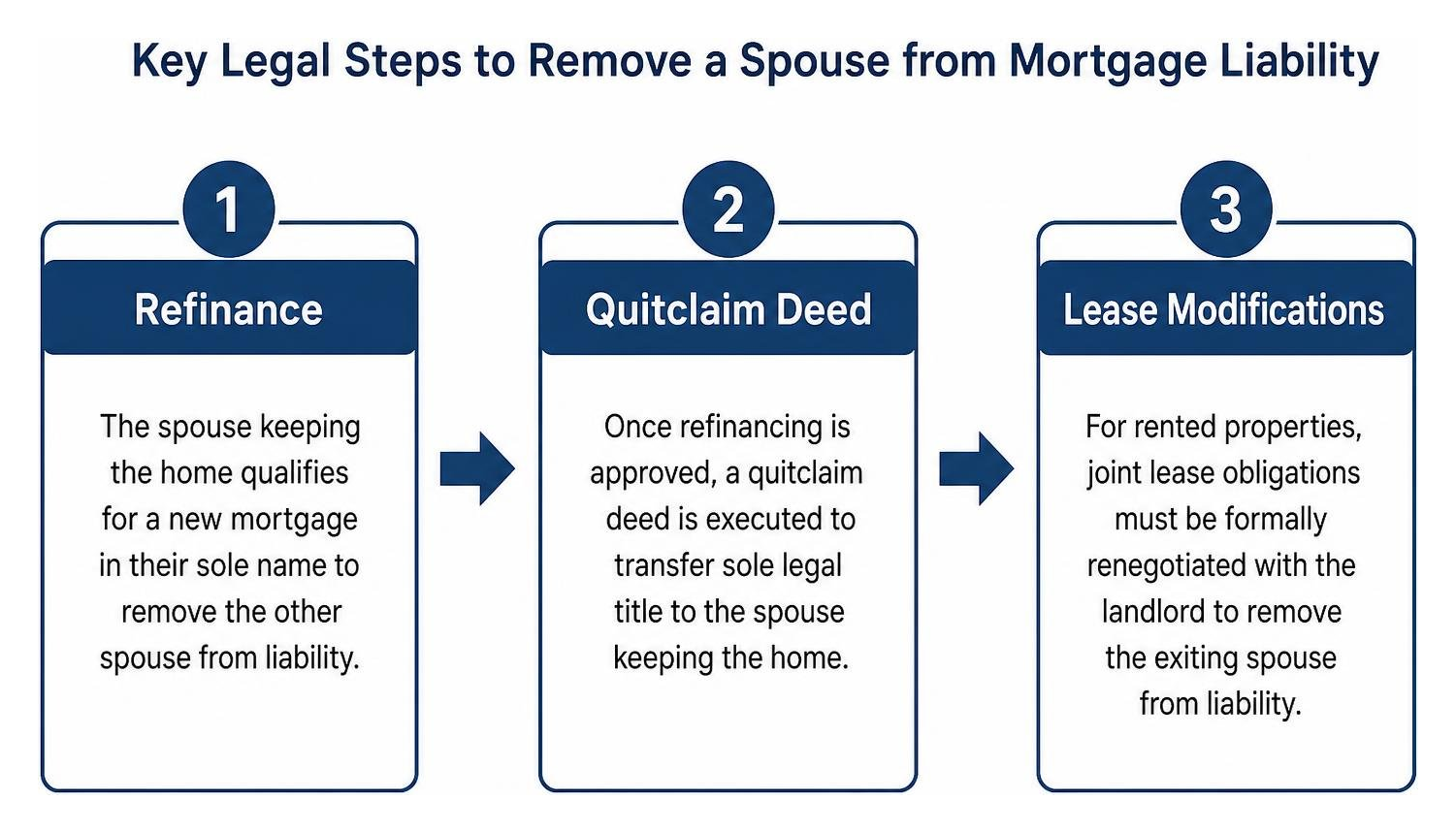
When one spouse agrees to keep the residence:
- Refinancing Requirements: The party keeping the home must qualify for a new mortgage independently to release the non-retaining spouse from liability.
- Quitclaim Deed Execution: Once refinancing is secured, a quitclaim deed is executed to transfer sole legal title.
- Lease Modifications: For rented properties, joint lease obligations must be formally renegotiated with the landlord to remove an exiting spouse from liability.
If your spouse defaults on a joint debt after the divorce without these safeguards in place, the mortgage company can come after you for payment, damaging your credit. Working with an east windsor divorce housing rights lawyer ensures strict contractual deadlines and clear financial protections are built directly into your settlement.
When to Hire an East Windsor Divorce Housing Rights Lawyer vs Standard Counsel
While a traditional divorce attorney manages the general dissolution of marriage, an attorney skilled in housing rights understands how family law intersects with complex real estate and landlord-tenant rules.
If your divorce involves concurrent eviction proceedings, complex real estate holdings, disputes over unwritten rental agreements, or non-paying family tenants, specialized legal representation becomes crucial.
Navigating Foreclosure, Eviction, and Mercer County Housing Resources
If financial difficulties during separation lead to mortgage defaults or landlord-tenant disputes, you must act quickly. Facing eviction or foreclosure alongside a pending divorce creates intense pressure, but New Jersey provides legal protections to preserve your housing stability.
When a home faces foreclosure during a pending divorce, an emergency motion can be filed in Mercer County Family Court or Superior Court to stay proceedings, mandate loan modification applications, or compel the immediate sale of equity to protect both spouses’ credit.
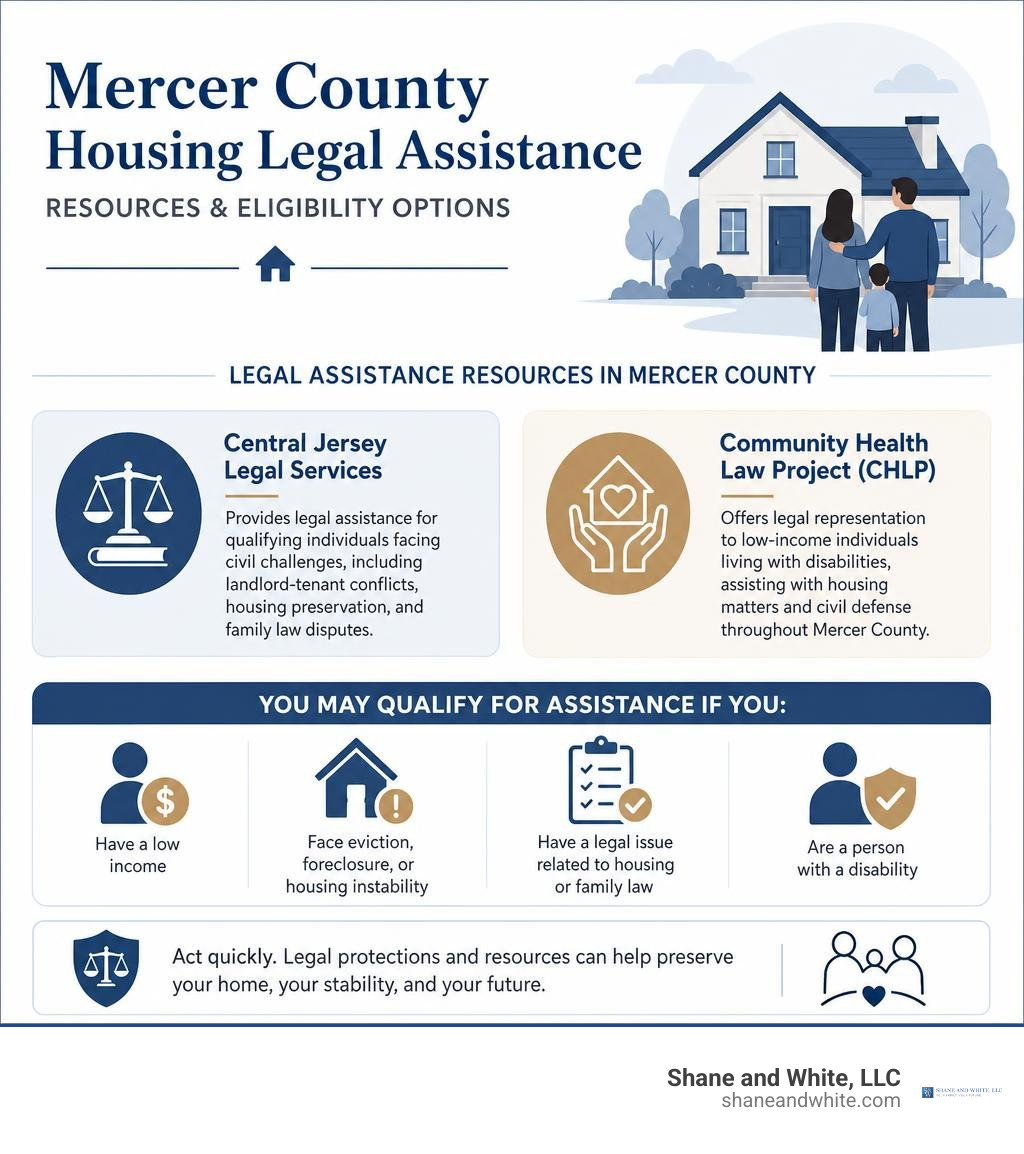
For low-income residents facing economic hardship, community organizations offer vital civil support in Mercer County:
- Central Jersey Legal Services: Provides legal assistance for qualifying individuals facing civil challenges, including landlord-tenant conflicts, housing preservation, and family law disputes.
- Community Health Law Project (CHLP): Offers legal representation to low-income individuals living with disabilities, assisting with housing matters and civil defense throughout Mercer County.
If you are navigating complex court hearings, read Navigating Tough Times Your Guide to East Windsor Family Court Attorneys for guidance on preparing your case.
Critical Housing Mistakes to Avoid During an East Windsor Divorce

When emotions run high during a separation, acting without sound advice can jeopardize your property rights. Be careful to avoid these costly mistakes:
- Moving Out Prematurely: Leaving the marital home voluntary without a written agreement or court order can compromise your position regarding exclusive use and impact custody arguments by establishing a new status quo.
- Stopping Payment on Housing Expenses: Refusing to pay assigned mortgage or utility bills out of frustration directly harms your credit score and can result in judicial sanctions.
- Ignoring Tax Implications: Transferring real estate or selling property without accounting for capital gains tax exemptions can result in unnecessary tax bills.
- Relying on Informal Property Valuations: Accepting a casual property appraisal rather than obtaining a professional valuation often leads to unfair equity calculations.
Frequently Asked Questions About Divorce Housing Rights
Can my spouse kick me out of our East Windsor home during a divorce?
No. In New Jersey, neither spouse can legally lock out or remove the other from the marital residence simply because a divorce has been filed. Both spouses hold equal possessory rights to the home regardless of whose name is on the deed or lease.
A spouse can only be removed if a court grants a motion for exclusive possession or if a temporary restraining order (TRO) is issued under the Prevention of Domestic Violence Act.
What happens to a joint mortgage if one spouse keeps the home?
If one spouse keeps the home, they must usually refinance the mortgage independently into their own name to remove the other spouse’s name from the debt.
The settlement agreement will set a clear deadline for this refinancing—typically 60 to 180 days. Once refinanced, the departing spouse signs a quitclaim deed transferring their ownership interest. If refinancing is impossible due to credit or income constraints, the court will typically order the home to be sold.
How does child custody influence who gets the house in Mercer County?
Courts prioritize residential stability for minor children. The parent awarded primary residential custody is often given preference to remain in the marital home to minimize disruption to the children’s schooling, routines, and social connections.
However, the custodial parent must still be financially capable of maintaining the home or receiving sufficient support to cover housing costs.
Secure Your Future with Experienced Family Law Representation

Protecting your housing rights during a divorce requires a clear strategy, attention to legal detail, and effective courtroom representation. At Shane and White, LLC, we bring over 40 years of family law experience to help clients navigate property division, child custody, and housing disputes across New Jersey.
Whether you need to secure exclusive possession of your home, negotiate a fair buyout, or protect your financial credit during a divorce, our team provides personalized attention every step of the way. Explore our comprehensive services on our Practice Divorce page and contact our firm today to discuss your case.


