


What Is Child Support and How Is It Calculated?
Child support is a court-ordered payment made by one parent to the other to help cover a child’s basic needs — including food, housing, clothing, education, and medical care.
Here’s a quick overview of how it works:
| Question | Quick Answer |
|---|---|
| Who pays? | The noncustodial parent (the one the child doesn’t live with most of the time) |
| Who receives it? | The custodial parent or legal guardian |
| How is the amount set? | Based on both parents’ incomes, number of children, and parenting time |
| Who can apply? | Either parent or a legal guardian |
| What if payments stop? | Enforcement actions like wage garnishment, license suspension, or passport revocation can apply |
| Can the amount change? | Yes, through a formal modification process |
If you’re going through a divorce or separation in New Jersey, figuring out child support can feel overwhelming. The formula isn’t simple. The rules change. And the stakes are high — for you and your children.
This guide breaks it all down in plain language: how support is calculated, how to enroll, how to modify an order, and what happens if payments stop.
I’m Kenneth White, Esq., a Certified Matrimonial Attorney with decades of experience helping New Jersey families navigate child support and all aspects of family law. I’ll walk you through everything you need to know.
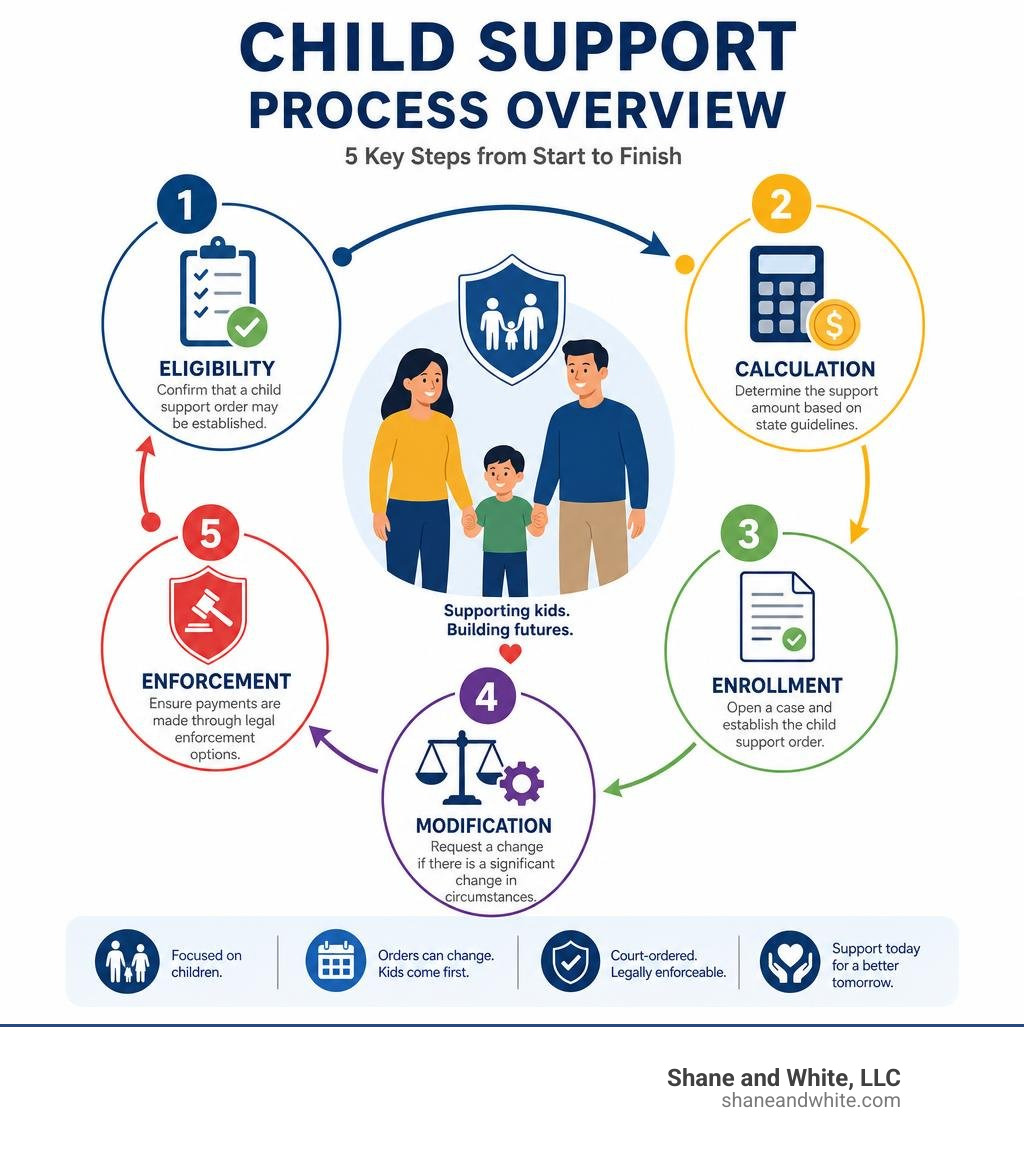
Understanding Child Support and Eligibility
At its core, child support is designed to ensure that children do not become the financial victims of a parental breakup. The law operates under a very clear philosophy: children are entitled to share in the current income of both parents, regardless of whether those parents were ever married, lived together, or remain in contact today.
In New Jersey, this financial obligation is a continuous legal duty. It belongs entirely to the child; it is not a personal wind-fall for the custodial parent, nor can it be waived by a parent in exchange for giving up visitation rights. Whether you live in Edison, East Windsor, or anywhere else across Middlesex County or Mercer County, understanding how eligibility works is the first step in protecting your family’s future.
Who Qualifies to Receive or Pay Support?
Generally, the parent who has primary physical custody (the custodial parent) receives the payments, while the parent who has the child for fewer overnights (the noncustodial parent) makes the payments. However, legal guardians or relatives who have physical custody of a child are also fully eligible to receive support from both biological or adoptive parents.
Establishing parentage is the absolute foundation of any support obligation. Before a court can order someone to pay, legal parentage must be established. This can happen voluntarily at birth through a signed Certificate of Parentage, or through court-ordered genetic testing. If you are navigating this process during a marital split, our guide on Child Support in a Divorce explains how these initial determinations fit into the broader divorce process.
The Legal Role of Support Agencies
Many parents turn to local and state agencies to help manage their cases. In New Jersey, the state’s program provides essential administrative services. You can explore their official portal at the NJ Child Support – Home website to see the digital tools available to local families.
However, it is crucial to understand what these public agencies can and cannot do.
What Support Agencies Can Do:
- Locate noncustodial parents using state and national databases.
- Establish legal parentage (paternity).
- Establish and formally register court orders for financial and medical support.
- Collect and distribute payments directly to custodial parents.
- Initiate automated enforcement actions when a paying parent falls into arrears.
What Support Agencies Cannot Do:
- Resolve custody disputes or handle visitation schedules.
- Manage divorce proceedings.
- Help you obtain or enforce restraining orders.
- Establish or enforce alimony or spousal support.
Because local agencies do not legally represent either parent, their staff cannot provide personalized legal advice. If you are facing complex disputes regarding custody or parenting time, working with a private family law firm ensures your personal rights are advocated for.
How to Calculate Child Support Obligations
New Jersey, like 38 other states, utilizes the Income Shares Model to calculate support obligations. This model is built on a simple premise: a child should receive the same proportion of parental income that they would have received if the parents were still living together in a single household.
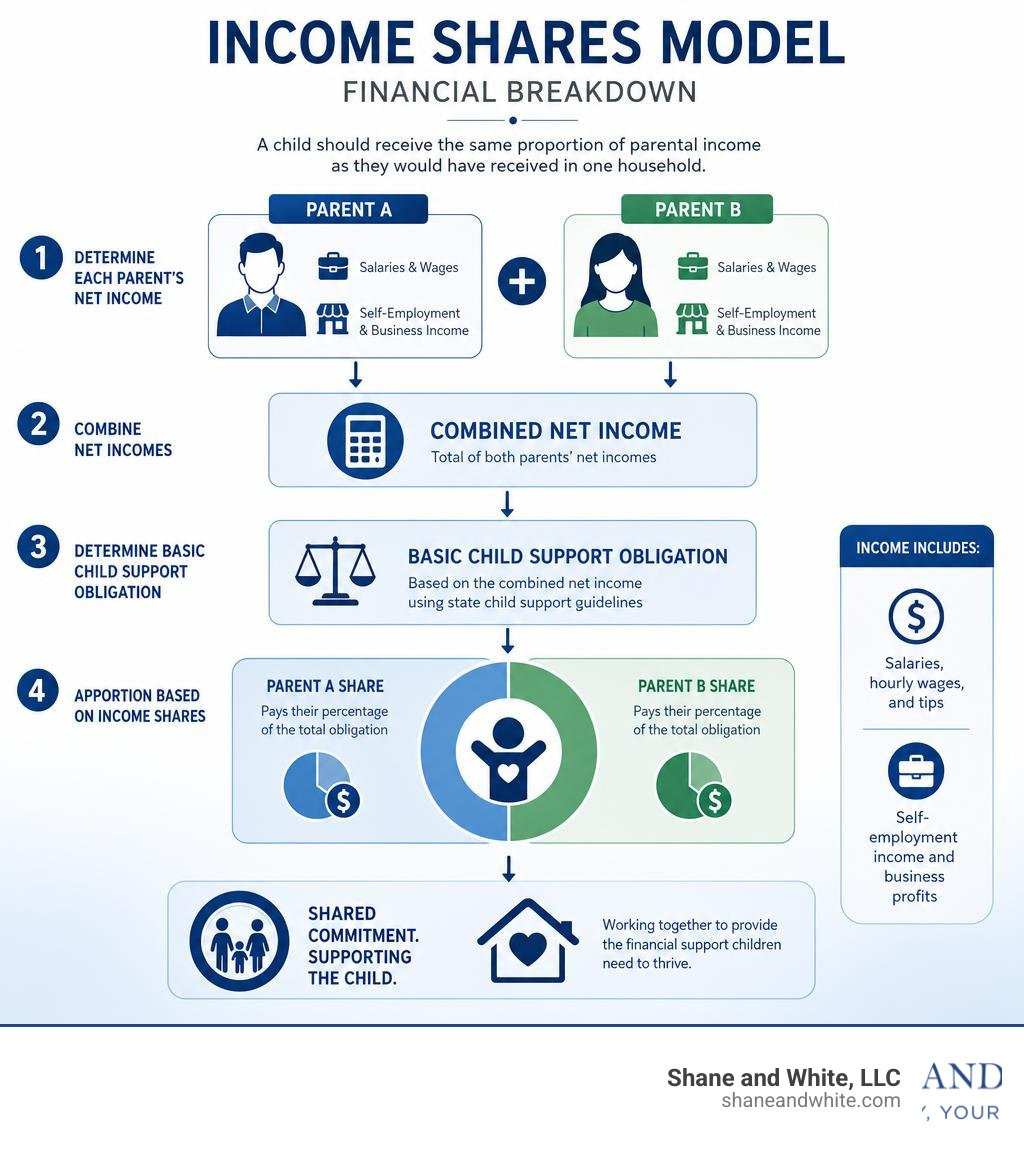
Under this model, the state combines the net incomes of both parents to determine a “basic child support obligation” using standardized economic tables. This total obligation is then apportioned between the parents based on their respective percentages of the combined income.
To calculate this accurately, we must first determine each parent’s gross income. This includes:
- Salaries, hourly wages, and tips.
- Self-employment income and business profits.
- Bonuses, commissions, and overtime pay.
- Severance pay, unemployment benefits, and workers’ compensation.
- Pension and retirement benefits.
- Alimony received from a prior relationship.
Once gross income is established, specific mandatory deductions—such as income taxes, mandatory union dues, and prior child support orders—are subtracted to arrive at the net income used in the formula.
Key Factors in the Child Support Formula
While the Income Shares Model provides a baseline, several critical variables will adjust the final monthly figure.
- Parenting Time (Overnights): The number of overnights a child spends with each parent significantly impacts the calculation. If the noncustodial parent has the child for more than 104 overnights per year (which is approximately two overnights per week), the court uses a “Shared Parenting” worksheet instead of a “Sole Parenting” worksheet. This adjusts the obligation downward to account for the direct expenses (like food and entertainment) the noncustodial parent pays while the child is in their care.
- Number of Children: The formula scales up based on the number of children requiring support, though the cost per child decreases slightly with each additional dependent.
- Standard of Living: In high-income households, the standard guidelines may not fully cover the child’s actual needs. Courts can deviate from the standard guidelines to ensure the child benefits from the parents’ higher standard of living.
- Alimony Payments: Spousal support obligations can directly impact the cash flow available for children. If you are navigating both types of support, you can read our detailed breakdown of Does Alimony Affect Child Support to see how these two calculations interact.
Different states use varying structures for these calculations. For comparison, you can look at the structured approach in the 2025 Michigan Child Support Formula Manual or review how other jurisdictions handle unique cost-of-living adjustments, such as the Child Support Guidelines established for Hawaii’s Family Courts.
Handling Medical Support and Child Care Expenses
A standard support order is not limited to a single cash payment; it must also address healthcare and child care.
- Health Insurance: Parents are legally required to provide health insurance coverage for their children if it is available at a reasonable cost through an employer. The cost of the child’s portion of the insurance premium is added to the basic support calculation and shared proportionally.
- Ordinary vs. Extraordinary Medical Expenses: In New Jersey, the basic child support guideline assumes the custodial parent will pay the first $250 per child, per calendar year, in unreimbursed health care expenses (such as co-pays, prescription drugs, and basic dental visits). Any unreimbursed medical or dental expenses exceeding $250 per year are considered “extraordinary” and are divided between the parents based on their percentage share of combined net income.
- Child Care Costs: Work-related child care expenses (such as daycare or after-school programs) are added directly to the basic support obligation, ensuring both parents contribute to the costs that allow them to remain employed.
Enrolling in Services and Modifying Existing Orders
Setting up your initial support order or seeking to update an existing one requires navigating specific administrative and legal pathways.

The Enrollment Process for Parents
To begin receiving services, either parent or a legal guardian can submit a formal application. In New Jersey, this can be done online through the NJ Child Support – Home portal or by visiting your local county Board of Social Services or Family Court intake office.
When applying, you must provide as much detail as possible, including:
- Full names, dates of birth, and Social Security numbers for all parties.
- Current or last known addresses and employment details for both parents.
- Existing custody, divorce, or separation agreements.
- Birth certificates and proof of parentage for the children.
While public programs exist across North America—such as the system outlined in Arranging child support | ontario.ca or the procedures in the Child Support Handbook for North Carolina—New Jersey residents must follow the specific rules of the New Jersey Family Court system to ensure their local orders are fully enforceable.
How to Modify a Child Support Order
Life is full of changes, and a support order set years ago may no longer make sense today. In New Jersey, either parent can file a motion to modify a support order if they can demonstrate a substantial, permanent change in circumstances.
Common reasons to request a modification include:
- A permanent loss of employment or a significant involuntary reduction in income.
- A severe, long-term illness or disability affecting a parent’s ability to work.
- Significant changes in the child’s needs, such as new medical diagnoses or educational expenses.
- A major shift in the parenting time schedule (e.g., a child moving in with the noncustodial parent full-time).
- The incarceration of the paying parent.
Additionally, support cases monitored by the state are subject to a three-year review process, where the administrative agency checks if the order still aligns with the parents’ current incomes. Some orders are also eligible for an automatic Cost of Living Adjustment (COLA) every two years.
If you are a father seeking to adjust your financial obligations due to a change in custody or income, working with an experienced attorney is vital. Learn more about how we advocate for balanced outcomes in our article on How a Child Support Lawyer Supports Fathers Rights.
Enforcement Actions for Non-Payment
When a noncustodial parent fails to pay their court-ordered obligation, they build “arrears” (unpaid back support). In New Jersey, child support arrears do not simply vanish; they remain a permanent legal debt that cannot be discharged through bankruptcy and must be paid even after the child reaches adulthood.
Wage Withholding and Financial Sanctions
The state has a wide array of powerful administrative tools to collect unpaid support without needing to go back to court for every missed payment. You can review the court-monitored collection process on the Child Support Collections and Enforcement – NJ Courts page.
The most common enforcement mechanisms include:
- Income Withholding (Wage Garnishment): The state issues a direct order to the paying parent’s employer, requiring them to deduct the child support amount directly from the parent’s paycheck before they receive it.
- Tax Refund Intercept: The state can seize federal and state income tax refunds to pay down outstanding arrears.
- Credit Bureau Reporting: If arrears exceed a specific threshold, the delinquency is reported to major credit bureaus, severely impacting the parent’s credit score.
- License Suspension: The state can suspend driver’s licenses, professional licenses (such as medical, legal, or nursing licenses), and recreational licenses (like hunting or fishing licenses) of parents who owe significant back support.
- Warrants and Arrests: In extreme cases of non-payment, the court can issue a child support warrant, leading to the parent’s arrest and detention until a specific “purge amount” is paid.
For comparison on how neighboring states handle delinquency and payment tracking, you can read the Payments FAQ provided by New York’s support services.
Passport Revocation and Interstate Enforcement
For parents owing substantial back support, enforcement actions extend to the federal level. Under federal law, if a parent owes more than $2,500 in child support, the U.S. Department of State will automatically deny their passport application or revoke their active passport.
Interstate cases present unique challenges, but federal laws like the Uniform Interstate Family Support Act (UIFSA) ensure that states work together. If a noncustodial parent moves out of New Jersey, the New Jersey order can be registered and enforced by the child support agency in their new state. For an overview of how interstate and international enforcement portals operate, you can check the Child Support portal of New York State.
Special Programs and Unique Situations
The legal system recognizes that certain families face unique challenges that require specialized administrative programs and protections.
Support for Military Families and Incarcerated Parents
- Military Families: Servicemembers have a strict legal duty to support their children. Programs like the federal HEROES initiative help streamline paternity establishment and support management for military families, taking into account unique military pay structures (including basic allowances for housing and subsistence).
- Incarcerated Parents: In the past, child support arrears would continue to accumulate while a parent was in prison, leaving them with insurmountable debt upon release. Under current New Jersey law, incarceration is generally treated as a change in circumstances that allows for a temporary modification or suspension of the active support obligation, preventing the accumulation of unpayable arrears.
Protections for Family Violence Survivors
For survivors of family violence, pursuing child support can carry safety risks. Support agencies have strict safety protocols in place to protect these families:
- Confidential Addresses: The physical addresses, phone numbers, and employers of survivors are kept strictly confidential and redacted from court documents.
- Good Cause Waivers: If pursuing child support would put the parent or child in physical danger, individuals receiving public assistance can apply for a “Good Cause” waiver to safely opt out of the requirement to cooperate with child support enforcement.
Frequently Asked Questions
Navigating the child support system brings up many practical questions. Here are some of the most common issues we help families resolve.
Can support obligations continue past age 23 for special needs children?
Yes. While New Jersey child support obligations generally terminate automatically when a child turns 19 (and cannot extend past age 23 for students), there is a crucial exception for special needs children.
Under a New Jersey law that took effect on December 1, 2020, parents can file a motion to continue child support and Title IV-D services beyond the age of 23 if the child has a severe, permanent mental or physical incapacity that causes them to remain financially dependent on their parents.
Does the standard obligation cover the cost of braces and dental work?
As discussed earlier, the basic child support guidelines only cover the first $250 of unreimbursed medical and dental expenses per child, per year. Because orthodontic care like braces easily exceeds this cap, the remaining cost is not covered by standard child support. Instead, parents must divide the remaining balance in proportion to their incomes, as outlined in their custody agreement or divorce decree.
What happens if a parent stops paying their obligation?
If your co-parent stops paying, do not take matters into your own hands by withholding visitation or parenting time—this is illegal and can harm your standing in court. Instead, you must use formal legal channels to enforce the order. For a step-by-step action plan, read our guide on What to Do if Your Ex Stops Paying Child Support.
Conclusion
Calculating and managing child support is a complex process, but you do not have to navigate it alone. Whether you need to establish an initial order, modify an existing one, or enforce unpaid obligations, having the right legal support makes all the difference.
At Shane and White, LLC, we have over 40 years of experience serving families in Edison, East Windsor, Middlesex County, and Mercer County, New Jersey. We pride ourselves on providing personalized attention, compassionate representation, and clear, honest communication.
If you have questions about your child support case, contact our Edison office today to schedule a consultation. Let us help you protect your children’s financial well-being and secure your peace of mind.


