


What You Need to Know About No Fault Divorce in New Jersey
No fault divorce in New Jersey means you can end your marriage without blaming your spouse for anything. Here is what you need to know right away:
Quick Answer: No Fault Divorce in New Jersey
| Irreconcilable Differences | Separation | |
|---|---|---|
| Grounds | Breakdown of marriage | Living apart in separate homes |
| Minimum time | 6 months of differences | 18 consecutive months apart |
| Must live apart? | No | Yes |
| Residency required | 12 months in NJ | 12 months in NJ |
| Prospect of reconciliation | None | None |
New Jersey officially calls divorce a “dissolution” — because you are dissolving a legal union. This applies to marriages, civil unions, and domestic partnerships.
The state offers two no-fault paths. You can file based on irreconcilable differences (you don’t have to move out). Or you can file based on separation (you must live in separate homes for at least 18 months). Neither path requires you to prove your spouse did anything wrong.
This guide walks you through every step — from filing your complaint to getting your final judgment.
I’m Kenneth A. White, Esq., a Matrimonial Law Attorney certified by the Supreme Court of New Jersey with extensive experience handling no fault divorce in New Jersey cases — including serving as an Early Settlement Panelist and court-appointed mediator in Middlesex County. I’ll walk you through everything you need to know to approach this process with clarity and confidence.
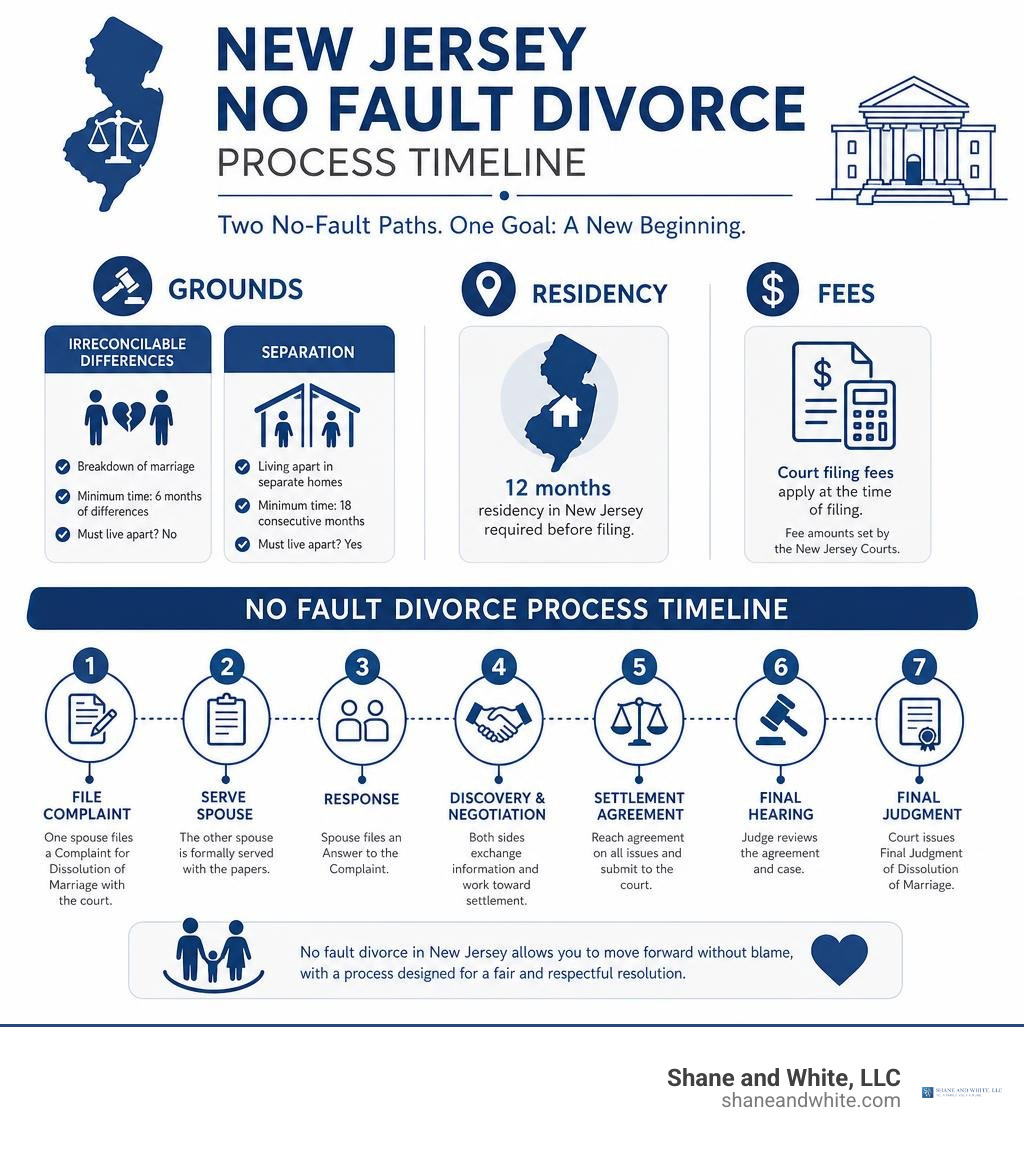
Discover more about no fault divorce new jersey:
Understanding No Fault Divorce New Jersey Grounds
Deciding to end a marriage is never easy, but New Jersey’s modern legal framework makes the process much more humane than it used to be. Decades ago, getting a divorce required proving that one spouse was legally “at fault” for the breakdown of the marriage. This led to bitter courtroom battles, manufactured drama, and unnecessary emotional trauma.
Fortunately, those days are long gone. Under New Jersey Revised Statutes Section 2A:34-7 (2025), traditional fault-based defenses like recrimination (arguing “you did it too!”), condonation (arguing “but you forgave me!”), and the clean hands doctrine have been completely abolished. This means one spouse cannot legally block a divorce by trying to excuse their own behavior or pointing fingers. If the marriage is broken, the court will allow it to be dissolved.
To understand how to proceed, you first need to look at What are the requirements to file for divorce in New Jersey?. New Jersey recognizes both fault-based grounds (like extreme cruelty or adultery) and no-fault grounds. When filing for a no fault divorce in New Jersey, you will choose between two primary legal grounds: irreconcilable differences or separation.
Let’s look at how these two legal pathways compare side-by-side:
| Legal Ground | Irreconcilable Differences | Separation |
|---|---|---|
| Statutory Authority | N.J.S. 2A:34-2(i) | N.J.S. 2A:34-2(d) |
| Living Arrangements | Spouses can share the same house | Must live in entirely separate habitations |
| Required Duration | Minimum of 6 months | Minimum of 18 consecutive months |
| Reconciliation Prospect | Absolutely none | Absolutely none |
| Primary Advantage | Faster; no need to maintain two households | Clear, physical boundary established |
Requirements for No Fault Divorce New Jersey Based on Irreconcilable Differences
The addition of “irreconcilable differences” as a ground for divorce in 2007 revolutionized family law in our state. Under N.J.S.2A:34-2, specifically subsection (i), filing under this ground requires you to establish the following criteria:
- You or your spouse must have lived in New Jersey for at least 12 consecutive months before the day you file the complaint.
- You and your spouse have experienced irreconcilable differences for a period of at least six months.
- These differences have caused the breakdown of your marriage, making it clear that the marriage should be dissolved.
- There is absolutely no reasonable prospect of reconciliation.
The beauty of this ground is that you do not have to move out of the marital home to file. In today’s economy, maintaining two separate households during a divorce is financially impossible for many families in Middlesex and Mercer County. Citing irreconcilable differences allows you to remain in the same house while legally ending your marriage.
Requirements for No Fault Divorce New Jersey Based on Separation
The second no-fault option is separation. To file under this ground, you and your spouse must have lived separate and apart in entirely different habitations for at least 18 consecutive months before filing the complaint.
However, there are many Legal separation myths and facts that couples must navigate. A common misconception is that you can be “separated” while living in different bedrooms under the same roof. For the purposes of a separation-based divorce in New Jersey, the court requires strict physical separation in separate residences. Additionally, there must be no reasonable prospect of reconciliation at the end of the 18-month period. Because this option requires waiting a year and a half while maintaining separate homes, the vast majority of our clients choose the six-month irreconcilable differences path instead.
Eligibility and Preparing Your Divorce Complaint
Before you can draft your paperwork, you must meet New Jersey’s strict residency requirement. Either you or your spouse must have been a bona fide resident of New Jersey for at least 12 consecutive months immediately before filing. The only exception to this 12-month rule is if you are filing on the grounds of adultery, which is a fault-based ground. For a no fault divorce in New Jersey, the one-year residency rule is non-negotiable.
Once you establish residency, you can begin preparing to file. Reviewing The Divorce Process Guide is a great way to understand the macro-level steps involved.

Required Forms and Where to Find Them
To initiate a divorce, you must complete and file a specific packet of legal documents. If you are representing yourself, these forms can be obtained directly from the New Jersey Courts website or through Legal Services of New Jersey (LSNJ), which offers a complete divorce kit with step-by-step instructions for low-income residents for $25.
The core documents required to start your divorce include:
- The Verified Complaint: This is the formal document that asks the court to grant your divorce and outlines the grounds (such as irreconcilable differences).
- Certification of Verification and Non-Collusion: A sworn statement certifying that your complaint is truthful and that you are not working in secret agreement with your spouse to deceive the court.
- Confidential Litigant Information Sheet (CLIS): A document containing sensitive personal data, such as Social Security numbers and birth dates, which is kept sealed from public view.
- Certification of Insurance Coverage: A document listing all active health, life, auto, and homeowner insurance policies.
- Certification of Notification of Complementary Dispute Resolution (CDR): A form certifying that you have been informed of alternative ways to resolve your issues outside of a trial.
Relief Requested in the Complaint
The Verified Complaint is not just a request to end the marriage; it is also your opportunity to ask the court for specific types of “relief.” This includes:
- Equitable Distribution: The fair (though not necessarily equal) division of marital assets and debts.
- Alimony: Financial support paid from one spouse to the other.
- Child Custody and Parenting Time: Determining where your children will live and how decisions will be made for them.
- Child Support: Financial assistance to cover the costs of raising your children.
- Wife’s Name Change: Requesting to legally return to a maiden or prior surname.
Navigating these requests can be incredibly tricky, especially in cases of Divorce in New Jersey when one spouse controls the money. If your spouse has historically handled all the finances, you will need to utilize the legal discovery process to uncover assets and ensure you receive a fair settlement.
Filing and Serving the Divorce Complaint
Once your documents are drafted, they must be filed with the Family Division of the Superior Court in the county where you lived when the cause of action arose (usually the county where you currently reside, such as Middlesex County or Mercer County).
The state of New Jersey has modernized this process by introducing the Judiciary Electronic Document Submission (JEDS) system, allowing you to upload your documents electronically.
When you file, you must pay the required court fees:
- The filing fee for a divorce complaint is $300.
- If you have children and are requesting custody or parenting time, you must pay an additional $25 parenting workshop fee.
- If you cannot afford these fees, you can submit a fee waiver request along with proof of your financial situation (such as public benefits or low income).
For a detailed walkthrough of this phase, check out our guide on Your Divorce Start to Finish.
Serving Your Spouse and the 60-Day Deadline
Filing the papers is only half the battle; you must also formally notify your spouse. Under the New Jersey Court Rules, you have a strict 60-day deadline from the date the court returns your “process-issued” complaint to serve your spouse.
According to the Divorce (2026 Legal Guide) — Rules & Requirements, service must be performed in one of the following ways:
- Personal Service: Hiring a County Sheriff’s Officer or a private process server to physically hand the documents to your spouse.
- Acknowledgment of Service: If your spouse is cooperative, they (or their attorney) can sign an Acknowledgment of Service form, confirming they received the papers and bypassing the need for a process server.
- Substituted Service / Publication: If you have made diligent efforts and absolutely cannot find your spouse, you can ask the court for permission to serve them by publishing a notice in a local newspaper.
What Happens After Filing: Default and Dispute Resolution
After being served, your spouse (now the “defendant”) has exactly 35 days to respond. They can file an Answer, an Answer and Counterclaim (asking for their own terms), or an Appearance (indicating they don’t contest the divorce but want to be heard on issues like custody or asset division).
If they file a response, the defendant must pay a filing fee of $175 (plus the $25 parenting workshop fee if custody is contested).

During this waiting period, it is easy to make critical errors. Read up on Common mistakes to avoid during a divorce to protect your rights and keep your case on track.
Divorce on the Papers and Default Judgments
If your spouse completely ignores the complaint and fails to respond within 35 days, you can apply for a default judgment.
Under New Jersey Supreme Court Directive #12-22, New Jersey allows uncontested and default divorces to be finalized entirely “on the papers.” This means that if you and your spouse have a signed settlement agreement, or if your spouse has defaulted and you submit the correct certifications, a judge can sign your Final Judgment of Divorce without requiring either of you to physically appear in a courtroom.
This administrative path is incredibly efficient, but your paperwork must be absolutely flawless. If court staff find any deficiencies in your submitted documents, you have only 10 days to correct them before a personal court appearance is mandated.
Alternative Dispute Resolution (ADR) Options
If your divorce is contested, you don’t have to head straight to a trial. In fact, fewer than 2% of divorce cases in New Jersey actually go to trial. Instead, the court utilizes several dispute resolution options to help you reach an agreement:

- Early Settlement Panel (ESP): A program where experienced family law attorneys (like Kenneth A. White, Esq.) volunteer to review your financial issues and recommend a fair settlement.
- Economic Mediation: If the ESP doesn’t resolve your case, you will be referred to a mediator to help you negotiate outstanding financial disputes.
- Arbitration: A private process where you hire a neutral third party to make binding decisions about your case, bypassing the public court system entirely.
To clear up some common myths about this phase of the process, take a look at the Top 7 misconceptions in divorce.
Frequently Asked Questions about New Jersey Divorce
How long does the no-fault divorce process typically take in New Jersey?
The timeline depends heavily on whether your case is uncontested or contested. An uncontested no fault divorce in New Jersey (where you and your spouse agree on all terms) can be finalized in as little as 2 to 4 months.
A contested divorce, where you must go through discovery, mediation, and court appearances, can take anywhere from 6 to 18 months or longer. For a deeper look at what influences these timelines, read our article on How long does it take to get divorced in New Jersey?.
What happens if my spouse refuses to sign or respond to the divorce papers?
Your spouse cannot trap you in a marriage by refusing to sign the papers. If they fail to respond within 35 days of being served, you can file a request to enter a default.
Before the default hearing can take place, you must serve your spouse with a Notice of Proposed Final Judgment at least 20 days before the hearing. This notice outlines exactly what you are asking the judge for (such as the house, custody, or support). If your spouse still does not show up, the judge will typically grant your requests and sign the divorce judgment.
Can I change my name back to my maiden name during the divorce?
Yes. Under N.J.S.A. 2A:34-21, you can request to legally resume your maiden name or any prior surname as part of your divorce judgment.
To do this, you must include the request in your complaint and make a specific certification during the finalization of your divorce. You must certify that you have no criminal convictions under your married name, are not currently under criminal investigation, are not trying to avoid creditors, and provide the last four digits of your Social Security number. Once the judge signs the Final Judgment of Divorce, you can use that document to update your Social Security card, driver’s license, and passports. For more tips on what to do after your divorce is finalized, see our guide on What happens now tying up loose ends upon your divorce.
Conclusion
Navigating a no fault divorce in New Jersey requires careful attention to detail, strict adherence to court deadlines, and a clear understanding of your rights. Whether you are filing on the grounds of irreconcilable differences or separation, having the right legal team by your side can make all the difference.
If you don’t handle the process correctly, you might find yourself facing a legal nightmare. We have seen cases where people assumed everything was finalized, only to ask themselves: I thought I was divorced but I’m still legally married what do I do?. Don’t let that happen to you.
At Shane and White, LLC, we bring more than 40 years of combined experience to the table. We provide personalized attention, compassionate guidance, and clear communication to clients throughout Middlesex County, Mercer County, and the surrounding New Jersey areas. We are here to help you protect your assets, secure your parental rights, and achieve a clean, fresh start.
Ready to take the next step? Schedule a consultation with our experienced Mercer County divorce lawyers at Shane and White, LLC today. Let us help you navigate your divorce from start to finish with the skill and dedication you deserve.


