


Why a Qualified Domestic Relations Order Matters in Divorce
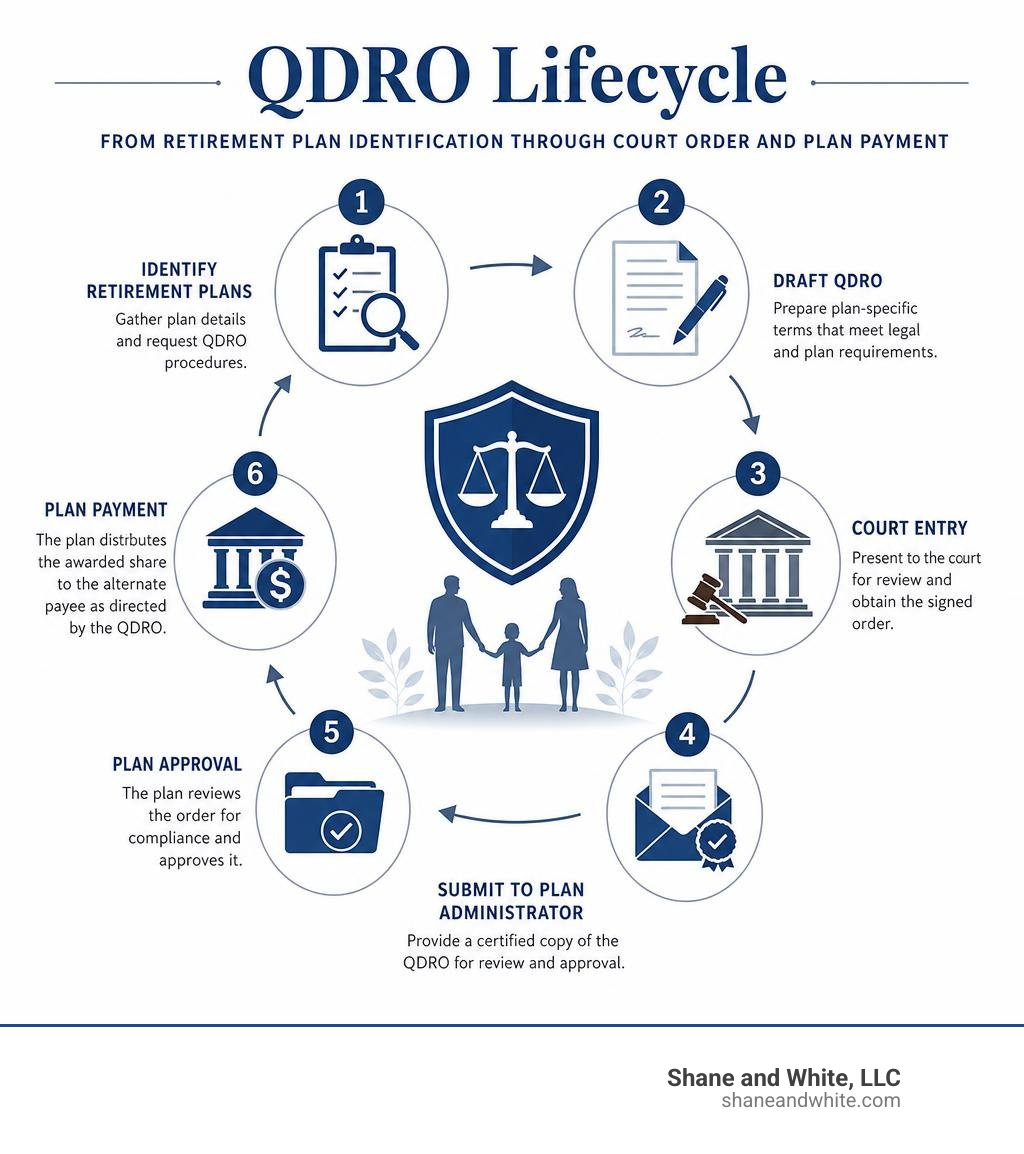
A Qualified Domestic Relations Order (QDRO) is the court order that lets a private employer retirement plan legally pay part of a participant’s 401(k), pension, or similar benefit to a former spouse, child, or dependent. If retirement assets are part of your New Jersey divorce, the practical path is to identify every plan, get its QDRO procedures, draft plan-specific terms, obtain court entry, and submit the certified order to the plan administrator for approval.
A divorce judgment or settlement agreement alone may not be enough for an ERISA-covered retirement plan to divide benefits. Federal law generally protects retirement benefits from assignment, but a valid QDRO is a key exception. That matters because employer retirement savings are often among a family’s largest assets. More than 62 million private wage and salary workers are covered by employer-provided retirement plans in the United States.
Getting the details right is important. The order must identify the parties and plan, clearly state the share or formula being awarded, and avoid demanding benefits the plan does not offer. Delays can also create real risks if the participant retires, changes beneficiary elections, withdraws funds, or dies before the order is accepted.
I am Kenneth White, Esq., a New Jersey Supreme Court Certified Matrimonial Law Attorney with long-standing family-law and divorce-resolution experience in Middlesex County. I help clients address the legal and financial details behind a qualified domestic relations order so retirement-division terms are clear, practical, and aligned with the larger divorce settlement.
Relevant articles related to qualified domestic relations order:
- What to Expect When You Are Getting a Divorce
- The Complete Guide to Remarrying After Divorce
- Understanding How Attorney Fees Are Paid in Divorce
What Is a Qualified Domestic Relations Order and How Does It Work?
Under the Employee Retirement Income Security Act of 1974 (ERISA) § 206(d)(3) and Section 414(p) of the Internal Revenue Code (IRC), private employer retirement plans are shielded by strict “anti-alienation” rules. These rules prohibit employees from assigning, transferring, or giving away their retirement rights to third parties.

The law carves out an exception for domestic relations. When spouses dissolve a marriage in New Jersey, the court creates or recognizes marital property rights through a domestic relations order (DRO). However, that state court order only transforms into an enforceable qualified domestic relations order once it meets statutory federal criteria and is approved by the plan administrator. For detailed regulatory standards, review the U.S. Department of Labor QDRO overview.
Definition, Purpose, and Alternate Payee Eligibility
A domestic relations order is any judgment, decree, or court-approved property settlement that relates to child support, alimony, or marital property rights under state law.
Federal law strictly defines who can receive retirement benefits under a QDRO. An alternate payee is limited to:
- A spouse
- A former spouse
- A child of the participant
- Another dependent recognized under domestic relations law
If an alternate payee is a minor or legally incompetent, the order can direct payments to a designated legal guardian, conservator, or trustee acting in loco parentis.
Statutory Requirements for a Valid Qualified Domestic Relations Order
To achieve qualified status, an order must explicitly contain specific information:
- Full legal name and last known mailing address of the participant and each alternate payee.
- The exact, formal legal name of each retirement plan covered by the order.
- The specific dollar amount or precise percentage formula to be paid to the alternate payee.
- The exact number of payments or period over which the order applies.
Additionally, the order must not:
- Require the plan to provide any type or form of benefit, or any option, not otherwise provided under the plan.
- Require the plan to pay increased actuarial benefits.
- Require the payment of benefits to an alternate payee that are already required to be paid to another alternate payee under a previously established QDRO.
- Require payment in the form of a joint and survivor annuity with respect to the alternate payee and a subsequent spouse.
Practitioners frequently utilize standardized federal drafting frameworks such as the IRS model language for retirement orders to ensure core statutory compliance.
Plan Administrator Authority and ERISA Anti-Alienation Rules
A common misconception is that a state court judge has the final say over whether an order binds a retirement plan. In reality, state courts lack the jurisdiction to determine whether a DRO qualifies under ERISA.
The retirement plan administrator holds the statutory fiduciary duty to evaluate the order and determine its qualified status. If a plan administrator rejects an order, the parties must either amend the order in state court or challenge the fiduciary’s determination in federal court. Furthermore, private retirement plans cannot be joined as formal parties to state divorce actions due to federal ERISA preemption.
Dividing Defined Benefit vs. Defined Contribution Retirement Plans
Retirement assets fall into distinct categories, each requiring different legal and actuarial mechanics during equitable distribution. To understand how these assets fit into your broader case, consult The Ultimate Guide to New Jersey Divorce Laws and Process.
Defined Contribution Plans: 401(k), 403(b), and Account Rollovers
Defined contribution plans—such as 401(k), 403(b), and profit-sharing plans—maintain individual account balances. Dividing these assets involves specifying a valuation date (such as the date the divorce complaint was filed or a negotiated cut-off date).
The order should specify whether the alternate payee’s share includes market gains and losses from the valuation date through the actual date of distribution. It must also address whether outstanding loan balances are included or excluded when calculating the divisible marital balance. Once qualified, the plan segregates the funds into a separate account for the alternate payee, who can execute a tax-free rollover into their own qualified retirement account or traditional IRA.
Defined Benefit Pensions: Separate Interest vs. Shared Payment Approaches
Defined benefit plans (traditional pensions) promise a lifetime monthly annuity rather than a lump-sum balance. Dividing a pension requires choosing between two primary approaches:
- The Separate Interest Approach: Divides the participant’s accrued benefit into two independent shares before payments begin. The alternate payee controls when to start receiving monthly payments (typically on or after the participant reaches earliest retirement age) and receives payments calculated over their own lifetime.
- The Shared Payment Approach: Splits each monthly check as and when the participant receives disbursements. This approach is mandatory if the participant has already retired and entered pay status. Under a shared payment structure, payments to the alternate payee cease upon the participant’s death unless explicit survivor benefits were established.
When dealing with terminated or distressed pension plans, attorneys reference the Pension Benefit Guaranty Corporation drafting guidelines to adhere to Title IV statutory limits.
Private ERISA Plans vs. Public and Government Pension Systems
Governmental retirement plans—such as the New York State and Local Retirement System (NYSLRS), Texas Employees Retirement System (ERS), New Jersey public pensions (PERS, TPAF, PFRS, SPRS), the Federal Thrift Savings Plan (TSP), Civil Service Retirement System (CSRS), Federal Employees Retirement System (FERS), and military pensions—are exempt from ERISA’s QDRO provisions under ERISA § 4(b) and IRC § 414(p)(9).
These public systems do not accept standard ERISA QDRO templates. Instead, they require specialized domestic relations orders (often called Court Orders Acceptable for Processing, or COAPs) governed strictly by state or federal statutes. In governmental plans, automatic statutory ERISA spousal protections do not apply; survivor rights and benefit allocations must be explicitly drafted according to each system’s administrative rules.
Step-by-Step Process to Obtain a Qualified Domestic Relations Order
Securing an effective division order requires careful procedural coordination. Managing these steps smoothly helps you understand How to Reach a Fair Divorce Settlement Without Going Broke.

Gathering Plan Information and Summary Plan Descriptions
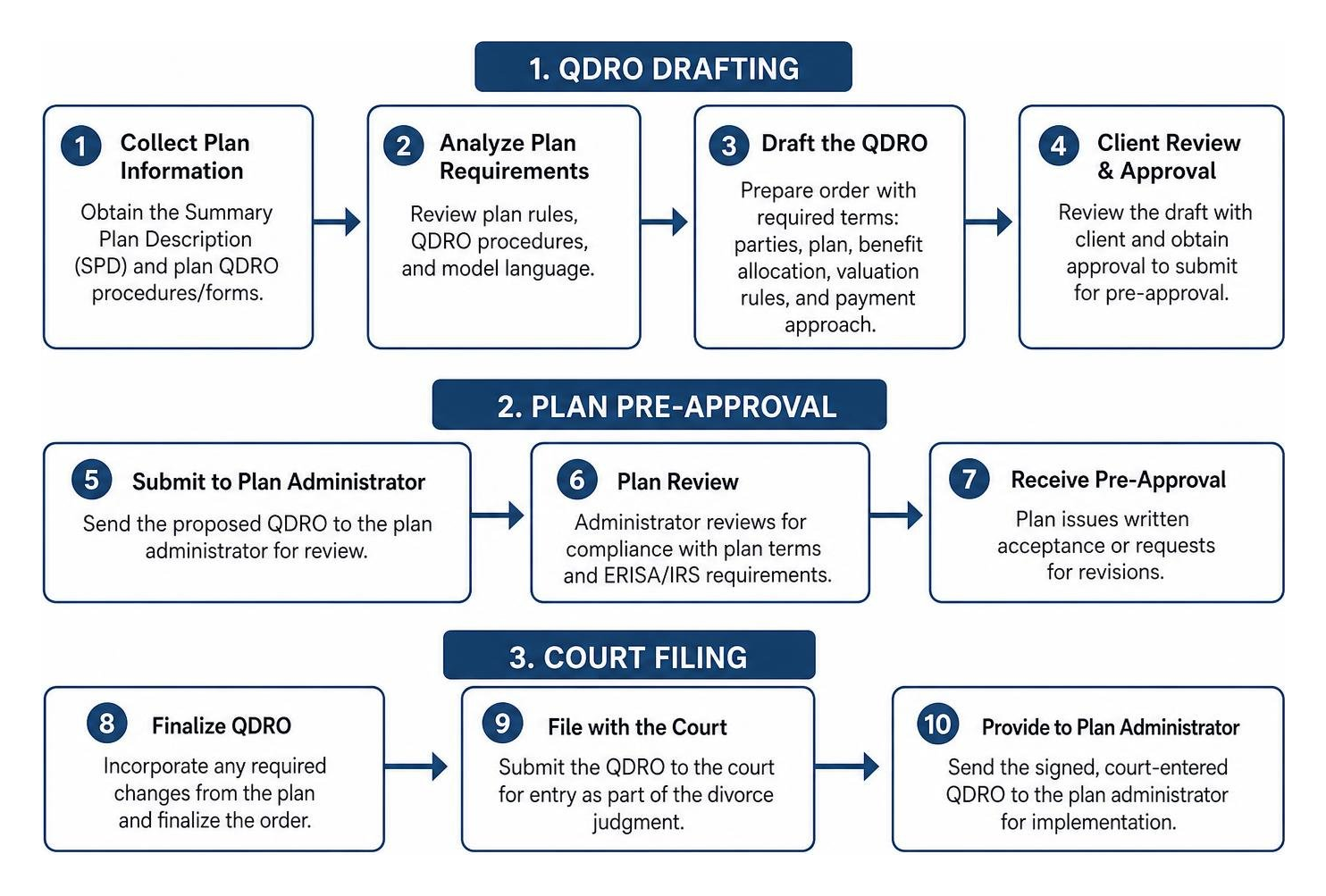
Before drafting, you must collect the governing plan records:
- The formal Summary Plan Description (SPD)
- Written QDRO Procedures and model forms from the plan administrator
- Recent participant benefit statements
- Form 5500 filings (if plan administrator contact details are unknown)
Under U.S. Department of Labor regulations, prospective alternate payees are entitled to request plan information necessary to prepare a domestic relations order. For complete details on administrative disclosures, see the federal guidance on retirement benefit division.
Drafting, Administrative Pre-Approval, and Court Certification
- Drafting: Prepare the order using the plan’s specific model language while incorporating the negotiated terms of the Marital Settlement Agreement (MSA).
- Pre-Approval Review: Whenever permitted by the plan, submit the unsigned draft to the plan administrator for preliminary review. This prevents having to re-file amended orders with the court if the administrator requests technical revisions.
- Court Entry: Submit the finalized order to the state family court judge for signature and entry.
- Certification: Obtain a certified copy stamped by the court clerk.
Formal Plan Submission and Implementation
Submit the certified order directly to the plan administrator for final qualification. The administrator will place an administrative hold on the account, review the order against statutory requirements, and issue a formal written qualification notice.
Once approved, the administrator segregates the funds or updates their pension records to prepare for future disbursements. For insight into the broader administrative and legal expenses involved in family law matters, review our guide on Understanding How Attorney Fees Are Paid in Divorce.
Tax Implications and Distribution Rules for Divorcing Spouses
Retirement divisions carry distinct tax considerations under federal law.
Direct Rollovers, Cost Basis Allocation, and Early Withdrawal Penalties
When an alternate payee who is a spouse or former spouse receives a distribution under a QDRO, they have two primary options:
- Direct Rollover: Roll the funds directly into their own traditional IRA or eligible employer plan, maintaining full tax deferral until retirement.
- Cash Distribution: Take an immediate cash distribution. While the distribution is subject to ordinary income tax (and mandatory 20% federal tax withholding), it is exempt from the 10% early withdrawal penalty under IRC § 72(t)(2)(C), regardless of the alternate payee’s age.
If the participant had after-tax contributions (cost basis) in the plan, that basis is allocated pro-rata between the participant and the alternate payee based on the present value of the benefits assigned.
Tax Liability Rules for Child Support and Dependent Distributions
Tax treatment changes entirely when retirement benefits are paid to a child or dependent alternate payee to satisfy child support obligations.
Under the Internal Revenue Code, distributions paid to a child or dependent are taxable to the participant employee, not to the child. The plan issues IRS Form 1099-R to the employee, who must report the income on their personal tax return.
Critical Risks of Delay, Survivor Benefits, and Common Drafting Pitfalls
Timing is critical when dealing with retirement orders. Reviewing What to Expect When You Are Getting a Divorce helps keep these administrative requirements on schedule.
Protecting Pre-Retirement (QPSA) and Post-Retirement (QJSA) Survivor Annuities
In defined benefit pension plans, lifetime benefit payments stop when the participant dies unless survivor annuities are explicitly established in the QDRO:
- Qualified Preretirement Survivor Annuity (QPSA): Protects the alternate payee if the participant dies before retirement. The order must designate the former spouse as the surviving spouse for QPSA purposes.
- Qualified Joint and Survivor Annuity (QJSA): Protects the alternate payee after retirement benefit commencement. Once a participant retires and elects a benefit payout option, that beneficiary election is generally irrevocable.
If survivor benefits are omitted from the QDRO, the alternate payee’s monthly payments will terminate entirely upon the participant’s death.
Consequences of Participant Retirement, Remarriage, or Death Before Qualification
Delaying the submission of a QDRO can result in catastrophic financial losses:
- Participant Retirement: If the employee retires before the QDRO is qualified, they may select a single-life annuity or name a new spouse as survivor beneficiary, permanently extinguishing the former spouse’s survivorship rights.
- Participant Death: If the participant dies before the order is qualified, the entire benefit may revert to a newly married surviving spouse or lapse completely under plan terms.
- Asset Depletion: An employee may take loans, withdraw funds, or change investment allocations while unmonitored.
Common Drafting Mistakes to Avoid
- Ordering Unallowable Benefit Options: Demanding a lump-sum distribution from a pension plan that only offers monthly annuities.
- Ambiguous Valuation Dates: Failing to specify an exact calendar cut-off date for defined contribution account balances.
- Ignoring Market Fluctuations: Failing to specify whether the alternate payee’s share includes investment gains and losses prior to distribution.
- Omitting Survivor Protections: Forgetting to designate the former spouse as a surviving spouse for QPSA and QJSA benefits.
- Failing to Address Plan Loans: Neglecting to state whether outstanding loan balances reduce the gross marital balance or are assigned solely to the borrowing spouse.
- Relying on Generic Forms: Using standard ERISA templates for exempt state, municipal, or military retirement systems.
Frequently Asked Questions About Retirement Asset Division
Can a single order cover multiple retirement plans?
While federal law permits a single domestic relations order to reference multiple plans sponsored by the same employer, doing so often causes administrative confusion. Most plan administrators require a separate, freestanding QDRO for each individual retirement plan (e.g., one order for a 401(k) plan and a separate order for a defined benefit pension plan) to ensure clear qualification and processing.
What happens if an ex-spouse dies before the retirement benefits are distributed?
Under a separate interest approach in a defined benefit or defined contribution plan, the alternate payee’s share is segregated into their own account or lifetime annuity. In defined contribution plans, the alternate payee can designate their own beneficiaries. In defined benefit plans or under shared payment approaches, benefits may terminate upon the alternate payee’s death unless the QDRO explicitly provides for contingent alternate payees or estate succession permitted under plan rules.
Can an alternate payee roll over retirement funds into an IRA tax-free?
Yes. An alternate payee who is a spouse or former spouse can roll over their awarded share of a defined contribution plan directly into their own traditional IRA or eligible employer-sponsored plan via a trustee-to-trustee transfer without incurring immediate income taxes or early withdrawal penalties.
Conclusion: Protecting Your Financial Future During Divorce
Retirement assets frequently represent years—or decades—of marital effort. Ensuring these assets are divided accurately requires precision, procedural vigilance, and a detailed understanding of both state matrimonial law and federal employee benefits regulations.
At Shane and White, LLC, our legal team brings more than 40 years of focused family-law experience to clients across Edison, Metuchen, Woodbridge, New Brunswick, East Brunswick, and throughout Middlesex County, New Jersey. We provide personalized attention and clear communication to safeguard your financial stability.
If you are navigating a divorce involving pensions, 401(k) plans, or complex business and retirement holdings, contact our office to schedule a consultation with an experienced New Jersey divorce representation team that will protect your rights at every stage of the process.


