


Can You Claim Social Security Benefits After Divorce?
Yes. If you were married to your former spouse for at least 10 years, are age 62 or older, are currently unmarried, and your own retirement benefit is lower, you may be able to claim Social Security on your ex-spouse’s work record. Start by confirming the marriage dates in your marriage certificate and final divorce decree, then compare your own estimated benefit with up to 50% of your ex-spouse’s full retirement age benefit.
Your claim does not reduce your former spouse’s check, affect a current spouse’s benefit, or require your ex’s approval. If your ex has not filed yet, you may still qualify once you have been divorced for at least two years and your former spouse is eligible for retirement benefits.
This is an important part of planning for divorce and Social Security, especially as later-life divorce becomes more common. The rules are federal, technical, and easy to overlook during an already stressful divorce process.
I am Kenneth White, Esq., a Certified Matrimonial Law Attorney in New Jersey with decades of experience helping clients address the financial issues that arise in family-law matters. Understanding divorce and Social Security can help you ask informed questions as you plan for a stable post-divorce future.
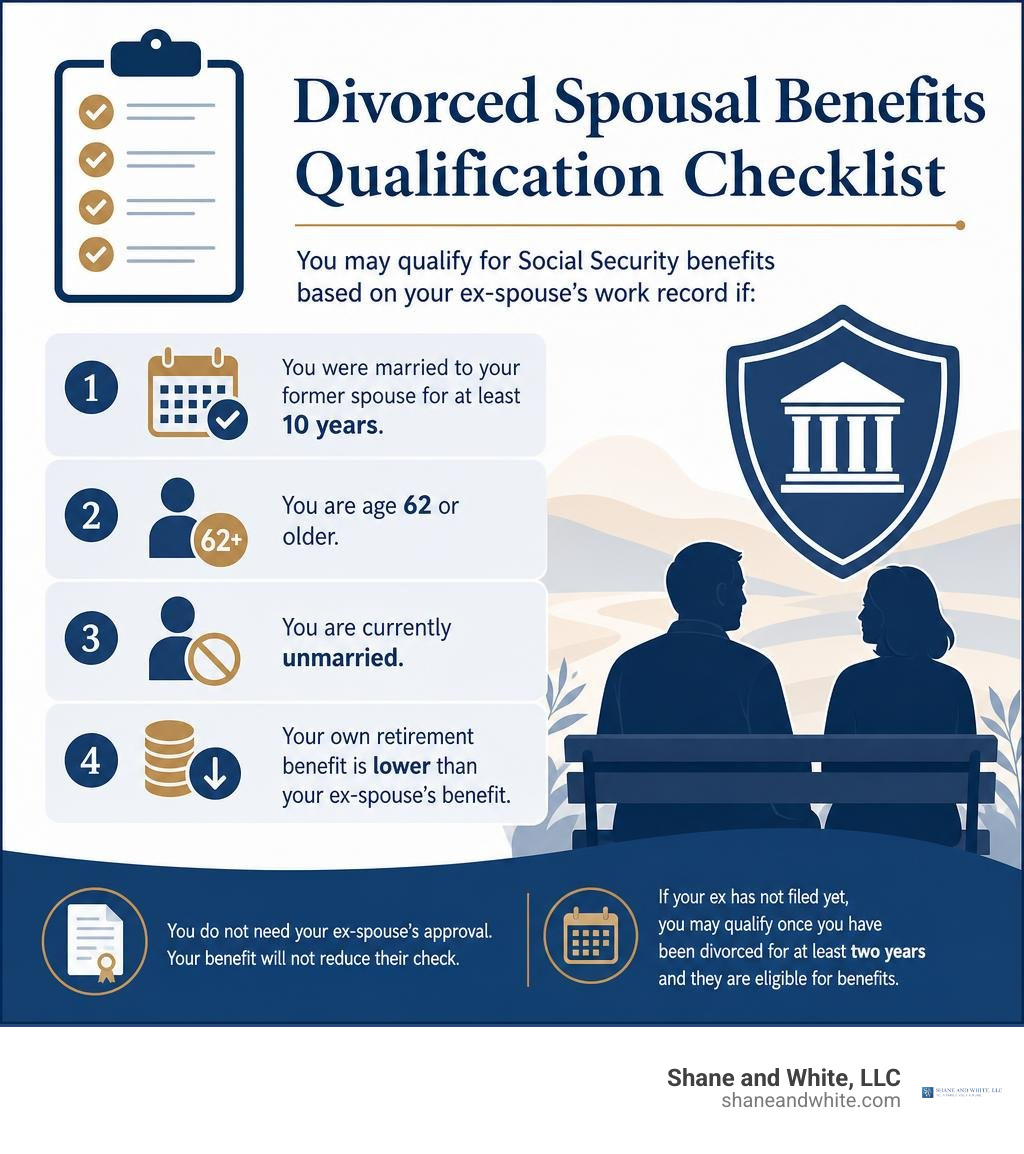
Quick divorce and social security definitions:
Understanding Divorce and Social Security Rules and Eligibility
Navigating life after a marital split requires a solid grasp of your financial entitlements. More than 4 in 10 Americans nearing retirement age do not know that divorced individuals can collect Social Security based on an ex-spouse’s earnings history. With gray divorce rates tripling for adults aged 65 and older since 1990—now accounting for 36% of all marital dissolutions nationwide—understanding these federal rules is critical for retirement security.
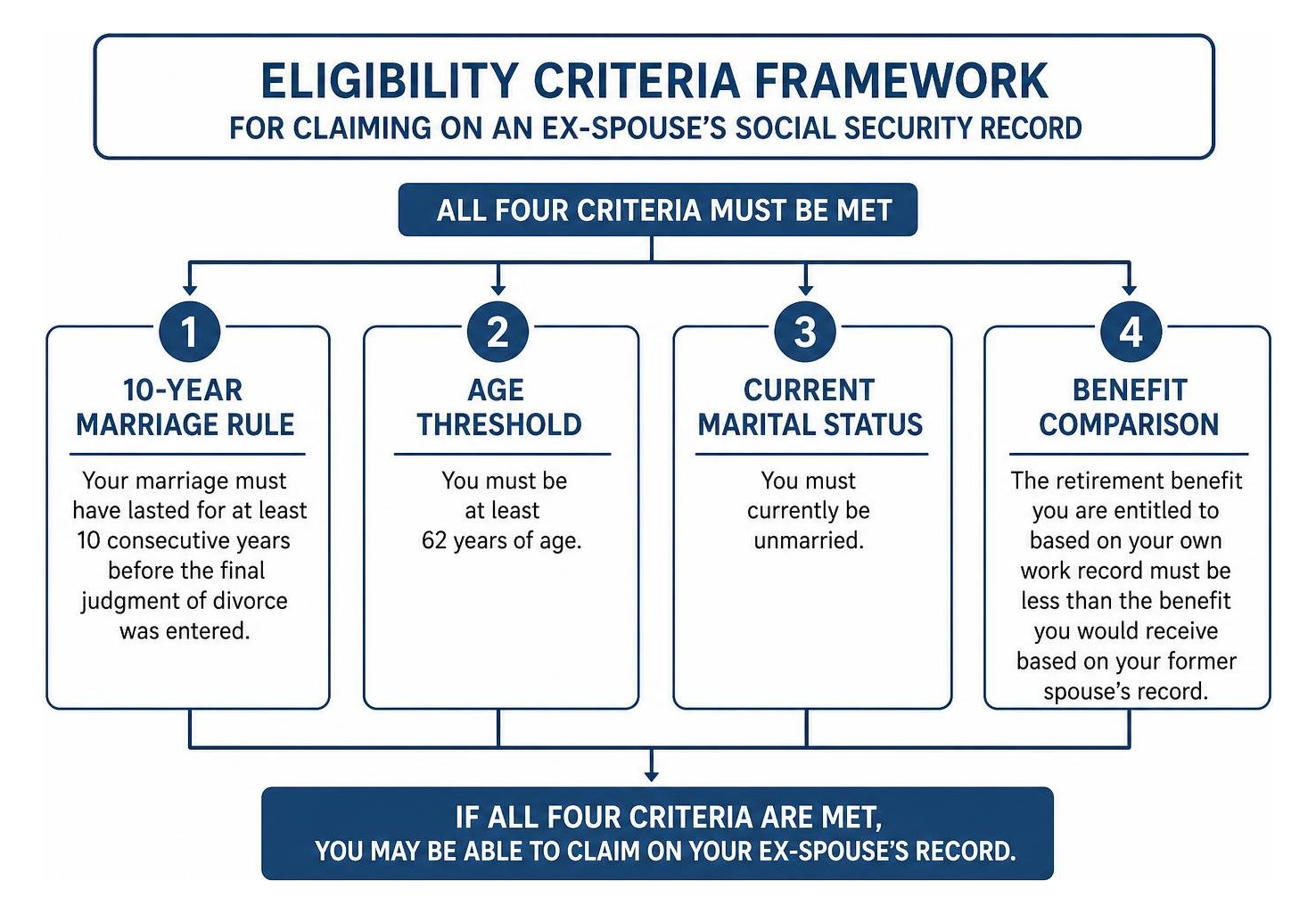
To successfully claim benefits on your former spouse’s work record, you must satisfy four basic statutory criteria established under federal law:
- The 10-Year Marriage Rule: Your marriage must have lasted for at least 10 consecutive years prior to the date the final judgment of divorce was entered. The Social Security Administration (SSA) applies this strictly; being married for nine years and 11 months will result in a denial.
- Age Threshold: You must be at least 62 years of age.
- Current Marital Status: You must currently be unmarried.
- Benefit Comparison: The retirement benefit you are entitled to based on your own work record must be less than the benefit you would receive based on your former spouse’s record.
As highlighted in reporting on how a divorced spouse married at least 10 years can claim up to half an ex’s Social Security without touching the ex’s own check, these rights belong to you independently by federal statute. While navigating state-specific divorce proceedings outlined in The Ultimate Guide to New Jersey Divorce Laws and Process, keep in mind that federal Social Security entitlements operate under their own distinct legal framework.
How Divorce and Social Security Rules Affect Remarriage
Remarriage fundamentally alters your eligibility for spousal benefits on an ex-partner’s record. If you remarry, you forfeit the right to claim benefits under your previous spouse’s earnings history, as you are now eligible to claim on your new spouse’s record once eligible.
However, if your subsequent marriage ends due to divorce, death, or annulment, your eligibility to claim on your first spouse’s record is restored, provided that initial marriage met the 10-year rule. For those considering tying the knot again, reviewing The Complete Guide to Remarrying After Divorce can help clarify how entering a new marriage affects various legal and financial agreements.
Gender Neutrality and Same-Sex Marriage Entitlements
Social Security spousal and divorced spousal benefits are strictly gender-neutral. Following statutory updates enacted by Congress in 1983, ex-husbands and ex-wives are evaluated under the exact same legal criteria.
Furthermore, following the landmark 2015 Supreme Court ruling in Obergefell v. Hodges, these protections apply equally to same-sex divorced couples across the country. Regardless of gender, any individual who meets the continuous 10-year marriage threshold and statutory age requirements has full legal standing to apply.
Calculating Your Benefit: Primary Insurance Amount and Timing Strategies
Your divorced spousal benefit is determined by your ex-spouse’s Primary Insurance Amount (PIA)—the baseline monthly benefit they are entitled to receive at their Full Retirement Age (FRA). The maximum benefit a divorced spouse can receive is 50% of the ex-spouse’s PIA.
It is vital to understand that spousal benefits do not earn delayed retirement credits. While personal retirement benefits increase by 8% per year for every year you delay claiming between your FRA and age 70, a divorced spousal benefit maxes out at your own FRA (typically age 67 for anyone born in 1960 or later). Delaying a spousal claim past your FRA will not yield a higher monthly check.
As explored in personal finance analyses like the Divorced Spouse Benefit Worth $1,840 a Month: The Social Security Rule Most Americans Miss, maximizing this payout requires careful coordination with other post-marital assets. In New Jersey, addressing these income streams alongside marital property is covered under Financial Issues in Divorce: Dealing With Alimony and Equitable Distribution.
| Claiming Age | Percentage of Ex-Spouse’s FRA Benefit Received | Illustrative Monthly Payment (Ex-Spouse PIA: $3,680) |
|---|---|---|
| Age 62 | 32.5% | $1,196 |
| Age 63 | 35.0% | $1,288 |
| Age 64 | 37.5% | $1,380 |
| Age 65 | 41.7% | $1,534 |
| Age 66 | 45.8% | $1,685 |
| Age 67 (Full Retirement Age) | 50.0% | $1,840 |
| Age 70 | 50.0% (No delayed credits) | $1,840 |
Early Claiming Penalties vs. Waiting Until Full Retirement Age
Filing for benefits before reaching your Full Retirement Age results in a permanent reduction of your monthly payment. If your FRA is 67 and you choose to file as early as age 62, your spousal benefit is permanently reduced to roughly 32.5% of your ex-partner’s PIA rather than the full 50%.
This reduction can have lasting consequences. Data indicates that women experience an average drop of 45% in their standard of living following a gray divorce, compared to a 21% decline for men. The case study Gray Divorce Cut Her Standard of Living Nearly in Half at 63. Social Security Became Her Safety Net, and Her Strategy illustrates how choosing the right claiming age can mean thousands of dollars in difference each year.
Additionally, if you claim early while continuing to work, your payments may be subject to the SSA Retirement Earnings Test ($23,400 limit for early filers), which temporarily withholds $1 for every $2 earned above the annual statutory cap.
Multiple Ex-Spouses and Dual Entitlement Rules
If you were married more than once, and each marriage lasted at least 10 continuous years, you do not collect multiple checks combined. Instead, the SSA applies the dual entitlement rule: you receive an amount equal to the highest single benefit available, whether based on your own work record or that of either former spouse.
When you submit your application, the SSA automatically evaluates each eligible earnings history and pays out the largest benefit amount.
Privacy, Consent, and the Zero-Sum Myth

One of the most persistent misconceptions surrounding Social Security after divorce is the fear of conflict or retaliation. Many individuals worry that filing on an ex-partner’s record will reduce that former partner’s monthly check, trigger an angry phone call, or require court permission.
None of these concerns are true:
- Zero Impact on Your Ex-Spouse: Your ex-spouse’s monthly retirement benefit is completely untouched. They receive the exact same dollar amount regardless of whether you file.
- Current Spouses Are Unaffected: If your ex-spouse has remarried, their current spouse can still claim full spousal benefits without any reduction.
- Exempt from Family Maximum Caps: Benefits paid to a divorced spouse do not count toward the statutory family maximum benefit limit.
- Strict Privacy and Non-Notification: The SSA does not notify your former spouse when you file a claim on their record. The entire process is confidential.
- Divorce Decrees Cannot Waive Rights: Even if a marital settlement agreement contains language where a party purports to “waive” rights to federal Social Security benefits, the SSA considers such clauses legally unenforceable under federal anti-alienation provisions.
For higher earners curious about post-divorce obligations, our article But I Paid Alimony: Why Should My Former Spouse Be Able to Collect My Social Security? breaks down why federal benefits operate independently from state alimony awards. Furthermore, while employer pensions and 401(k) accounts require specialized orders as detailed in Demystifying Qualified Domestic Relations Orders for Divorcing Couples, Social Security benefits never require a QDRO.
Step-by-Step Guide: How to Apply for Divorced Spousal Benefits
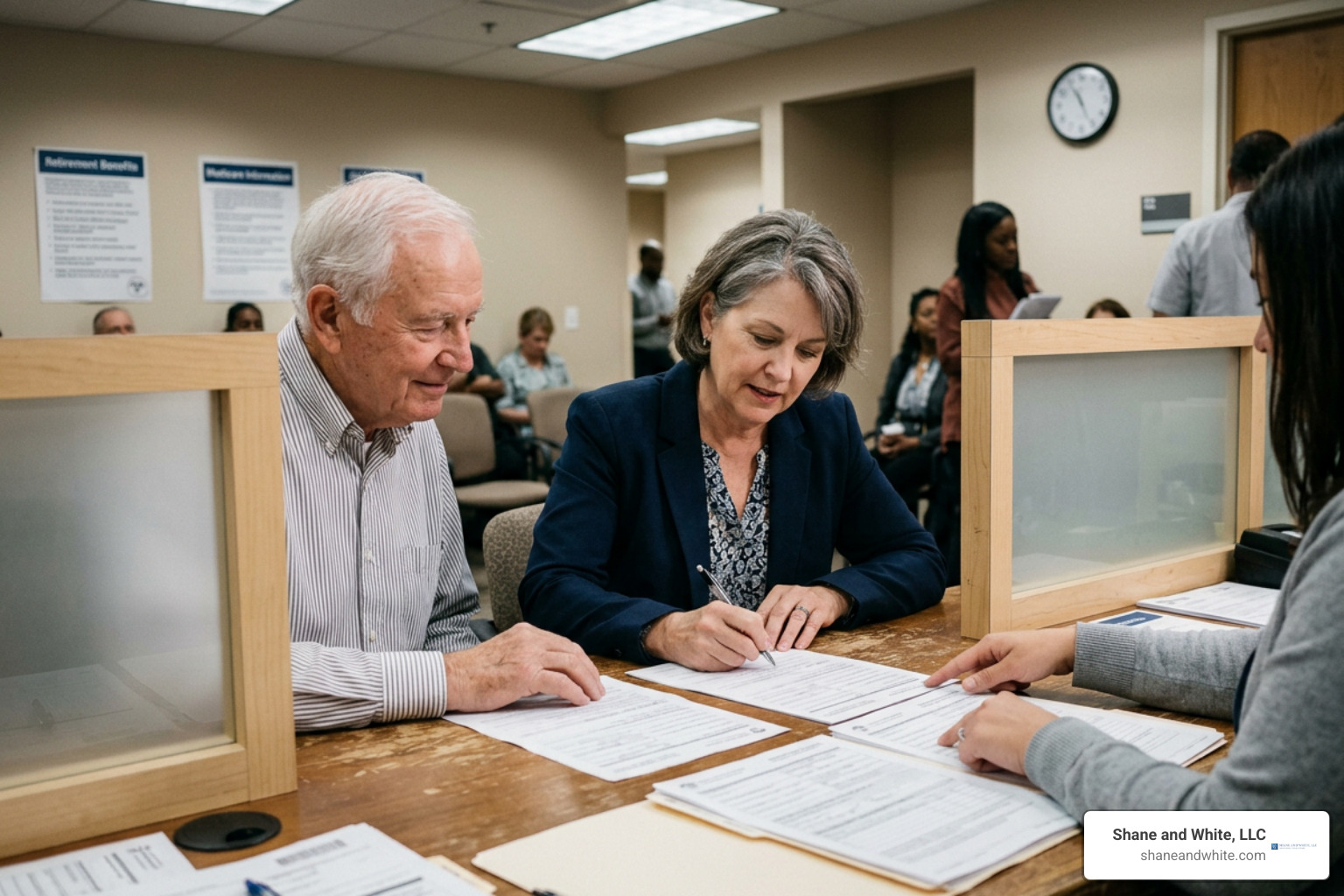
Claiming your divorced spousal benefit requires filing Form SSA-2 (Information You Need to Apply for Spouse’s or Divorced Spouse’s Benefits). You can apply:
- Online at SSA.gov (if you are within three months of turning 62 or older)
- By telephone by calling the national toll-free line at 1-800-772-1213 (TTY 1-800-325-0778)
- In person by scheduling an appointment at your local Social Security field office
If your claim is denied or you dispute a benefit calculation, you have 60 days from the date of the written determination notice to file a formal appeal. Further background on filing procedures is available through resources on Divorce and Social Security Spousal Benefits.
Required Documentation and Application Checklist
To prevent administrative delays, assemble the following original or certified records before contacting the SSA:
- Your original or certified birth certificate (or proof of U.S. citizenship / legal alien status)
- Your official marriage certificate establishing the start of the marriage
- Your final judgment of divorce proving the marriage was dissolved after at least 10 continuous years
- Your ex-spouse’s Social Security number, or their full legal name, date of birth, and parents’ names to enable the SSA to pull their earnings record
- Your most recent W-2 forms or federal self-employment tax returns
- Your bank routing and account numbers to establish direct deposit
Navigating Divorce and Social Security Survivor Benefits
If your former spouse passes away, your divorced spousal benefit automatically converts into a surviving divorced spouse benefit upon application. This transition provides substantial financial protection:
- 100% Benefit Amount: As a surviving divorced spouse, you can receive up to 100% of your deceased ex-spouse’s benefit (including any delayed retirement credits they accumulated), rather than the standard 50% spousal maximum.
- Age 60 Threshold: Survivor benefits can be claimed as early as age 60 (or age 50 if you are disabled).
- The Remarriage Rule After Age 60: If you remarry after reaching age 60 (or age 50 with a disability), your remarriage does not terminate your right to collect survivor benefits based on your deceased former spouse’s earnings.
Strategic claiming guidance is detailed in Social Security Tips for Divorced Spouses and Widows, showing how surviving ex-spouses can choose to collect survivor benefits first while allowing their own personal retirement benefit to accrue credits until age 70.
Frequently Asked Questions About Divorced Spousal Benefits
Can my ex-spouse block me from receiving Social Security in our divorce settlement?
No. Federal law supersedes state-level divorce agreements when it comes to Social Security. Private contracts, marital settlement agreements, or court orders attempting to waive or assign statutory Social Security rights are void and will not be enforced by the Social Security Administration.
What happens if my ex-spouse has not yet claimed their Social Security benefits?
Under the “independently entitled ex-spouse” rule, you do not have to wait for your former partner to file for retirement. As long as your ex-spouse is at least 62 years old and fully insured, you can claim benefits on their record provided you have been legally divorced for at least two consecutive years.
Will claiming benefits on my ex-spouse alert them or lower their monthly payment?
No. The Social Security Administration maintains strict privacy guidelines and will not inform your ex-spouse when you file a claim against their record. Your monthly check is paid directly from the Social Security trust fund and has no impact on what your ex-spouse or their current household receives.
Conclusion
Understanding how marital dissolution impacts your retirement is an essential step in rebuilding your financial life. Coordinating federal entitlements with state equitable distribution, alimony orders, and retirement savings ensures you do not leave vital income on the table.
At Shane and White, LLC, we have spent more than 40 years helping individuals throughout Edison, Metuchen, Woodbridge, East Brunswick, and surrounding New Jersey communities navigate complex divorce and financial transitions. If you have questions about structuring your marital settlement agreement or protecting your long-term assets, contact our office today to schedule a confidential consultation.


