


When Can You Remarry After Divorce? Start With the Final Judgment
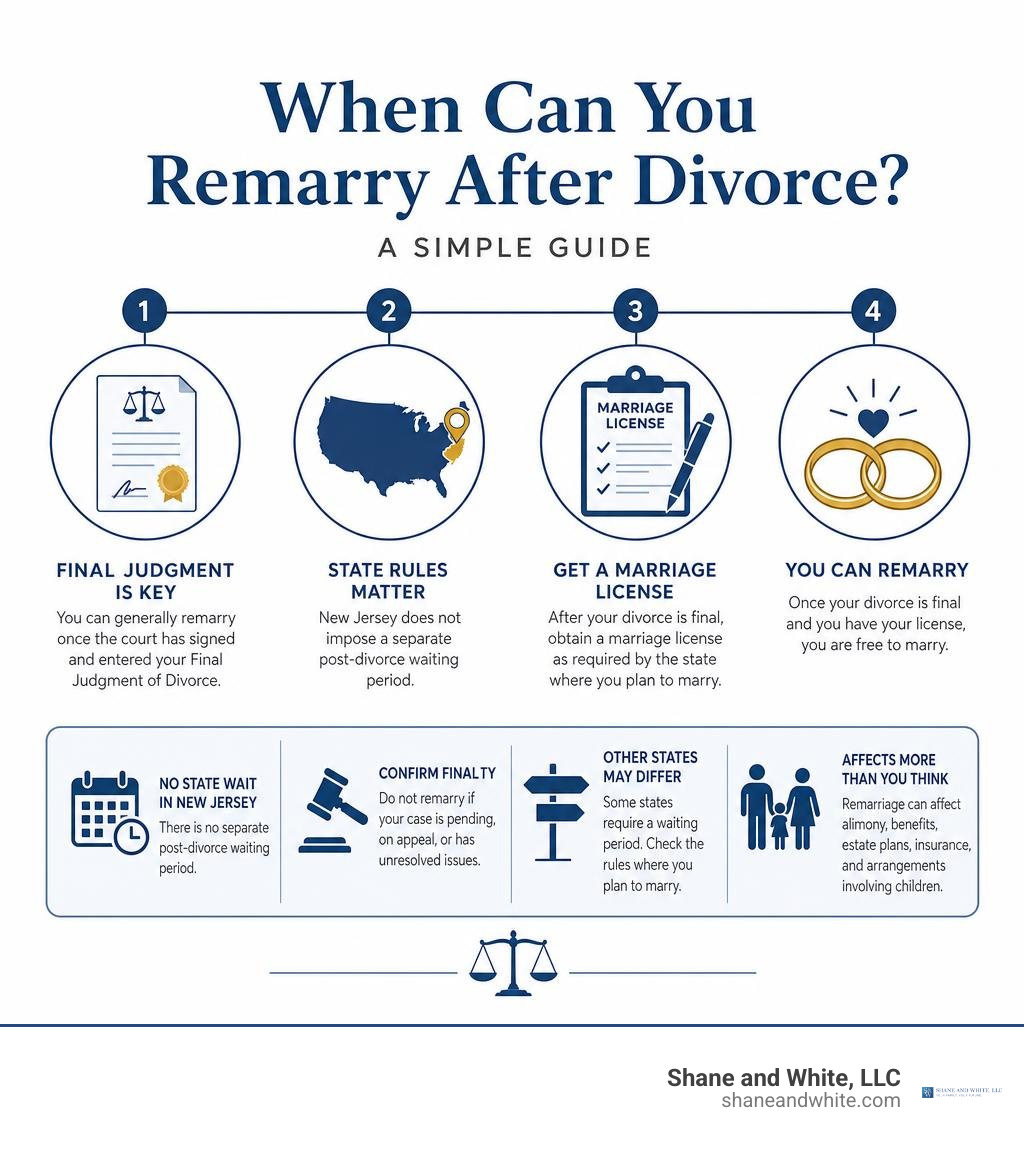
When can you remarry after divorce? In New Jersey, you can generally remarry once the court has signed and entered your Final Judgment of Divorce. New Jersey does not impose a separate post-divorce waiting period, but you should not plan a wedding until you confirm that your divorce is final and no court issue is holding it up.
| Your situation | Can you remarry? |
|---|---|
| Divorce case is still pending | No |
| Judge signed and court entered the Final Judgment of Divorce in New Jersey | Generally, yes |
| Appeal or unresolved court issue may affect finality | Confirm your status before remarrying |
| You live in another state | It depends – some states require a waiting period |
A new marriage can affect more than your relationship status. It may change alimony, Social Security benefits, estate plans, insurance, and financial arrangements involving children. Religious rules can also set a different timeline than civil law.
I am Kenneth White, Esq., a New Jersey Supreme Court-certified matrimonial law attorney who has helped clients navigate divorce, settlement, and post-divorce issues for decades. I understand that the question of when can you remarry after divorce often comes with real emotional and financial pressure, so this guide starts with the legal facts you need to move forward with confidence.
When can you remarry after divorce terms to learn:
State Laws: When Can You Remarry After Divorce?

When you are ready to start a new chapter in life, timing is everything. The short answer to when can you remarry after divorce depends primarily on the jurisdiction in which your divorce was granted. While state laws vary widely across the country, the underlying legal concept remains constant: you must be completely unmarried in the eyes of the law before you can legally contract a new marriage.
Determining When Can You Remarry After Divorce in New Jersey
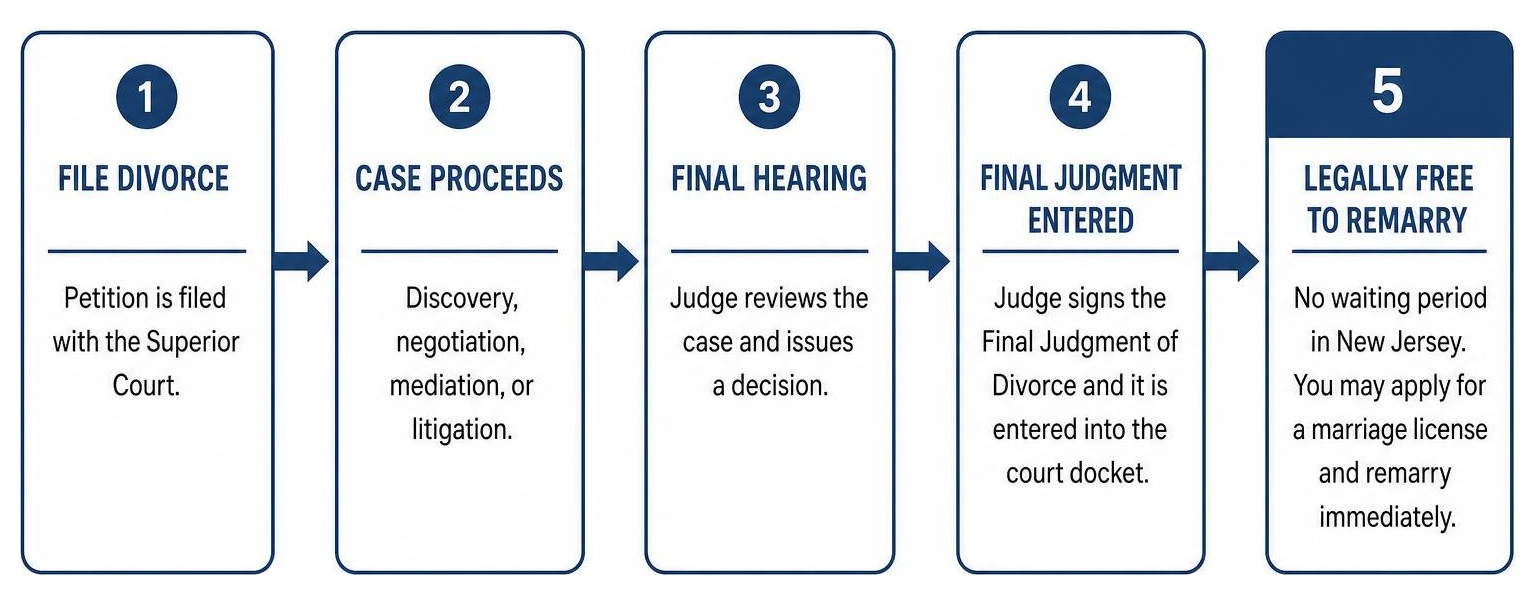
In New Jersey, the law provides a straightforward answer. Once a judge of the Superior Court signs your Final Judgment of Divorce and it is formally entered into the court docket, your prior marriage is officially dissolved. New Jersey is among approximately 35 states that enforce zero post-divorce waiting period. This means that as soon as the court enters your final decree, you are legally free to apply for a new marriage license and tie the knot immediately.
However, understanding how long does it take to get divorced in New Jersey is critical before booking a caterer or reserving a wedding venue. An uncontested divorce with a signed marital settlement agreement may take anywhere from a few weeks to a few months to reach a final hearing, whereas contested litigation can linger for a year or longer. Never rely on an estimated timeline provided by an attorney or a court clerk as a guarantee for scheduling a second wedding; you must have the physical, stamped Final Judgment of Divorce in hand.
State-by-State Rules on When Can You Remarry After Divorce
If your divorce was granted outside of New Jersey, or if you plan to relocate or hold your ceremony in another state, you must be aware of state-specific post-divorce waiting periods or statutory “cooling-off” periods.
While states like New Jersey, Connecticut, and Utah impose zero waiting period after the final decree is signed, other states mandate waiting periods ranging from 30 days to 6 months:
| State | Post-Divorce Remarriage Waiting Period | Notes / Exceptions |
|---|---|---|
| New Jersey | 0 Days | Immediate remarriage allowed once Final Judgment is entered. |
| Connecticut | 0 Days | Immediate remarriage allowed post-decree; 90-day pre-divorce wait applies. |
| Utah | 0 Days | Immediate remarriage allowed post-decree. |
| Texas | 30 Days | Mandatory 30-day wait under Family Code 6.801; can be waived for good cause. |
| Kansas | 30 Days | 30-day wait unless remarrying your former spouse. |
| Rhode Island | 3 Months | Wait required between decision and final decree entry. |
| Wisconsin | 6 Months | Mandatory 6-month wait before entering a new marriage anywhere. |
| Massachusetts | 90 to 120 Days | Nisi period: 90 days for contested (1B), 120 days total for uncontested (1A). |
If you are unsure about the rules governing your specific court decree, reviewing the divorce process guide or consulting with experienced legal counsel is essential to prevent costly administrative delays.
Legal Risks and Consequences of Remarrying Too Soon
Attempting to remarry before your prior divorce is legally absolute carries severe legal risks. Premature remarriage creates a situation where you are legally married to two people simultaneously—a status known as bigamy.
Under New Jersey law, as well as statutes across all U.S. jurisdictions, any marriage entered into while a prior valid marriage still exists is void ab initio (invalid from the very beginning). It does not require a formal divorce to dissolve the second marriage; the law treats it as though it never existed.
Consider these significant risks:
- Automatic Invalidity: A marriage celebrated during a post-divorce waiting period or while an appeal is pending is automatically null and void.
- Criminal Penalties: In many states, knowingly entering into a bigamous marriage can lead to misdemeanor or felony criminal charges. For example, in Utah, bigamy is classified as a third-degree felony carrying up to 5 years in prison.
- Complications During Appeals: If your ex-spouse files a timely appeal against the Final Judgment of Divorce, the divorce decree may be stayed or modified. Remarrying during an active appeal creates immense legal jeopardy regarding property rights and marital status.
If you find yourself in a situation where you scheduled a wedding prematurely or suspect your prior divorce was never finalized, read our guide on i thought i was divorced but I’m still legally married what do I do to learn how to correct your marital status quickly.
Essential Documents and Marriage License Application Requirements

Once you have verified that your divorce is legally final and any required waiting periods have elapsed, you can begin the administrative process of applying for a new marriage license.
Documentation Required for Second Marriage Licensing
When applying for a marriage license in New Jersey—whether at a municipal clerk’s office in Edison, East Brunswick, Woodbridge, or elsewhere in Middlesex County—previously divorced applicants must fulfill specific documentation requirements.
To ensure a seamless application process, bring the following items to your municipal Registrar of Vital Statistics:
- Government-Issued Photo Identification: Valid driver’s license, state ID, or passport.
- Proof of Residency: Required for at least one applicant if applying in your home municipality.
- Social Security Number: Required for identity verification under federal guidelines.
- Certified Copy of Final Judgment of Divorce: A standard photocopy will not suffice. You must present an official document bearing the court stamp and judge’s signature proving that your prior marriage was formally dissolved.
- Application Fee: Typically around $28 in New Jersey municipalities.
For municipal specifics, such as local office hours and appointment scheduling, review the official East Brunswick Marriage License Information page.
In New Jersey, there is a mandatory 72-hour holding period between the time you apply for your marriage license and the time it is issued. Plan your ceremony date accordingly so you do not run into scheduling bottlenecks.
Post-Remarriage Name Change and Administrative Updates
If you or your new spouse intend to change your surname following remarriage, you must follow a logical administrative order to avoid identity discrepancies:
- Social Security Administration (SSA): Update your name with the SSA first by filing Form SS-5 along with your certified marriage certificate.
- Motor Vehicle Commission (MVC): Once your Social Security record is updated, visit an MVC agency to update your New Jersey driver’s license and vehicle registration.
- U.S. Passport Service: Submit a passport renewal application to reflect your legal name change.
- Financial Institutions & Employers: Update payroll, bank accounts, credit cards, and insurance coverage.
If you wish to adopt a surname that differs from standard marriage naming options, you may need to file a formal court petition by following the NJ Courts Name Change Guidelines.
How Remarriage Affects Alimony, Child Support, and Social Security
Entering a second marriage brings significant changes to existing financial arrangements established during your divorce. Understanding these adjustments prevents unexpected legal disputes down the road.
Alimony Termination and Cohabitation Rules
One of the most immediate financial consequences of remarriage in New Jersey involves spousal support (alimony). Under New Jersey statute (N.J.S.A. 2A:34-23), an obligation to pay open durational or limited duration alimony terminates automatically upon the remarriage of the recipient spouse, unless your Property Settlement Agreement explicitly states otherwise.
Key rules governing alimony and new relationships include:
- Prompt Notification: The alimony recipient has an affirmative legal duty to notify the paying ex-spouse immediately upon remarrying. Failing to do so can result in court orders forcing the recipient to reimburse all overpaid spousal support.
- Cohabitation Prior to Remarriage: Moving in with a new romantic partner prior to marriage can also trigger a suspension or termination of alimony under New Jersey’s cohabitation statutory guidelines, provided the paying spouse can show a mutually supportive relationship resembling marriage.
To learn more about closing out financial obligations after a divorce decree, read our article on what happens now tying up loose ends upon your divorce.
Child Support Obligations and Stepparent Income
A common area of confusion is how remarriage affects child support calculations. In New Jersey, child support is calculated using state guidelines based primarily on the income of the two biological (or legal) parents.
- Stepparent Income Is Excluded: Your new spouse’s earnings are not included in New Jersey child support guidelines to calculate support for your children from a previous marriage. A stepparent has no legal duty to support stepchildren.
- Indirect Financial Changes: While a new spouse’s income is excluded, remarriage might alter your overall household tax status or available income, which in rare instances could serve as a factor during a formal motion to modify support based on changed circumstances.
Social Security Divorced Spouse Benefits After Remarriage
If you were married to your former spouse for at least 10 years, you may be eligible to collect Social Security retirement or disability benefits based on their work record. However, remarrying impacts these federal rights based on your age:
- Remarrying Before Age 60: If you remarry before reaching age 60 (or age 50 if disabled), you generally lose eligibility to receive derivative Social Security benefits on your former spouse’s record.
- Remarrying After Age 60: If you remarry at or after age 60, your eligibility to claim benefits based on your former spouse’s record remains intact without penalty.
Financial Planning and Prenuptial Agreements for Second Marriages
Entering a second marriage often involves combining mature financial portfolios, pre-existing real estate, business interests, or obligations to children from prior relationships.
Protecting Assets with Second Marriage Prenuptial Agreements
Prenuptial agreements are especially crucial for second marriages. Under New Jersey’s Uniform Premarital and Pre-Civil Union Agreement Act, couples can define property rights, protect separate assets, and establish clear rules regarding spousal support in the event of a future divorce or death.
A well-crafted prenuptial agreement helps:
- Protect Inheritance Rights: Ensure specific assets or real estate pass to children from a first marriage.
- Ring-Fence Pre-Owned Property: Maintain sole ownership of businesses, retirement savings, or homes acquired prior to the second marriage.
- Prevent Future Litigation: Clearly outline expectations for spousal support or property division before walking down the aisle.
Review what are the requirements to file for divorce in New Jersey to see how asset division works when no agreement is in place.
Updating Estate Plans and Beneficiary Designations
Remarriage requires a comprehensive review of your estate planning documents. Under New Jersey law, a surviving spouse has an “elective share” right to a portion of a deceased spouse’s estate, regardless of what a pre-existing will states, unless that right was explicitly waived in a prenuptial agreement.
Be sure to perform the following updates immediately after remarrying:
- Revise Your Last Will and Testament and Trusts: Align your estate distribution goals with your new family structure.
- Update Beneficiary Designations: Review primary and contingent beneficiaries on life insurance policies, 401(k) plans, IRAs, and annuities.
- Grant Powers of Attorney: Assign healthcare proxy and financial power of attorney roles to reflect your current wishes.
Religious and Biblical Considerations for Remarriage
For many individuals, determining when can you remarry after divorce involves spiritual guidelines alongside civil state laws. Civil law permissions do not automatically align with religious doctrines.
Biblical Perspectives and Christian Theology
In Christian theology, marriage is viewed as a lifelong sacred covenant. Scriptural discussions regarding divorce and remarriage focus heavily on biblical grounds:
- Foundational Rule: Passages like 1 Corinthians 7:10–11 emphasize remaining unmarried or seeking reconciliation with a former spouse whenever possible.
- Biblical Exceptions: Many theologians interpret Matthew 19:9 and 1 Corinthians 7:12–15 as permitting divorce and subsequent remarriage in cases involving marital unfaithfulness (adultery) or abandonment by an unbelieving spouse.
- Spiritual Reconciliation: Many Christian denominations view divorce as forgivable under faith, encouraging individuals to seek spiritual counsel from pastoral leadership prior to entering a second marriage.
Catholic, Jewish, and Islamic Post-Divorce Requirements
Major world faiths maintain distinct procedural rules before approving a religious second wedding ceremony:
- Catholicism: A civil divorce is not recognized as dissolving a sacramental marriage. A divorced Catholic must obtain an official Decree of Nullity (annulment) from a church tribunal before remarrying within the Catholic Church. This process can take 6 to 18 months.
- Judaism: Under Jewish law (Halakha), a civil divorce does not dissolve a religious marriage. The husband must grant, and the wife must accept, a formal religious divorce document called a Get. Without a Get, any subsequent relationship is considered adulatory under Jewish law.
- Islam: Islamic law requires a waiting period called Iddah for women following a divorce—typically lasting three monthly cycles or until delivery if pregnant—to ensure clarity regarding paternity before entering a new marriage contract.
Understanding the difference between civil separation and formal dissolution can help clear up religious and legal confusion; explore our analysis of legal separation myths and facts to learn more.
Frequently Asked Questions about Remarrying After Divorce
What happens if I remarry before my divorce decree is finalized?
If you remarry before your Final Judgment of Divorce is signed and entered by the court, your new marriage is automatically void from the beginning under New Jersey law. You also risk criminal allegations of bigamy. You must wait until the judge formally signs your decree.
Do I need to show my final divorce decree to get a new marriage license?
Yes. When applying for a marriage license in New Jersey after a prior divorce, municipal clerks require you to present an official certified copy of your Final Judgment of Divorce showing the official court seal and judge’s signature.
Will my new spouse’s income reduce my child support payments?
No. In New Jersey, child support calculations are based exclusively on the income of the child’s biological or adoptive parents. Your new spouse’s earnings are not counted as parent income under the New Jersey Child Support Guidelines.
Conclusion
Knowing exactly when can you remarry after divorce comes down to one fundamental milestone: receiving an official, court-entered Final Judgment of Divorce. While New Jersey permits immediate remarriage once that final judgment is signed, jumping ahead without confirming your decree, updating estate plans, or understanding alimony impacts can create complex legal headaches.
At Shane and White, LLC, our legal team brings over 40 years of combined family law experience to clients across Edison, East Brunswick, Woodbridge, and throughout Middlesex County. We provide personalized attention and clear communication every step of the way—whether you are working through an initial divorce, negotiating a prenuptial agreement, or addressing post-divorce alimony modifications.
Contact us today by visiting our Shane and White Divorce Practice page to schedule a confidential consultation and protect your future as you begin your next chapter.


