


Step 1: Meet Grounds and Residency Rules for a Low Cost Divorce in NJ
To achieve a low cost divorce in NJ, spouses should file on no-fault grounds like irreconcilable differences, use official self-help court packets or apply for an in forma pauperis fee waiver to eliminate filing costs, and resolve custody and property distribution through uncontested settlement agreements or free court mediation. Meeting state residency requirements and avoiding high-conflict litigation allows couples to finalize their dissolution affordably.
Achieving an affordable dissolution begins with understanding New Jersey’s statutory requirements. In New Jersey, the legal term for divorce is “dissolution.” Rushing to file without verifying that you meet state jurisdiction rules or selecting complex fault grounds can quickly turn an otherwise budget-friendly process into a protracted, expensive dispute.
For a complete overview of the legal framework governing these cases, review The Ultimate Guide to New Jersey Divorce Laws and Process and learn what to expect when you are getting a divorce.
Understanding No-Fault Dissolution Grounds
To keep costs low, filing on no-fault grounds is almost always the best approach. Under New Jersey law, spouses have two primary no-fault avenues:
- Irreconcilable Differences: This is the most common and cost-effective ground for dissolution. You must show that irreconcilable differences have existed between you and your spouse for at least 6 months, that these differences make it clear the marriage has broken down, and that there is no reasonable prospect of reconciliation.
- Separation: You and your spouse must have lived separate and apart in different residences for at least 18 consecutive months prior to filing, with no reasonable expectation of getting back together.
Choosing fault grounds—such as extreme cruelty, adultery, or desertion—often escalates conflict. Proving fault requires compiling extensive evidence, deposing witnesses, and spending additional hours in court, all of which drive up expenses. Filing based on irreconcilable differences removes the need to prove marital misconduct, allowing both parties to focus on resolving practical matters like property division and child-related arrangements amicably.
Meeting New Jersey Residency Requirements
Before a New Jersey court can dissolve your marriage, you must satisfy state residency laws:
- General 12-Month Rule: For no-fault filings based on irreconcilable differences or separation, at least one spouse must have resided in New Jersey for at least 12 consecutive months immediately before filing the divorce complaint.
- Adultery Exception: The only exception to the one-year rule is adultery, where the cause of action can be filed if at least one spouse is a bona fide resident when the conduct occurred and when the complaint is filed. However, because fault claims increase litigation expenses, sticking to irreconcilable differences remains the primary path for keeping costs down.
- County Venue: You must file your paperwork in the Family Division of the Superior Court in the county where you resided when the cause of action arose. If neither spouse lives in that county anymore, you file in the county where the defendant lives, or where the plaintiff lives if the defendant resides out of state.
Step 2: Preparing and Filing NJ Divorce Forms on a Budget
Once you confirm jurisdiction, the next step is obtaining and filing the necessary paperwork without paying thousands of dollars in administrative or drafting fees. Following The Divorce Process Guide ensures you understand each procedural step, while exploring how to reach a fair divorce settlement without going broke helps you manage the financial transition effectively.
Essential Court Documents and Free Packets
To initiate a dissolution action, the court requires specific forms. You can download these forms for free directly from the official New Jersey Judiciary website or consult your local county Superior Court Office of the Ombudsman for procedural guidance. Additionally, Legal Services of New Jersey (LSNJ) offers a complete self-represented divorce kit containing comprehensive instructions and printable forms for $25.
The core initial filing packet includes:
- Complaint for Divorce: Outlines the grounds, residency history, children, and relief requested (such as division of debts or name change).
- Summons: Notifies your spouse that a complaint has been filed and provides the legal timeframe to respond.
- Certification of Verification and Non-Collusion: Confirms that your complaint is truthful and not filed in collusive agreement with your spouse.
- Certification of Insurance Coverage: Verifies current medical, life, vehicle, and property insurance policies to ensure coverage remains intact during proceedings.
- Certification of Notification of Complementary Dispute Resolution (CDR): Confirms you have been informed of alternative dispute resolution methods.
- Case Information Statement (CIS): A comprehensive breakdown of assets, debts, income, and living expenses required whenever financial support, alimony, or equitable distribution is requested.
Filers can submit these documents electronically using the Judiciary Electronic Document Submission (JEDS) system, by certified mail with return receipt requested, or in person at the county Family Division Clerk’s office.
Applying for a Court Filing Fee Waiver
The standard court fee to file a divorce complaint as a plaintiff in New Jersey is $300. If your case involves child custody or parenting time requests, the court mandates an additional $25 fee for a parent education workshop, bringing the total initial filing cost to $325. If the defendant files an appearance or answer, the response fee is $175 (plus $25 if parenting matters are involved).
If you cannot afford these fees due to low income or financial hardship, you can apply for an official fee waiver (in forma pauperis).
| Item / Category | Standard Court Fee | Fee Waiver (In Forma Pauperis) |
|---|---|---|
| Plaintiff Divorce Complaint | $300 | $0 (if approved by court) |
| Parenting Workshop Fee | $25 (if custody/parenting time is contested) | $0 (if approved by court) |
| Defendant Answer / Appearance | $175 | $0 (if approved by court) |
| Eligibility Criteria | Standard income | Low income, public assistance, or verified financial hardship |
| Required Submission | Payment via JEDS / check / cash | Verified petition and certification of assets, income, and expenses |
To request a waiver, complete and submit a verified petition for fee waiver along with proof of household income, public benefits documentation (such as TANF, SNAP, or SSI), and a breakdown of monthly expenses. If approved by the assigned Family Division judge, all court filing fees are waived entirely.
Step 3: Serving Papers and Managing Custody Affordably
After your complaint is assigned a court docket number, New Jersey court rules require formal service of process on your spouse. Navigating this step carefully prevents procedural delays, helps you avoid common mistakes to avoid during a divorce, and provides essential structure—especially when addressing divorce in New Jersey when one spouse controls the money.
Serving Papers and Custody Rules for a Low Cost Divorce in NJ
Under New Jersey court rules, you must serve the filed Summons, Complaint, and accompanying certifications on your spouse within 60 days of receiving your docketed paperwork from the court.
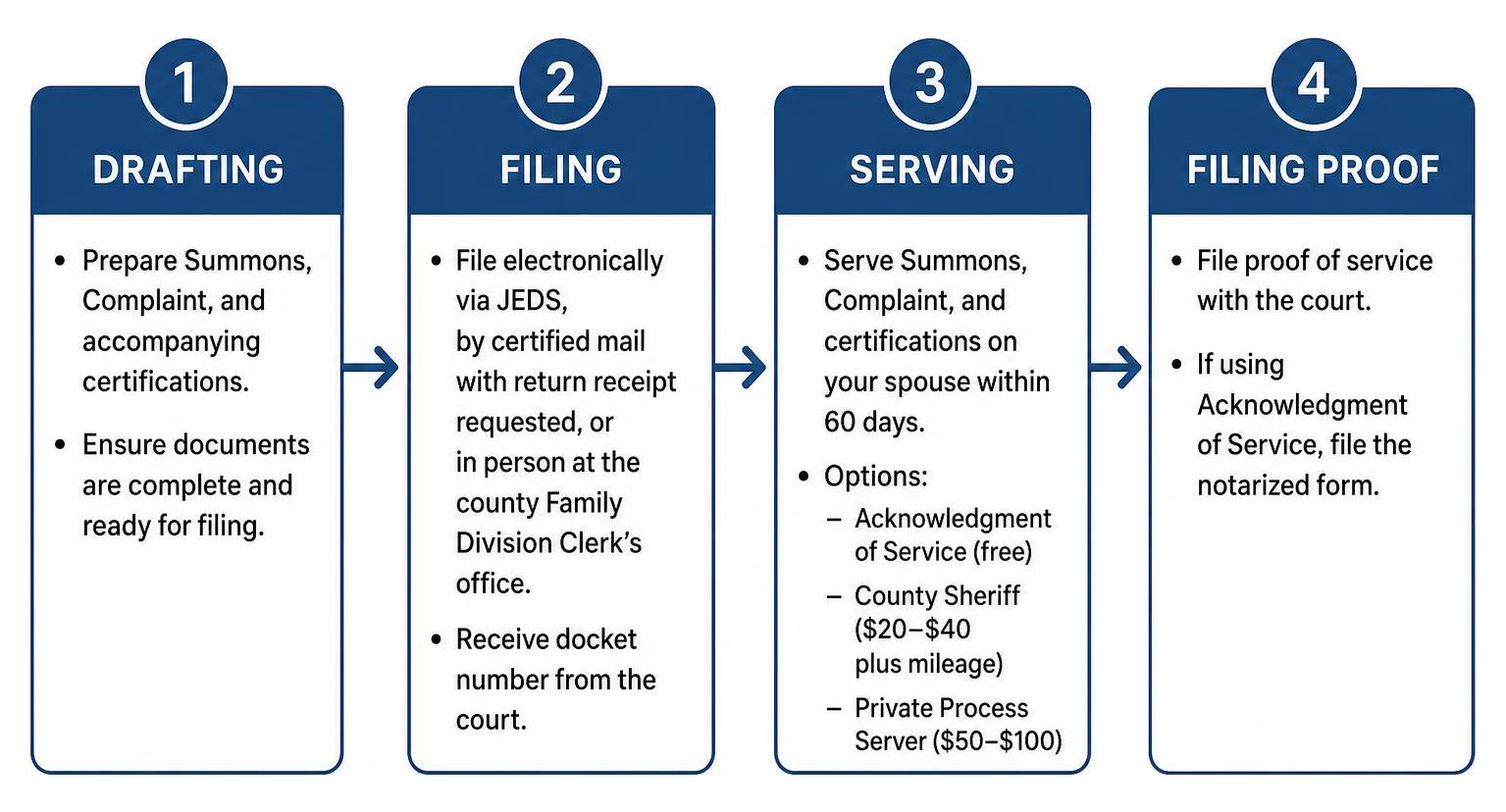
Several options exist for completing service, ranging from free to low-cost:
- Acknowledgment of Service (Cheapest): If your spouse is cooperative, you can hand or mail them the papers alongside an Acknowledgment of Service form. Your spouse signs the form before a notary and returns it to you. You then file this proof with the court clerk, incurring zero service fees.
- County Sheriff’s Office: You can deliver two copies of the summons and complaint to the Sheriff’s Office in the county where your spouse lives or works. The Sheriff serves the papers in person for a modest statutory fee (typically $20 to $40 plus mileage).
- Private Process Server: If the sheriff is unable to complete service, licensed private process servers can be hired, generally charging between $50 and $100 depending on location and attempts required.
If the defendant is served but fails to file an answer within 35 days, you can request an entry of default, allowing the dissolution to proceed uncontested without extensive courtroom litigation.
Protecting Child Custody and Support on a Limited Budget
When minor children are involved, resolving parenting disputes efficiently prevents costly evaluations and trial fees:
- Court-Sponsored Custody Mediation: New Jersey Family Courts automatically refer parents with contested custody or parenting time issues to free, mandatory court mediation before judges hear contested motions. A trained court mediator helps both parents establish a realistic parenting plan.
- New Jersey Child Support Guidelines: Child support calculations in New Jersey follow statutory shared-parenting and sole-parenting worksheets based on parental income, overnights, health insurance premiums, and daycare costs. Using the court’s automated support software removes ambiguity and reduces legal disputes over support figures.
- Guardian ad Litem: If child safety or fitness is genuinely contested, the court may appoint a guardian ad litem or custody expert to advocate for the child’s best interests. While this involves costs, parents can request that the court apportion fees based on respective financial capacities.
Step 4: Resolving Disputes Outside Court with Alternative Dispute Resolution
The single most effective way to keep your divorce affordable is utilizing Complementary Dispute Resolution (CDR). Litigation in open court drains savings through motion practice, formal discovery, and trial preparation. Exploring your divorce start to finish highlights how alternative dispute resolution helps reach finality quickly, and discovering how a divorce attorney helps protect your rights and assets ensures equitable property division during settlement negotiations.
Using Settlement Panels and Court Mediation
New Jersey courts provide several structured settlement avenues to resolve contested issues without a full trial:
- Early Settlement Panel (ESP): If economic issues (such as alimony, debt division, or asset distribution) remain unresolved after initial filings, the court refers the parties to an ESP. The panel consists of two experienced, volunteer family law attorneys who review both parties’ CIS forms and settlement proposals, then provide an informal, non-binding recommendation on how a judge would likely rule. This service is provided at no cost to the parties.
- Economic Mediation: If parties do not accept the ESP recommendation, they are referred to economic mediation. In New Jersey, court-approved economic mediators provide the first two hours of service for free (including one hour of preparation and one hour of mediation). If additional sessions are necessary, the mediator’s standard hourly rate applies, split between the parties.
- Binding Arbitration: For couples seeking private resolution outside the public court record, an independent arbitrator can be hired to issue binding decisions efficiently, avoiding lengthy court calendar delays.
Completing a Low Cost Divorce in NJ and Getting Final Records
Once all issues are resolved—either through a signed Marital Settlement Agreement (MSA) or an uncontested default hearing—the judge enters a final Judgment of Divorce (JOD). This document legally dissolves the marriage, incorporates your property and custody agreements, and restores prior legal surnames if requested.
To obtain certified copies of your final Judgment of Divorce for updating records, Social Security, vehicle titles, or passports:
- Contact the Superior Court Clerk’s Office in Trenton or your county Family Division records department.
- Standard certified copies with a raised seal generally cost $10 to $25 per copy.
- Requests can be processed online, by mail, or in person by providing your docket number and identification.
Step 5: Finding Affordable Legal Help and Pro Bono Assistance in New Jersey

While representing yourself is entirely possible, not every situation is suitable for an entirely DIY approach. Recognizing the signs you need a divorce attorney for your case is crucial, and understanding how a local divorce attorney can save time and stress can prevent severe long-term financial consequences.
Regional Help in Bergen County and North Newark
For residents facing financial hardship, New Jersey offers several non-profit legal aid and pro bono networks:
- Legal Services of New Jersey (LSNJ): Provides free legal representation and advice to income-eligible individuals across the state through regional offices and their statewide legal hotline.
- Northeast New Jersey Legal Services: Serves low-income residents in Bergen, Hudson, and Passaic counties, offering family law assistance, domestic violence representation, and sliding-scale civil support.
- Volunteer Lawyers for Justice (VLJ): Operates legal clinics and direct pro bono referral panels in Essex County (including North Newark) and across North Jersey, connecting qualifying filers with volunteer private attorneys.
- County Family Court Self-Help Centers: Located within county courthouses, court ombudsmen assist self-represented litigants with procedural questions, form selection, and electronic filing navigation.
Options When You Earn Too Much for Legal Aid
Many working individuals find themselves in a challenging middle ground: they exceed the strict income ceilings for free legal aid, yet cannot afford tens of thousands of dollars for a prolonged contested trial.
If you find yourself in this situation, consider these flexible options:
- Unbundled / Limited-Scope Legal Services: Rather than hiring an attorney on a full-retainer basis for the entire case, you hire counsel exclusively for specific tasks—such as reviewing your self-drafted Marital Settlement Agreement, calculating child support, or preparing your Case Information Statement.
- Structured Payment Plans: Many private practitioners offer manageable installment plans or reduced initial retainers for uncontested matters.
- Targeted Consultations: Booking a single strategic consultation gives you legal clarity on statutory rights and settlement parameters before you negotiate directly with your spouse.
When evaluating your situation, knowing how to choose your family law attorney ensures you select counsel who respects your financial boundaries and prioritizes practical settlement over costly courtroom warfare.
Frequently Asked Questions About Affordable New Jersey Divorce
How much does an uncontested divorce typically cost in New Jersey?
An uncontested divorce where both spouses agree on all terms can cost as little as $300 to $325 in mandatory court filing fees if handled entirely pro se. Utilizing a low-cost document packet (such as the $25 LSNJ kit) and serving documents by mail keeps out-of-pocket costs under $400. If limited-scope legal counsel is retained to draft or review the settlement agreement, total costs generally range between $1,000 and $2,500, compared to contested litigation which can exceed $15,000 to $30,000.
Can I get a divorce filing fee waiver if I cannot afford $300?
Yes. If your household income is at or below state poverty guidelines, or if you receive government assistance (such as SNAP, TANF, SSI, or Medicaid), you can submit a verified petition for a fee waiver (in forma pauperis). If approved by a Superior Court judge, the $300 filing fee and the $25 parenting workshop fee are completely waived.
How do I obtain a certified copy of my final Judgment of Divorce?
You can request certified copies with an official raised seal directly from the Superior Court Clerk’s Office in Trenton or from your local county Family Division record room. You will need to provide the docket number, names of both parties, and the year the judgment was signed. The standard statutory fee is typically $10 for a certified copy and $25 for an authenticated (exemplified) copy.
Conclusion
Dissolving a marriage in New Jersey does not have to result in crippling debt. By leveraging no-fault grounds, utilizing court-approved self-help resources, exploring fee waivers, and embracing alternative dispute resolution methods like Early Settlement Panels and mediation, you can protect both your peace of mind and your financial future.
At Shane and White, LLC, our team brings over 40 years of combined legal experience to help individuals and families across Middlesex County navigate family law matters with clarity, practical strategy, and personalized attention. Whether you need limited-scope document review or full representation in an uncontested matter, explore our East Brunswick family law solutions to achieve a fair, cost-effective resolution.


