


Divorce Can Change Immigration Status, But Timing Matters
Divorce and immigration status depend on where you are in the immigration process. A divorce before a marriage-based green card is approved will usually end that application. A conditional two-year green card holder may still keep status by filing Form I-751 with a waiver and proof the marriage was real. A person with a 10-year green card usually does not lose permanent resident status solely because of divorce, but may need to use the five-year, rather than three-year, path to citizenship.
The most useful first steps are to:
- Identify your current status: pending application, conditional green card, permanent green card, or dependent visa.
- Save records showing the marriage was entered in good faith, including leases, taxes, insurance, bank records, photos, and messages.
- Do not miss immigration deadlines, especially the Form I-751 filing deadline for conditional residents.
- Get advice from both a New Jersey family-law attorney and an immigration attorney before signing a divorce agreement or finalizing a judgment.
Divorce is governed by state law, while immigration is federal law. That means a New Jersey divorce judgment can change the marital relationship USCIS relies on, but a U.S. citizen spouse cannot simply order deportation or cancel a valid green card. The exact date of separation, filing, approval, and final divorce can make a major difference.
I am Kenneth White, Esq., a New Jersey Supreme Court Certified Matrimonial Law Attorney with decades of family-law experience, including divorce matters where immigration concerns affect a family’s choices. Understanding divorce and immigration status early can help you protect your rights and prepare for the next legal step.
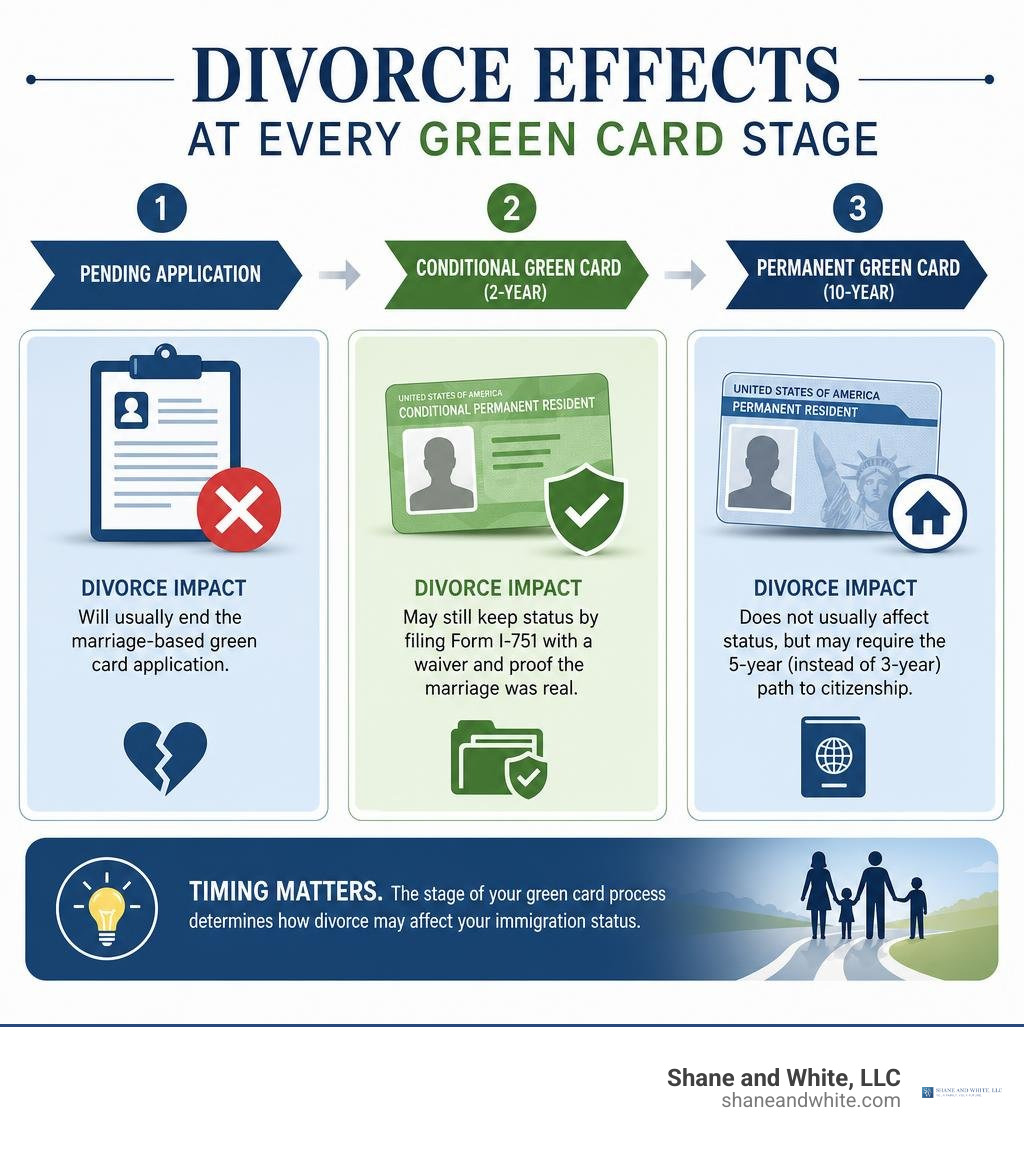
Divorce and immigration status word guide:
Understanding How Divorce and Immigration Status Intersect in the U.S.
When a marriage dissolves, it triggers a chain reaction across two distinct legal systems: state family courts and federal immigration authorities. In New Jersey, our state courts handle the equitable distribution of assets, alimony, child custody, and the formal dissolution of the marital bond. Meanwhile, the Department of Homeland Security (DHS) and U.S. Citizenship and Immigration Services (USCIS) govern legal residency, visa compliance, and naturalization.
Family courts determine when a marriage is legally over, but USCIS decides what that legal termination means for your right to remain in the United States. Federal law places significant emphasis on the bona fide marriage doctrine—the requirement that a marriage was entered into with genuine intent to build a shared life, rather than solely to secure an immigration benefit.
Understanding the legal rights of immigrant spouses during marital breakdown is critical for avoiding unintended immigration violations.
| Legal Event | State Family Law Recognition | Federal Immigration (USCIS) Impact |
|---|---|---|
| Physical Separation | Spouses live apart; may file separate tax returns or draft a separation agreement. | Marriage is still legally valid; joint petitions may face heavy scrutiny during interviews. |
| Filing for Divorce | Action is pending in court; temporary support and custody orders may be entered. | Pending marriage-based petitions remain technically active but cannot be approved once finalized. |
| Final Judgment of Divorce | Marriage is dissolved; parties are legally single and free to remarry. | Terminating event; ends underlying basis for pending marriage-based petitions and dependent visas. |
Legal Separation vs. Final Dissolution Under Immigration Law
A frequent point of confusion is whether moving out or filing for legal separation immediately invalidates an immigration status.
In federal immigration jurisprudence, marital status is evaluated under the laws of the jurisdiction where the couple resides. In New Jersey, physical separation alone does not terminate the legal marriage. Until a Superior Court Family Part judge signs a final Judgment of Divorce, you remain legally married.
However, USCIS applies a practical standard. If a couple is physically separated or actively litigating a divorce during a green card interview, USCIS officers will scrutinize whether a viable, bona fide marriage still exists. While an unfinalized divorce does not immediately cancel a visa on paper, USCIS will not grant an adjustment of status if the marriage is no longer viable or if the petitioning spouse refuses to attend the mandatory adjustment interview.
Can a U.S. Citizen Spouse Cancel Sponsorship or Force Deportation?
During contentious marital disputes, petitioning spouses sometimes threaten to have their foreign-born partner deported. It is vital to understand that a U.S. citizen cannot unilaterally order removal proceedings or revoke an already-issued green card.

A petitioning spouse can withdraw an unapproved Form I-130 (Petition for Alien Relative) at any time before USCIS adjudicates it. If withdrawn, USCIS closes the adjustment of status process.
However, deportation and removal are exclusively within the statutory authority of federal immigration judges and immigration officers—not private citizens. Fabricating immigration fraud allegations in state court to gain leverage in child custody or financial matters can backfire significantly in both family court and federal proceedings. Immigrants facing these threats should seek experienced divorce representation immediately to protect their legal footing.
How Divorce Impacts Green Cards at Different Stages
The effect of a divorce on your legal status depends directly on what stage your immigration case occupies at the exact moment the divorce judgment is signed.
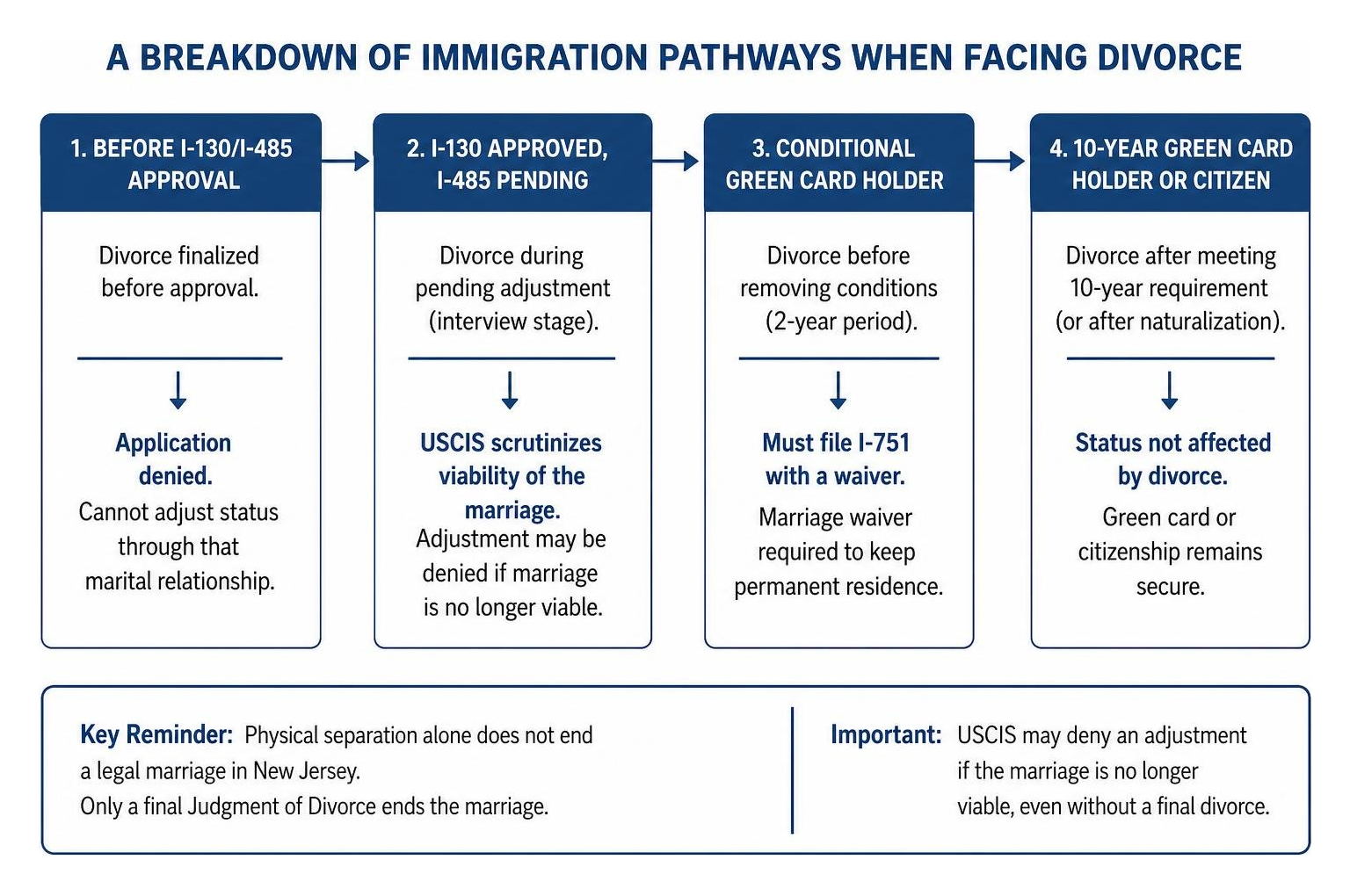
How Pending Green Card Petitions Impact Divorce and Immigration Status
If you are currently waiting for your initial Form I-485 (Application to Register Permanent Residence or Adjust Status) to be approved and your marriage ends, the foundation of your marriage-based application disappears.
- Before I-130/I-485 Approval: If a divorce is finalized before USCIS grants your green card, the application must be denied. The immigrant spouse cannot adjust status through that marital relationship.
- Interview Requirements: Both spouses must attend the adjustment interview. If the U.S. citizen spouse refuses to appear, USCIS will deny the Form I-485 for abandonment or lack of prosecution.
- Alternative Relief: Once a pending marriage-based application falls through, the foreign national must transition to another lawful status (such as an employment-based visa or student status) or face departing the country.
Couples navigating these complex transitions benefit from having comprehensive family law counsel to align divorce timelines with administrative procedures.
The Intersection of Divorce and Immigration Status for Conditional Residents
Foreign nationals who have been married for less than two years on the date their lawful permanent residence is approved receive a two-year conditional green card. This status is designed to deter marriage fraud.
Normally, the couple must file a joint Form I-751 (Petition to Remove Conditions on Residence) within the 90-day window immediately preceding the card’s expiration date. When a marriage ends in divorce during this two-year period, joint filing is no longer legally possible.

Fortunately, federal law allows conditional residents to request an individual waiver of the joint filing requirement. Filing a proper waiver provides an official Form I-797 receipt notice, which extends conditional resident status for up to 48 months while USCIS processes the petition. This extension allows the non-citizen spouse to maintain lawful employment authorization and travel permissions during administrative reviews.
Removing Conditions on Permanent Residence After a Divorce
Divorcing within the two-year conditional window does not mean you are automatically required to leave the United States. Federal regulations under 8 CFR § 216.4 outline specific waiver categories that allow a conditional resident to self-petition on Form I-751.
The primary waiver grounds include:
- Good Faith Marriage Waiver: The marriage was entered into in good faith, but the relationship was terminated through divorce or annulment.
- Battered Spouse / Abuse Waiver: The marriage was entered into in good faith, but the immigrant spouse or child was subjected to physical battery or extreme cruelty by the citizen spouse.
- Extreme Hardship Waiver: Removal from the United States would result in extreme hardship arising from circumstances that occurred after conditional residency was granted.

Proving a Good Faith Marriage After Dissolution
When filing an I-751 waiver based on divorce, the burden of proof rests entirely on the immigrant spouse. USCIS will scrutinize the filing to confirm the marriage was legitimate at its inception and not entered into to circumvent immigration laws.
Crucial evidence for establishing a bona fide marriage includes:
- Joint Financial Records: Bank account statements spanning the duration of the marriage, joint credit card statements, and shared investment portfolios.
- Shared Real Estate / Residential Leases: Lease agreements showing both spouses as tenants, joint home deeds, or mortgages.
- Tax Documentation: Official IRS joint tax return transcripts filed during the marital years.
- Joint Insurance Policies: Health, dental, auto, and life insurance policies listing each other as covered dependents or beneficiaries.
- Evidence of Shared Life: Utility bills in both names, joint vehicle titles, travel itineraries, photographs together across the entire timeline of the relationship, and correspondence.
- Marital Counseling Records: Invoices or letters from family therapists or marriage counselors, which demonstrate that the couple actively tried to preserve their relationship when difficulties arose.
- Third-Party Affidavits: Sworn statements from friends, family members, or community leaders attesting to the authenticity of the relationship.
Protection for Abused Spouses Under VAWA and Battered Spouse Waivers
When a marriage involves domestic abuse, immigration law provides distinct protections so non-citizens are not forced to stay in dangerous environments to protect their status.
Under the Violence Against Women Act (VAWA), abused spouses of U.S. citizens may independently self-petition for a green card using Form I-360. This relief is available to both men and women.
Key procedural rules for VAWA petitions:
- Two-Year Filing Window: If the marriage ends in divorce, the abused spouse must file the Form I-360 self-petition within two years of the final divorce judgment.
- Evidentiary Standard: Applicants must demonstrate good faith marriage, shared residence, and that they suffered battery or “extreme cruelty” (which includes coercive control, psychological abuse, threats of deportation, and financial isolation).
- Confidentiality Protections: Under 8 U.S.C. § 1367, USCIS is strictly prohibited from disclosing any information regarding a VAWA petition to the abusive spouse or using information provided exclusively by an abuser to make an adverse determination.
Financial Obligations and Dependent Visa Vulnerabilities
Divorce impacts not only permanent residency applications but also nonimmigrant dependent visas and ongoing support obligations established during the immigration process.
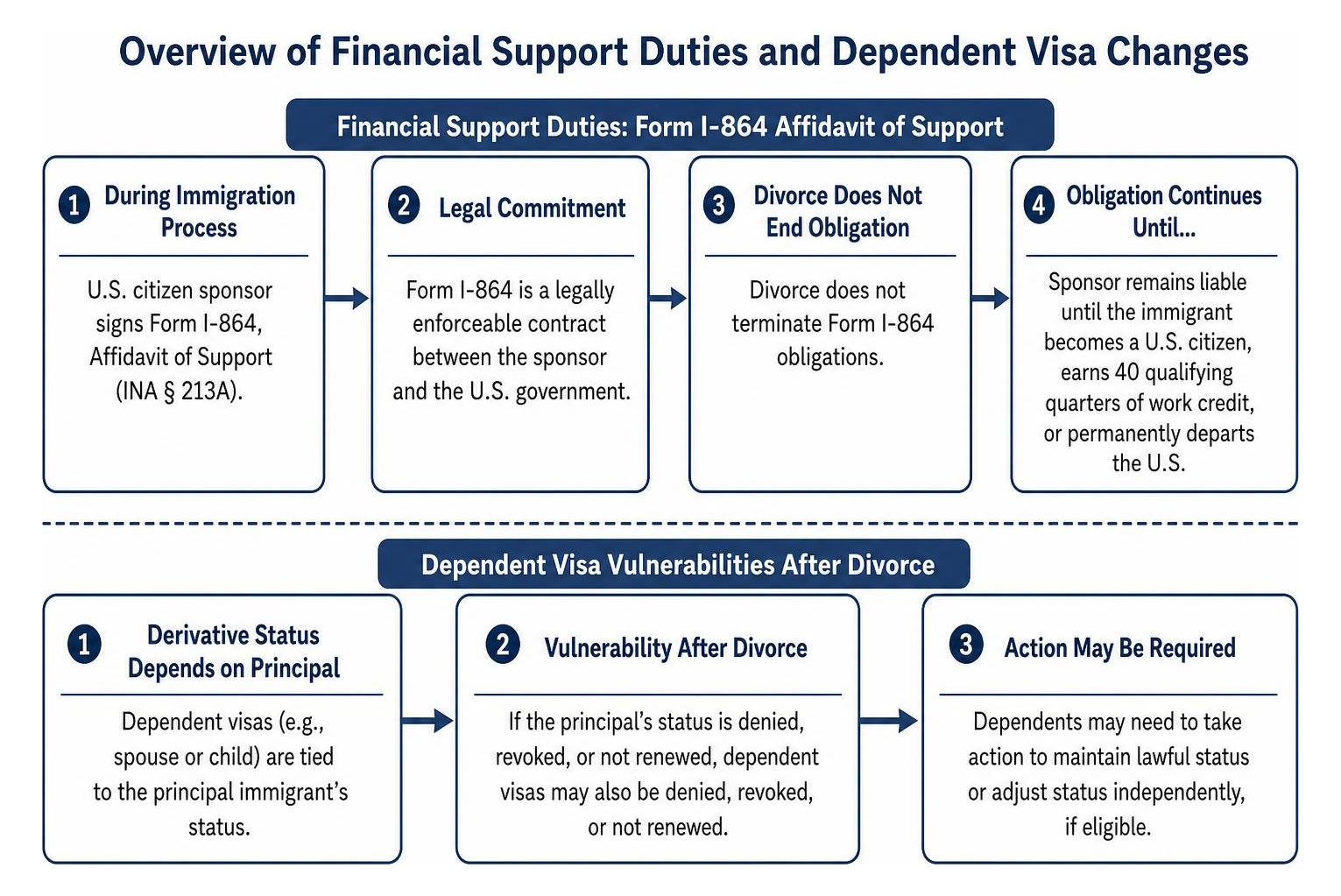
Why the Form I-864 Affidavit of Support Survives Divorce
When a U.S. citizen sponsors an immigrant spouse, they must sign Form I-864, an Affidavit of Support under Section 213A of the INA. This document is a legally enforceable contract between the sponsoring spouse and the U.S. government.
A critical point for both spouses is that divorce does not terminate Form I-864 obligations.
The sponsoring spouse remains financially responsible for ensuring the immigrant spouse has an income at or above 125% of the Federal Poverty Guidelines until one of the following terminating events occurs:
- The sponsored immigrant becomes a naturalized U.S. citizen.
- The sponsored immigrant earns or is credited with 40 qualifying quarters of work under the Social Security Act (roughly 10 years of work).
- The sponsored immigrant permanently departs the U.S. or is placed in removal proceedings and obtains a new grant of relief.
- The sponsored immigrant or the sponsor dies.
Divorce settlements, prenuptial agreements, and state alimony waivers do not eliminate this federal support duty. State family courts in New Jersey can enforce Form I-864 financial obligations as a matter of contract law during matrimonial litigation.
What Happens to Dependent Visas and Employment Authorization
Foreign nationals living in the U.S. on dependent visas (such as H-4, L-2, E-2, or F-2) are directly tied to their spouse’s primary nonimmigrant status.
When a divorce is finalized:
- Immediate Loss of Status: The dependent nonimmigrant visa becomes invalid upon the entry of the final divorce judgment.
- Employment Authorization Revocation: Any Employment Authorization Document (EAD) issued under that dependent status is no longer valid.
- Grace Periods: While DHS regulations provide a discretionary 60-day grace period following certain employment terminations, this provision does not automatically apply in the same manner to dependent visa holders whose status ends due to divorce.
- Changing Status: To remain in the U.S. lawfully, a dependent spouse must transition to an independent visa—such as an H-1B specialty occupation visa, an F-1 student visa, or an O-1 visa—before the divorce is finalized.
Managing these multi-layered legal hurdles requires familiarity across various practice areas to prevent inadvertent out-of-status stays.
Frequently Asked Questions About Divorce and Immigration Status

Can I keep my 10-year permanent green card if I get divorced?
Yes. Once you hold an unconditional 10-year Permanent Resident Card (Form I-551), your status as a Lawful Permanent Resident (LPR) is secure and does not depend on remaining married.
When your 10-year green card approaches expiration, you will file Form I-90 to renew it as an administrative process. Divorce alone is not a basis for USCIS to revoke a permanent green card.
However, if you later apply for U.S. citizenship, USCIS will review your entire immigration history and may examine whether your initial marriage was bona fide.
When should I file an I-751 waiver if my divorce is still pending?
If your two-year conditional green card is nearing its expiration date and your divorce is filed but not yet finalized by the family court, you should not wait for the court proceedings to finish before taking action.
You must file Form I-751 within the mandatory 90-day window before your card expires. You can submit the petition requesting a waiver along with proof that the divorce is actively pending in court.
USCIS will typically issue a Request for Evidence (RFE) providing an extension of time (usually 87 days) to submit the final divorce decree. Once the final Judgment of Divorce is signed, you submit it to USCIS to complete the waiver adjudication.
How does divorce change the timeline for applying for U.S. citizenship?
Divorce directly alters your eligibility timeline for naturalization under Form N-400:
- Spouses of U.S. Citizens (3-Year Rule): A lawful permanent resident married to and living in marital union with a U.S. citizen can apply for naturalization after three years of continuous residence.
- Divorced Permanent Residents (5-Year Rule): If the marriage terminates before the naturalization oath, you lose eligibility under the expedited three-year rule. You must wait until you have accumulated five years of continuous residence as a green card holder before applying for citizenship.
The only exception applies to individuals who obtained their permanent residency through a VAWA self-petition or a battered spouse waiver; they remain eligible to apply for naturalization under the expedited three-year rule even after their marriage ends.
Conclusion: Protecting Your Immigration Future During Divorce
Going through a divorce is challenging on its own, and managing visa rules at the same time adds an extra layer of complexity. However, a marital breakdown does not automatically mean losing your legal status in the United States.
By preserving joint documentation, tracking strict filing deadlines, and understanding how state divorce judgments affect federal immigration processes, you can protect your rights and maintain your path forward.
At Shane and White, LLC, we bring over 40 years of dedicated legal experience to families in Edison, New Jersey, and throughout Middlesex County—including Metuchen, Woodbridge, East Brunswick, New Brunswick, North Brunswick, Monroe, Piscataway, and Sayreville.
Whether you are negotiating support agreements, addressing marital assets, or assessing how family court actions influence your immigration timeline, our team provides the focused guidance you need.
Contact us to discuss protecting your rights in divorce and family matters with dedicated, experienced legal representation.


