


A Clear Path to Resolving Edison Child Custody Disputes
A stable Edison child custody arrangement starts with a practical, child-focused parenting plan. Parents should identify where the child will live, set a reliable parenting-time schedule, address school and medical decisions, and create clear rules for holidays, transportation, and communication. If agreement is not possible, a New Jersey family court decides custody based on the child’s best interests, not on a preference for either parent.
Focus first on what will reduce conflict and give your child consistency:
- Put parenting time and exchange details in writing.
- Define how major legal, school, and health decisions will be made.
- Keep communication brief, respectful, and centered on the child.
- Gather financial records early, because support and custody issues often overlap.
- Consider mediation or negotiation before asking the court to decide.
New Jersey custody law is gender-neutral. Courts must assess each parent’s real ability to provide care, stability, safety, and support. A parent’s gender – or a broad assumption about a mother’s or father’s role – should not decide the outcome. That principle is illustrated by Edison v. Edison, a North Dakota case in which an appellate court rejected a custody decision overly shaped by generalized assumptions connected to breastfeeding. The key lesson applies broadly: a child’s needs matter, but courts must evaluate the actual family and evidence before them.
I am Kenneth White, Esq., a New Jersey Supreme Court Certified Matrimonial Law Attorney with experience in Middlesex County family-law practice, mediation, and court-appointed family roles. This guide explains the practical and legal issues that can shape an Edison child custody plan and help families move toward a workable resolution.

Easy Edison child custody word list:
Navigating Edison Child Custody Laws and Parenting Standards

When addressing custody matters in Edison and across Middlesex County, understanding the foundational distinction between legal custody and physical (residential) custody is critical. Legal custody concerns decision-making authority regarding the child’s health, education, and general welfare, while physical custody establishes where the child resides on a day-to-day basis. Parents can explore different types of custody arrangements to determine whether joint legal custody, shared residential responsibility, or sole custody best serves their child’s needs.
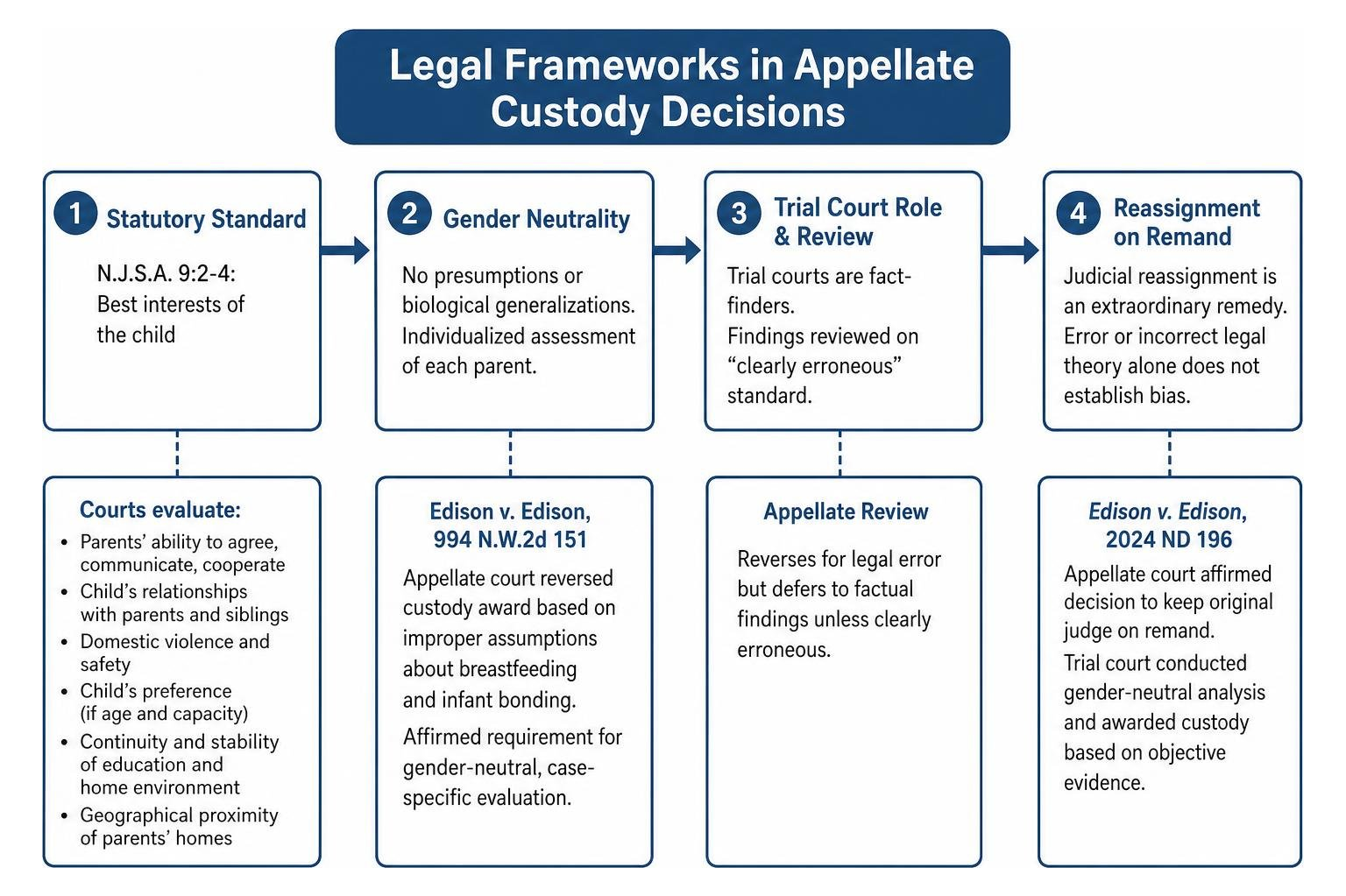
Under New Jersey statutory law (N.J.S.A. 9:2-4), custody decisions are governed strictly by the best interests of the child. When parents cannot reach an amicable resolution, family courts evaluate specific statutory factors, including:
- The parents’ ability to agree, communicate, and cooperate in matters relating to the child.
- The interaction and relationship of the child with parents and siblings.
- The history of domestic violence, safety of the child, and safety of either parent from physical abuse.
- The preference of the child when of sufficient age and capacity to reason.
- The continuity and stability of the child’s education and home environment.
- The geographical proximity of the parents’ homes.
Courts look closely at how effectively parents communicate to foster long-term co-parenting stability, ensuring that both parents remain meaningfully involved whenever safe and practical.
How Gender Neutrality Protects Parental Rights in Edison Child Custody Cases
Modern family law has firmly eliminated historical presumptions such as the “tender years doctrine,” which once routinely favored mothers in disputes involving infants and young children. Today, statutory standards demand strict gender neutrality. Neither parent walks into court with an inherent biological or legal advantage.
The nationwide commitment to gender-neutral evaluations is well illustrated by appellate jurisprudence, including Edison v. Edison, 994 N.W.2d 151. In that foundational ruling, an appellate court overturned a trial judge’s custody award because it relied on impermissible biological generalizations concerning breastfeeding and infant bonding. The appellate court established that while an infant’s nutritional and developmental needs are factual considerations, trial courts cannot make blanket biological assumptions that maternal feeding automatically establishes a superior psychological bond. Custody determinations require individualized assessments of each parent’s caregiving capabilities, bonding efforts, and parental fitness.
Judicial Standards, Bias Claims, and Reassignment Precedents
Trial courts serve as the primary fact-finders in custody proceedings, and their factual findings are reviewed on appeal under a deferential “clearly erroneous” standard. When a trial court’s ruling is reversed due to legal error, the question often arises whether the case should be remanded to the same judge or reassigned to a new one.
In Edison v. Edison, 2024 ND 196, the appellate court addressed this exact issue on remand. The father alleged judicial bias and requested a new judge after the initial custody determination was overturned. However, the appellate court affirmed the decision to keep the original judge. The court reasoned that judicial reassignment is an extraordinary remedy. A trial judge’s initial reliance on an erroneous legal theory or subconscious assumption does not automatically establish disqualifying bias, particularly when the judge is already deeply familiar with an extensive evidentiary record. On remand, the trial court eliminated the flawed generalizations, conducted a proper gender-neutral statutory analysis, and properly awarded primary residential responsibility based on objective evidence.
Financial Calculations and Support Obligations in Contested Custody
Child custody and child support are closely intertwined. In New Jersey, support calculations rely on the Child Support Guidelines, which use an “income shares” model factoring in each parent’s gross income, the number of overnights the child spends with each parent, health insurance premiums, work-related childcare costs, and recurring medical expenses.
When financial disputes arise during custody proceedings, understanding how child support attorneys address custody finances helps ensure that calculations reflect true earning capacities. When an obligor parent is found to be voluntarily unemployed or underemployed without just cause, courts may impute income based on published statewide average earnings for comparable occupations.
| Income Element | Self-Employment Gross Revenue | Allowable Child Support Net Income |
|---|---|---|
| Gross Business Receipts | $120,000 | Ineligible for automatic baseline deduction |
| Legitimate Ordinary Expenses | -$45,000 | Fully deducted (wages, supplies, rent) |
| Accelerated Depreciation / Tax Write-offs | -$15,000 | Added back to gross income |
| Refundable Tax Credits Received | +$4,500 | Added to obligor’s calculated gross earnings |
| Total Guideline Basis | $120,000 (Gross) | $64,500 (Guideline Income Basis) |
Self-Employment Income and Business Loss Offsets
Calculating income for self-employed parents requires meticulous review of tax returns, general ledgers, and profit-and-loss statements over a multi-year period (frequently averaged over three to five years). Family courts do not simply accept reported tax losses at face value. Business depreciation, non-cash write-offs, and personal expenses run through a business entity are routinely scrutinized and added back to gross income for support purposes.
Furthermore, courts assess whether business losses from one enterprise may offset income from other sources, as well as whether external financial benefits—such as refundable tax credits or litigation recoveries—must be included in support determinations. These financial calculation issues are common across jurisdictions; for example, the appellate court in Edelstein v. Edelstein, 2025 Ohio 1514 evaluated the intersection of complex marital assets, federal lawsuit proceeds, and parental support obligations. Courts maintain broad discretion to ensure that child support accurately reflects the economic reality of the household.
Developing Effective Parenting Plans and Dispute Resolution Strategies

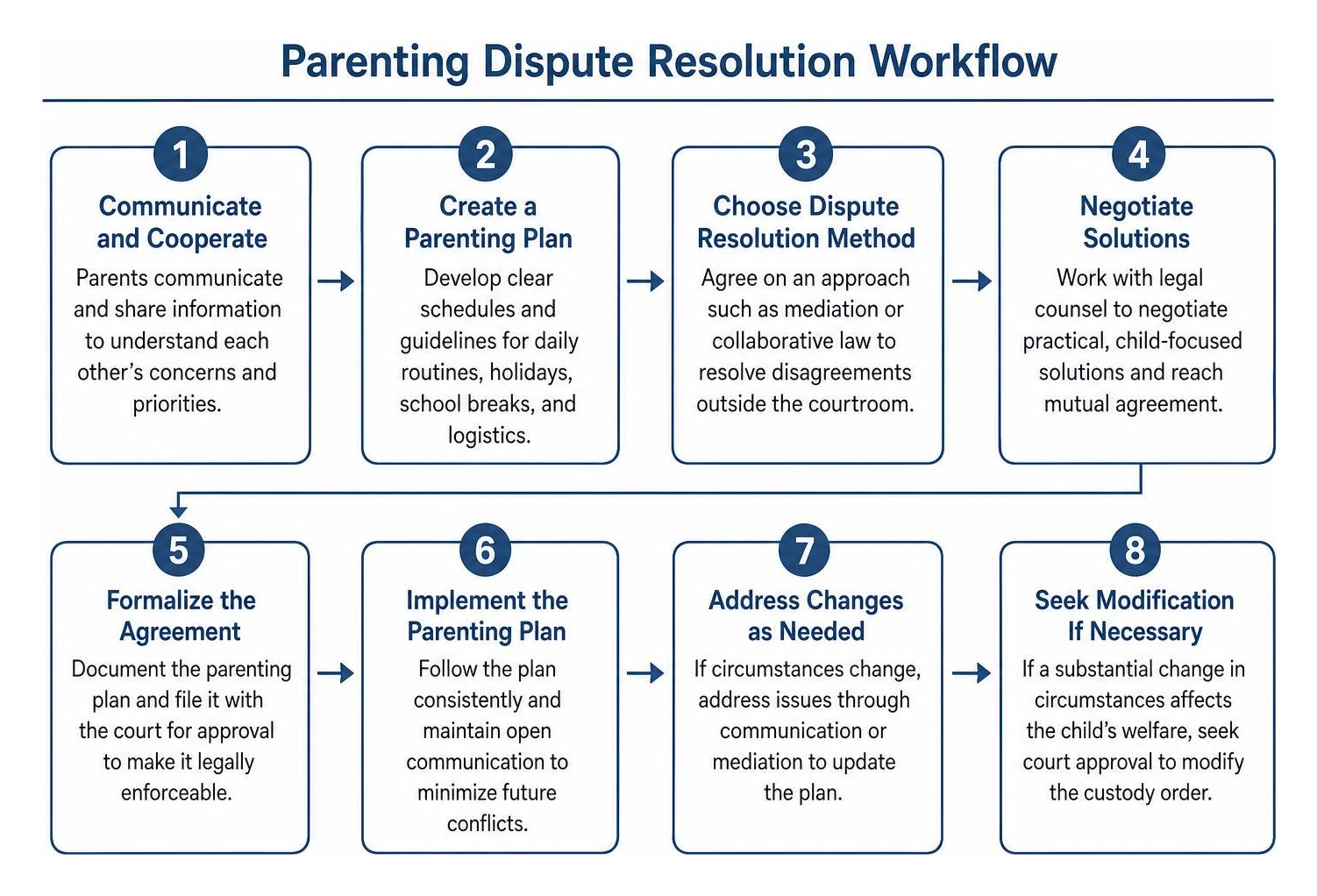
A comprehensive parenting plan serves as the bedrock of post-divorce stability. When parents draft clear guidelines for residential schedules, holiday rotations, school break coverage, and pick-up and drop-off logistics, they minimize future misunderstandings. Learning the steps for drafting a conflict-free parenting plan protects children from parental conflict and ensures that school transportation and extracurricular schedules run smoothly.
Understanding how to handle divorce when children are involved requires parents to prioritize predictable routines and clear boundaries. A well-structured agreement should specify how schedule adjustments will be requested and how routine schedule conflicts will be handled.
Resolving Edison Child Custody Disputes Outside the Courtroom
Litigation in family court can be emotionally draining and financially costly. Alternative dispute resolution methods—such as private custody mediation and collaborative family law—offer parents an empowering avenue to craft tailored parenting schedules outside of a courtroom.
Working collaboratively with legal counsel is essential. Engaging in working with a family lawyer to resolve custody disputes provides parents with a balanced perspective on statutory standards and practical parenting solutions. By seeking early legal guidance for parenting plans, parents can identify potential friction points early and negotiate a durable parenting agreement that serves their child’s long-term interests.
Modifying Custody When Family Circumstances Change
Custody orders and parenting plans are not set in stone. As children grow and family dynamics evolve, a formal modification may become necessary. In New Jersey, a parent seeking to modify a final custody order must demonstrate a “substantial change in circumstances” that directly affects the child’s welfare.
Parents considering revisiting custody arrangements over time must provide concrete evidence—such as significant changes in work schedules, medical developments, or educational needs. When a modification involves moving out of state or a substantial distance away, parents must comply with strict interstate relocation procedures, which require either the other parent’s written consent or formal court approval before the child can be moved.
Frequently Asked Questions About Edison Custody Determinations
How do family courts evaluate breastfeeding without violating gender neutrality?
Courts evaluate breastfeeding strictly as an individualized nutritional and developmental factor rather than a gender-based legal presumption. Judges assess how feeding schedules fit into parenting time, accommodating nursing while encouraging active paternal bonding through bottle feeding, expressed milk storage, and progressive parenting-time schedules that expand as the child matures.
How is child support calculated when a parent is self-employed or underemployed?
For self-employed parents, courts examine multi-year historical earnings, business tax returns, profit-and-loss statements, and non-cash business deductions. If a parent is found to be intentionally underemployed without reasonable justification, the court may impute income using published occupational wage data and historical earning capacity.
Under what legal standards will an appellate court reassign a custody case on remand?
Appellate courts reassign a case to a new judge only under extraordinary circumstances where actual bias, personal animus, or an appearance of partiality is shown. If a trial judge’s initial ruling was based on a misunderstanding of statutory law or an improper generalization, appellate courts generally remand to the same judge to preserve judicial economy and leverage the judge’s existing familiarity with the case history.
Conclusion
Establishing a healthy, long-lasting parenting arrangement requires a clear understanding of statutory best-interest factors, disciplined financial disclosures, and an unwavering commitment to your child’s developmental well-being. Whether you are creating an initial parenting plan, addressing complex support calculations, or seeking a necessary custody modification, our team at Shane and White, LLC provides dedicated, child-centered counsel. For trusted guidance tailored to your family’s needs, consult our experienced legal representation across Middlesex County to secure your child’s future.


