The Transition from Permanent Alimony NJ to Open Durational Support
Under the ultimate guide to new jersey divorce laws and process, New Jersey law formally retired traditional permanent alimony and replaced it with open durational alimony under N.J.S.A. 2A:34-23. While open durational alimony does not carry a preset expiration date at the time of divorce, it is not unconditional or permanent in a literal sense; it is modifiable and subject to suspension or termination upon retirement, cohabitation, or significant involuntary changes in financial circumstances. In New Jersey, this form of long-term support is generally reserved for marriages spanning at least 20 years.
This statutory shift replaced lifetime alimony awards with a framework that balances ongoing financial fairness against changing life circumstances, establishing clear guidelines for both paying and recipient spouses.
Before a court can address spousal support, the parties must have legal standing. Under 2A:34-13 Matrimonial or civil union action. , individuals aged 16 or older have the legal capacity to prosecute or defend matrimonial actions in New Jersey. Once a valid action is before the court, the judge evaluates what type of support fits the economic realities of the union.
The primary difference introduced by the statutory reforms centers on the duration of the marriage. For any marriage or civil union lasting less than 20 years, the total duration of alimony cannot exceed the length of the marriage, except in rare and exceptional circumstances. Open durational support is reserved almost exclusively for unions spanning 20 years or more.
| Alimony Category | Marriage Duration Baseline | Preset Expiration Date? | Primary Statutory Objective | Modifiability |
|---|---|---|---|---|
| Open Durational | Typically 20+ years | No | Long-term support to balance economic disparities | Yes (Retirement, Cohabitation, Income Drop) |
| Limited Duration | Under 20 years | Yes (Cannot exceed marriage length) | Economic transition for defined timeframe | Yes (Under substantial change standard) |
| Rehabilitative | Any duration | Yes (Based on educational plan) | Support while payee acquires training/credentials | Yes (If plan changes or fails) |
| Reimbursement | Any duration | Yes (Tied to specific cost recovery) | Repay financial contribution to spouse’s degree | No (Non-modifiable by statute) |
Marriage Duration and Qualifying for Permanent Alimony NJ
A common misconception is that crossing a specific anniversary mark entitles a spouse to lifetime payments. While the 20-year guideline in N.J.S.A. 2A:34-23 sets a boundary for open durational support, marriage length alone does not dictate the outcome.
This principle was addressed by the New Jersey Supreme Court in Gnall v. Gnall. In that case, the trial court reviewed the economic circumstances and type of spousal support that plaintiff, who had left her job as a computer programmer to care for the parties’ children, should receive after a 15-year marriage. The Appellate Division had attempted to create a bright-line rule suggesting a 15-year union was inherently “long-term” and warranted permanent alimony.
The New Jersey Supreme Court overturned that approach, holding that trial courts must evaluate all statutory factors as a whole rather than relying on marriage duration in isolation. A 15-year marriage is not short-term, but it does not automatically trigger open durational support without considering economic dependency, health, earning potential, and the equitable distribution of marital assets.
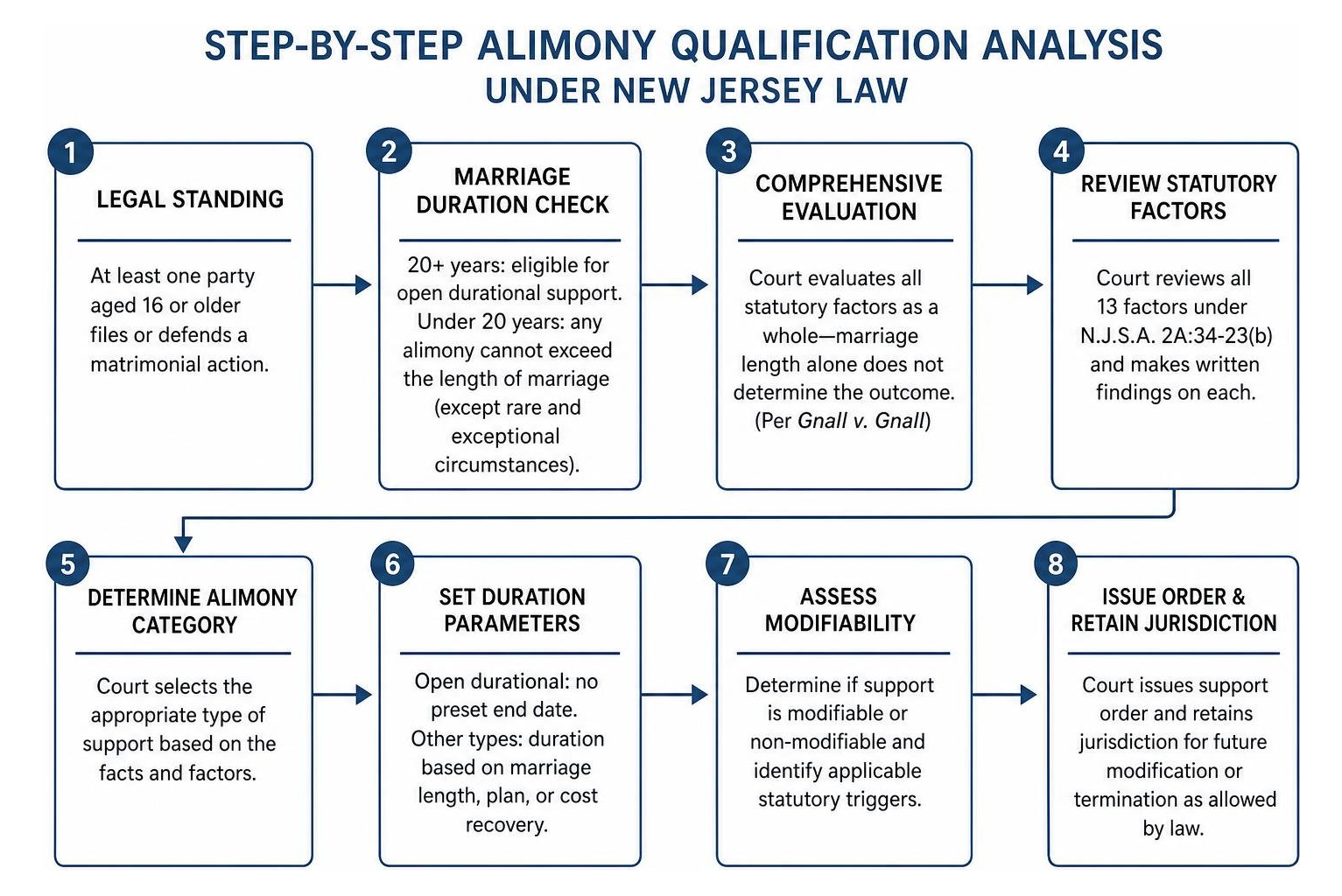
The Statutory Factors New Jersey Courts Evaluate
When establishing spousal maintenance, New Jersey family courts review thirteen distinct factors under N.J.S.A. 2A:34-23(b). Judges must issue specific written findings on each point:
- Actual need and ability to pay: The dependent spouse’s financial shortfall versus the supporting spouse’s surplus income.
- Duration of the marriage or civil union: The baseline for deciding between limited and open durational support.
- Age, physical, and emotional health: The impact of chronic conditions or age on future self-sufficiency.
- Standard of living established during the marriage: The economic baseline enjoyed by both spouses prior to separation.
- Earning capacities, educational levels, and employability: The marketable skills of both spouses and any necessary time or training required to obtain suitable employment.
- Length of absence from the job market: Career sacrifices made by a party who stepped back to focus on domestic or child-rearing responsibilities.
- Parental responsibilities for children: The impact of ongoing custody arrangements on full-time employment availability.
- History of financial and non-financial contributions: Homemaking, career-building support, and child care provided by each party.
- Equitable distribution of property: The income-producing nature of assets distributed in the divorce.
- Income available through investment assets: Dividends, rental proceeds, or interest available to either party.
- Tax consequences of alimony payments: Current federal and state tax treatment for both payor and payee.
- Nature and amount of pendente lite support: Temporary support paid while the divorce was pending.
- Any other factor the court deems relevant: Equitable issues unique to the family’s situation.
For high-income families throughout Middlesex County, assessing these factors requires careful valuation of complex compensation packages, business holdings, and lifestyle expenses. Working alongside top rated law firms for high net worth spousal maintenance in mercer middlesex helps ensure that executive perks, stock options, and discretionary business revenues are accurately incorporated into the support formula.
Modification Triggers: When Can Support Be Altered or Ended?
Once an open durational alimony order is entered, it remains in place until an event occurs that changes the financial foundation of the original judgment. In New Jersey, support orders are not set in stone; they are subject to the standard established in the landmark case Lepis v. Lepis.
Under the Lepis standard, the party seeking to modify or terminate alimony carries the burden of proving a substantial, permanent, and involuntary change in circumstances. Temporary financial downturns, voluntary career pivots, or speculative future losses do not meet this threshold. When structuring an initial divorce, using smart strategies to dissolve your nj marriage without massive debt helps establish clear financial baselines that make future modifications more straightforward.
Retirement Age and the Rebuttable Presumption
One of the most significant aspects of New Jersey’s alimony statute is the treatment of retirement. The law establishes a rebuttable presumption that alimony ends when the paying spouse reaches full retirement age as defined by the federal Social Security Administration.
When an obligor reaches full retirement age:
- The burden shifts to the recipient spouse to prove that alimony should continue.
- The court reviews whether the recipient remains economically dependent and whether the paying spouse retains significant post-retirement income or assets.
- Any arrearages that accrued prior to the retirement date cannot be erased or forgiven.
If a supporting spouse seeks to retire early before attaining full Social Security retirement age, the presumption does not apply automatically. Instead, the payor must file a formal application demonstrating good cause, the reasonableness of the early retirement age, industry norms, health considerations, and the ongoing financial impact on the supported spouse.
Cohabitation Rules Under Current New Jersey Standards
Under N.J.S.A. 2A:34-23(n), alimony may be suspended or terminated if the payee cohabits with a romantic partner. The statute makes clear that cohabitation does not require the couple to reside full-time under the same roof. Instead, cohabitation involves a mutually supportive, intimate relationship where the couple has assumed rights and duties typical of a marriage or civil union.
To prove cohabitation, the paying spouse must present evidence showing:
- Intertwined finances: Joint bank accounts, shared credit lines, or joint asset ownership.
- Shared living expenses: Mutual responsibility for rent, mortgage, utilities, or household groceries.
- Recognition in the community: Social circles, family events, and public interactions acknowledging the couple as a committed unit.
- Shared household chores: Living together, maintaining a shared residence, or handling household tasks together.
- Promises of ongoing support: Express or implied commitments between the new partners to care for one another financially.
If the court finds sufficient initial evidence of cohabitation, it may order financial discovery into the new partner’s contributions, which can lead to a suspension or complete termination of the alimony award.
Wage Earners vs. Self-Employed Modification Claims
When an obligor experiences a sharp drop in income, New Jersey courts evaluate wage earners and business owners through different evidentiary lenses.
- W-2 Wage Earners: An employee who suffers an involuntary job loss must show that they made diligent, documented efforts to find comparable employment. If new employment is secured at a lower salary after an exhaustive job search, the court evaluates whether the payor is underemployed before granting a downward modification.
- Self-Employed Individuals: Courts view claims of sudden income loss by business owners with closer scrutiny. Business owners must disclose detailed corporate general ledgers, tax returns, cash receipts, and accounts receivable to prove that a revenue drop is genuine and not an effort to shelter personal earnings.
The procedural path for these claims was highlighted in the appellate matter A-5236-16T4 – C.J. VS. D.J. (FM-20-0002-10, UNION COUNTY AND STATEWIDE) . The court held that while prior motion findings may bind parties, newly submitted financial evidence—such as updated corporate and individual tax filings showing a lasting reduction in earnings—can create a genuine issue of material fact requiring a full evidentiary plenary hearing.
Protecting Financial Certainty Through Settlement Agreements

Litigating spousal maintenance through a full trial gives a family court judge broad discretion over your finances. To avoid that uncertainty, most divorcing couples resolve support issues outside the courtroom using a detailed Marital Settlement Agreement (MSA).
When crafting these agreements, spouses can negotiate customized parameters that dictate how and when support will change over time. Consulting how to work with an alimony and divorce lawyer in mercer county enables parties to draft precise contractual provisions that minimize future court appearances.
Parties may choose to include an anti-Lepis clause in their agreement. An anti-Lepis provision is a contractual term where both parties agree to waive their statutory right to seek future modifications based on changed economic circumstances. New Jersey courts generally enforce these provisions if:
- The agreement was reached with full financial disclosure.
- Both parties entered the agreement knowingly and voluntarily.
- Both spouses were represented by competent legal counsel.
- The enforcement of the clause does not yield an unconscionable or inequitable result under current conditions.
Structuring Marital Agreements to Address Permanent Alimony NJ
When structuring an open durational support agreement, experienced attorneys include specific structural tools to balance flexibility with financial predictability.
- Income Floors and Ceilings: The agreement can define specific income brackets. If the paying spouse’s earnings remain within this negotiated band, no modification requests may be filed. If income involuntarily drops below the floor or rises above the ceiling, an expedited review process is triggered.
- Step-Down Provisions: In situations where the supported spouse anticipates growing their earning capacity over several years, the parties can agree to step-down adjustments. The monthly support amount automatically reduces at fixed intervals (e.g., year 5, year 8) without requiring post-judgment motion practice.
- Explicit Retirement Definitions: Rather than relying entirely on statutory definitions, the MSA can outline the exact age, notice requirements, and pension asset offsets that will take effect when the paying spouse retires.
- Alternative Dispute Resolution (ADR) Mandates: To avoid costly motion practice in the Superior Court, agreements often mandate that parties submit future modification disputes to private mediation or arbitration before filing formal court pleadings.
Understanding these structural options beforehand is part of knowing what to expect when you are getting a divorce, helping both spouses establish a manageable financial framework for life after marriage.
Frequently Asked Questions About Spousal Support in New Jersey
Does permanent alimony in New Jersey ever automatically end?
No form of alimony in New Jersey is entirely unconditional. While open durational alimony does not have a set expiration date on day one, it automatically terminates upon the death of either party or the remarriage/civil union of the recipient spouse.
It can also end or be adjusted through a court order if the paying spouse reaches full Social Security retirement age, if the supported spouse cohabits with a romantic partner, or if an involuntary change in economic circumstances warrants termination.
Can spousal support exceed the total length of the marriage?
For marriages lasting less than 20 years, New Jersey statute dictates that alimony duration cannot exceed the length of the marriage unless exceptional circumstances are proven.
Exceptional circumstances may include:
- Severe, chronic illness or disability of a spouse.
- A spouse giving up their career or educational growth entirely to support the other’s professional advancement.
- An inability of a dependent spouse to ever achieve basic economic self-sufficiency due to age or health.
For marriages that reach or exceed the 20-year mark, open durational support is permitted and may run for a duration that exceeds the marriage length, provided the statutory factors continue to justify support.
What happens if the paying spouse suffers an involuntary job loss?
If a paying spouse experiences an involuntary layoff, business closure, or severe disability, they must act promptly by filing a motion to modify support. Under current New Jersey rules, an obligor must generally show that the loss has persisted for at least 90 days before seeking a formal modification.
The court will assess the reasons for the job loss, the severance or unemployment benefits received, and documented proof of an ongoing, good-faith search for comparable employment across relevant industries. While the search is underway, the court may enter temporary financial relief or order a temporary reduction in payments pending further review.
Conclusion

The transformation of New Jersey alimony law from traditional lifetime payments to open durational support reflects an effort to balance long-term financial fairness with economic reality. No support obligation is meant to serve as an insurmountable financial trap for the payor, nor should it leave a vulnerable, dependent spouse without the resources necessary to maintain their standard of living.
Whether you are negotiating the terms of an initial divorce settlement or seeking to modify an existing support judgment due to retirement, cohabitation, or income loss, having skilled legal counsel on your side makes all the difference. At Shane and White, LLC, our legal team brings more than 40 years of combined family law experience to clients across Middlesex County, including Edison, Metuchen, Woodbridge, East Brunswick, New Brunswick, North Brunswick, Monroe, Piscataway, and Sayreville.
If you are navigating separation with the best mercer county divorce lawyers or resolving support disputes across Central New Jersey, we are here to provide clear guidance and dedicated advocacy.
Schedule a consultation at our East Brunswick office to discuss your rights, evaluate your alimony options, and protect your financial future.