How to Divide Home Equity and Mortgage Debt in a Divorce
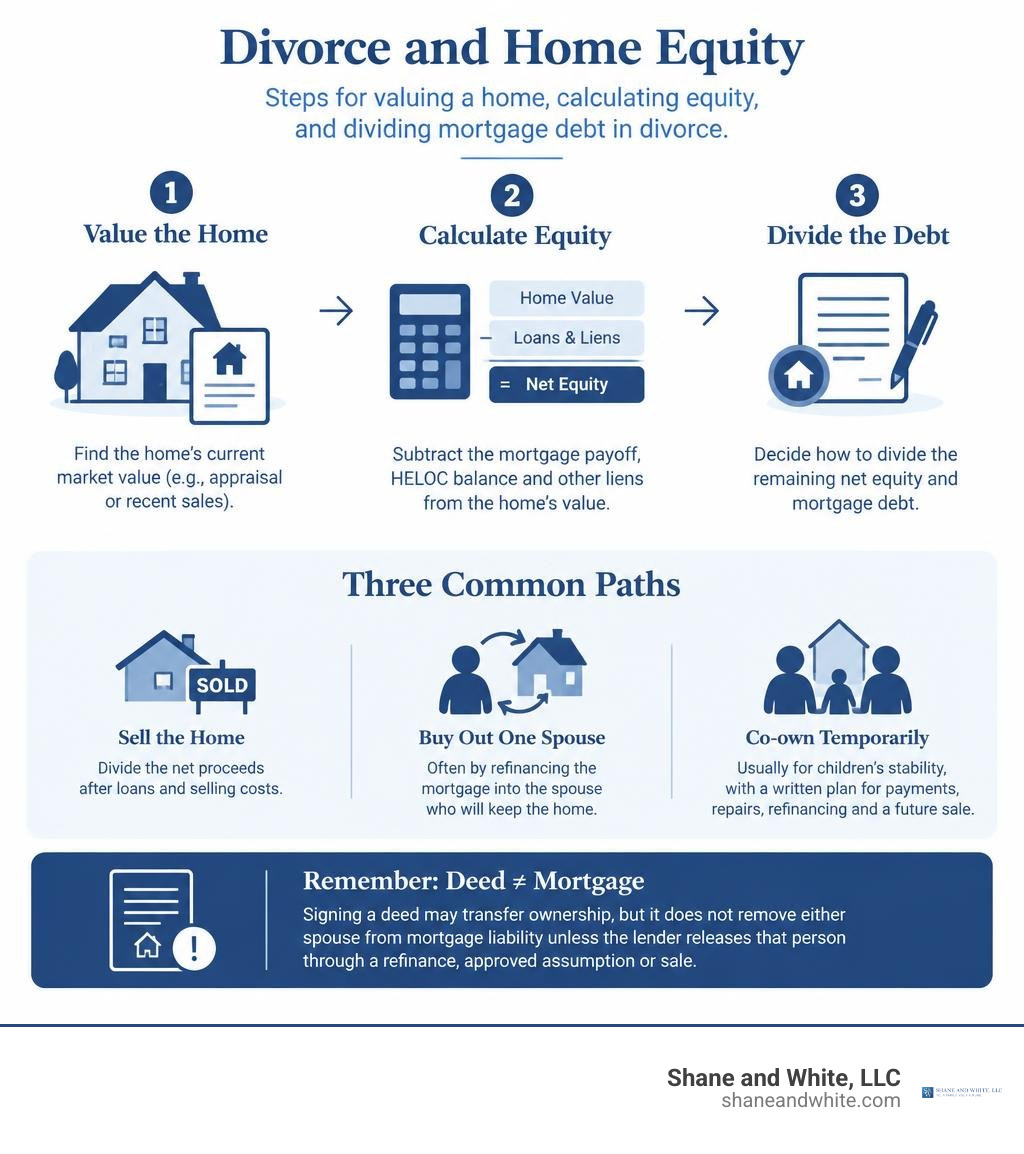
To handle divorce and home equity, first determine the home’s current value, subtract the mortgage payoff, HELOC balance, and other liens, and then decide how to divide the remaining net equity. In New Jersey, courts use equitable distribution, which means the result should be fair, not always an automatic 50/50 split.
Most couples take one of three paths:
- Sell the home and divide the net proceeds after loans and selling costs.
- Buy out one spouse, often by refinancing the mortgage into the spouse who will keep the home.
- Co-own temporarily, usually to give children stability, with a written plan for payments, repairs, refinancing, and a future sale.
The deed and the mortgage are not the same thing. Signing a deed may transfer ownership, but it does not remove either spouse from mortgage liability unless the lender releases that person through a refinance, approved assumption, or sale.
I am Kenneth White, Esq., a New Jersey Supreme Court-certified matrimonial attorney with decades of family-law experience in Middlesex County, including service as an Early Settlement Panelist and court-appointed mediator. I help clients address divorce and home equity issues with a clear focus on property rights, mortgage risk, and practical settlement options.
Divorce and home equity vocabulary:
Navigating Divorce and Home Equity: Valuation, Law, and Calculation
When a marriage dissolves, the family residence represents both a sanctuary of memories and the largest single line item on the marital balance sheet. Dividing this asset requires setting aside emotional attachment to focus on cold, hard math and legal statutes. Determining what your home is worth and how that value fits within state law forms the foundation of every settlement negotiation.

Before negotiating buyouts or sales, both spouses must agree on an accurate fair market value (FMV). Relying on automated online real estate estimates often leads to friction, as these algorithms overlook deferred maintenance, foundation cracks, or unpermitted renovations. In formal proceedings, couples generally rely on one of two methods:
- Comparative Market Analysis (CMA): A local real estate professional evaluates recent sales of comparable properties in your immediate neighborhood (such as Edison, Metuchen, or Woodbridge) to estimate a reasonable listing price. While useful for informal mediation, a CMA lacks the evidentiary weight required in contested court hearings.
- Independent Professional Appraisal: Both spouses jointly hire (or the court appoints) a licensed real estate appraiser to conduct an exhaustive physical inspection. The appraiser produces an objective, legally defensible valuation report based on current square footage, condition, structural integrity, and verified neighborhood comps.
According to research on how home equity is split in divorce, securing an accurate, mutually accepted valuation is the essential first step before any mathematical split can occur. Understanding this process within an overview of New Jersey divorce laws and procedures ensures that neither party leaves money on the table or assumes disproportionate debt.
Calculating Divorce and Home Equity: The Core Formula
Once the fair market value is established, calculating actual home equity is straightforward. Equity represents what you actually own free and clear—not the gross market price of the property.
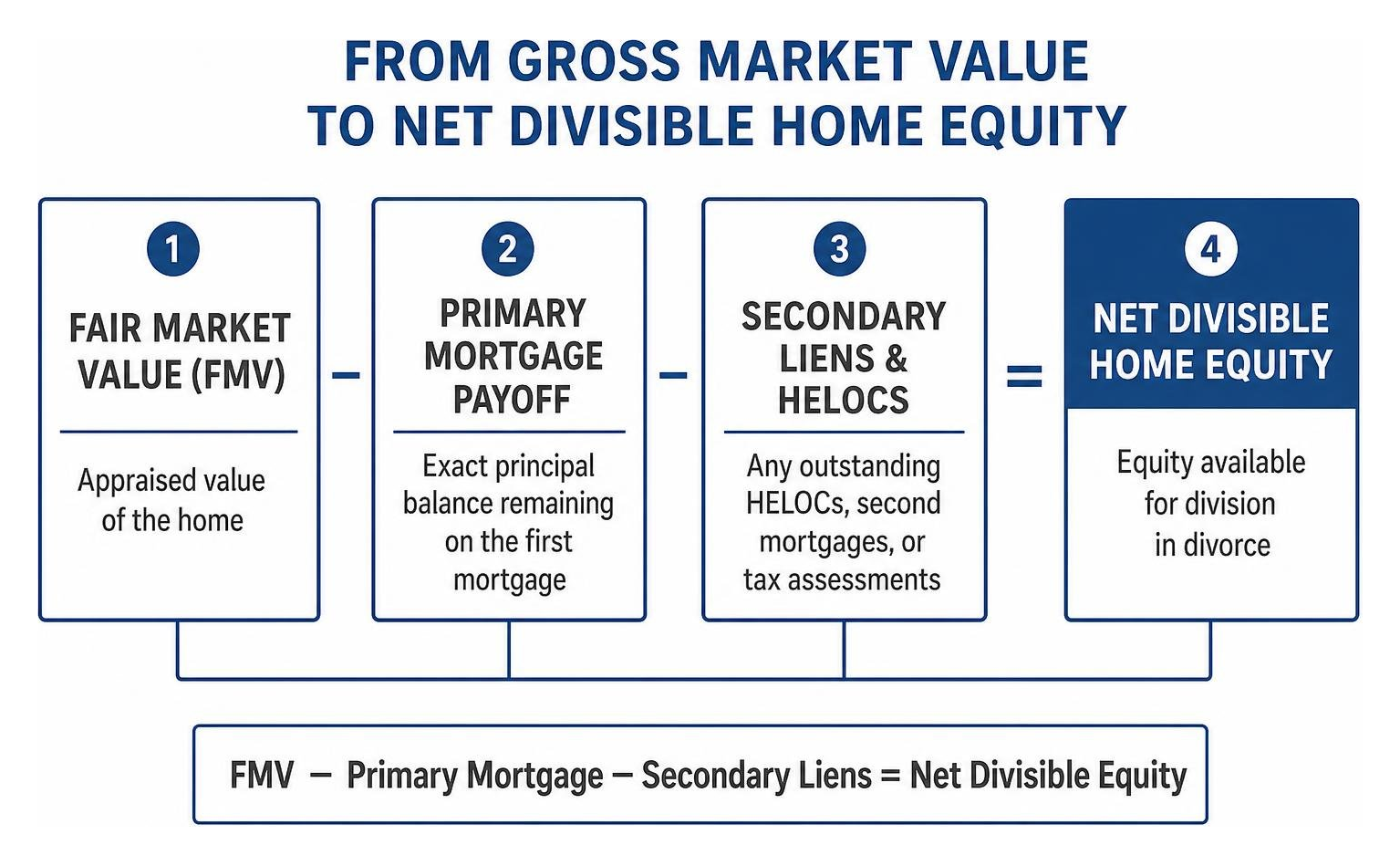
To calculate net divisible equity, apply the following step-by-step formula:
- Start with Fair Market Value (FMV): The appraised value of the real estate.
- Subtract Primary Mortgage Payoff: The exact principal balance remaining on the first mortgage (obtained via a formal lender payoff statement, which includes accrued daily interest).
- Subtract Secondary Liens & HELOCs: Any outstanding Home Equity Lines of Credit, second mortgages, or municipal tax assessments.
- Subtract Judgment Liens or Mechanics’ Liens: Any recorded legal claims against the title.
- Deduct Anticipated Transactional Costs (If Selling): If the home will be listed on the market, deduct standard broker commissions (typically 5% to 6%), transfer taxes, attorney fees, and closing costs.
For instance, if a home in Middlesex County appraises for $600,000, has an outstanding mortgage balance of $250,000, and carries a $50,000 HELOC, the total debt against the property is $300,000. If the parties agree to an internal buyout (avoiding broker fees), the net marital equity available for allocation is exactly $300,000.
Equitable Distribution vs Community Property Frameworks
How that $300,000 net equity gets divided depends entirely on state jurisdictional law. The United States divides family property under two distinct legal doctrines:
- Community Property: Enforced in nine states (such as California and Texas), this framework treats all assets and debts acquired during the marriage as owned equally (50/50) by both spouses, regardless of who earned the money or whose name appears on the deed.
- Equitable Distribution: Used across New Jersey and the majority of U.S. jurisdictions, this framework requires the court to divide marital property fairly and equitably, which does not necessarily mean an automatic 50/50 mathematical split.
In an equitable distribution state like New Jersey, family court judges possess broad judicial discretion. When determining how to apportion home equity, courts evaluate statutory factors, including:
- The duration of the marriage.
- The age and physical/emotional health of each party.
- The income, earning capacity, and separate assets brought to the marriage.
- The standard of living established during the marriage.
- The economic circumstances of each spouse at the time the division becomes effective.
- Non-monetary contributions, such as homemaking, child-rearing, and career-sacrifice to support the other spouse’s education or advancement.
While many long-term marriages result in an equal split of the home’s net equity, judges can and do adjust these ratios to achieve true economic justice.
Separate Property Claims and Pre-Marital Home Ownership
A common complication arises when one spouse purchased the home before the wedding day. Under standard legal principles, assets acquired prior to marriage are classified as separate property and are exempt from distribution. However, real estate rarely stays entirely “separate” over years of married life due to legal doctrines known as transmutation and active appreciation.
If a pre-marital home is titled solely in Spouse A’s name, but during the marriage:
- Joint marital earnings were used to pay down the monthly mortgage principal;
- Marital funds financed renovations, additions, or major capital repairs; or
- Spouse B contributed substantial “sweat equity” through physical labor that increased the market value;
then the home’s equity becomes a commingled asset.
In these situations, the court separates the property into two distinct components:
- The Pre-Marital Baseline: The original down payment and equity established prior to the wedding date remain the separate property of the purchasing spouse.
- The Marital Component: Any reduction in loan principal paid with marital funds, plus the active appreciation in value generated by marital investments or sweat equity during the marriage, is classified as marital property subject to equitable distribution. Passive appreciation (market-driven inflation) on the pre-marital baseline may remain separate, requiring forensic accounting or historical appraisals to calculate the exact split.
The Core Paths for Dividing the Marital Home
When resolving who gets what, couples generally must choose between three foundational paths: an outright sale, an internal buyout/offset, or deferred co-ownership. Selecting the right path requires balancing emotional realities with financial liquidity, borrowing power, and tax considerations.
| Strategy | Primary Mechanism | Best Suited For | Major Advantages | Potential Drawbacks |
|---|---|---|---|---|
| Outright Sale | Liquidate property on the open market; split net escrow proceeds. | Couples seeking a clean financial break; neither can afford solo mortgage. | Total debt elimination; complete financial detachment; clear cash split. | Moving expenses; closing costs; potential disruption to schooling. |
| Spousal Buyout / Asset Offset | One spouse retains title; refinances debt and pays equity (or trades other assets). | One spouse has sufficient solo income and wants to remain in the residence. | Minimal disruption for children; avoids broker fees and transfer commissions. | Requires high credit/income to qualify for solo loan; high monthly burden. |
| Deferred Co-Ownership | Both spouses retain title/mortgage for a set period before selling. | Families prioritizing school continuity until children reach defined milestones. | Preserves low legacy interest rates; provides emotional stability for kids. | Ongoing joint financial liability; shared repair disputes; delayed closure. |
Navigating these choices is an integral part of approaches to reaching a fair divorce settlement, allowing both parties to protect their balance sheets and maintain financial independence.
Selling the Property and Splitting Net Proceeds
For many couples, selling the marital home represents the cleanest, most practical resolution. An outright sale eliminates joint debt obligations, liquidates home equity into accessible cash, and provides each spouse with funds to establish separate households.
When executing a sale:
- The property is listed through an independent, mutually selected real estate agent.
- The settlement agreement dictates specific parameters: listing price, acceptable price reductions over time, and minimum offer thresholds.
- At the closing table, the escrow agent disburses funds to satisfy all mortgages, lines of credit, property taxes, transfer fees, and real estate commissions.
- The remaining net escrow proceeds are distributed directly to each spouse according to their negotiated marital settlement agreement.
This approach eliminates the ongoing financial entanglement of shared credit profiles and protects both parties from the risk of future mortgage default by an ex-spouse.
Offsetting Real Estate with Other Marital Assets
If one spouse has a strong desire to stay in the home but lacks the liquid cash to execute a buyout, couples frequently turn to asset equalization. Rather than refinancing to pull out cash, the spouse keeping the residence relinquishes their legal claim to other marital assets of equivalent value.
Common offset trades involve:
- Retirement Accounts: Exchanging home equity for equal value in 401(k)s, traditional IRAs, Roth IRAs, or defined-benefit pensions. This process is executed via a Qualified Domestic Relations Order (QDRO), as outlined in our guide on splitting retirement assets and retirement plans.
- Liquid Cash and Investment Portfolios: Offsetting real estate value against taxable brokerage accounts, certificates of deposit (CDs), or high-yield savings balances.
- Other Physical Property: Trading ownership of vacation homes, investment properties, vehicles, or business equity.
Critical Tax Warning: When trading assets, a dollar of home equity is not identical to a dollar in a pre-tax retirement account. A $100,000 equity buyout received in cash is generally tax-free, whereas a $100,000 distribution from a traditional 401(k) will incur federal and state income taxes upon withdrawal. Offsets must be calculated using after-tax valuations to ensure true equity.
Deferred Sale and Temporary Post-Divorce Co-Ownership
When minor children are involved, uprooting them from their childhood home, neighborhood friends, and school district can add unnecessary distress to an already difficult life transition. In response, some couples agree to—or a judge may grant—a deferred sale arrangement (often referred to as an exclusive use and possession award).
Under this framework:
- One spouse (typically the primary custodial parent) remains in the marital residence with the children.
- Both spouses maintain joint title ownership and remain on the existing mortgage for a predefined window of time.
- The marital settlement agreement establishes clear, non-negotiable “trigger events” that mandate an immediate sale or buyout, such as:
- The youngest child graduating from high school or reaching age 18.
- The resident spouse remarrying or cohabiting with a new romantic partner in the home.
- A default on agreed mortgage, tax, or insurance obligations.
- A set calendar date (e.g., exactly 24 or 36 months post-divorce).
While deferred sales provide stability, they carry legal and credit risks. The agreement must explicitly define who pays for routine maintenance, structural repairs over a set dollar threshold (e.g., repairs exceeding $500), homeowners insurance, and property taxes, as well as how future equity growth will be divided upon final liquidation.
Handling Mortgage Debt, Refinancing, and Financial Liabilities
Dividing home equity cannot be done in a vacuum; it must always be paired with a comprehensive strategy for resolving mortgage debt. A common and costly mistake in property division is focusing entirely on property title while ignoring joint promissory notes.

When addressing housing debt, practical steps for securing housing rights during divorce must align with strict lending regulations. Mortgage lenders are not bound by family court divorce decrees; they enforce contract law.
Managing Divorce and Home Equity Through Buyouts and Refinancing
When one spouse elects to retain the house, they must buy out the exiting spouse’s share of the net equity while removing the exiting spouse from the existing mortgage note. This is typically accomplished through a divorce buyout refinance (often structured as an equity buyout loan).
As detailed in industry insights from LendingTree’s guide on preserving equity during divorce, an equity buyout refinance replaces the old joint mortgage with a new single-borrower mortgage. The new loan balance equals the old mortgage payoff plus the cash amount owed to the departing spouse for their equity share.
To qualify for an equity buyout refinance, the retaining spouse must satisfy strict underwriting criteria independently:
- Loan-to-Value (LTV) Limits: Conventional equity buyout guidelines typically permit financing up to 80% of the home’s appraised value (VA loans may permit up to 90% or 100% for qualified veterans).
- Debt-to-Income (DTI) Ratios: The retaining spouse’s total monthly debt obligations (new mortgage payment, property taxes, car loans, credit cards) generally cannot exceed 41% to 45% of their verified gross monthly income.
- Credit Score Requirements: Conventional lenders generally mandate a minimum FICO credit score of 620, with preferable interest rates reserved for scores of 720 and above.
- Support Income Seasoning: If the retaining spouse relies on child support or alimony to qualify for the loan, Fannie Mae and Freddie Mac guidelines typically require proof that the support has been received consistently for at least 6 months, with legal documentation proving it will continue for at least 36 months post-closing.
Title Transfer vs Mortgage Liability: The Quitclaim Trap
One of the most dangerous traps in matrimonial real estate is confusing property title with debt liability.
A Quitclaim Deed (or Bargain and Sale Deed with Covenants) transfers an individual’s ownership rights and legal title of the real estate to the other party. However, executing and recording a quitclaim deed does not remove your name, your credit profile, or your legal obligation from the underlying mortgage promissory note.
If Spouse B signs a quitclaim deed conveying title to Spouse A, but Spouse A fails to refinance the joint mortgage:
- Spouse B no longer owns any portion of the house.
- Spouse B remains 100% legally liable to the mortgage lender for the entire unpaid loan balance.
- If Spouse A misses mortgage payments or enters foreclosure, Spouse B’s credit score will be damaged, and the bank can pursue Spouse B directly for payment.
- Spouse B’s debt-to-income ratio will remain burdened by the full mortgage payment, often preventing them from securing a mortgage to buy a new residence.
To prevent this trap, well-crafted marital settlement agreements mandate a strict refinancing deadline (typically 60 to 90 days post-judgment). If the retaining spouse cannot successfully refinance and remove the other spouse within that window, the agreement must trigger a mandatory listing of the home for immediate public sale.
Resolving Negative Equity, Second Mortgages, and Underwater Homes
When market downturns or excessive secondary borrowing leave a property with “negative equity”—where total mortgage debt exceeds current market value—the legal focus shifts from dividing assets to allocating marital debt.
If a marital home is underwater:
- Debt Allocation: The court will evaluate the origin of the debt. If second mortgages or HELOC balances were used for joint marital benefits (home renovations, living expenses, family vacations), the negative equity is divided equitably between both parties.
- Cash Contribution to Sell: If the home must be sold, both spouses may be required to bring cash to the closing table to satisfy the mortgage shortfall and broker commissions.
- Short Sale Negotiation: If neither spouse has the liquid assets to cover the deficit, the parties must jointly apply for a lender-approved short sale. While a short sale prevents a formal foreclosure judgment, it does impact both parties’ credit ratings and requires specialized legal navigation, consistent with preventing excessive marital debt during separation.
Tax Consequences and Protective Legal Strategies
Dividing real estate assets without proper tax planning can trigger costly surprises. Fortunately, the Internal Revenue Code provides significant protections for divorcing couples when transactions are structured correctly within a formal decree.
Understanding these rules ensures you protect your net proceeds:
- IRC Section 1041 (Tax-Free Transfers): Under Section 1041 of the Internal Revenue Code, the transfer of property between spouses—or former spouses if incident to a divorce—is entirely non-taxable. No capital gains, gift taxes, or immediate income taxes are recognized at the time of the transfer.
- Carryover Cost Basis: The spouse who receives the marital home takes on the property’s existing tax cost basis (the original purchase price plus the verified cost of capital improvements made over the years). If you buy out your spouse and later sell the home years down the road, your capital gains tax will be calculated from that original historical basis, not the buyout valuation.
- IRC Section 121 (Primary Residence Exclusion): Under standard tax rules, single filers can exclude up to $250,000 of capital gain from the sale of their primary residence, while married couples filing jointly can exclude up to $500,000. To qualify, you must have owned and used the home as your principal residence for at least two out of the five years preceding the sale.
- Special Divorce Relief for Section 121: In deferred sale agreements where one spouse moves out while the other remains with the children, the tax code provides critical protection. As long as the marital settlement agreement grants the resident spouse exclusive occupancy, the non-resident spouse is legally treated as using the home as their principal residence during that period. When the property is eventually sold, both spouses can claim their full individual $250,000 capital gains exclusions (totaling $500,000).
Addressing these financial realities early is an essential part of navigating what to expect in divorce, protecting you from unexpected tax liabilities after your judgment is finalized.
Frequently Asked Questions About Splitting Property and Mortgages
Does signing a quitclaim deed remove my name from the mortgage?
No. Signing a quitclaim deed transfers your legal ownership interest in the real estate, but it has no effect on your contractual obligation to the mortgage lender. Even after signing the deed, you remain fully liable for the monthly payments, interest, and any potential foreclosure actions until the mortgage is formally refinanced into the other spouse’s sole name, assumed with a formal lender liability release, or paid off through a property sale.
Can my spouse force the sale of the house if we disagree on equity?
Yes. If spouses cannot reach an agreement regarding the home’s fair market value, buyout terms, or who should retain the residence, the family court has the authority to order the property listed for immediate sale on the open market. Courts view real estate liquidation as the ultimate equitable remedy because an arm’s-length open market transaction establishes true market value and produces liquid cash that can be divided fairly.
What happens to a home equity line of credit during a divorce?
A Home Equity Line of Credit (HELOC) is secured debt attached to your property title and must be addressed during the divorce proceedings. Both spouses are jointly liable for any balance drawn on the line during the marriage. As soon as a divorce complaint is filed, attorneys routinely advise clients to contact the lender to freeze the HELOC to prevent either spouse from making additional withdrawals. During final division, the HELOC balance must either be paid in full at closing, rolled into a buyout refinance, or offset against other marital assets.
Protecting Your Real Estate and Financial Future
Dividing the marital residence is rarely just about property lines and square footage; it is about securing your financial foundation for the next chapter of your life. Every decision you make—from choosing an appraiser and structuring a buyout refinance to drafting mortgage indemnity clauses—carries long-term consequences for your credit score, tax liability, and overall wealth.
For more than 40 years, our team at Shane and White, LLC has guided individuals and families throughout Middlesex County—including Edison, Metuchen, Woodbridge, East Brunswick, New Brunswick, North Brunswick, Monroe, Piscataway, and Sayreville—through every phase of complex divorce litigation and asset division. We combine deep knowledge of New Jersey matrimonial law with personalized attention and practical financial strategies.
Whether you are seeking to preserve your family home, negotiate an equitable buyout, or ensure your release from joint mortgage debt, we are here to protect your rights. Contact Shane and White, LLC today to schedule a confidential consultation with an experienced family-law attorney.