


Understanding Jurisdiction and Legal Rules for a Mercer County Divorce
Navigating the legal landscape of a mercer county divorce starts with understanding where and how your case fits into the New Jersey judicial system. In New Jersey, divorce is officially referred to as “dissolution.” Whether you are dissolving a marriage, a civil union, or a domestic partnership, the process is governed by state-wide family law statutes enforced at the county court level.
To initiate divorce proceedings in Mercer County, the court must possess proper subject-matter and personal jurisdiction over your marriage. Understanding these foundational legal rules saves significant time and prevents costly administrative delays down the road. For an in-depth look at state-wide statutory frameworks, explore The Ultimate Guide to New Jersey Divorce Laws and Process.
Residency Requirements and Grounds in New Jersey
Before filing a divorce complaint in Mercer County, you must meet New Jersey’s strict statutory residency requirements. Under state law, at least one spouse must have been a bona fide resident of New Jersey for at least 12 consecutive months immediately preceding the filing of the divorce complaint. The only statutory exception to this 12-month rule involves filing on fault-based grounds of adultery, where residency at the time of filing is sufficient.
When establishing legal cause to end a marriage, New Jersey offers both no-fault and fault-based grounds:
- Irreconcilable Differences (No-Fault): The vast majority of couples utilize irreconcilable differences. This requires showing that your marriage has experienced breakdown for at least six months, with no reasonable prospect of reconciliation.
- Eighteen-Month Separation (No-Fault): The spouses must have lived in separate habitations continuously for at least 18 months, with no reasonable prospect of getting back together.
- Fault-Based Grounds: New Jersey recognizes specific legal fault grounds, including adultery, extreme cruelty, desertion (lasting 12 consecutive months or more), habitual drunkenness or drug addiction, institutionalization for mental illness, and imprisonment.
While fault-based grounds remain on the books, most litigants choose no-fault irreconcilable differences. Fault claims rarely offer financial or strategic advantages and frequently increase litigation costs and emotional friction.
Differentiating Mercer County in NJ, PA, and OH
When researching legal resources online for a mercer county divorce, you may encounter conflicting information regarding court rules, fees, and forms. This occurs because three different states—New Jersey, Pennsylvania, and Ohio—have a jurisdiction named Mercer County.
- Mercer County, New Jersey: The subject of this guide. Handled by the Superior Court, Chancery Division, Family Part in Trenton. Operates under New Jersey’s equitable distribution laws, state court rules, and statewide Case Information Statement requirements.
- Mercer County, Pennsylvania: Governed by Pennsylvania domestic relations laws, requiring filing through the Mercer County Court of Common Pleas in Mercer, PA.
- Mercer County, Ohio: Handled by the Court of Common Pleas in Celina, OH, governed by Ohio Revised Code and unique local restraint orders.
To ensure your filing is handled properly, confirm that all court documents, fee schedules, and local filing guidelines pertain strictly to the Mercer Vicinage of the Superior Court of New Jersey.
Filing Requirements and Courthouse Procedures in Trenton
All family law matters originating in Mercer County, New Jersey are processed through the Mercer Vicinage Family Part, located in the capital city of Trenton.

Knowing where to go and how paperwork moves through the clerk’s office ensures your filing proceeds without procedural setbacks.
Document Requirements and Filing Fees for a Mercer County Divorce
Initiating a formal divorce action requires filing a standard packet of legal pleadings. The primary document is the Complaint for Divorce, which outlines the legal grounds, marital history, and specific relief requested (such as property division, alimony, custody, or child support).
Alongside the Complaint, you must file several supporting certifications:
- Summons: Formal legal notice directing the defendant spouse to respond within 35 days.
- Case Information Statement (CIS – Form CN 10482): A comprehensive mandatory financial disclosure document detailing assets, liabilities, monthly living expenses, and historical income.
- Certification of Insurance Coverage: A sworn document verifying that existing health, life, auto, and homeowner insurance policies remain active.
- Complementary Dispute Resolution (CDR) Certification (Form CN 10889): Verification that you have been notified of alternative dispute options such as mediation and arbitration.
The base court filing fee for a divorce complaint in New Jersey is $300. If your complaint includes prayers for child custody or parenting time, an additional $25 mandatory parenting workshop fee is assessed, bringing the initial court filing total to $325. For detailed procedural steps and official filing rules, reference the NJ Courts Self-Help Divorce Guide.
If you cannot afford court filing fees due to financial hardship, you can submit an application for an In Forma Pauperis fee waiver alongside your divorce complaint. If approved by a judge, initial filing and service fees are waived.
Service of Process and Mercer Vicinage Local Rules
Once the Family Division clerk accepts your divorce complaint and assigns a formal docket number (formatted as FM-11-XXXXX-XX), you must formally serve your spouse with the papers. Under New Jersey Court Rules, you have 60 days from the filing date to complete service of process.
Service can be accomplished through several approved channels:
- Acknowledgment of Service: Your spouse (or their attorney) signs a formal document confirming receipt of the Summons and Complaint.
- Sheriff’s Service: The Mercer County Sheriff’s Office personally delivers the summons packet to your spouse’s residence or workplace.
- Private Process Server: A licensed process server personally delivers the paperwork.
For complete courthouse locations, chamber contacts, and filing operational hours, refer to the official Mercer Vicinage Directory. The Mercer County Family Part is located at the Mercer County Civil Courthouse, 175 South Broad Street, Trenton, NJ 08650, operating Monday through Friday from 8:30 a.m. to 4:30 p.m. Electronic filings are primarily processed through the Judiciary Electronic Document Submission (JEDS) system.
Property Division, Custody Rules, and Alternative Dispute Resolution
Resolving a mercer county divorce requires addressing core marital issues: dividing financial assets, establishing parenting plans, and setting appropriate support arrangements.
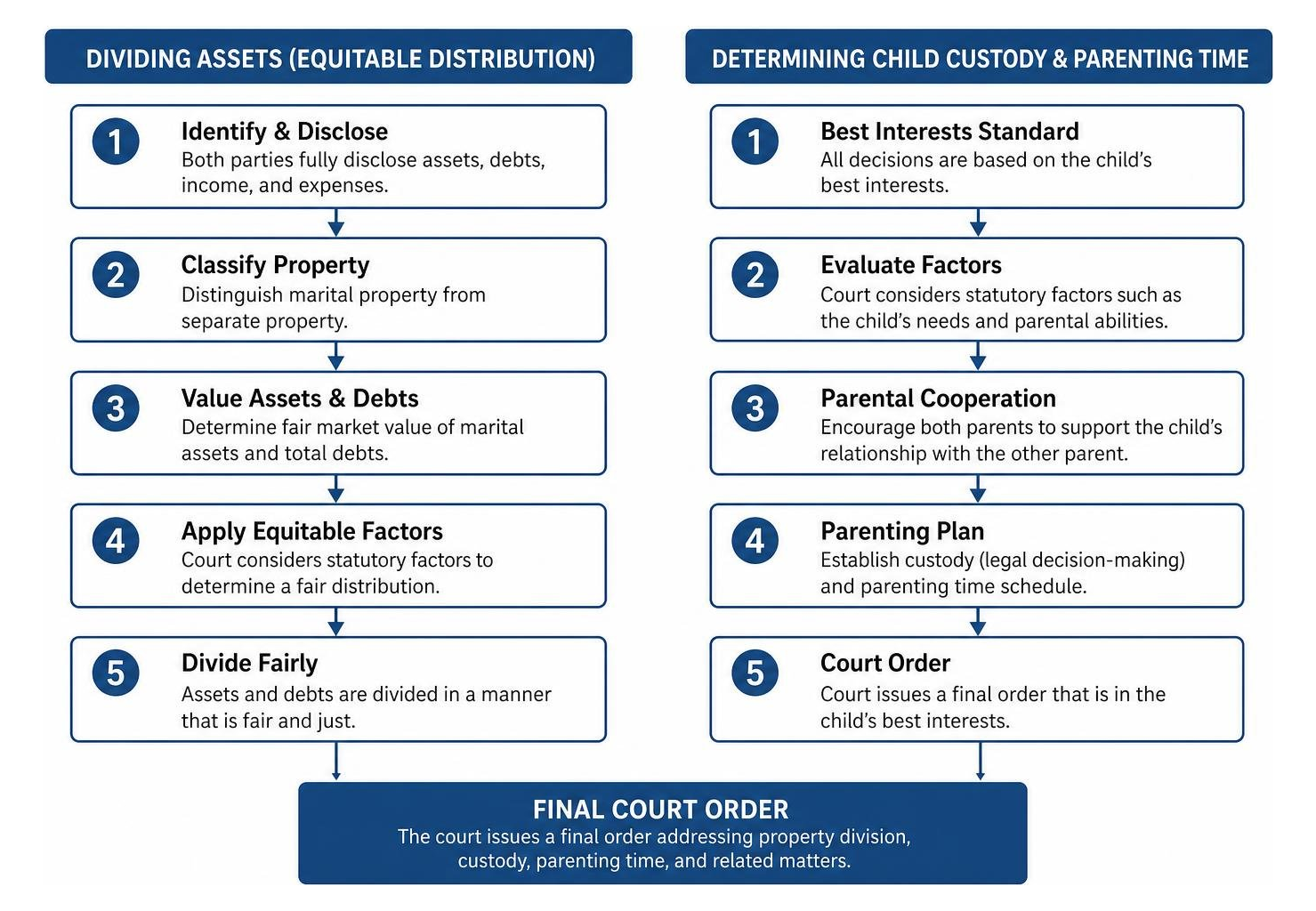
New Jersey legal framework emphasizes fairness, transparency, and child welfare over rigid, arbitrary mathematical splits.
Financial Disclosures and Equitable Distribution
New Jersey is an equitable distribution state, not a community property state. Equitable distribution means that marital property and debts are divided fairly and justly based on the circumstances of the marriage, rather than through an automatic 50/50 division.
Marital assets generally include all real estate, bank accounts, investment portfolios, retirement accounts (such as 401ks and pensions), businesses, vehicles, and personal property acquired by either spouse during the marriage. Separate property—such as assets acquired prior to the marriage or gifts/inheritances received individually from third parties—is typically exempt from distribution, provided it was not commingled.
To evaluate what assets are subject to division, refer to What Assets Get Shared in a Divorce. Full financial disclosure through the Case Information Statement (CIS) is legally mandatory to ensure equitable terms.
Child Custody Rules and Kayden’s Law
When minor children are involved, legal custody (decision-making authority regarding health, education, and welfare) and residential custody (where the children physically reside) must be determined based on the best interests of the child.
New Jersey family courts strongly encourage frequent and continuing contact with both parents, provided both parents are capable of exercising sound parental judgment. When custody or parenting time is contested, both parents are required to attend a court-mandated Parents Education Program ($25 fee).
Importantly, New Jersey custody matters are informed by recent legislative reforms, including Kayden’s Law (Ch. 316). This law prioritizes child safety above all other factors during custody determinations, placing strict limits on unsafe visitation orders and prohibiting coercive reunification therapies when credible allegations of domestic violence or abuse exist.
Early Settlement Panels and Mediation Opportunities
The vast majority of divorce complaints filed in Mercer County are resolved prior to trial through Complementary Dispute Resolution (CDR). The court system provides multiple built-in opportunities to negotiate a fair agreement:
- Custody and Parenting Time Mediation: Free court-sponsored mediation sessions designed to assist parents in resolving custody and scheduling disputes with a court mediator.
- Early Settlement Panels (ESP): If financial issues remain unresolved after initial disclosures, parties must present their financial dispute to an Early Settlement Panel. The panel—composed of experienced local family law attorneys—evaluates the case and offers non-binding settlement recommendations.
- Economic Mediation: If parties do not settle at ESP, they are referred to court-annexed economic mediation, where a trained private mediator helps bridge remaining financial gaps.
- Binding Arbitration: Parties may choose to hire an independent arbitrator to render a final, binding decision outside the public courtroom.
To explore how settlement programs work during litigation, read our resource on Settlement Opportunities During Your Divorce Proceedings.
How to Choose the Best Family Law Attorney for Your Case
Selecting the right legal advocate is one of the most critical decisions you will make during a divorce proceeding.

Your attorney must understand Mercer County courtroom procedures, possess deep familiarity with New Jersey statutory law, and offer compassionate, practical counsel tailored to your goals.
Evaluating Attorney Experience and Qualifications
When evaluating family law attorneys to represent you in Mercer County, look beyond general legal advertising. Consider the following key credentials:
- Certified Matrimonial Law Designation: Look for attorneys recognized by the Supreme Court of New Jersey as Certified Matrimonial Law Attorneys—a designation earned by demonstrating significant trial experience, judicial peer evaluation, and advanced knowledge in family law.
- Local Mercer Vicinage Experience: Practical familiarity with Mercer County judges, court staff, and local practice norms is invaluable when streamlining filings or appearing before a bench.
- Focused Practice: Select a law firm dedicated specifically to family law, divorce, alimony, and custody matters rather than general practice firms.
For detailed guidelines on making an informed selection, read How to Work with an Alimony and Divorce Lawyer in Mercer County and Finding the Right New Jersey Family Law and Divorce Attorney.
Managing Timeline and Legal Expenses in a Mercer County Divorce
The total cost and duration of a mercer county divorce depend heavily on the level of dispute between the parties.
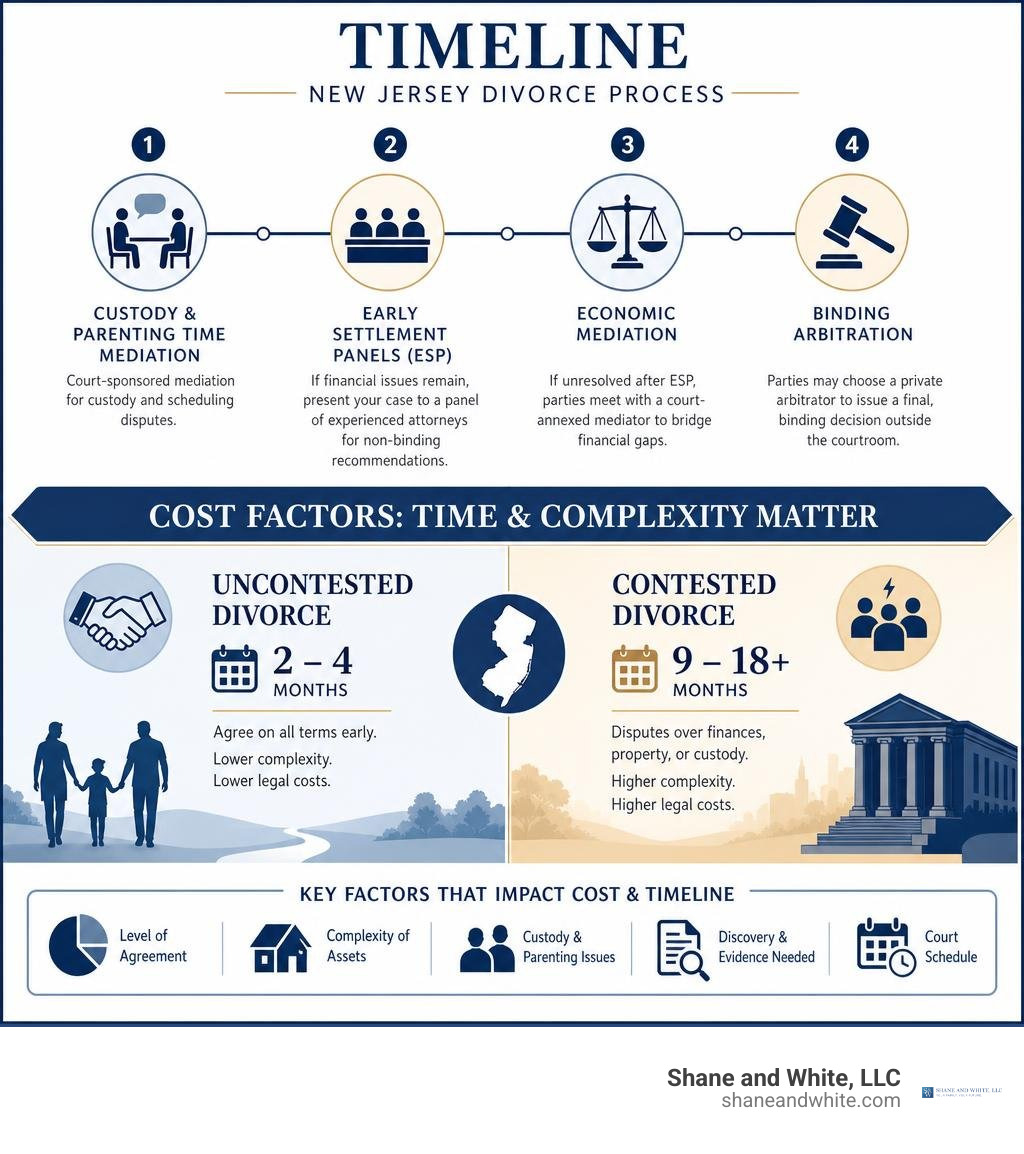
- Uncontested Divorce: When both spouses agree on all financial, property, and child-related terms before or shortly after filing, the process can often be finalized in 2 to 4 months. Uncontested divorces incur predictable, lower legal expenses.
- Contested Divorce: Cases involving disputed business valuations, complex asset tracing, or intense custody conflicts can take 9 to 18 months or longer. Contested matters require formal discovery, expert appraisals, and multiple court appearances, which increase total costs.
Establishing clear communication with your lawyer from the start regarding retainer structures, hourly rates, and case goals helps maintain control over your legal expenses.
Frequently Asked Questions About Mercer County Divorce
How long does an uncontested divorce take in Mercer County?
An uncontested divorce in Mercer County typically takes between 2 to 4 months to complete from the date of filing. The exact timeline depends on court scheduling capacity at the Mercer Vicinage Family Part, how quickly documents are signed, and prompt service of process.
Where do I file for divorce in Mercer County, New Jersey?
Divorce complaints for Mercer County residents are filed with the Superior Court of New Jersey, Mercer Vicinage, Family Part. The physical courthouse is located at:
Mercer County Civil Courthouse
175 South Broad Street
Trenton, NJ 08650
Filings are submitted electronically through the Judiciary Electronic Document Submission (JEDS) system or brought directly to the Family Division clerk’s office.
What are the court filing fees for divorce in New Jersey?
The baseline filing fee for a Complaint for Divorce in New Jersey is $300. If your filing includes requests regarding child custody or parenting time, an additional $25 fee is required for the mandatory parenting education program, bringing the total filing fee to $325. If you cannot afford these costs, you may apply for an In Forma Pauperis fee waiver with the court.
Conclusion
At Shane and White, LLC, based in Edison, New Jersey, our legal team brings over 40 years of dedicated experience to clients navigating complex matrimonial and family law matters across New Jersey. We understand that going through a divorce is deeply personal and emotionally demanding. That is why we emphasize clear communication, compassionate guidance, and strategic advocacy tailored to your unique personal and financial goals.

Whether you are preparing to file for divorce, working through equitable distribution disputes, or establishing custody arrangements for your children, having seasoned counsel makes all the difference. Visit our Divorce Practice page today to learn how our dedicated team can safeguard your rights, your family, and your financial future.


