


Introduction
Navigating a divorce in New Jersey requires satisfying the state’s 12-month residency rule, preparing and filing formal Family Part pleadings (including the Summons, Complaint, and Case Information Statement), and serving the non-filing spouse within 60 days. Working with a qualified divorce lawyer in NJ ensures proper handling of complex equitable distribution, spousal alimony, child custody arrangements, and mandatory dispute resolution stages like the Early Settlement Panel (ESP) and economic mediation. Strategic legal representation protects your financial interests and parental rights from initial filing to the entry of the Final Judgment of Divorce.
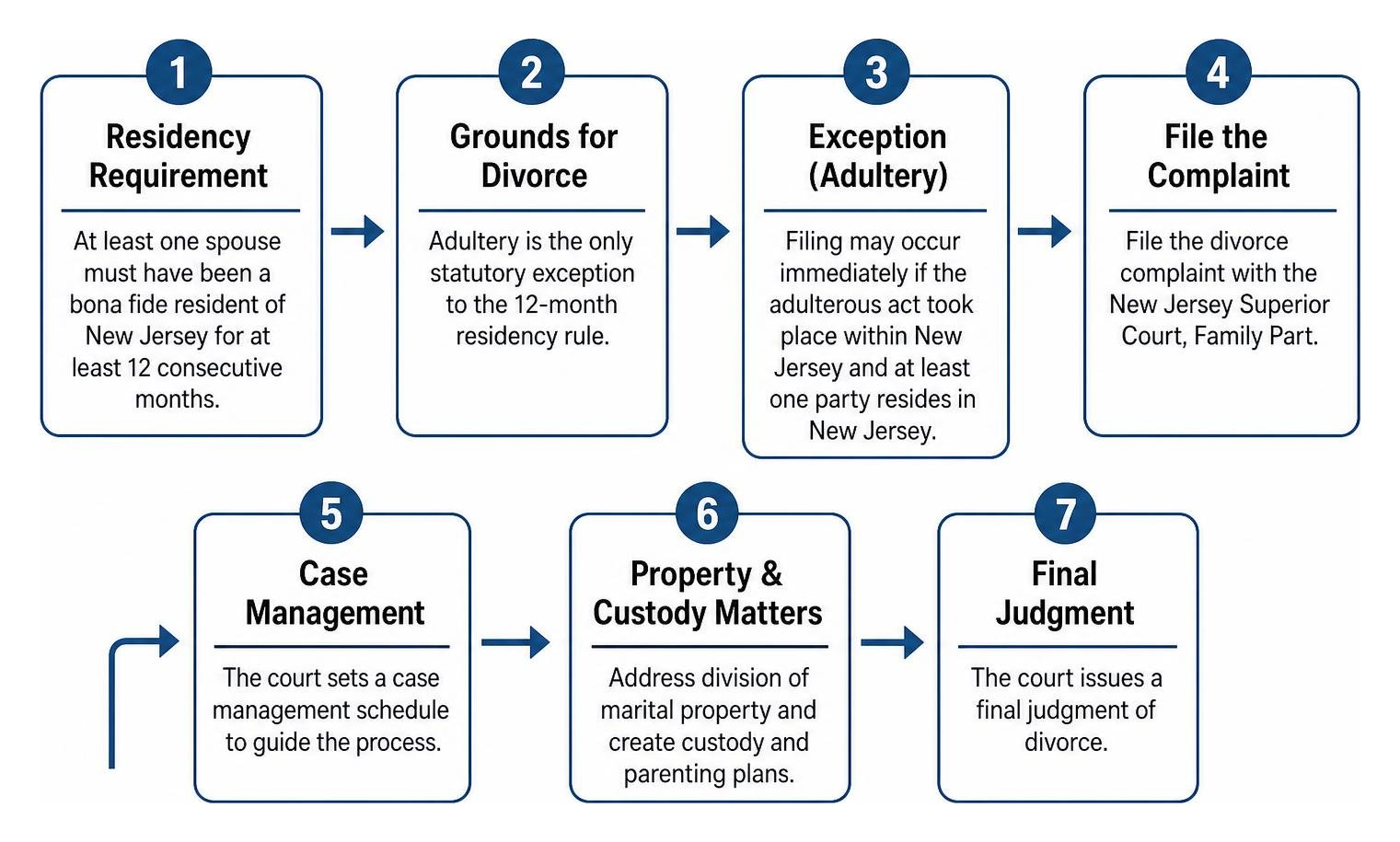
1. Grounds for Divorce and Legal Filing Requirements in New Jersey
To initiate a dissolution in the Garden State, you or your spouse must satisfy clear jurisdictional criteria. Under New Jersey law, at least one spouse must have been a bona fide resident of the state for at least 12 consecutive months before the complaint is filed. The only statutory exception to this 12-month rule involves adultery, where the filing may occur immediately if the act took place within the state and at least one party resides in New Jersey. Reviewing What are the Requirements to File for Divorce in New Jersey is a wise first step before drafting documents.

Additionally, New Jersey extends its jurisdiction to civil unions and domestic partnerships formed within the state. If you registered your union in New Jersey and subsequently relocated to a jurisdiction that does not permit dissolution of civil unions, you can still file for dissolution in the specific New Jersey county where your union was originally established.
No-Fault vs. Fault-Based Dissolution
New Jersey permits both no-fault and fault-based divorce filings, each carrying distinct legal considerations as outlined in The Ultimate Guide to New Jersey Divorce Laws and Process:
- Irreconcilable Differences (No-Fault): The most common ground in modern practice. It requires proving that the marriage has experienced a breakdown for a period of at least six months, with no reasonable prospect of reconciliation. It avoids public accusations of marital misconduct on the court record.
- Separation (No-Fault): Requires the spouses to have lived separate and apart in different residences for at least 18 consecutive months without reconciliation.
- Extreme Cruelty (Fault): Involves physical or mental cruelty that endangers the safety or health of the plaintiff or makes it unreasonable to expect them to continue cohabitation.
- Adultery (Fault): Pleading adultery requires naming the co-respondent or detailing specific instances, introducing heightened evidentiary burdens.
- Other Fault Grounds: Include desertion for 12 or more months, institutionalization for mental illness for 24 or more months, addiction to narcotic drugs or habitual drunkenness for 12 months, and imprisonment for 18 or more consecutive months.
Fault grounds rarely yield a financial advantage in equitable distribution or alimony determinations unless the conduct directly resulted in the dissipation of marital assets.
Essential Court Forms and JEDS Filing Procedures
Filing for divorce requires submitting a formal packet of pleadings to the Superior Court, Chancery Division, Family Part in the appropriate county venue. Following The Divorce Process Guide ensures proper documentation, including:
- Summons and Complaint for Divorce: Outlining the jurisdictional facts, the statutory grounds, and the specific relief requested (such as custody, child support, alimony, and equitable distribution).
- Confidential Litigant Information Sheet (CN 10486): Providing mandatory identifying details for state record-keeping.
- Certification of Insurance Coverage: Confirming all active health, life, auto, and homeowner insurance policies to prevent unauthorized cancellations during proceedings.
- Certification of Notification of Complementary Dispute Resolution (CDR) Alternatives (CN 10889): Certifying that you are aware of alternative dispute resolution processes.
- Family Part Case Information Statement (CIS) (CN 10482): A detailed financial disclosure listing all income, monthly budgets, assets, and liabilities.
All filings submitted through the Judiciary Electronic Document Submission (JEDS) platform must be uploaded as separate PDF files rather than a single aggregated document to avoid rejection by court clerks.
2. Court Filing Costs, Fee Waivers, and Service of Process Deadlines
The procedural journey of a dissolution case involves mandatory statutory fees and strict operational timeframes:
| Action / Document | Filing / Service Fee | Applicable Notes |
|---|---|---|
| Plaintiff’s Complaint for Divorce | $300.00 | Mandatory initial court docketing fee |
| Defendant’s Answer / Counterclaim | $175.00 | Mandatory fee to formally contest or respond |
| Parenting Workshop Fee | $25.00 | Assessed to each party when child custody/parenting time is contested |
| County Sheriff Service of Process | ~$35.00 – $50.00+ | Varies by mileage and county sheriff guidelines |
| LSNJ Pro Se Divorce Kit | $25.00 | Instructional resource for qualified low-income filers |
Understanding every expense from Your Divorce Start to Finish helps prevent unexpected financial hurdles.
New Jersey Divorce Fee Breakdown and Low-Income Relief
The baseline cost to file a complaint is $300, with an additional $25 assessed if custody or parenting time is disputed. If a defendant files an Answer or Counterclaim, their filing fee is $175, plus the $25 parenting workshop fee if applicable.
For individuals facing severe financial hardship, New Jersey provides an in forma pauperis waiver application. Submitting a verified petition detailing monthly income, liquid assets, and living expenses allows a judge to review and potentially waive these court fees entirely. Low-income residents can also access guidance materials through Legal Services of New Jersey (LSNJ).
Serving Divorce Papers Within the 60-Day Window
Once your complaint receives a Family Part docket number, New Jersey Court Rules mandate that the defendant be served with the Summons and Complaint within 60 days. Navigating this stage carefully prevents Common Mistakes to Avoid During a Divorce.
Service options include:
- Acknowledgment of Service: If relations remain cooperative, the defendant’s attorney (or the defendant pro se) may sign an Acknowledgment of Service, confirming receipt and eliminating the need for formal process servers.
- County Sheriff’s Office: The sheriff in the county where the defendant resides or works serves the documents personally for a statutory fee.
- Private Process Server: A licensed process server personally delivers the documents and executes a formal Affidavit of Service for court filing.
- Substituted Service or Service by Publication: If the defendant cannot be located after diligent inquiry, the court may permit service via certified mail or publication in local newspapers.
3. Why Hiring a Qualified Divorce Lawyer in NJ Protects Your Rights
Retaining dedicated legal representation transforms an overwhelming legal process into a structured, proactive strategy. Within our Family Law practice, we focus on safeguarding your financial and parental rights at every juncture.

The Advantage of Working With a Certified Matrimonial Law Attorney
Only approximately 2% of all licensed attorneys in New Jersey earn the designation of Certified Matrimonial Law Attorney from the Supreme Court of New Jersey. This distinction requires extensive trial experience, peer evaluation by judges and fellow matrimonial attorneys, rigorous continuing legal education, and passage of a comprehensive examination. When discovering How to Choose Your Family Law Attorney, prioritizing this certification ensures your counsel has demonstrated proficiency in complex matrimonial litigation.
How an Experienced Divorce Lawyer in NJ Protects High-Value Assets and Custody
Navigating high-asset distribution, business valuations, and custody matters requires comprehensive financial and trial skills. Learning How a Divorce Attorney Helps Protect Your Rights and Assets provides peace of mind throughout the case.
Our practice assists clients with:
- Equitable Distribution: Uncovering hidden assets, valuing closely held businesses, evaluating executive compensation, stock options, and dividing retirement accounts (401k, pensions) via Qualified Domestic Relations Orders (QDROs).
- Alimony Determinations: Applying statutory factors (open durational, limited duration, rehabilitative, or reimbursement alimony) based on marital standard of living, earning capacities, and marriage length.
- Child Custody and Support: Structuring detailed parenting plans, calculating New Jersey Child Support Guidelines, and handling complex parenting-time disputes.
- Pendente Lite Relief: Securing crucial temporary court orders for child support, alimony, mortgage payments, and custody while litigation is ongoing.
4. Complementary Dispute Resolution: Mediation, Early Settlement Panels, and Arbitration
New Jersey courts strongly emphasize Complementary Dispute Resolution (CDR) to encourage settlement outside the courtroom, as outlined in What to Expect When You Are Getting a Divorce.
Navigating Custody Mediation and Early Settlement Panels (ESP)
When custody or parenting time is contested, parties participate in court-sponsored, confidential mediation with court staff. If financial issues remain unresolved after the discovery period, cases proceed to the mandatory Early Settlement Panel (ESP).
In the ESP program, two neutral, experienced volunteer matrimonial attorneys review both parties’ settlement memos. The panel delivers non-binding recommendations on how a Family Part judge would likely resolve the financial issues at trial. As an active Middlesex County Divorce Lawyer who frequently serves on these panels, we leverage this insider perspective to evaluate and negotiate settlements effectively.
Economic Mediation and Binding Matrimonial Arbitration
If the ESP does not produce a settlement, the court refers the parties to mandatory Economic Mediation. The first two hours of economic mediation (including one hour of mediator prep time) are provided at no charge by court-approved mediators.
For clients seeking complete confidentiality and faster resolution, private binding arbitration is an alternative to public court proceedings. In arbitration, the parties select a qualified matrimonial arbitrator whose formal rulings carry the same weight as a Superior Court judgment.
5. Strategic Steps to Retaining Legal Counsel and Finalizing Dissolution
Choosing legal representation sets the foundation for your case. Following our guidance on Finding the Right New Jersey Family Law and Divorce Attorney helps you prepare for initial consultations.
Key Qualifications to Evaluate in a Divorce Lawyer in NJ
When interviewing attorneys, prepare strategic questions to assess their experience:
- Are you certified by the Supreme Court of New Jersey as a Matrimonial Law Attorney?
- How many years have you practiced matrimonial law in my specific county courthouse?
- What is your strategic approach to settlement negotiations versus aggressive trial litigation?
- How does your billing structure operate, and what retainer deposit is required?
- Who will be the primary attorney managing my day-to-day filings and court appearances?
Transparent answers to these questions will clarify expectations. You can reach out directly via our Contact Us page to schedule an in-depth case evaluation.
Finalizing the Judgment of Divorce and Obtaining Court Records
Once all issues are resolved through a Marital Settlement Agreement (MSA) or trial, the court enters a Final Judgment of Divorce (FJOD), officially dissolving the legal marriage.
To secure certified copies of your final divorce judgment with the raised gold seal (often needed for passport renewals, name changes, or real estate transactions), contact the Superior Court Clerk’s Office in Trenton at 609-421-6100 or submit a records request through your local county courthouse records division.
Frequently Asked Questions About New Jersey Divorce
How long does a contested divorce take in New Jersey?
A fully contested divorce typically takes between 9 and 18 months, depending on county court dockets, the complexity of the marital estate, and expert discovery timelines. For a detailed breakdown of case duration, read How Long Does It Take to Get Divorced in New Jersey. Uncontested matters with an executed settlement agreement can often be resolved in a fraction of that time.
What is the primary difference between irreconcilable differences and fault grounds?
No-fault irreconcilable differences only require demonstrating a six-month breakdown of the marital relationship, avoiding public accusations of fault in court pleadings. Fault grounds (such as adultery or extreme cruelty) require specific factual evidence and testimony, increasing litigation costs without offering an equitable distribution advantage in most cases.
Can I get court fees waived if I cannot afford a divorce in NJ?
Yes. If your income falls below specific poverty thresholds, you can file an application for a fee waiver (in forma pauperis) with the Superior Court Family Division. If approved by a judge, initial filing fees, motion fees, and parenting workshop costs are waived.
Conclusion
Dissolving a marriage involves navigating legal, financial, and personal challenges. With over 40 years of dedicated legal experience, Shane and White, LLC provides strategic counsel and personalized attention to clients across Edison, Metuchen, Woodbridge, East Brunswick, New Brunswick, North Brunswick, Monroe, Piscataway, Sayreville, and all of Middlesex County.
Whether negotiating an amicable settlement agreement or advocating in complex courtroom litigation, having a Certified Matrimonial Law Attorney on your side protects your future. Explore our dedicated resources on Divorce in New Jersey or contact our team today to schedule your consultation.


