
Understanding Divorce Laws in New Jersey
To file for divorce in New Jersey, either you or your spouse generally must have lived in the state for 12 straight months. A common no-fault ground is irreconcilable differences that have lasted at least six months. You file a divorce complaint with the Superior Court, serve your spouse, and resolve issues such as property, support, and parenting through an agreement or a court decision.
I’m Kenneth White, Esq. If you searched for “divorce laws nj,” I want to help you understand what those rules mean for your next steps. I’m certified by the Supreme Court of New Jersey as a Matrimonial Law Attorney and have served on the Middlesex County Early Settlement Panel and as a court-appointed mediator.
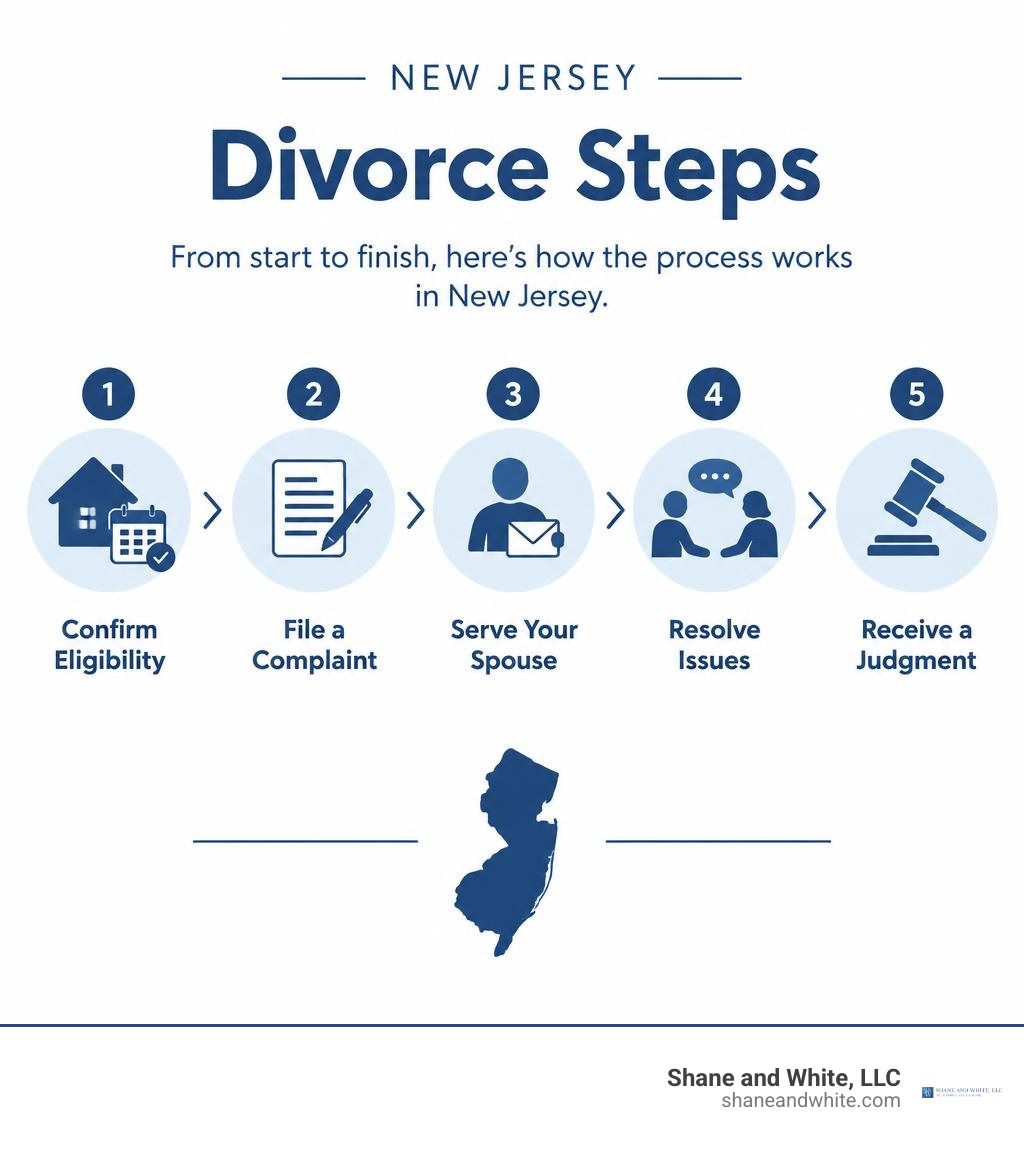
Navigating Divorce Laws NJ: Residency Requirements and Statutory Grounds
In New Jersey, the legal term for divorce is “dissolution.” While the terminology sounds formal, the process is designed to bring a clear, legal close to a marital union. To initiate this process, the court must have subject-matter jurisdiction over your marriage.
The baseline rule requires that either you or your spouse must have been a bona fide resident of New Jersey for at least 12 consecutive months immediately before filing the divorce complaint. You must also be at least 18 years of age to file on your own behalf; if an individual is under 18, a parent or legal guardian must file on their behalf.
There is one critical exception to the 12-month residency rule: if your ground for divorce is adultery, you only need to establish bona fide residency in New Jersey at the time the adulterous act took place and when filing the complaint. For a deeper look at the foundational steps, review our comprehensive guide to the divorce process.
No-Fault vs. Fault Grounds Under Divorce Laws NJ
Under New Jersey Revised Statutes Section 2A:34-2, spouses may file under either no-fault or fault-based causes of action. Most couples today choose no-fault grounds because it reduces interpersonal conflict and eliminates the need to prove marital misconduct in open court.
| Ground Type | Legal Basis | Required Timeline / Standard |
|---|---|---|
| No-Fault | Irreconcilable Differences | Marriage broken down for at least 6 months with no prospect of reconciliation |
| No-Fault | Separation | Spouses living separate and apart in different residences for at least 18 consecutive months |
| Fault-Based | Extreme Cruelty | Endangerment to health or safety; complaint filed at least 3 months after the last incident |
| Fault-Based | Willful Desertion | Unjustified abandonment by one spouse for 12 or more consecutive months |
| Fault-Based | Adultery | Extramarital sexual relations; no 12-month waiting period required |
| Fault-Based | Addiction / Incarceration | 12+ months of chemical addiction or 18+ consecutive months of imprisonment |
Specific Statutory Grounds and Waiting Periods
While irreconcilable differences is the most commonly cited cause, New Jersey law enumerates several specific fault grounds:
- Willful and Continued Desertion: One spouse departs the marital home against the other’s wishes for at least 12 consecutive months.
- Extreme Cruelty: Physical, emotional, or psychological conduct that makes it unreasonable or unsafe for the spouses to cohabitate. The law requires a 3-month cooling-off window after the last act of cruelty before filing.
- Voluntary Addiction or Habitual Drunkenness: Continued substance dependence lasting for at least 12 straight months.
- Institutionalization for Mental Illness: Consecutive confinement in a mental health facility for 24 months or more.
- Imprisonment: Confinement in a correctional facility for 18 or more consecutive months.
- Deviant Sexual Conduct: Non-consensual sexual acts performed without the other spouse’s agreement.
Step-by-Step Procedure for Filing a Divorce Complaint
Divorce matters in New Jersey are handled by the Superior Court of New Jersey, Chancery Division, Family Part, located in the county where the cause of action arose or where either party resides. Filers submit paperwork through the Judiciary Electronic Document Submission (JEDS) portal, in person at the local county courthouse, or by mail. To understand the operational rhythm of a case, read our overview on what to expect throughout your proceedings.
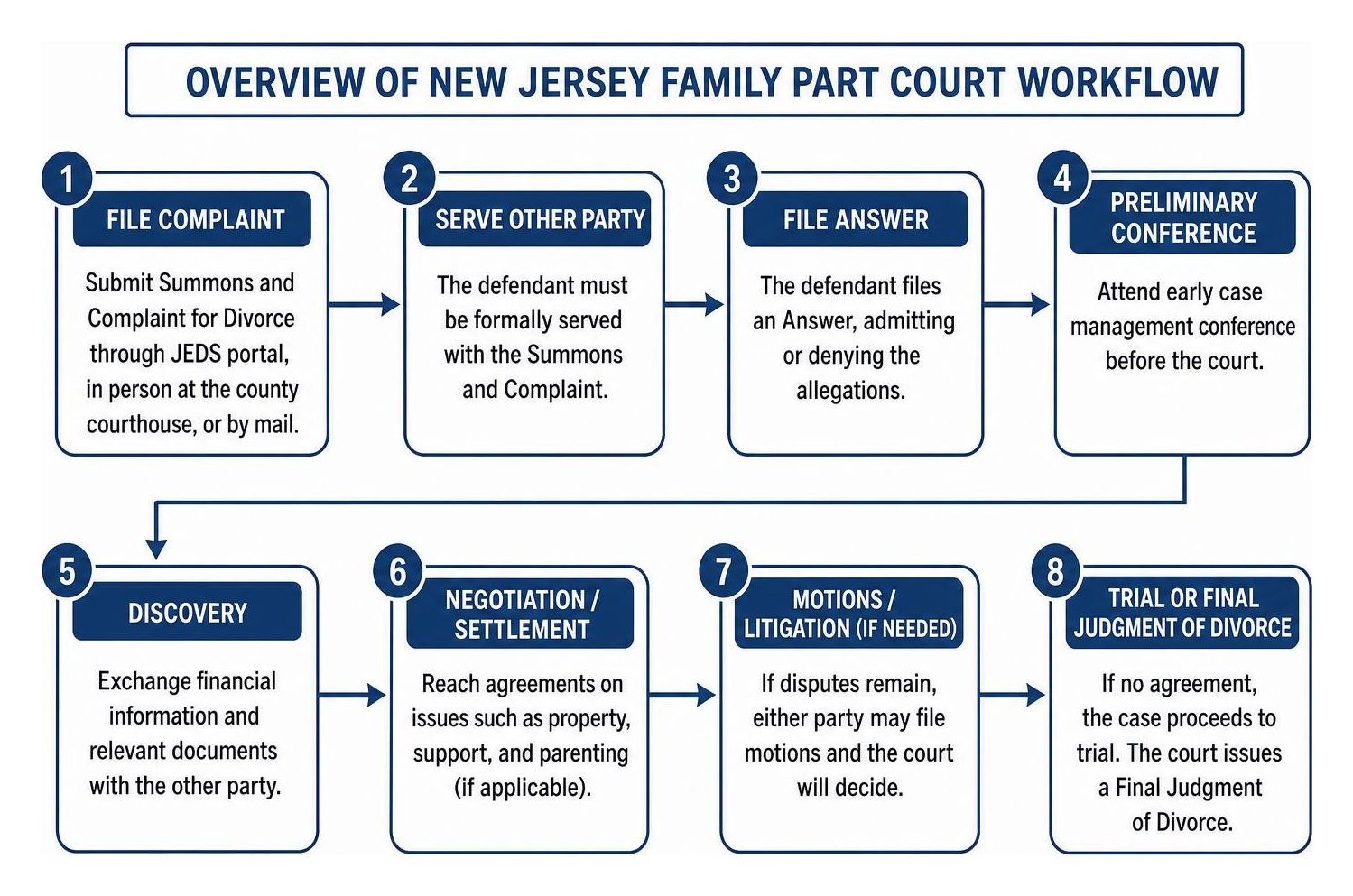
Required Court Forms and Documentation
Self-represented filers and attorneys rely on the New Jersey Judiciary Divorce Self-Help Portal to access official court documents. A complete initial filing package contains:
- Summons and Complaint for Divorce: Outlines jurisdictional facts, statutory grounds, and requested relief (such as alimony or equitable distribution).
- Certification of Verification and Non-Collusion: Confirms that the allegations are true and the case is not filed in fraudulent agreement with your spouse.
- Confidential Litigant Information Sheet (Form CN 10486): Collects vital personal information for internal court tracking.
- Certification of Insurance Coverage: Lists all existing health, life, auto, and homeowner insurance policies to prevent unauthorized cancellations during litigation.
- Certification of Notification of Complementary Dispute Resolution (CDR) Alternatives (Form CN 10889): Certifies that the parties have been informed of mediation and settlement options.
- Family Part Case Information Statement (CIS) (Form CN 10482): A detailed financial disclosure covering historical budgets, real estate, debts, and income.
Filing Fees, Fee Waivers, and Service of Process

Filing a divorce complaint incurs mandatory court fees:
- Plaintiff Filing Fee: $300 to file the initial complaint.
- Defendant Filing Fee: $175 to file an answer, counterclaim, or appearance.
- Parenting Workshop Fee: $25 for cases involving minor children (waived if a restraining order exists or a signed property settlement agreement is submitted).
If you cannot afford these costs, you may apply for an indigent fee waiver by demonstrating financial hardship.
Once the court assigns a docket number, the complaint must be served on your spouse within 60 days. Acceptable service methods include hand-delivery by a County Sheriff’s Officer, an authorized private process server, or having your spouse sign an official Acknowledgment of Service. Understanding these procedural milestones helps establish clear expectations regarding uncontested divorce waiting periods.
Financial Obligations: Alimony and Attorney Fee Awards
Spousal support is not automatic; it is based on financial need, earning capabilities, and marital duration. During ongoing litigation, a judge can order temporary (pendente lite) support to maintain household bills. You can also explore how attorney fees are paid in divorce when one party lacks independent resources or the other party engages in bad-faith litigation.
Determining Alimony Types and Duration Under Divorce Laws NJ
New Jersey recognizes four statutory alimony structures:
| Alimony Type | Primary Purpose | Standard Duration |
|---|---|---|
| Open Durational | Long-term support for dependent spouses | Marriages lasting 20+ years; ends at standard retirement age |
| Limited Duration | Intermediate financial support | For marriages under 20 years; duration cannot exceed marriage length (absent exceptional circumstances) |
| Rehabilitative | Funds education or professional training | Short-term; follows an established educational or job-reentry plan |
| Reimbursement | Repays sacrifices made for a spouse’s advanced degree | Fixed financial sum paid periodically or in a lump sum |
Factors Influencing Alimony Determinations
Under N.J.S.A. 2A:34-23(b), family court judges weigh 14 distinct factors when deciding spousal support:
- Actual financial need and the supporting spouse’s ability to pay.
- Duration of the marriage.
- Physical and emotional health, as well as the age of each party.
- Standard of living established during the marriage.
- Earning capacities, educational levels, and employability of both parties.
- Parental responsibilities for minor children.
- Length of absence from the job market for caregiving duties.
- Equitable distribution of property and debts awarded in the divorce.
Division of Property, Debts, and Dispute Resolution

New Jersey is an equitable distribution state, not a community property state. Marital assets and debts acquired between the date of marriage and the date of filing the divorce complaint are divided fairly, though not necessarily on a 50/50 basis. Marital property includes real estate, bank accounts, pensions, and stock portfolios, while separate property generally includes inheritances or gifts received individually from third parties. To protect your post-divorce financial footing, employ strategic strategies to dissolve marriage without debt.
Settlement Options and Court Procedures
The vast majority of family law cases settle outside the courtroom. The court provides structured alternative dispute resolution mechanisms to help spouses avoid an expensive trial:
- Direct Negotiation: Spouses and their attorneys draft a comprehensive Property Settlement Agreement (PSA) or Marital Settlement Agreement (MSA).
- Early Settlement Panel (ESP): Experienced, neutral family law attorneys volunteer to review financial information and recommend a balanced settlement.
- Economic Mediation: If the ESP recommendation is not accepted, parties proceed to court-mandated economic mediation with a neutral specialist.
Domestic Violence Safeguards and Self-Representation Realities
When a Temporary Restraining Order (TRO) or Final Restraining Order (FRO) is in place under the Prevention of Domestic Violence Act, standard court-mandated mediation is prohibited to protect victim safety. However, if the victim consents, economic issues may be addressed through specialized domestic violence economic mediation using separate rooms or remote video platforms.
While self-representation (pro se) is permitted, navigating court rules, discovery deadlines, and pension division (such as Qualified Domestic Relations Orders) can be overwhelming. Reviewing a consultation checklist for family law helps ensure you gather the necessary documentation before speaking with an attorney.
Frequently Asked Questions About New Jersey Divorce Laws
How do I locate and request a copy of my final divorce record in New Jersey?
Certified copies of a final Judgment of Divorce are maintained by the Superior Court Clerk’s Office Records Center in Trenton. You can request a certified copy online or by mail by providing both spouses’ full legal names, the county of venue, the approximate year of dissolution, and your assigned docket number.
Can a judge order my spouse to pay for my divorce attorney fees?
Yes. Under New Jersey Court Rule 5:3-5(c), judges may award counsel fees based on the financial disparity between the parties, the good faith or bad faith of either litigant, the reasonableness of the positions taken, and the fees previously paid.
How can domestic violence affect procedures for resolving financial issues?
If an active restraining order is present, standard interpersonal mediation is prohibited. Financial disputes must be resolved through direct attorney-led negotiations, formal court hearings, or specialized economic mediation programs where the parties remain strictly separated.
Conclusion
Navigating a divorce requires clear strategic planning and a solid understanding of your statutory rights. At Shane and White, LLC, we bring over 40 years of combined legal experience to clients throughout Edison, New Brunswick, Woodbridge, and surrounding Middlesex County communities. Whether you are dealing with complex asset division, alimony calculations, or child custody matters, our team provides personalized representation tailored to your unique goals. Contact us today to secure experienced New Jersey divorce representation and protect your future.