
How Long Does a Divorce Take?
A divorce can take a few months or several years. The biggest difference is whether both spouses agree on property, support, and parenting. For example, an uncontested divorce in New York often takes 3 to 6 months, while a contested case can take 1 to 3 years. California requires at least 6 months, even when both spouses agree. In New Jersey, your timeline will depend on the issues in your case and the court’s schedule.
I’m Kenneth White, Esq., a New Jersey Supreme Court-certified matrimonial law attorney who helps clients understand how long divorce cases take. My experience as a mediator and early settlement panelist has shown me how resolving disputes can change that timeline.
Key Factors Determining How Long Divorce Takes to Finalize
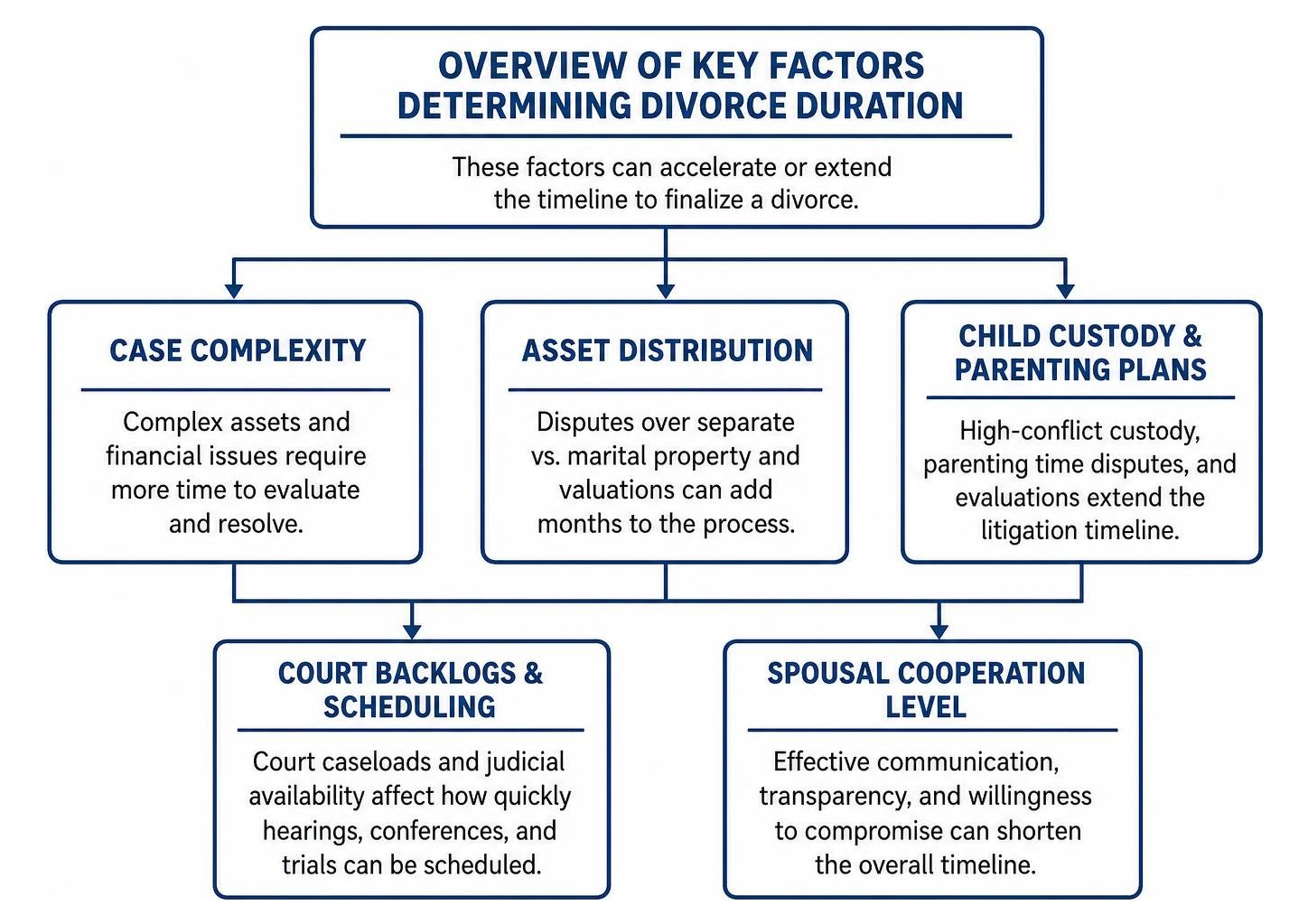
When clients ask us how long their proceedings will take, we always explain that no two family law matters follow an identical path. The overall length of a marital dissolution depends on several practical and procedural elements that can either accelerate or drag out the case.
- Case Complexity: Dividing a simple bank account and a rented apartment takes substantially less time than valuing privately owned businesses, executive stock options, or complex real estate portfolios.
- Asset Distribution: When parties dispute separate versus marital property, forensic accounting evaluations and formal appraisals become necessary, adding months to the calendar.
- Child Custody and Parenting Plans: High-conflict custody arrangements, parenting time disagreements, and independent psychological evaluations require careful review, inevitably extending the litigation timeline.
- Court Backlogs and Scheduling: Family courts manage heavy caseloads. Scheduling motions, mandatory settlement conferences, and multi-day trials hinges directly on judicial availability.
- Spousal Cooperation Level: Timely communication, transparency with financial records, and a genuine willingness to compromise can resolve a matter in months, whereas stalling tactics can prolong it for years.
Uncontested vs. Contested Timelines: How Long Divorce Cases Last
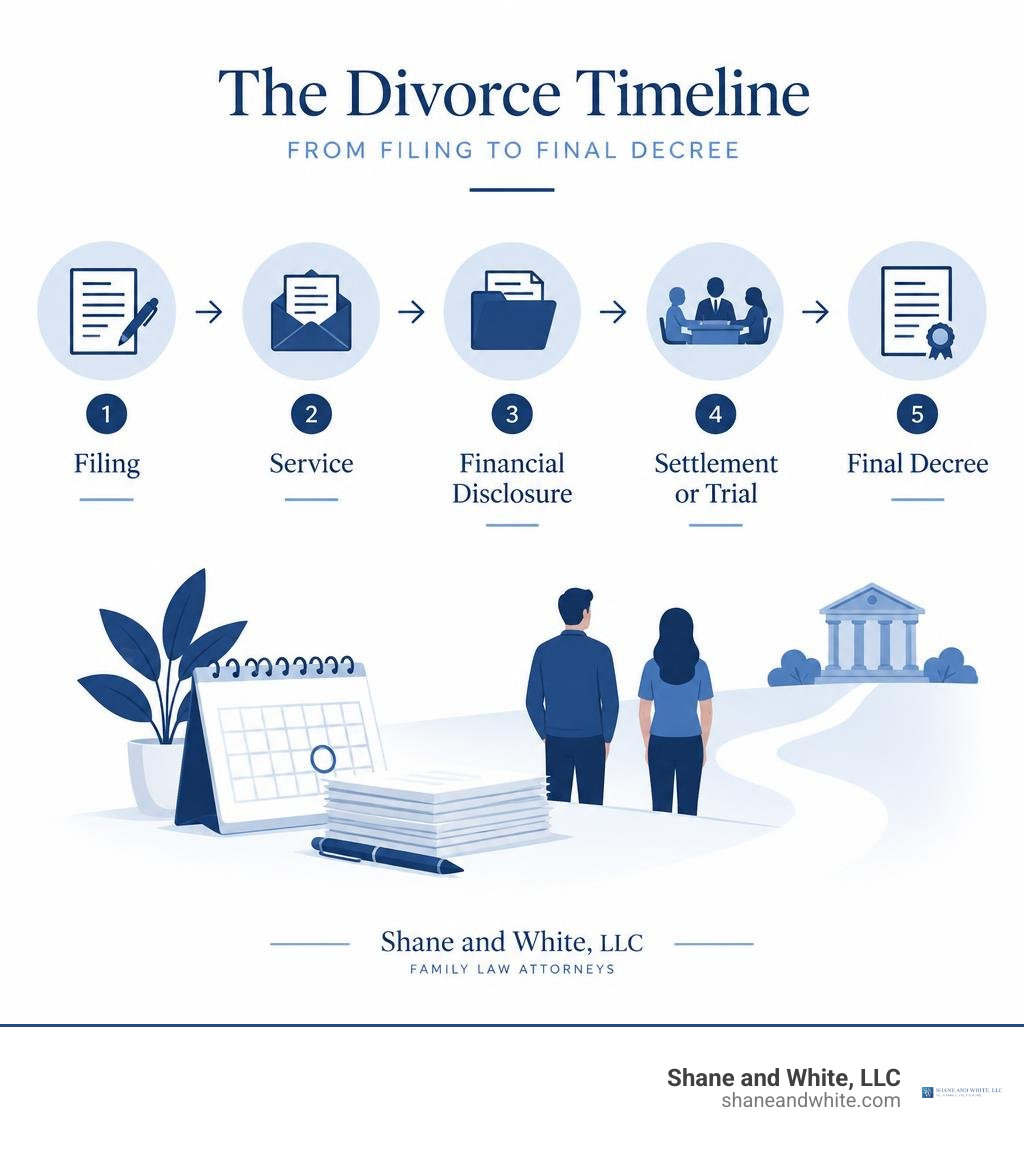
The procedural divide between an uncontested and a contested divorce represents the single largest factor dictating your timeline. An uncontested matter occurs when both parties have already resolved all terms—including equitable distribution, alimony, child support, and custody—and simply need the court to enter a judgment.
Conversely, a contested divorce involves disputed issues requiring court intervention, formal discovery, and potential trial proceedings. To understand the statutory waiting periods involved when couples agree on terms, review our guide to realistic uncontested divorce waiting periods.
| Stage | Uncontested Divorce Timeline | Contested Divorce Timeline |
|---|---|---|
| Initial Filing & Service | 1 to 4 weeks | 1 to 2 months |
| Pendente Lite / Temporary Orders | Usually unnecessary | 1 to 3 months (if filed) |
| Financial Discovery & Valuations | Minimal (voluntary disclosures) | 3 to 9 months |
| Settlement Conferences & Mediation | 1 to 2 months | 3 to 6 months |
| Trial Preparation & Hearing | None | 6 to 18 months |
| Total Estimated Duration | 2 to 6 months | 1 to 3+ years |
If you are beginning this process, reading about what to expect when getting a divorce will help you prepare for every stage of litigation.
Temporary Orders, Automatic Freezes (ATROs), and Financial Discovery
Once an action begins, spouses must manage their immediate living situations and finances while the case remains pending. Courts utilize specific mechanisms to maintain the status quo:
- Automatic Restraining Orders (ATROs): In many jurisdictions, filing the initial summons immediately activates statutory orders that freeze marital assets, preventing either party from draining accounts, modifying insurance policies, or transferring property without court approval or mutual written consent.
- Pendente Lite Relief: When spouses cannot agree on interim financial support or parenting schedules while litigation proceeds, either party can file a motion for temporary relief. This establishes temporary alimony, child support, and exclusive possession of the marital residence until final judgment.
- Financial Discovery & Depositions: During contested litigation, both sides exchange formal interrogatories, request production of documents, and depose witnesses. If hidden assets or complex business valuations are suspected, forensic accountants are retained, which adds significant time to the pre-trial phase.
State-by-State Timelines and Mandatory Waiting Periods
Every state establishes its own legal framework governing residency thresholds, mandatory cooling-off periods, and procedural filing requirements. Approaching your case requires navigating family court with strategic planning tailored to your specific jurisdiction.
New York: Procedural Stages, Automatic Orders, and County Processing
Under New York Domestic Relations Law (DRL §170(7)), a no-fault divorce requires an irretrievable breakdown of the marriage for at least six months. New York does not impose a mandatory post-filing statutory cooling-off period; instead, duration is driven by court calendars and procedural compliance.
In places like Erie County, Supreme Court clerks process complete uncontested divorce packets electronically within 60 to 90 days. Conversely, contested actions involving discovery, preliminary conferences, and expert valuations typically require 1 to 3 years. For those handling New Jersey actions, review official New Jersey court divorce procedures for local requirements.
California, Nebraska, and Maryland: Mandatory Cooling-Off Rules
Several states impose strict statutory timeframes that establish hard minimum timelines:
- California: State law mandates a strict six-month waiting period that begins the exact day the respondent is served with divorce papers, not the date of filing. An uncontested matter takes approximately 6 to 8 months, while contested cases extend from 9 to 18 months or longer. Learn more through the California Courts divorce self-help guide.
- Nebraska: Nebraska requires a mandatory 60-day waiting period following formal service of process before the court can hold a final hearing or enter a dissolution decree. Additionally, Nebraska law prohibits parties from remarrying anywhere in the world for at least six months after the divorce decree is signed.
- Maryland: Maryland permits divorce based on a six-month continuous separation, even if spouses reside under the same roof while living separate lives. If the grounds occurred outside the state, at least one spouse must satisfy a six-month Maryland residency requirement prior to filing.
International Perspectives: How Long Divorce Takes in Canada and the UK

Understanding divorce durations outside the United States illustrates how different legal systems balance statutory reflection periods against procedural efficiency. Regardless of jurisdiction, reaching a fair divorce settlement without financial strain remains the most effective strategy to avoid prolonged proceedings.
Canada: One-Year Separation Requirement and Desk-Order Decrees
Under the federal Divorce Act in Canada, the primary no-fault ground requires spouses to live separate and apart for at least 12 continuous months before a court grants a divorce (unless specific fault grounds like cruelty or adultery are proven).
Spouses may file their paperwork before the year concludes, but the decree will not be issued until the full 12 months have elapsed. Simple uncontested actions resolved via a desk-order divorce (reviewed by a judge without an in-person hearing) generally take 4 to 6 months to process once filed. After the court signs the divorce order, Canadian law imposes a mandatory 31-day waiting period before the order becomes legally absolute and remarriage is permitted. Contested Canadian divorces frequently span 1 to 3 years.
England and Wales: The 26-Week No-Fault Timeline
Following comprehensive legal reforms, England and Wales established a streamlined no-fault process using the standard D8 application. A divorce in this jurisdiction cannot be finalized in less than 26 weeks from start to finish:
- Filing the Application: Either spouse (or both jointly) submits the divorce application.
- 20-Week Reflection Period: The law imposes a mandatory 20-week statutory cooling-off window from the date of issue to allow the couple to reflect, seek mediation, or make financial arrangements.
- Conditional Order: After the 20 weeks expire, the applicant can apply for a Conditional Order (confirming eligibility for dissolution).
- 43-Day Final Order Window: The applicant must wait a mandatory 6 weeks and 1 day (43 days) after the Conditional Order is granted before applying for the Final Order, which legally dissolves the marriage.
For more details on this process, consult the England and Wales no-fault divorce framework.
Frequently Asked Questions About the Divorce Timeline
Can a divorce be finalized without any court appearances?
Yes. In many jurisdictions, if you and your spouse enter into a comprehensive settlement agreement and submit all necessary affidavits, financial disclosures, and proposed judgments electronically, a judge can review and sign the final decree in chambers without requiring you to appear in an open courtroom.
How long after a divorce decree is signed before you can remarry?
This depends entirely on local law. In states like New York or New Jersey, you are legally free to remarry as soon as the final judgment is entered and stamped by the court clerk. However, in Nebraska, you must wait six months post-decree, and in Canada, you must wait for the 31-day appeal period to expire before obtaining a Certificate of Divorce.
What is the fastest way to expedite a pending divorce?
The most effective way to expedite your case is to provide complete, organized financial documentation immediately, engage in good-faith negotiations or private mediation early, maintain open communication with your attorney, and reach a comprehensive agreement on all marital issues rather than waiting for court trial dates.
Conclusion
Determining how long your marital dissolution will take comes down to preparation, statutory requirements, and whether disputes can be resolved amicably outside the courtroom. At Shane and White, LLC, our legal team brings over 40 years of dedicated family law experience to help clients navigate these timelines with clarity and confidence. If you are preparing for dissolution and want clear guidance on your case, explore our detailed analysis of how long it takes to get divorced in New Jersey or contact our office to discuss your legal options.