


What Are the Types of Custody? A Clear Guide for New Jersey Parents
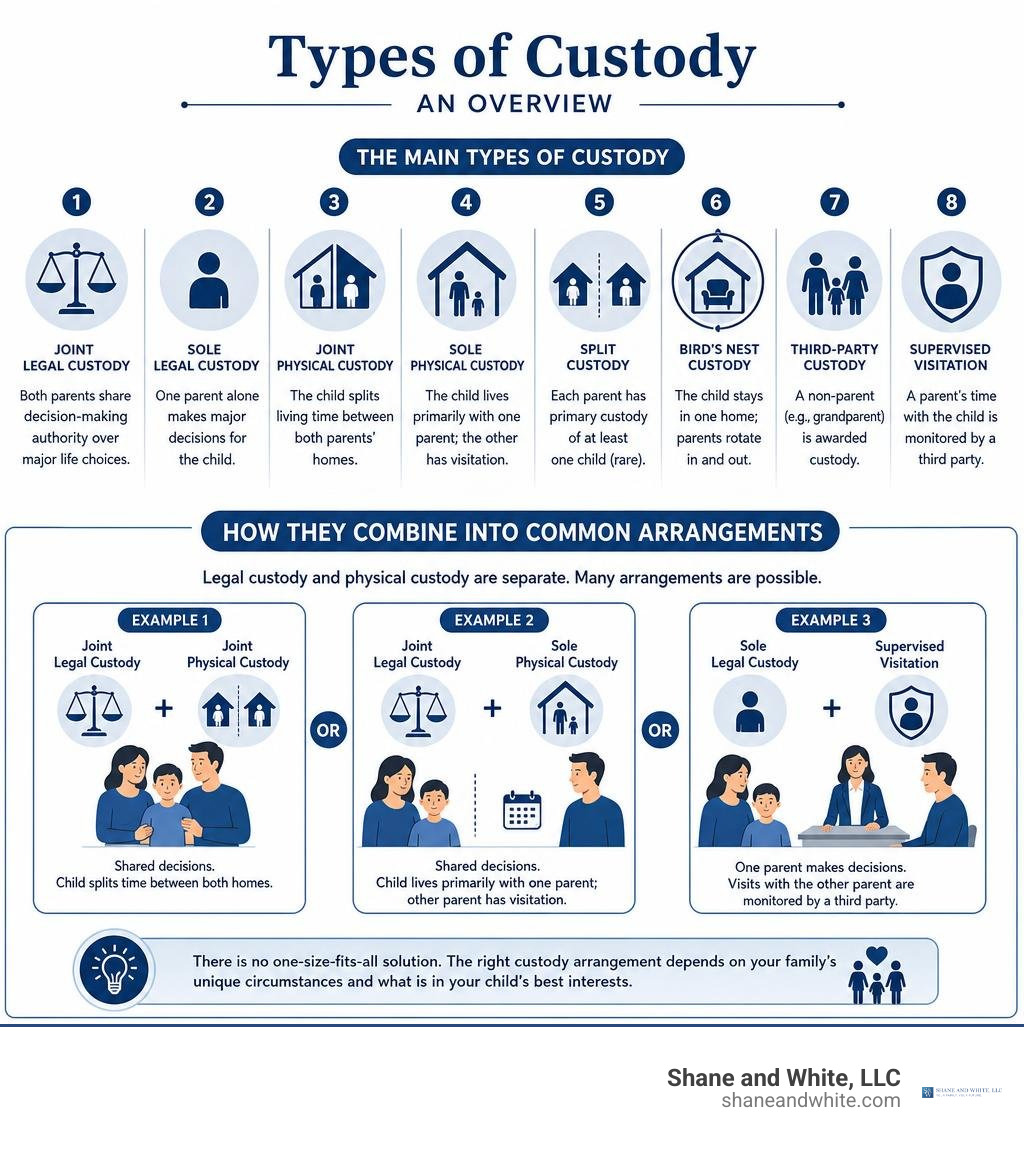
Understanding the types of custody is the first step every parent needs to take when facing a separation or divorce. Here is a quick overview:
| Custody Type | What It Means |
|---|---|
| Joint Legal Custody | Both parents share decision-making authority over major life choices |
| Sole Legal Custody | One parent alone makes major decisions for the child |
| Joint Physical Custody | The child splits living time between both parents’ homes |
| Sole Physical Custody | The child lives primarily with one parent; the other has visitation |
| Split Custody | Each parent has primary custody of at least one child (rare) |
| Bird’s Nest Custody | The child stays in one home; parents rotate in and out |
| Third-Party Custody | A non-parent (e.g., grandparent) is awarded custody |
| Supervised Visitation | A parent’s time with the child is monitored by a third party |
These types are not separate choices — they combine. For example, you can have joint legal custody while one parent has sole physical custody. The arrangement that works for your family depends on your specific circumstances, your child’s needs, and what a New Jersey family court determines is in your child’s best interests.
Custody decisions affect everything: where your child sleeps at night, who signs their school forms, and how much time each parent gets. Getting it wrong — or not understanding your options — can have lasting consequences.
I’m Kenneth A. White, Esq., a Certified Matrimonial Law Attorney at Shane and White, LLC, with decades of experience helping New Jersey families navigate all types of custody arrangements, from straightforward agreements to complex contested disputes. Let me walk you through everything you need to know.
Legal Custody vs. Physical Custody: The Two Core Dimensions
When parents begin discussing the types of custody, they often treat “custody” as a single, all-or-nothing concept. In reality, custody is split into two entirely distinct dimensions: decision-making authority (legal custody) and residential arrangements (physical custody).
These two dimensions operate independently. A parent can have shared decision-making power even if the child lives with them only on alternating weekends. Understanding this distinction is the foundation of building a functional parenting plan that protects your child’s well-being and preserves your parental rights.

To explore how these structures work across different states, you can Learn about the types of child custody arrangements | Mass.gov .
Understanding Legal Custody: Decision-Making Authority
Legal custody does not dictate where your child sleeps. Instead, it grants the legal right and responsibility to make major, long-term decisions about your child’s upbringing. These major life choices typically fall into four primary categories:
- Education: Choosing a public, private, or charter school, tutoring services, or specialized educational programs.
- Healthcare: Selecting primary care doctors, dentists, therapists, and approving non-emergency medical treatments or surgeries.
- Religious Up upbringing: Determining which religious traditions, services, or educational programs the child will participate in.
- Extracurricular Activities: Enrolling the child in long-term, high-commitment sports, arts, or summer camps that impact both households’ schedules.
In roughly 80% to 90% of cases nationwide, courts award joint legal custody, meaning both parents must consult and agree on these major decisions. Making a unilateral decision when joint legal custody is in place—such as enrolling your child in a new school without the other parent’s consent—can lead to serious legal consequences, including being held in contempt of court.
If you are currently drafting a parenting plan, you should understand Why Your Child Custody Plans Need Early Legal Guidance to ensure your decision-making rights are clearly defined and enforceable.
Understanding Physical Custody: Where the Child Lives
Physical custody, also referred to as “residential custody” or “parenting time,” defines where the child physically resides on a day-to-day basis and who manages their daily care.
The parent with physical custody handles the immediate, routine needs of the child: preparing meals, managing bedtime, driving them to school, and overseeing homework. Physical custody is highly structured around overnight schedules, which directly influence child support calculations in New Jersey.
Under New Jersey child support guidelines, the number of overnights a child spends with each parent directly impacts the financial obligations of both parties. For a deeper look at how residential parenting time is structured, check out the resources provided in Child custody and parenting time | California Courts | Self Help Guide .
If you are concerned about how your living arrangements will affect your financial responsibilities, you may wonder: Can a Child Support Lawyer Help With Custody Issues? The answer is a resounding yes, as the two issues are legally intertwined. Additionally, if either parent plans on moving, you must follow specific rules regarding Moving With Your Child in the State of New Jersey to avoid violating physical custody orders.
Exploring the Main Types of Custody: Sole vs. Joint Arrangements
Choosing between sole and joint custody is rarely a matter of personal preference; it is a decision guided by parental fitness, cooperation levels, stability, and the child’s emotional health.
| Feature | Joint Custody Arrangements | Sole Custody Arrangements |
|---|---|---|
| Decision-Making | Shared equally; both parents must agree on major choices. | Unilateral; one parent makes all major decisions. |
| Living Arrangements | Child splits time between both households (e.g., 50/50 or 60/40). | Child lives primarily with one parent; other has visitation. |
| Court Presumption | Strongly favored by courts to maintain active bonds with both parents. | Only awarded in cases of unfitness, abuse, or safety risks. |
| Communication Need | High; requires consistent, respectful parental cooperation. | Low; minimizes contact between high-conflict parents. |
Sole Custody vs. Joint Custody in Practice
In New Jersey, as in more than 30 states across the country, there is a legal presumption or strong preference that some form of shared parenting is in the child’s best interests. Courts recognize that children thrive when they maintain strong, active relationships with both parents.
Sole physical and legal custody is relatively rare. It is typically only awarded when the court determines that one parent is unfit or if there are severe safety concerns, such as a documented history of abuse, neglect, substance addiction, or severe, untreated mental health issues.
For parents navigating these emotional waters, we recommend reading our guides on Your Children and Your Divorce and How to Handle Divorce When Children Are Involved to understand how to keep your children’s emotional health at the center of your legal strategy.
How Different Types of Custody Combine into Common Arrangements
Because legal and physical custody are distinct, they can be combined in several ways to suit a family’s unique lifestyle.
- Joint Legal Custody and Joint Physical Custody: The child splits their time relatively evenly between both homes (e.g., alternating weeks or a 2-2-3 schedule), and both parents share equal decision-making power. This is highly common for parents who live near each other and communicate cooperatively.
- Joint Legal Custody and Sole Physical Custody: The child lives primarily with one parent (the primary residential custodian) and visits the other parent on a structured schedule (such as alternating weekends and one weeknight dinner). However, both parents must still jointly agree on major school, medical, and religious choices. This is the most common custody arrangement in the United States.
- Sole Legal Custody and Sole Physical Custody: One parent has full decision-making authority and the child lives with them full-time. The other parent may have limited, supervised, or no visitation, depending on safety evaluations.
To read more about how these combinations function in real-world scenarios, review Types of Child Custody Explained | Unvow .
Less Common and Alternative Custody Options
Not every family fits into a standard joint-or-sole physical custody mold. When unique family dynamics, sibling bonds, or extreme logistical challenges arise, alternative custody structures can provide creative solutions.

Split Custody and Bird’s Nest Arrangements
Two of the most unique, albeit less common, physical arrangements are split custody and bird’s nest custody.
- Split Custody: This occurs when parents have multiple children, and each parent takes primary physical custody of at least one child. For example, an older teenager might live primarily with their father, while a younger child lives with their mother. Courts generally disfavor split custody because they strongly prefer keeping sibling bonds intact. However, a judge may approve this if there is a large age gap, highly divergent developmental needs, or if an older child expresses a strong, reasoned preference.
- Bird’s Nest Custody (Nesting): In a nesting arrangement, the children remain permanently in the family home. Instead of the children packing suitcases every week, the parents rotate in and out of the home, living in a separate apartment or secondary residence during their “off” time. While highly stable for children, nesting requires exceptional parental cooperation, meticulous communication, and significant financial resources to maintain three separate living spaces. It works best as a temporary transition plan during the initial stages of a separation.
Third-Party Custody and Psychological Parents
Sometimes, circumstances prevent either biological parent from providing a safe, stable home. In these cases, third-party custody may be awarded to a non-parent, such as a grandparent, aunt, uncle, or adult sibling.
In New Jersey, a third party can obtain legal standing to seek custody by proving they have acted as a “psychological parent.” This means they have lived with the child, provided daily care, established a deep parental bond, and functioned as a parent with the consent of the biological parents. To understand the legal rights associated with these statuses, you can read What Does Custody Status Mean? Types and Legal Rights – LegalClarity .
Partial Custody, Supervised Visitation, and Virtual Visits
If a parent does not have primary physical custody, their parenting time may take several forms:
- Partial Custody: This is a term used in some jurisdictions to describe a parenting schedule where the non-primary parent has the child for strictly less than half of the overnights per year. Essentially, it is primary custody viewed from the other parent’s perspective.
- Supervised Visitation: If a parent has been absent for a long period, or if there are safety concerns regarding substance abuse or domestic violence, a court may order supervised visitation. These visits must take place in the presence of a court-approved supervisor, such as a social worker, a professional agency, or a trusted family member, to ensure the child’s safety while allowing the parent-child relationship to rebuild.
- Virtual Visits: In our highly digital landscape, virtual visits (scheduled video calls via Zoom, FaceTime, or WhatsApp) are increasingly integrated into formal parenting plans. These are highly appropriate as a supplement for parents who travel frequently, live out of state, or as a transitional step for parents rebuilding a connection with their child.
If your current schedule no longer reflects your family’s daily reality, you can learn more about updating your plan by reading Revisiting Your Custody Arrangements.
How Courts Determine the Best Interests of the Child
When parents cannot agree on a parenting plan, the decision falls to a family court judge. Every custody decision in New Jersey is guided by a single, child-centric standard: the best interests of the child.
Key Factors Judges Evaluate in Custody Disputes
Judges do not make custody decisions based on parental convenience or abstract ideas of “fairness” to the adults. Instead, under New Jersey statute (N.J.S.A. 9:2-4), the court evaluates several specific factors:
- The parents’ ability to agree, communicate, and cooperate in matters relating to the child.
- The interaction and relationship of the child with their parents and siblings.
- The history of domestic violence, safety concerns, or parental substance abuse.
- The stability of the home environment offered by each parent.
- The quality and continuity of the child’s education.
- The geographical proximity of the parents’ homes and the logistical feasibility of the schedule.
- The child’s preference, provided the child is of sufficient age and capacity to form an intelligent decision (typically, children aged 12 and older can express their preference, though the judge makes the final decision).
Navigating these statutory factors in court requires experienced advocacy. To understand how a legal professional presents these factors to a judge, read about The Role of a Family Lawyer in Resolving Custody Disputes and discover how we work to protect your parental rights while Putting Kids First With an East Windsor Child Custody Attorney.
If you want to avoid a highly contested courtroom trial altogether, you may also explore: Can a Family Lawyer Help You Avoid a Custody Battle? (Yes, through structured negotiation and mediation).
State Terminology Variations for Different Types of Custody
As you research child custody, you will notice that different states use wildly different terms. Many states are moving away from terms like “custody” and “visitation” because they can create a “winner-take-all” mentality that fuels parental conflict.
- States like Arizona, Colorado, and Illinois officially use “parenting time” and “decision-making responsibility.”
- Texas uses the term “conservatorship” (such as “joint managing conservators”).
- In West Virginia, a co-parent with fewer than 127 overnights is not legally considered a joint physical custodian, which heavily impacts child support.
- In Maryland, shared physical custody requires the child to spend at least 35% of their overnights with each parent.
Regardless of the terminology used, the goal remains the same: creating a detailed, enforceable parenting plan. For a comprehensive overview of how these legal terms differ nationwide, review Types of Child Custody – FindLaw .
Frequently Asked Questions about Child Custody
What is the difference between full custody, primary custody, and sole custody?
These terms are often used interchangeably in casual conversation, but they have distinct meanings:
- Full Custody is an informal, non-legal term. When parents say they want “full custody,” they usually mean they want sole legal and sole physical custody, giving them total control over decisions and daily care.
- Sole Custody is the actual legal term for when one parent has exclusive legal and physical custody, and the other parent has limited or no visitation.
- Primary Custody (or being the “primary residential custodian”) means the child lives with you for the majority of the time, but you still share joint legal custody (decision-making) with the other parent.
What is the most common custody arrangement in the United States?
The most common custody arrangement is joint legal custody combined with sole physical custody (where one parent is the primary residential custodian and the other has structured parenting time/visitation). In roughly 80% to 90% of cases, courts award joint legal custody so both parents remain involved in major life decisions, even if the child primarily resides in one home.
What is shared custody and how does it relate to joint custody?
“Shared custody” is often used as a synonym for joint physical custody. In many states, “shared physical custody” is a specific legal designation used for child support purposes, requiring the child to spend a minimum threshold of overnights in each home (such as at least 35% of the year, or roughly 128 overnights) to qualify for a shared-parenting child support calculation.
Conclusion: Securing Your Child’s Future
Choosing and negotiating the right types of custody is one of the most critical decisions you will ever make for your family. The choices you make today will shape your child’s daily routine, emotional stability, and relationship with both parents for years to come.
At Shane and White, LLC, we bring more than 40 years of family law experience to clients throughout Edison, East Windsor, Middlesex County, Mercer County, and across New Jersey. We pride ourselves on providing the personalized attention, clear communication, and compassionate guidance you need to navigate the family court system with confidence.
Additionally, resolving a child custody case is a major life transition that should trigger updates to your estate planning. Once your custody agreement is finalized, it is essential to update your will, name a legal guardian for your minor children, and establish a healthcare proxy to ensure your children are protected no matter what the future holds.
If you are ready to discuss your custody options, draft a parenting plan, or modify an existing order, we are here to help. Contact us today to schedule a consultation at our Edison, NJ office, and let us help you put your kids first. Explore our Practice: Child Custody & Visitation services to take the first step toward securing your family’s future.


