
Child Custody: What Parents Need to Know
Child custody determines who makes major decisions for a child and where the child lives. Legal custody covers decisions such as health care and education. Physical custody covers daily care and living arrangements. Either may be shared or assigned to one parent. In New Jersey, courts decide custody based on the child’s best interests, not simply what either parent wants.
A clear parenting plan can spell out schedules, holidays, and how parents will handle decisions. If you are facing a custody dispute, start by noting your child’s needs and the care each parent provides.
I’m Kenneth White, Esq., a New Jersey Supreme Court-certified matrimonial law attorney who has served as a court-appointed guardian ad litem and mediator. In this guide, I’ll explain the types of child custody and what they can mean for your family.
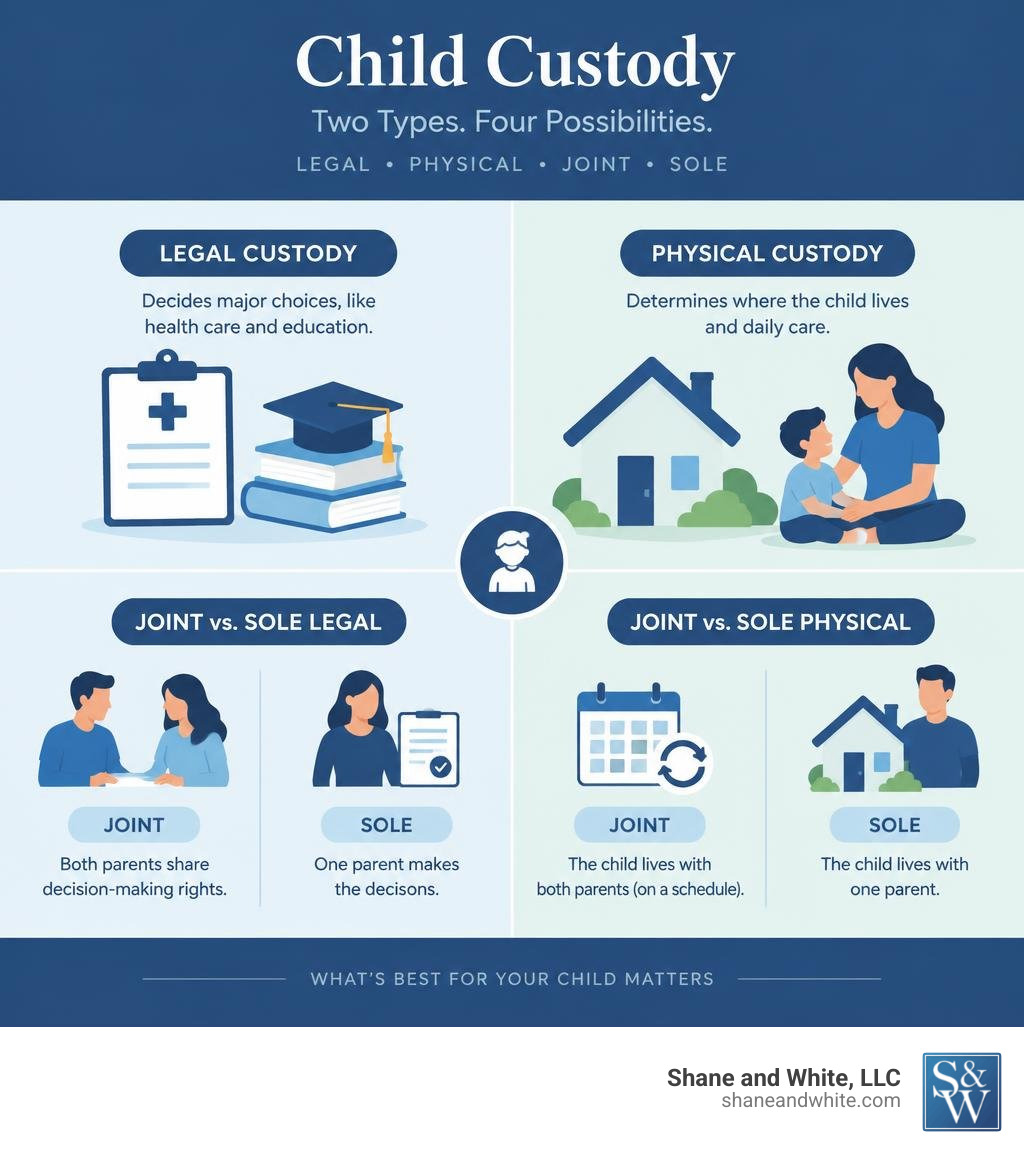
Simple child custody word guide:
Defining the Legal Framework of Child Custody
When parents separate or divorce, the family court steps in to ensure children maintain stability, safety, and continuous emotional support. The legal framework governing custody focuses primarily on parental fitness and the unique needs of the children involved. Rather than viewing custody as a prize to be won, family courts view it as a distribution of essential parental responsibilities.
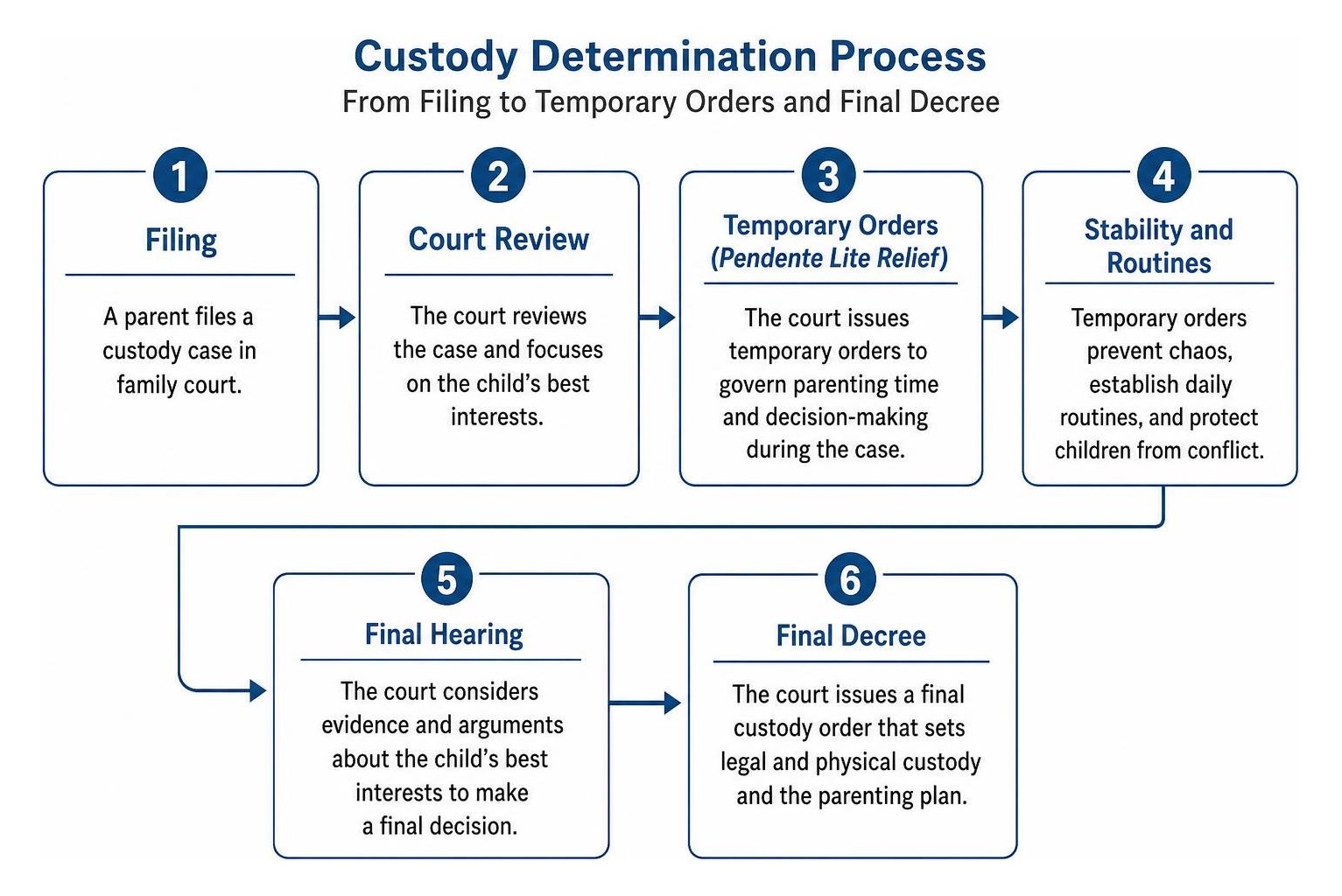
During the early stages of a separation, courts often establish temporary orders (pendente lite relief) to govern parenting time and decision-making while the litigation is ongoing. These temporary structures prevent chaos, establish daily routines, and protect children from parental conflict. Understanding New Jersey custody laws helps parents approach these proceedings with realistic expectations and a cooperative mindset.
Legal vs. Physical Child Custody
Custody is divided into two distinct legal concepts: legal custody and physical (residential) custody.
- Legal Custody: This grants a parent the legal authority to make major, long-term decisions regarding the child’s life. These decisions encompass schooling, religious upbringing, non-emergency medical treatments, and extracurricular commitments. In modern family law, understanding decision-making healthcare authority is critical when managing wellness plans, therapy, and specialized treatments.
- Physical Custody: This refers to where the child resides on a day-to-day basis and who provides routine daily care, supervision, meals, and lodging. The home where the child spends the majority of their time is often termed the primary residence, and that parent is designated the Parent of Primary Residence (PPR). The other parent is known as the Parent of Alternate Residence (PAR).
| Custody Type | Decision-Making Authority | Daily Physical Care | Common Living Arrangement |
|---|---|---|---|
| Joint Legal Custody | Shared equally by both parents | Negotiated per parenting schedule | Primary residence with one parent or shared across both |
| Sole Legal Custody | Exclusively held by one parent | Set by court schedule | Child resides primarily with the legal custodian |
| Joint Physical Custody | Shared or allocated by agreement | Substantially divided (e.g., 50/50) | Child alternates between two homes regularly |
| Sole Physical Custody | Shared or single-parent legal | Managed almost exclusively by one parent | Child lives full-time with one parent; other parent exercises parenting time |
Sole vs. Joint Arrangements
In most modern custody disputes, family courts favor joint legal custody because research and judicial experience demonstrate that children thrive when both parents remain actively involved. Under joint legal custody, neither parent’s opinion outranks the other; both must consult and reach mutual consent on major life choices.
Conversely, sole legal custody is reserved for situations where joint decision-making is impractical or dangerous—such as cases involving chronic substance abuse, severe untreated mental illness, abandonment, or unyielding domestic conflict. Sole physical custody grants one parent primary day-to-day care while providing the other parent with structured parenting time. To explore these options further, review our breakdown of the different types of custody and how they work to see how each impacts daily routines.
Core Parenting Schedules and Custody Models
Creating a realistic schedule requires balancing work demands, school commutes, and children’s developmental stages. There is no one-size-fits-all schedule, and parents are encouraged to design practical routines that limit disruption.

When selecting a schedule, parents frequently evaluate standard options such as alternating weeks (7-on/7-off), the 2-2-3 rotation, or alternating weekends combined with mid-week dinner visits. Exploring how to choose the right types of custody ensures the chosen model matches your child’s age and temperament.
Bird’s Nest and Split Custody
Some families explore alternative arrangements to maintain child stability:
- Bird’s Nest Custody (Nesting): In this arrangement, the children remain permanently in the family home while the parents rotate in and out according to their parenting schedule. While nesting insulates children from the stress of moving between two residences, it requires high parental cooperation, separate living spaces for off-duty parents, and shared household financial management. As the joke goes among family mediators, in bird’s nest custody, the parents rotate like birds, but the chicks never have to leave the nest!
- Split Custody: Split custody occurs when there are multiple children, and each parent takes sole or primary physical custody of different siblings (for example, one child lives with the mother and another lives with the father). Courts generally disfavor separating siblings unless extraordinary circumstances show that living apart is necessary for the emotional or physical welfare of the children.
Drafting an Enforceable Parenting Plan
A parenting plan is a comprehensive written agreement that details how parents will raise their children post-separation. To prevent future litigation, a well-crafted plan must clearly define:
- Regular weekly school-year schedules
- Holiday and school break rotations (alternating major holidays annually)
- Summer vacation allocation and notice deadlines
- Transportation and exchange drop-off locations
- Dispute resolution mechanisms (such as mandatory mediation before filing court motions)
Taking time to draft a conflict-free parenting plan protects your family from unnecessary disputes down the road.
The Best Interests Standard and Judicial Evaluations
When parents cannot agree on a schedule or decision-making structure, judges must intervene. The universal benchmark guiding every family court ruling is the “best interests of the child” standard. This standard elevates the child’s physical safety, emotional health, and long-term development above parental preferences or convenience.
For official state rules and self-help materials, parents can reference the New Jersey court guidelines on custody and visitation to see how administrative rules shape family proceedings.
Core Factors in Best Interest Determinations
Statutes require family court judges to evaluate multiple factors before issuing a custody order, including:
- The parents’ ability to agree, communicate, and cooperate in matters relating to the child
- The interaction and relationship of the child with parents and siblings
- Any history of domestic violence or safety concerns
- The safety of the child and the safety of either parent from physical abuse by the other parent
- The preference of the child when of sufficient age and capacity to reason
- The needs of the child and the stability of the home environment offered
- The quality and continuity of the child’s education
- The fitness of the parents and geographical proximity of the parents’ homes
In high-conflict matters, the court may appoint an expert or guardian to provide objective evaluations. Discover why New Jersey courts appoint an independent factfinder for children to better understand how independent custody evaluations influence judicial rulings.
Visitation, Supervised Contact, and Virtual Access
A non-custodial parent possesses an inherent right to parenting time unless clear evidence proves that contact would endanger the child’s physical or emotional well-being. When safety concerns, substance abuse issues, or long periods of parental absence exist, courts may order:
- Supervised Visitation: Parenting time takes place in the presence of a court-approved third party, social services agency, or professional monitoring facility.
- Virtual Access: Modern parenting orders routinely integrate scheduled video calls (via Zoom, FaceTime, or specialized co-parenting platforms). Virtual access maintains meaningful connections when parents live at a distance or travel for business.
For broad educational perspectives on how state court systems manage parental contact, you can review judicial child custody self-help resources to see common dispute resolution approaches across jurisdictions.
Complex Circumstances, Interstate Disputes, and Enforcement
Custody matters can become complicated when families cross state lines, when unmarried parents separate, or when non-parents seek visitation rights.

Cross-border legal principles frequently reflect standard international concepts. For instance, reviewing international parenting order frameworks highlights how modern courts worldwide emphasize practical child welfare over rigid ownership concepts.
Interstate Jurisdiction and Constitutional Rights
When parents live in different states, jurisdictional conflicts are resolved by uniform laws and federal statutes:
- Uniform Child Custody Jurisdiction and Enforcement Act (UCCJEA): Adopted across all 50 U.S. states and the District of Columbia, the UCCJEA establishes that exclusive custody jurisdiction belongs to the child’s “home state”—the state where the child lived with a parent for at least six consecutive months immediately prior to filing.
- Parental Kidnapping Prevention Act (PKPA): Under federal law (28 U.S.C. § 1738A), states must accord full faith and credit to valid custody determinations entered by sister states that had proper jurisdiction.
- Constitutional Protections: In landmark cases such as Troxel v. Granville (2000), the U.S. Supreme Court affirmed that fit parents have a fundamental liberty interest protected by the Fourteenth Amendment to direct the care, custody, and upbringing of their children.
- Indian Child Welfare Act (ICWA): For Native American children, federal law (25 U.S.C. §§ 1901-1963) imposes jurisdictional and placement standards designed to protect tribal integrity and cultural connections.
Relocation and Modifying a Child Custody Order
A final custody decree is legally binding, but life circumstances change. A parent seeking to modify an existing order must demonstrate a substantial change in circumstances that directly impacts the child’s best interests. Examples include major changes in work shifts, severe medical diagnoses, or a parent’s persistent failure to exercise allocated parenting time.
Relocation outside the state—or moving a substantial distance that impairs the current parenting schedule—requires either written consent from the other parent or formal authorization from the family court. When an uncooperative parent actively interferes with court-ordered parenting time, the aggrieved parent can file an enforcement motion (Order to Show Cause) seeking make-up time, attorney fees, or contempt citations. If your family situation has evolved, learn more about updating custody orders through formal court channels.
Domestic Violence, Military Service, and Third-Party Custody
- Domestic Violence: Family courts prioritize child safety above all else. Under domestic violence statutes, courts can issue immediate temporary restraining orders that grant emergency temporary custody and suspend or restrict an abusive parent’s contact.
- Military Service: The Servicemembers Civil Relief Act (SCRA) protects active-duty military personnel by allowing custody proceedings to be paused while a service member is deployed. Deployment alone cannot be used as the sole basis to permanently deprive a service member of custody.
- Third-Party and Grandparent Custody: Grandparents and third-party caregivers can petition for custody or visitation rights, but they must overcome the constitutional presumption favoring fit biological parents by demonstrating parental unfitness or proving that denying contact would cause concrete psychological or physical harm to the child.
If you are facing these complex family issues, working with a dedicated East Windsor child custody attorney ensures your rights and your child’s well-being remain fully protected.
Frequently Asked Questions
What is the difference between legal and physical custody?
Legal custody involves the right and responsibility to make major, long-term decisions concerning a child’s health, education, welfare, and religious development. Physical custody determines the physical residence where the child lives on a day-to-day basis and who handles daily caregiving routines.
Can a child choose which parent to live with?
In New Jersey, a child cannot legally make the final decision regarding where they live until they reach the age of majority (18). However, as children mature and demonstrate sound reasoning capabilities, judges frequently consider their input. A judge may conduct an in-chambers interview with the child to evaluate their maturity, preferences, and underlying reasons without subjecting them to a stressful open-court examination.
How does an unmarried father establish custody rights?
An unmarried mother automatically holds primary residential custody at birth. For an unmarried father to secure legal and physical custody rights, he must first legally establish paternity. Paternity can be established voluntarily by signing a Certificate of Parentage (COP) at birth or by filing a complaint to establish paternity and request custody or parenting time through the family court. Once paternity is confirmed, the father stands on equal legal footing with the mother under the best interests standard.
Conclusion
Navigating parental rights and scheduling disputes can be emotionally demanding, but maintaining a structured, child-centered approach ensures your family’s long-term stability. Understanding the distinctions between legal authority and physical residence allows you to craft a balanced, enforceable agreement tailored to your child’s unique developmental needs.
At Shane and White, LLC, our legal team brings more than 40 years of dedicated family-law experience to parents throughout Middlesex County and across New Jersey. We provide clear communication, personalized strategies, and compassionate advocacy inside and outside the courtroom. For experienced assistance with your parenting plan, modifications, or disputes, contact us today for dedicated child custody and visitation guidance.