
Find a Child Support Lawyer Near You Who Can Protect Your Position
If you are searching for a child support lawyer near me in New Jersey, start with an attorney who handles both support and custody issues in your county. Bring your pay stubs, tax returns, parenting-time schedule, child care and health insurance costs, and any existing court orders. A local lawyer can check whether the guideline calculation uses accurate income and overnights, then help you pursue or defend a fair order.
Child support is not a simple fixed payment. New Jersey courts consider both parents’ income, the number of children, parenting time, child care, health insurance, and other case-specific costs. A lawyer may be especially helpful when income is variable, a parent is self-employed, support has gone unpaid, or a custody change may require modification.
I am Kenneth White, Esq., a New Jersey Supreme Court Certified Matrimonial Law Attorney with long-standing family law and Family Court experience. If you need a child support lawyer near me, I help parents understand the numbers, prepare for court, and work toward practical resolutions during difficult family changes.

Easy child support lawyer near me glossary:
Why Hiring a Child Support Lawyer Near Me Matters for Your Case
Navigating child support proceedings in Middlesex County or neighboring communities involves far more than running figures through a standard software calculator. Local court procedures, case management conferences, and judge-specific scheduling rules can significantly affect how fast and effectively your matter is resolved. Family law is deeply personal, but family court is governed by rigid procedural deadlines, strict evidentiary thresholds, and intricate statutory guidelines.

When you partner with a legal team familiar with local courtrooms—such as the Middlesex County Family Court in New Brunswick—you benefit from counsel who understands the practical expectations of local judges and hearing officers. Having seasoned advocates on your side ensures your motions are properly filed, your financial disclosures are airtight, and your parental interests are actively defended. When finding the right New Jersey family law and divorce attorney, local familiarity provides you with a clear roadmap through initial filings, early settlement panels, and contested evidentiary hearings.
Resolving High-Asset and Variable Earnings with a Child Support Lawyer Near Me
Child support disputes often become contentious when a parent’s earnings fluctuate or come from complex revenue streams. In high-net-worth divorces or matters involving business owners, independent contractors, and corporate executives in Central New Jersey, calculating true gross income requires meticulous analysis.
Standard wage stubs rarely tell the whole story when compensation includes discretionary business write-offs, deferred bonuses, stock distributions, or rental income. We regularly evaluate complex corporate financials, collaborate with forensic accountants, and uncover concealed assets or artificially suppressed revenues. By holding both sides accountable to the statutory framework for income shares, we ensure that the baseline earnings plugged into support formulas accurately reflect actual financial capacity.
Protecting Parental Rights and Establishing Fair Support Obligations
Whether establishing paternity, seeking temporary pendente lite financial relief during a separation, or finalizing long-term custody arrangements, every parent deserves a fair outcome that prioritizes the child’s standard of living without creating severe economic hardship. Incomplete filings or unverified income claims can lead to skewed court orders that linger for years.
Our team works to safeguard your rights from day one, ensuring that both mandatory disclosures and discretionary adjustments—such as mandatory health insurance allocations and work-related childcare—are correctly factored into the equation. For a complete look at statutory factors and court expectations, consult our Child Support Guide 2026.
How State Child Support Guidelines Calculate Your Payments
New Jersey calculates child support using the Income Shares Model. This model operates on the principle that a child should receive the same proportion of parental income that they would have enjoyed if the household had remained intact.
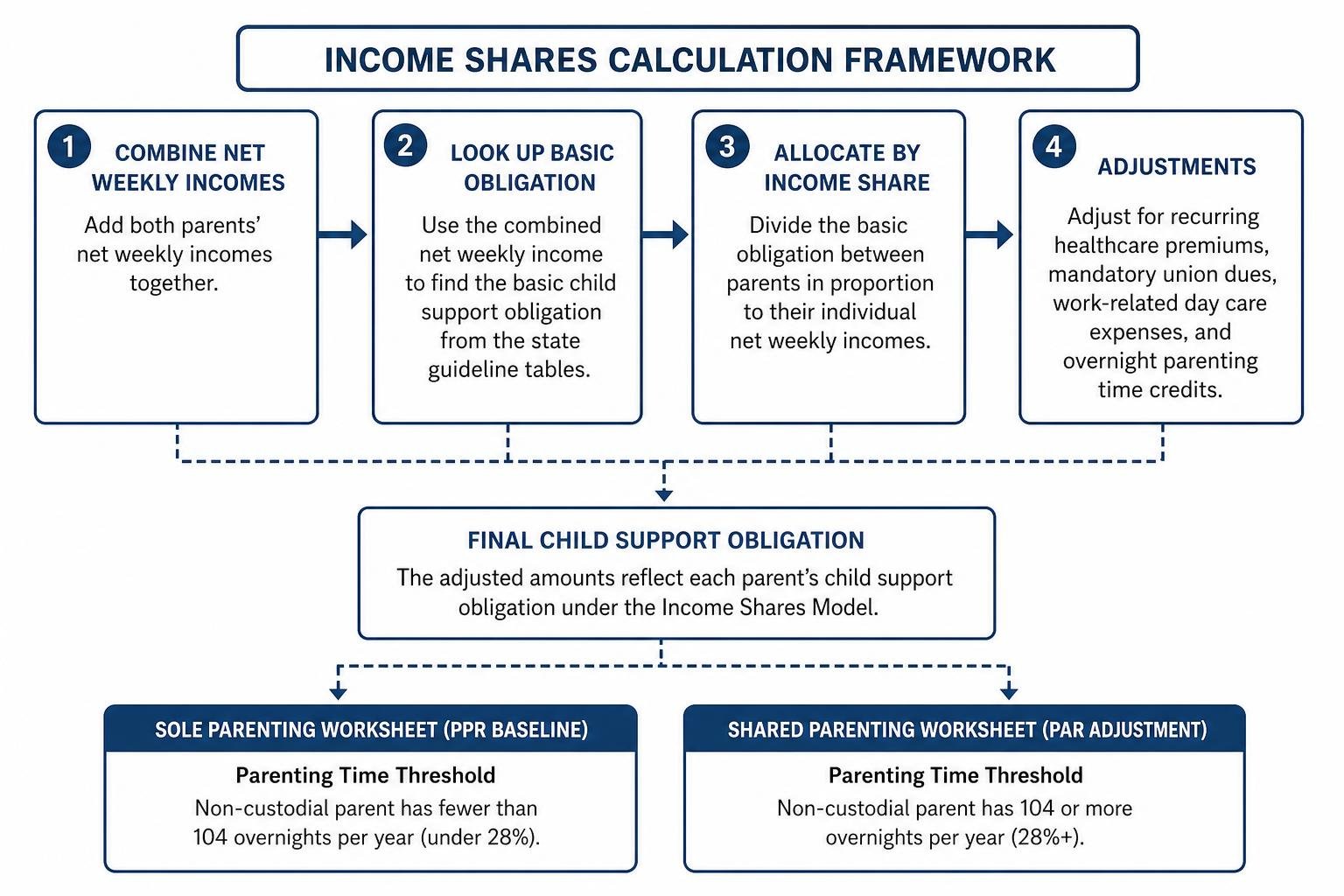
Under this system, both parents’ net weekly incomes are combined to establish a basic child support obligation from state guideline tables. That total baseline figure is then allocated between the parents in direct proportion to their individual earnings, with adjustments factored in for recurring healthcare premiums, mandatory union dues, work-related day care expenses, and overnight parenting time credits.
| Calculation Element | Sole Parenting Worksheet (PPR Baseline) | Shared Parenting Worksheet (PAR Adjustment) |
|---|---|---|
| Parenting Time Threshold | Non-custodial parent has fewer than 104 overnights per year (under 28%). | Non-custodial parent has 104 or more overnights per year (28%+). |
| Fixed Costs Assumption | Primary parent covers all fixed household costs (housing, utilities, food). | Both households incur duplicated fixed costs; adjustments are applied. |
| Variable Expenses | Transferred primarily through direct weekly support payments. | Handled directly by each parent during their designated parenting time. |
| Healthcare & Childcare | Added to the base amount and allocated strictly by income share. | Added to the combined total and allocated proportionally across households. |
What Counts as Gross Income and How Imputed Income Works
State guidelines define gross income expansively. It encompasses:
- Earned wages, salaries, tips, and overtime pay
- Net business and self-employment proceeds
- Performance bonuses, commissions, and severance packages
- Severance, disability, and worker’s compensation benefits
- Investment yields, capital gains, and rental proceeds
- Trust distributions and recurring annuity payments
When a parent intentionally reduces their hours, leaves a lucrative position, or remains voluntarily unemployed or underemployed to minimize support payments, the court can intervene. In these situations, a judge may calculate “imputed income” based on the parent’s past earning history, educational credentials, occupational qualifications, and prevailing regional wage data. In our practice, we also assist clients with protecting your income while managing child support withholding to keep garnishments aligned with legal limits.
How Physical Custody and Parenting Time Schedules Impact the Calculation
Child support and physical custody are intrinsically connected. The number of overnight visits a child spends with each parent directly affects the applicable statutory worksheet. When the Parent of Alternate Residence (PAR) exercises 104 or more overnights per year (representing at least 28% of the year), the court uses the Shared Parenting Worksheet rather than the Sole Parenting Worksheet.
Because duplicated expenses (such as maintaining separate bedrooms, utilities, and daily food supplies) occur across both residences, the shared worksheet applies a formulaic credit that reduces the support obligation transferred between parents. To explore how physical custody configurations operate in detail, review what are the different types of custody and how do they work? and our insights on putting kids first with an East Windsor child custody attorney.
Judicial Deviations and Mutual Parental Agreements
While child support guidelines carry a strong legal presumption of correctness, family court judges may deviate from standard calculations under specific circumstances, such as:
- Significant special needs or chronic medical costs for the child
- Private school tuition or specialized educational programs
- Substantial recurring visitation travel expenses
- High combined parental net income exceeding state guideline caps
- Extraordinary support obligations for children from other relationships
Parents can mutually negotiate a support figure that departs from standard statutory figures, but they cannot simply sign a private waiver. Any deviation must be submitted to the court via a formal written consent order explaining why the agreed-upon amount is fair, adequate, and in the child’s best interests.
Modifying Existing Child Support and Enforcing Non-Payment
Child support orders are not permanently set in stone. When life circumstances shift significantly, either parent may petition the family court to adjust the weekly obligation upward or downward.

To successfully modify an existing order, the moving party must establish a substantial, permanent, and unanticipated change in circumstances. Valid grounds for filing a modification motion include:
- Long-term, involuntary job loss or sustained pay reduction despite reasonable job searches
- A major shift in the physical custody or parenting-time schedule
- Severe, chronic illness or disability impacting earning capacity
- Significant, permanent increases in the receiving parent’s income
- Substantial adjustments in the child’s healthcare or educational needs
Temporary financial dips do not qualify. Before filing, it is crucial to understand the proper legal procedures by reviewing updating support and custody orders in East Windsor.
Enforcement Remedies for Unpaid Child Support and Arrears
Failing to pay court-ordered child support carries serious legal consequences under New Jersey law. Child support judgments do not expire, cannot be discharged through personal bankruptcy, and accrue interest on outstanding arrears.
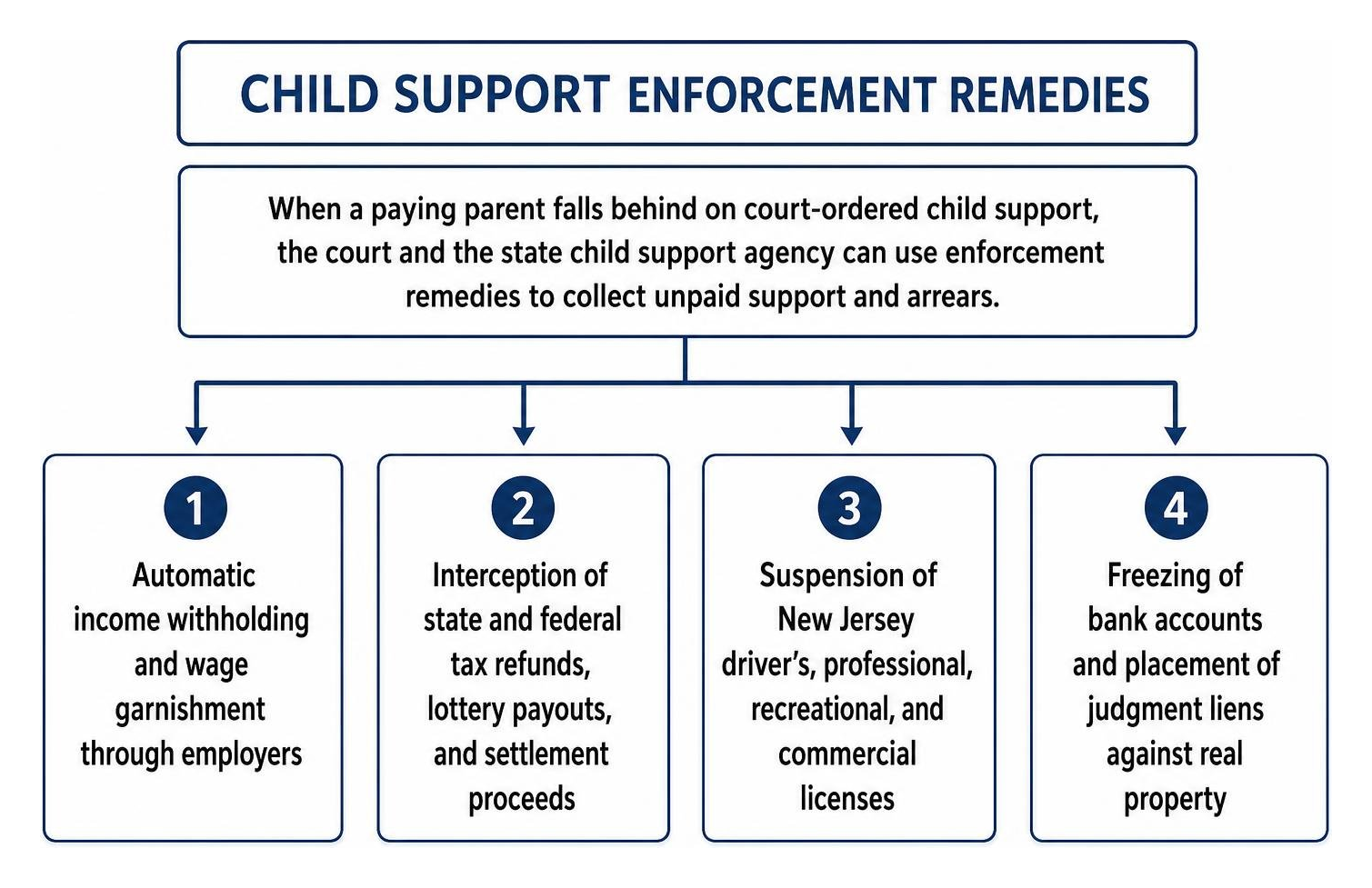
When a paying parent falls behind, the court and the state child support agency have aggressive enforcement mechanisms at their disposal:
- Automatic income withholding and wage garnishment directly through employers
- Interception of state and federal tax refunds, lottery payouts, and settlement proceeds
- Suspension of New Jersey driver’s, professional, recreational, and commercial licenses
- Freezing of bank accounts and placement of judgment liens against real property
- Revocation or denial of passport applications
- Issuance of bench warrants and findings of civil contempt during enforcement proceedings
Interstate Support Cases and the Uniform Interstate Family Support Act (UIFSA)
When one parent relocates out of New Jersey or moves across state lines, collecting or modifying support involves federal and multi-state legal standards. The Uniform Interstate Family Support Act (UIFSA) governs these cases, establishing clear rules regarding jurisdiction and continuing exclusive authority.
Under UIFSA, the state that entered the initial child support order generally retains exclusive jurisdiction to modify that order as long as at least one parent or the child continues to reside there. If the non-custodial parent moves out of state, the issuing court can register the support order with the new home state to enforce wage garnishments, suspend out-of-state licenses, or attach property without forcing the custodial parent to litigate the entire matter from scratch in an unfamiliar venue.
How to Prepare for Your Legal Case and Initial Strategy Session
A successful outcome in child support litigation begins with thorough financial preparation. Whether you are establishing an initial support award, defending against inflated income claims, or seeking to collect past-due arrears, organized documentation gives your attorney the leverage needed to negotiate effectively or present a compelling case at a formal hearing.
Checklist: What to Bring When Meeting a Child Support Lawyer Near Me
When meeting with our team in Edison or reviewing your case remotely across Middlesex County, bringing the following financial documents will help streamline your strategy session:
- Income Documentation: Your last three years of filed state and federal income tax returns (including all W-2s, 1099s, and corporate schedules if self-employed).
- Pay Statements: Your three most recent consecutive pay stubs showing year-to-date earnings and itemized deductions.
- Existing Court Orders: Copies of any existing child support worksheets, divorce decrees, custody judgments, or domestic violence restraining orders.
- Child-Related Expenses: Written proof of monthly health insurance premiums paid exclusively for the child, out-of-pocket medical expenses, and invoices for work-related day care or after-school care.
- Parenting Time Calendars: A clear record, log, or calendar showing the precise number of overnights the child spent in your household over the past 12 months.
- Proof of Special Expenses: Documentation of mandatory school fees, tutoring costs, athletic commitments, or documented medical therapy expenses for the child.
Frequently Asked Questions About Child Support Representation
When does child support legally end for a child?
In New Jersey, child support automatically terminates by operation of law when a child reaches 19 years of age, unless a specific exception applies. Support can be extended up to age 23 if the child is enrolled full-time in high school, college, vocational school, or a graduate program, or if the child has a severe physical or mental disability that existed prior to age 19. Child support may also end earlier if the child marries, enters active-duty military service, or becomes legally emancipated by court order.
What happens to support obligations if a paying parent is incarcerated?
Incarceration does not automatically erase child support debt. However, because extended imprisonment represents an involuntary loss of income, an incarcerated parent can file a formal motion seeking a temporary suspension or downward modification of their ongoing support obligation for the duration of their sentence. To understand the statutory mechanisms and court rulings governing these filings, read our guide on support obligations for an incarcerated parent.
Can parents legally agree to waive child support payments?
No. In New Jersey, the legal right to receive financial support belongs entirely to the child, not to the parents. While parents can negotiate reasonable settlement terms, allocate specific expenses, or consent to guideline deviations, they cannot enter into a binding agreement to waive child support altogether. The court must review any proposed consent agreement to confirm that the financial arrangement is sufficient to meet the child’s ongoing developmental needs under the best interests standard.
Conclusion
Child support determinations have a lasting impact on your family’s financial stability and your children’s quality of life. Achieving a fair, sustainable result requires clear financial disclosures, accurate guideline calculations, and proactive advocacy in family court.
At Shane and White, LLC, we bring more than 40 years of combined legal experience to parents across Edison, Metuchen, Woodbridge, East Brunswick, New Brunswick, North Brunswick, Monroe, Piscataway, Sayreville, and throughout Middlesex County. We provide the personalized attention and strategic counsel you need to handle initial orders, complex modifications, and enforcement proceedings with confidence. Contact our Edison office today to schedule a confidential consultation for experienced child support representation.