Finding the Right Family Lawyer in New Jersey
Start with your specific problem. Family lawyers in New Jersey handle divorce, child custody, child support, alimony, property division, and domestic violence matters. When choosing one, ask about experience with your issue, familiarity with your county’s family court, and how fees work. If you or your child may be in danger, tell the lawyer immediately so you can discuss urgent protections.
A good first meeting should leave you with a clearer view of your options, whether that means negotiating, trying mediation, or going to court.
I’m Kenneth White, Esq., and as an experienced advocate among family lawyers in New Jersey, I know that individuals facing domestic transitions need clear, dependable guidance during a challenging time. I’m a New Jersey Supreme Court-certified matrimonial law attorney who has served as an Early Settlement Panel member, mediator, and court-appointed guardian ad litem; here’s how to prepare for the process ahead.

Helpful family law and financial resources:
Comprehensive Representation: When to Consult Family Lawyers in New Jersey

Navigating family legal challenges can feel overwhelming. New Jersey family courts handle over 50,000 divorce and dissolution filings annually, reflecting just how many households encounter these transitions. Whether addressing sudden marital breakdown or long-standing financial disagreements, seeking early legal guidance provides clarity and protects your future.
Family law encompasses a broad spectrum of domestic issues. In our practice across Middlesex County—including Edison, Woodbridge, New Brunswick, and Sayreville—we regularly assist clients facing complex legal circumstances:
- Divorce and Dissolution: Filing no-fault complaints based on irreconcilable differences or fault-based grounds like extreme cruelty.
- Child Custody and Parenting Time: Creating realistic schedules that preserve meaningful parent-child relationships.
- Child Support and Alimony: Ensuring financial calculations align strictly with state formulas and statutory fairness factors.
- Domestic Violence Matters: Securing immediate civil protection orders when safety is compromised.
Understanding state-specific procedures is essential. Reviewing the ultimate guide to New Jersey divorce laws and process helps you anticipate key filing requirements, disclosure rules, and statutory standards before entering the courtroom.
How Top Family Lawyers in New Jersey Protect Parental Rights and Child Custody
Approximately 40% of family law cases in New Jersey involve custody disputes. Because these decisions alter daily family life, courts evaluate every matter through the lens of the “best interests of the child” under N.J.S.A. 9:2-4.
New Jersey recognizes two distinct forms of custody:
- Legal Custody: The authority to make major decisions regarding education, healthcare, and religious upbringing. Courts strongly favor joint legal custody unless exceptional circumstances exist.
- Physical (Residential) Custody: Where the child resides day-to-day. One parent may become the Parent of Primary Residence (PPR), while the other is the Parent of Alternate Residence (PAR), or parents may share equal residential time.
When high-stakes custody disagreements arise, our strategic roadmap helps parents understand how a dedicated divorce lawyer in NJ utilizes custody evaluations, parenting coordinators, and court-appointed experts to safeguard parental access and prevent parental alienation.
Equitable Distribution and Financial Settlements in NJ Divorce
New Jersey is an equitable distribution state, meaning marital property and debts are divided fairly, though not necessarily on a strict 50/50 basis. Marital property includes all assets acquired from the date of marriage until the filing of a divorce complaint, such as:
- Real estate equity and investment properties
- Retirement assets (401k accounts, pensions, IRAs)
- Closely held family businesses and professional practices
- Marital debts, including mortgages, credit cards, and personal loans
Complex assets demand thorough financial discovery and accurate valuation. Often, family legal transitions require coordinating with an estate planning attorney in Woodbridge, New Jersey to update wills, beneficiary designations, and trust agreements once financial settlements conclude.
Navigating the New Jersey Family Court Process and Case Timelines

Understanding the procedural roadmap of New Jersey Superior Court, Chancery Division, Family Part eliminates surprises and reduces litigation stress.
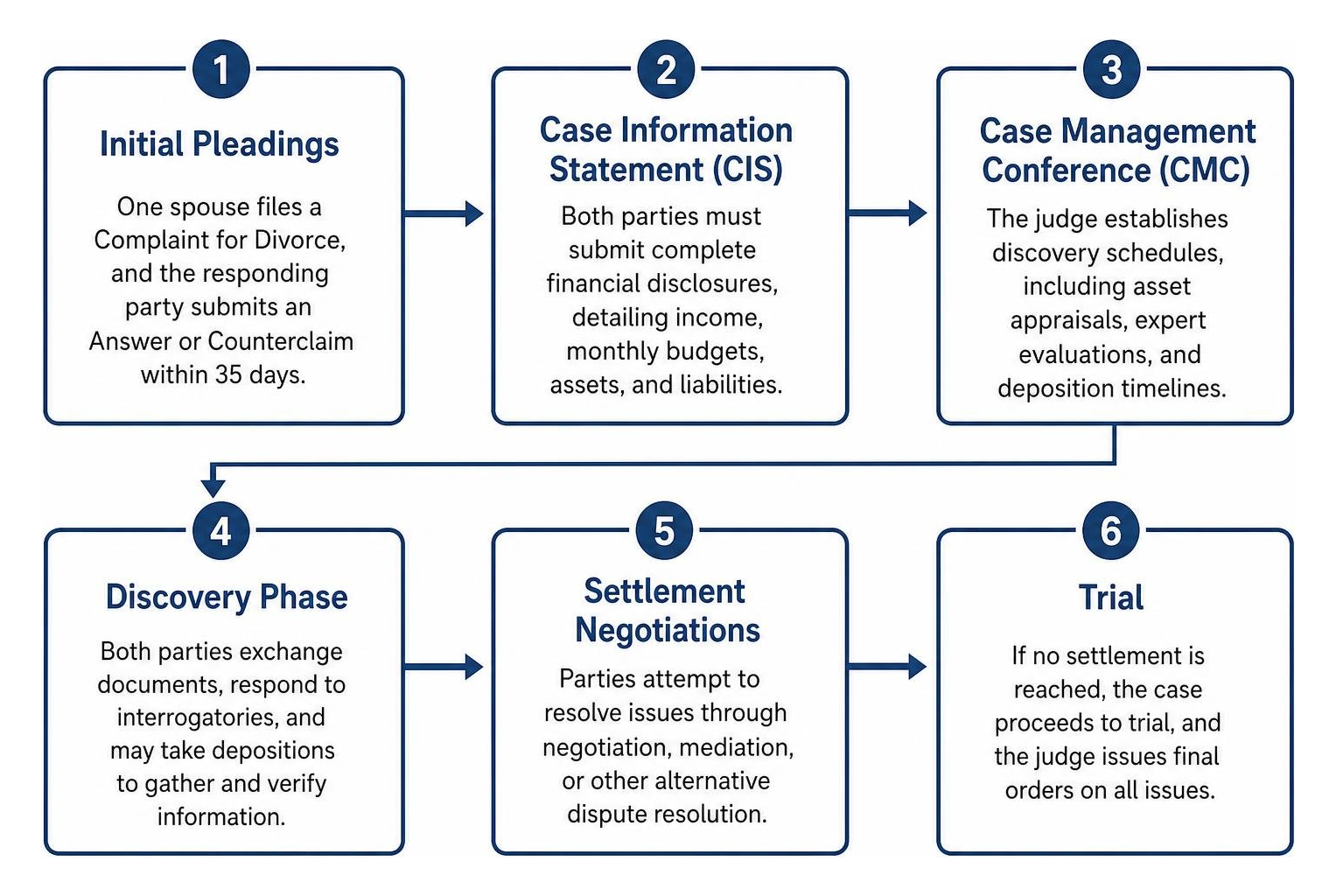
The typical court process follows several structured phases:
- Initial Pleadings: One spouse files a Complaint for Divorce, and the responding party submits an Answer or Counterclaim within 35 days.
- Case Information Statement (CIS): Both parties must submit complete financial disclosures, detailing income, monthly budgets, assets, and liabilities.
- Case Management Conference (CMC): The judge establishes discovery schedules, including asset appraisals, expert evaluations, and deposition timelines.
- Early Settlement Panel (ESP): Experienced volunteer matrimonial attorneys evaluate unresolved financial issues and recommend a fair settlement proposal.
- Economic Mediation: If ESP does not resolve all issues, parties participate in mandatory court-referred economic mediation.
- Intensive Settlement Conference (ISC) and Trial: Cases that cannot settle proceed to a final pretrial conference and courtroom trial.
To avoid procedural missteps, reviewing what to expect when you are getting a divorce provides valuable clarity on each administrative phase.
Managing High-Conflict Disputes, Domestic Violence, and Substance Abuse
When safety or severe conflict threatens a household, New Jersey provides rapid legal remedies under the Prevention of Domestic Violence Act (PDVA). A victim can obtain an immediate, ex parte Temporary Restraining Order (TRO) through local police or the family court intake unit.
A formal Final Restraining Order (FRO) hearing occurs within 10 to 14 days. An FRO imposes permanent protections, prohibits contact, awards temporary custody, and bars the defendant from possessing firearms. In cases involving substance abuse or volatile conflict, our firm coordinates risk assessments, hair-follicle testing, and supervised visitation protocols. When dealing with regional court variations, discovering how to find local divorce attorneys in Mercer County or Middlesex County ensures your advocate understands local judicial preferences.
Recent Trends and Statutory Updates in New Jersey Family Law
Family law continually evolves to match modern economic and domestic realities:
- Alimony Reform: For marriages lasting under 20 years, open-durational alimony is rarely awarded; instead, limited-duration alimony cannot exceed the length of the marriage except in extraordinary circumstances.
- Child Support Termination: Under N.J.S.A. 2A:17-56.67, child support obligations presumptively end when a child turns 19, unless an extension is granted for post-secondary education or severe disability.
- Virtual Court Proceedings: Many routine case management conferences, uncontested hearings, and settlement panels now occur via remote platforms, reducing client travel time and costs.
- Multi-Generational Planning: Complex family divorces involving aging parents or inheritance planning frequently intersect with elder law guidance, where consulting the best elder law lawyers in Metuchen, NJ helps protect legacy assets.
Resolving Disputes: Strategic Alternatives to Courtroom Litigation
Most New Jersey family disputes resolve outside the courtroom. Alternative Dispute Resolution (ADR) offers private, efficient paths toward fair agreements without the expense and adversarial strain of a trial.
| Feature | Courtroom Litigation | Divorce Mediation | Collaborative Law |
|---|---|---|---|
| Typical Cost | $15,000–$30,000+ per party | $3,000–$8,000 total | $8,000–$15,000 per party |
| Average Timeline | 12 to 24 months | 2 to 6 months | 4 to 9 months |
| Privacy Level | Public court record | Fully confidential | Fully confidential |
| Control Over Outcome | Decided by Judge | Mutually agreed by parties | Mutually agreed by parties |
| Atmosphere | Formal and adversarial | Cooperative problem-solving | Team-based negotiation |
Choosing an ADR path helps preserve wealth and co-parenting relationships. Learning how to reach a fair divorce settlement without going broke ensures you prioritize long-term financial stability over protracted court battles.
Collaborative Law and Mediation Options for NJ Families
In mediation, a neutral mediator assists both spouses in reaching mutually acceptable terms regarding property, support, and parenting time. In collaborative practice, each party retains separate, collaboratively trained counsel, signing a formal agreement pledging not to litigate while working alongside financial neutrals and family specialists. For families in neighboring townships, reviewing a comprehensive guide to finding an East Windsor divorce lawyer illustrates how local representation facilitates constructive out-of-court settlements.
Legal Costs, Retainers, and Selecting the Right Representation
In New Jersey, the average cost of a contested divorce ranges from $15,000 to $30,000, with attorney hourly rates typically spanning $300 to $500 per hour depending on experience and location. Understanding billing practices helps avoid financial strain during your proceedings.
Attorneys usually require an initial retainer fee—an advance deposit held in a trust account from which earned hourly fees and court costs are deducted. Under New Jersey Court Rule 5:3-5(c), judges may award counsel fees based on financial disparity, good faith participation, and the complexity of the case. Gaining insight into how attorney fees are paid in divorce allows you to plan your legal budget effectively.
What to Look for When Evaluating Family Lawyers in New Jersey
Selecting legal counsel is one of the most critical decisions you will make. When evaluating potential advocates, look for:
- Supreme Court Certification: Attorneys designated as Certified Matrimonial Law Attorneys by the Supreme Court of New Jersey have demonstrated substantial trial experience, peer recognition, and passed rigorous testing.
- Local Court Familiarity: Deep experience in the Middlesex County Family Division (located in New Brunswick) ensures your attorney understands local procedures and judicial expectations.
- Direct Communication: Ensure your attorney provides transparent updates and personalized attention rather than passing your file entirely to junior staff.
For step-by-step guidance, consult a practical guide to finding the right Edison NJ family lawyer to match your needs with the right advocate.
Preparing for Your Initial Legal Consultation
Arriving prepared for your consultation maximizes value and establishes a strong case strategy. Gather key financial documents in advance:
- Last three years of state and federal tax returns (including W-2s and 1099s)
- Recent pay stubs and proof of all income sources
- Bank, brokerage, and retirement account statements
- Mortgage balances, deeds, and current vehicle loans
- Monthly household expense records for your initial Case Information Statement
Using a free divorce lawyer consultation breakdown and checklist ensures no crucial asset or debt is overlooked during early strategy sessions.
Frequently Asked Questions About New Jersey Family Law
How long does a contested family law case typically take in New Jersey?
A contested family law case in New Jersey generally takes between 9 and 18 months to reach final resolution, depending on county court backlogs, the complexity of asset valuations, and the level of parental dispute. Cases resolved through mediation or settlement panels often conclude in under six months.
How is child support calculated under New Jersey state guidelines?
New Jersey calculates child support using the Income Shares Model (Appendix IX-A of the Court Rules). This formula considers both parents’ gross weekly incomes, taxes, mandatory deductions, the number of overnights spent with each parent, healthcare premiums for the child, and work-related childcare costs. New Jersey maintains one of the highest median child support figures in the country, reflecting regional living costs.
What is the difference between equitable distribution and community property?
In community property states, marital assets are strictly divided 50/50. In New Jersey’s equitable distribution system, courts allocate marital property based on fairness rather than equal division, considering factors such as marriage duration, standard of living, each party’s earning potential, economic contributions, and pre-existing debts.
Conclusion
Resolving sensitive family matters requires a strategic approach that balances assertive advocacy with long-term perspective. Whether dividing complex business assets, crafting a child-focused parenting schedule, or securing immediate safety protections, the right legal counsel provides confidence at every step.
At Shane and White, LLC, we offer over 40 years of dedicated legal experience helping individuals and families across Middlesex County—including Edison, Metuchen, Woodbridge, Piscataway, East Brunswick, North Brunswick, Monroe, and Sayreville—navigate the family court system with clear communication and personalized representation. Contact our team today to discuss your case and take proactive control of your legal future.