Navigating the Somerset County Family Part and Court Procedures
A Somerset County divorce lawyer guides you through local court procedures, protects your financial interests, and advocates for custody arrangements that serve your children’s needs. When hiring local counsel, look for an attorney with direct experience in the Somerset County Family Part, a clear communication style, and a strategy tailored to your case. Divorce cases for residents living in Somerset County are handled within the Somerset/Hunterdon/Warren Vicinage (Vicinage 13). Specifically, domestic matters are assigned to the Somerset County Family Part, based at the historic courthouse complex in downtown Somerville. Understanding how this specific venue operates can relieve significant anxiety as you begin this process.
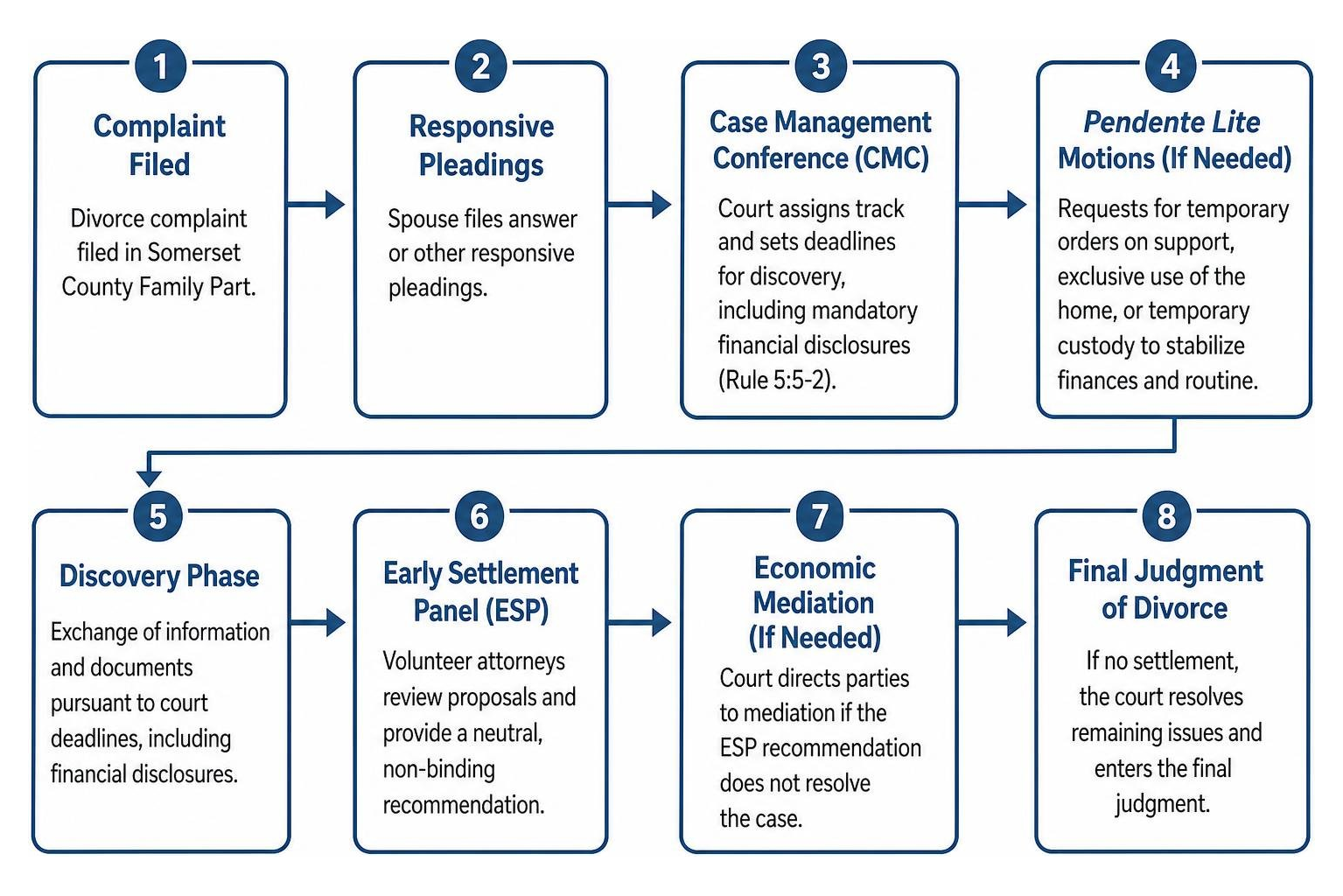
Following the initial complaint and responsive pleadings, the court establishes a track assignment and schedules a Case Management Conference (CMC). During this early appearance, the judge sets firm deadlines for discovery, including the mandatory exchange of financial disclosures governed by New Jersey Court Rule 5:5-2.
If you and your spouse disagree on immediate financial maintenance, exclusive use of the marital home, or temporary custody arrangements, we can file a pendente lite motion. These formal applications seek temporary court orders that stabilize your family’s routine and finances while the divorce is pending.
As discovery concludes, unresolved contested cases are scheduled for an Early Settlement Panel (ESP). The ESP consists of experienced, volunteer matrimonial attorneys who review both sides’ settlement proposals and provide a neutral, non-binding recommendation. If the panel’s recommendation does not resolve the matter, the court will direct the parties to economic mediation. To better understand how these procedural phases align, review our divorce roadmap for New Jersey family courts.
Filing Grounds and Early Relief in Somerset County
Under N.J.S.A. 2A:34-2, New Jersey allows individuals to dissolve a marriage on fault-based grounds (such as extreme cruelty, adultery, or desertion) or no-fault grounds. Most spouses file under N.J.S.A. 2A:34-2(i), citing irreconcilable differences that have existed for at least six months with no reasonable prospect of reconciliation. Choosing no-fault grounds avoids lengthy, expensive evidentiary disputes about personal behavior, keeping the focus entirely on equitable resolution.
When immediate crises arise—such as an abrupt cut-off of household funds, an unexpected denial of parenting time, or one party attempting to liquidate joint accounts—we file emergent applications (Orders to Show Cause) or standard pendente lite motions. These early relief petitions request:
- Temporary alimony and child support to keep bills paid
- Interim parenting schedules to maintain parent-child stability
- Exclusive possession of the family residence when living together is untenable
- Freezes on marital bank accounts to prevent asset dissipation
- Contribution toward interim counsel fees and forensic expert retainers
Venue Specifics Across Franklin Township, Bridgewater, and Somerville
Somerset County spans a diverse geographic landscape, ranging from the suburban corridors of Bridgewater and Hillsborough to expansive municipalities like Franklin Township. Venue is generally proper in the county where either spouse resided when the cause of action arose.
Franklin Township requires particular attention to administrative and geographic details. Because Franklin borders Middlesex County towns like New Brunswick and Piscataway, families frequently cross county lines for daily routines. A child might attend school or daycare near Route 27 while both parents work across county borders.
Drafting court pleadings with precise municipal identifiers prevents misdirected filings or administrative confusion between similarly named locales across the state. Ensuring your filings clearly establish Somerset County as the proper venue keeps your case on track at the Somerville courthouse without unnecessary jurisdictional delays. For additional information on family court operations, visit the New Jersey Courts Family Practice Division.
Child Custody, Parenting Plans, and Support in Somerset County
When children are involved, custody arrangements and parenting schedules are evaluated under the best-interests standard established in N.J.S.A. 9:2-4. New Jersey recognizes two primary forms of custody:
- Legal Custody: The authority to make major, long-term decisions regarding a child’s health, education, welfare, and religious upbringing. Joint legal custody is standard unless a parent presents a clear risk of harm.
- Physical (Residential) Custody: Where the child resides on a day-to-day basis. One parent may be designated the Parent of Primary Residence (PPR), while the other is the Parent of Alternate Residence (PAR), or parents may share equal residential custody.
Creating a functional parenting plan requires more than setting alternate weekends; it demands an honest evaluation of school transportation, extracurricular obligations, and each parent’s work schedule. You can read more about selecting representation for these sensitive matters in our guide to finding the right New Jersey family law attorney.
How a Somerset County Divorce Lawyer Manages Contested Custody and Parenting Plans
Contested custody disputes frequently arise from practical friction rather than malice. In Somerset County, a parenting plan can encounter problems if it treats large municipalities as compact neighborhoods. For example, a morning transition that requires commuting along Route 22, Route 206, or Interstate 287 during peak traffic can cause persistent school tardiness and parental conflict.
We resolve contested custody challenges by structuring detailed, realistic parenting plans that address:
- School logistics: Clear guidelines identifying which parent manages morning drop-offs, afternoon pick-ups, and sick days.
- Extracurricular commitments: Guidelines for enrolling children in local sports leagues or music lessons, along with clear rules for split transportation.
- Holiday and vacation schedules: Structured, alternating holiday rotations that prevent annual disputes over Thanksgiving, winter breaks, and summer vacations.
- Alternative dispute resolution: A clear mechanism, such as using a designated parenting coordinator or mediator, to address future schedule adjustments before turning to court motions.
When parents cannot reach common ground, the court may order a custody and parenting-time evaluation conducted by a court-appointed psychologist or mental health expert to assess the family’s dynamic and provide formal recommendations.
Calculating Child Support and Accounting for Regional Expenses
Child support in New Jersey is determined using the statutory Child Support Guidelines set forth in New Jersey Court Rule 5:6A. The guidelines use an Income Shares Model, assuming that children should receive the same proportion of parental income they would have enjoyed had the household remained intact.

The basic calculation integrates several mandatory components:
- Gross taxable and non-taxable income: Including wages, bonuses, commissions, self-employment earnings, and business distributions.
- Overnight parenting time: The percentage of overnights the child spends with each parent directly affects the support amount.
- Health insurance premiums: The marginal cost paid by either parent to cover the children on a medical plan.
- Work-related childcare costs: Necessary expenses for daycare, before-care, or after-care programs required for a parent to work.
- Other statutory factors: Mandatory union dues, government retirement contributions, and support obligations for children from other relationships.
For families with combined net annual incomes exceeding the statutory Guidelines maximum, the baseline guidelines apply up to that cap, and the court calculates supplemental support using the statutory factors in N.J.S.A. 2A:34-23(a). This accounts for expenses such as private school tuition, competitive extracurriculars, tutoring, and vehicle insurance for teenage drivers.
How a Somerset County Divorce Lawyer Protects Assets, Property, and Alimony Rights
Dividing assets and establishing spousal maintenance require careful analysis under New Jersey law. Property division is governed by equitable distribution under N.J.S.A. 2A:34-23.1, while alimony determinations follow the statutory factors outlined in N.J.S.A. 2A:34-23.
It is important to remember that equitable does not always mean a strict 50/50 split; rather, it requires a division that is fair based on the unique circumstances of the marriage.
| Factor Category | Equitable Distribution (N.J.S.A. 2A:34-23.1) | Alimony Determination (N.J.S.A. 2A:34-23) |
|---|---|---|
| Primary Goal | Fair allocation of marital assets and liabilities accumulated during the marriage | Financial support to help an economically dependent spouse maintain a lifestyle reasonably comparable to the marriage |
| Duration of Marriage | Factor in evaluating each spouse’s contribution to the marital estate | Significant factor; marriages under 20 years generally cap open-durational alimony eligibility |
| Income & Earning Capacity | Evaluated to ensure neither party is left with an unsustainable share of marital debts | Central factor in determining the payor’s ability to pay and the payee’s actual need |
| Separate Property | Excludes pre-marital assets, inheritances, and third-party gifts (if not commingled) | Income generated from exempt separate property may still be considered when evaluating total cash flow |
| Standard of Living | Relevant in deciding whether to retain or sell the marital residence | The marital lifestyle serves as a primary benchmark for establishing the alimony award |
| Tax Consequences | Evaluates capital gains liabilities, transfer taxes, and deferred retirement taxation | Alimony payments are non-deductible for the payor and tax-free to the recipient under current federal tax laws |
When addressing complex support disputes, reviewing high-net-worth spousal maintenance strategies provides valuable context for how courts evaluate significant income disparities.
High-Asset Division, Business Valuations, and Retirement Assets
Somerset County is home to corporate executives, business owners, and medical professionals whose divorces often involve complex asset structures. Valuing and dividing these assets requires both legal precision and financial analysis:
- Closely Held Businesses and Professional Practices: Determining the fair market value of an enterprise requires retaining independent forensic accountants. These experts evaluate historical earnings, normalize discretionary expenses, assess tangible assets, and calculate enterprise versus personal goodwill.
- Executive Compensation Packages: Dividing restricted stock units (RSUs), stock options, and deferred compensation plans requires applying coverture fractions (such as the Marx or Callahan formulas) to separate marital efforts from post-complaint vesting.
- Retirement Assets and Pensions: Defined contribution accounts (such as 401(k)s and 403(b)s) and defined benefit pensions earned during the marriage are marital property. Dividing these accounts without triggering premature withdrawal penalties or tax liabilities requires preparing and entering a Qualified Domestic Relations Order (QDRO).
Essential Financial Disclosures and the Case Information Statement
The foundation of every financial resolution in the Somerset County Family Part is the Case Information Statement (CIS), mandated under New Jersey Court Rule 5:5-2. This document requires complete transparency regarding each party’s income, living expenses, assets, and liabilities.
Completing an accurate CIS requires assembling several years of financial records:
- Complete federal and state income tax returns with all attached W-2s, 1099s, and K-1 schedules
- Recent pay stubs showing year-to-date earnings and itemized deductions
- Twelve months of statements for all checking, savings, money market, and investment accounts
- Year-end statements for retirement funds, pensions, and life insurance policies
- Current statements for mortgages, home equity lines, auto loans, and credit cards
- Real estate appraisals and property tax assessments
The CIS also includes a detailed budget divided into three categories: Shelter, Transportation, and General personal expenses. This budget establishes the marital standard of living, providing the court with a concrete baseline for evaluating alimony and child support requests.
Addressing Domestic Violence, Restraining Orders, and Emergency Relief

When domestic violence occurs, safety takes precedence over standard divorce litigation. New Jersey protects victims through the Prevention of Domestic Violence Act (PDVA), codified at N.J.S.A. 2C:25-17 et seq.
If an act of domestic violence occurs, a victim can apply for an emergency Temporary Restraining Order (TRO) through the local police department or directly at the Somerset County Courthouse. If granted, a TRO immediately:
- Prohibits the defendant from contacting, stalking, or communicating with the plaintiff
- Grants the plaintiff exclusive possession of the shared home
- Suspends the defendant’s parenting time or orders supervised contact
- Requires the defendant to surrender all firearms and weapons permits
Under N.J.S.A. 2C:25-29, the court schedules a Final Restraining Order (FRO) hearing within 10 days of the TRO’s issuance. Domestic violence matters proceed on a separate, expedited track from the underlying divorce. A final restraining order in New Jersey is permanent unless modified or vacated by a subsequent court order.
Our team represents clients on both sides of these proceedings—protecting victims who require legal safety measures and defending individuals facing unfounded allegations that could prejudice their custody or property rights.
Key Criteria for Selecting Legal Representation in Somerset County
Navigating a divorce requires clear guidance from an attorney who understands the law and local court procedures. You can read more about evaluating attorneys in our practical guide to choosing a family lawyer.
When seeking representation for a Somerset County divorce, consider the following factors:
- Courtroom Experience: Your attorney should be familiar with the Somerset County Family Part judges, local Early Settlement Panel procedures, and regional mediation resources.
- Certified Matrimonial Credentials: The Supreme Court of New Jersey designates attorneys as Certified Matrimonial Law Attorneys only after they demonstrate extensive trial experience, complete rigorous continuing education, pass a comprehensive examination, and receive favorable peer evaluations.
- Negotiation and Trial Readiness: While resolving matters through settlement saves time and expense, your legal team must possess the courtroom skill to present your case at trial if settlement efforts fail.
- Transparent Communication: You should receive direct, timely updates regarding court notices, motion deadlines, and settlement proposals.
Choosing the Right Somerset County Divorce Lawyer for Your Case
Every family law matter has its own unique challenges. Finding the right attorney involves selecting an advocate whose approach matches the specific demands of your case.
During your initial consultation, ask detailed questions about:
- How the firm approaches cases like yours involving contested custody, business valuations, or high-conflict negotiations
- The structure of the initial retainer, hourly billing rates, and how out-of-pocket expenses are handled
- The firm’s communication standards, including response times for emails, client calls, and court filings
- Who will manage the day-to-day work on your file and handle appearances before the Somerville Family Part
Choosing an experienced advocate ensures your legal rights, assets, and family relationships remain protected throughout every stage of the divorce.
Frequently Asked Questions About Somerset County Divorces
Where are divorce cases heard in Somerset County?
Somerset County divorce, custody, and support proceedings are heard in the Somerset County Family Part, located at the Somerset County Courthouse at 20 North Bridge Street, Somerville, NJ 08876. While routine case management conferences and motion hearings are often conducted virtually via platforms like Zoom, settlement conferences, domestic violence hearings, and trials generally occur in person at the Somerville courthouse.
How does living in Franklin Township impact divorce filing venue?
Franklin Township is located entirely within Somerset County, which means all family-law complaints involving residents must be filed with the Somerset County Vicinage in Somerville. Because Franklin Township borders Middlesex County municipalities, it is important that all court pleadings correctly identify Somerset County to avoid venue challenges or misdirected court notices.
Can child support and custody orders be modified after the divorce?
Yes. Under New Jersey law and the landmark standard established in Lepis v. Lepis, an existing child support, alimony, or custody order can be modified if a party demonstrates a substantial, permanent, and involuntary change in circumstances. Common examples include significant job loss, disability, an increase in a child’s educational or medical needs, or a parent’s relocation.
Conclusion
A successful divorce resolution requires a clear understanding of New Jersey family law, organized financial disclosures, and a strategic approach tailored to the Somerset County Family Part. Whether your case involves protecting business interests, resolving custody disagreements, or negotiating a fair distribution of marital property, working with experienced counsel provides clarity and peace of mind during a challenging transition.
At Shane and White, LLC, we bring over 40 years of family law experience to help clients navigate the legal, financial, and emotional complexities of divorce. Kenneth White, Esq., a Supreme Court of New Jersey Certified Matrimonial Law Attorney, offers personalized attention, clear communication, and practical legal advocacy designed to protect what matters most.
If you are preparing for a divorce or dealing with a contested family law matter in Somerset County, connect with our team today for dedicated divorce legal counsel. We will help you understand your legal options, develop a focused strategy, and work toward a stable future for you and your family.