
What to Check Before Hiring a Flat Fee Divorce Attorney
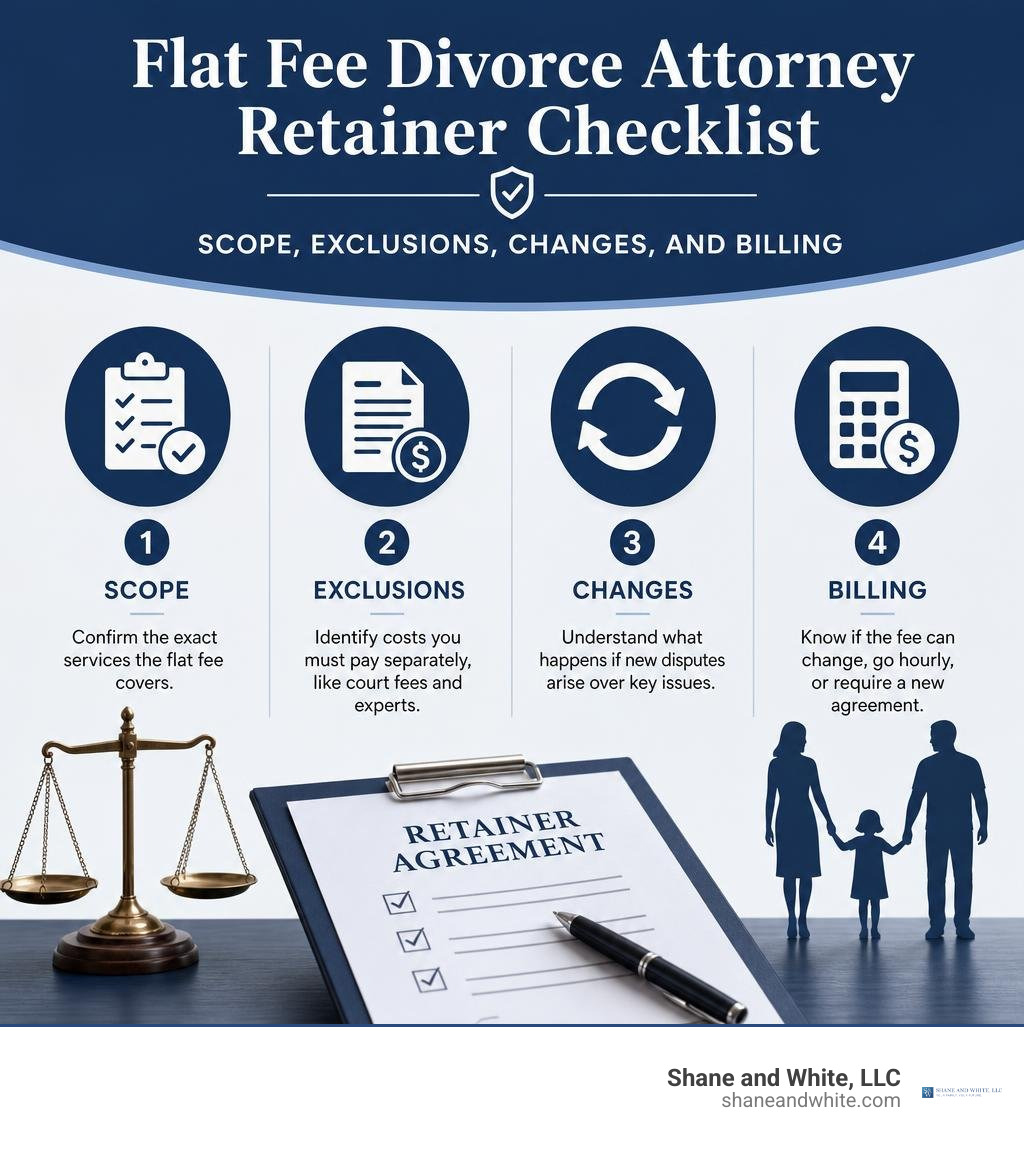
A flat fee divorce attorney charges one agreed price for clearly defined legal work instead of billing for every hour. Before signing a retainer, make sure it states:
- The exact services the fee covers, such as filings, negotiations, mediation, or court appearances.
- Costs you must pay separately, including court fees, process servers, experts, and appraisals.
- What happens if new disputes arise over custody, support, property, or debt.
- Whether the attorney will amend the fee, charge hourly, or require a new agreement if the case becomes contested.
Flat fees are most common in uncontested divorces, where spouses already agree on the major terms. Some lawyers also offer fixed pricing for contested matters, but the agreement must define the scope carefully. A low price is not always a full-service price; document preparation alone is very different from advice and representation by a licensed New Jersey divorce lawyer.
I am Kenneth White, Esq., a New Jersey Supreme Court Certified Matrimonial Law Attorney with decades of family-law experience, including settlement, mediation, and litigation. As a flat fee divorce attorney option is considered, I help clients focus on the retainer terms, the work their case actually needs, and the risks that may affect the final cost.
Learn more about flat fee divorce attorney:
How a Flat Fee Divorce Attorney Structures Legal Pricing
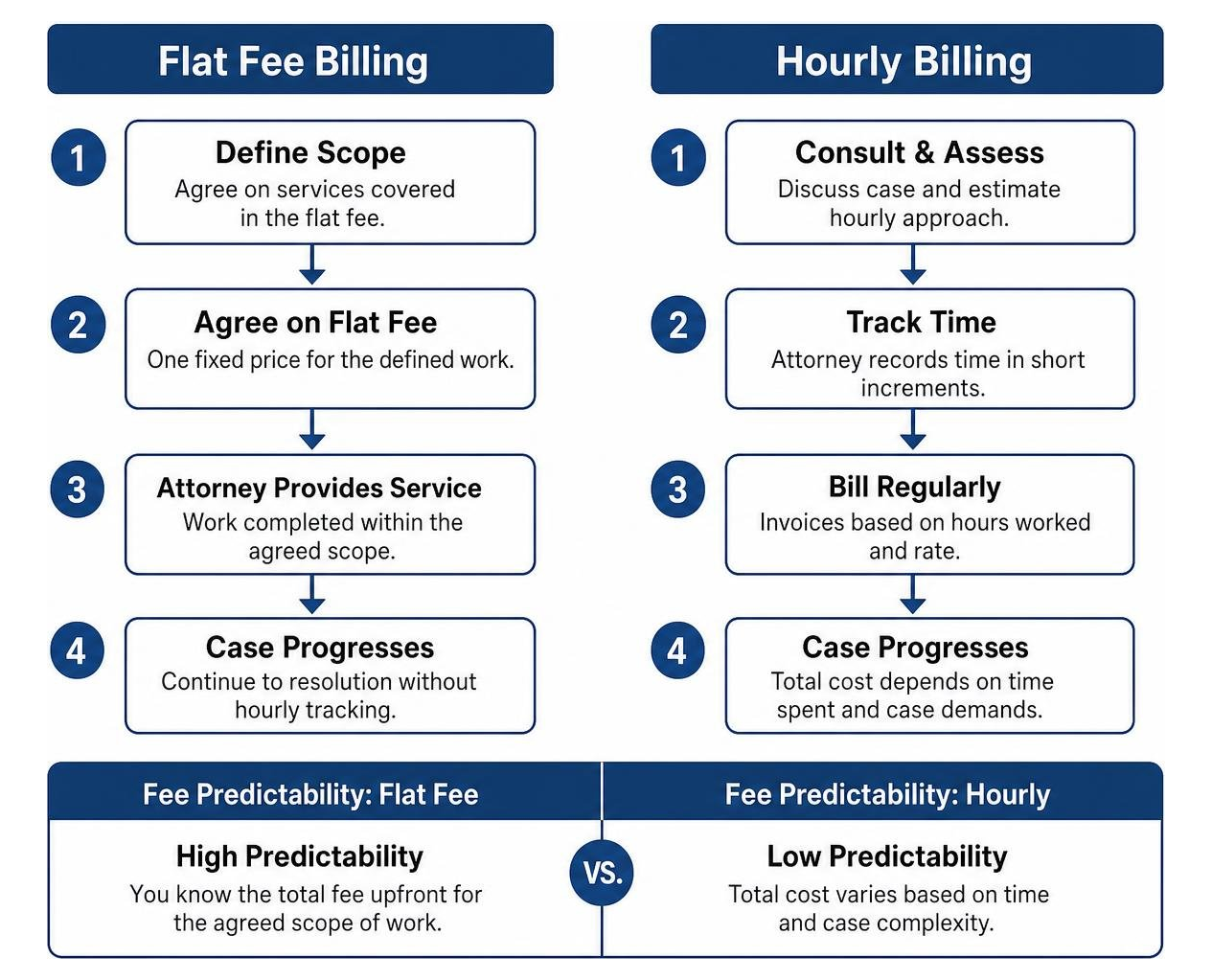
Legal billing has historically relied on the billable hour, where an attorney tracks every six-minute increment spent drafting pleadings, answering phone calls, or reviewing financial disclosures. While this model accounts for unpredictable litigation schedules, it often leaves clients feeling uneasy about their final invoice.
Fixed pricing shifts the financial dynamic entirely. Instead of paying an unpredictable monthly bill, you pay a single, transparent amount for a clearly established scope of legal services. When structuring these arrangements, attorneys evaluate the complexity of your marital estate, the presence of dependent children, and the overall cooperation level between both spouses. Understanding how attorney fees are paid in divorce allows you to assess whether a fixed retainer aligns with your legal and financial goals.
When to Hire a Flat Fee Divorce Attorney for Uncontested Matters
An uncontested divorce provides an ideal framework for fixed pricing. In these scenarios, both parties have already reached an agreement on all critical elements, including:
- Equitable distribution of marital real estate, bank accounts, and personal property
- Responsibility for joint marital debts and individual credit balances
- Child custody arrangements, legal decision-making rights, and structured parenting schedules
- Child support obligations and alimony duration or waivers
Because the substantive terms are settled amicably, the attorney focuses on drafting a legally binding Marital Settlement Agreement (MSA), filing the Complaint for Divorce, and securing the final judgment. This streamlined approach minimizes procedural delays and keeps total costs fully predictable.
Can a Flat Fee Divorce Attorney Handle Contested Litigation?
While flat fees are most prevalent in uncontested cases, certain firms offer structured or tiered flat fees for contested matters. Contested divorces involve formal discovery, motions for temporary relief, court appearances, and extensive settlement negotiations.
Attorneys offering fixed fees for contested matters often break the litigation into distinct stages:
- Initial Pleadings and Discovery Phase: Managing the petition, answer, case information statements, and initial financial disclosures.
- Mediation and Settlement Conferences: Representing the client during court-ordered or voluntary mediation sessions.
- Pre-Trial and Trial Phase: Intensive trial preparation, exhibit assembly, motions in limine, and courtroom appearances.
By segmenting contested litigation into distinct fee stages, you maintain price certainty for each phase of the case rather than facing an open-ended monthly retainer drain.
Flat Fee vs. Traditional Hourly Billing: Comprehensive Cost Comparison

Choosing between a fixed retainer and traditional hourly billing requires evaluating the financial tradeoffs of each model. Hourly retainers require you to deposit an upfront sum—often ranging between $3,500 and $7,500—which the firm draws down as work is performed. When the retainer balance runs low, the client must replenish the trust account.
If a case runs into unexpected procedural hurdles, hourly fees can quickly compound. In contrast, fixed fees establish an agreed price upfront, provided the case stays within the negotiated boundaries. Exploring how to reach a fair divorce settlement without going broke is essential when evaluating these payment models.
| Feature | Flat Fee Representation | Traditional Hourly Billing |
|---|---|---|
| Cost Predictability | High; total legal fees are agreed upon upfront. | Low; overall cost depends on total hours billed. |
| Billing Increments | None; unlimited standard communication within scope. | Billed in 6-minute (0.1 hour) increments. |
| Trust Replenishment | Generally not required unless scope expands. | Required whenever the retainer dips below minimum threshold. |
| Best Suited For | Uncontested cases, agreed settlements, or phased actions. | Highly volatile, unpredictable, or complex litigation. |
| Risk of Cost Surprises | Minimal, as exclusions are clearly detailed in writing. | Higher; motion practice or protracted disputes increase hours. |
Managing Scope Creep When Case Complexity Increases
Scope creep happens when a case originally designated as simple or uncontested develops unforeseen legal conflicts. For instance, if an amicable agreement suddenly collapses over home equity valuation or a newly disputed parenting schedule, the original scope no longer covers the required work.
A well-drafted flat fee retainer includes transition clauses. These terms explain what happens if negotiations fail:
- The retainer may switch to an hourly billing rate for additional litigation tasks.
- A supplemental flat fee addendum can be executed to cover formal mediation or court hearings.
- Clear notice provisions ensure you are informed of any required fee adjustments before new billable work begins.
Scope of Representation: What Is Included vs. Excluded in Fixed Retainers

Retainer agreements are legally binding contracts that govern your professional relationship with counsel. Understanding exactly what deliverables are part of the core fee helps prevent miscommunications. Adopting smart strategies to dissolve your nj marriage without massive debt starts with a thorough review of the retainer’s inclusions and exclusions.
Standard Inclusions in Fixed Retainer Packages
For an uncontested divorce package, a comprehensive flat fee retainer generally encompasses:
- Initial client intake, strategy consultation, and conflict checks
- Preparation and filing of the initial divorce pleadings and summons
- Drafting of the comprehensive Marital Settlement Agreement (MSA) and Child Support Guidelines worksheets
- Revisions to ensure all statutory requirements and parenting provisions are addressed
- Assembly of default or consent judgment paperwork and submission to the court for the final judgment of divorce
Out-of-Pocket Costs and Third-Party Expenses
Legal fees cover professional advocacy and document preparation, but they do not always include external court disbursements. Depending on the firm’s structure, clients are often responsible for third-party costs, which may include:
- Court Filing Fees: Mandatory statutory fees required by the family court clerk to open a docket.
- Process Server Fees: Costs associated with formally serving court documents upon a non-signatory spouse.
- Qualified Domestic Relations Order (QDRO) Preparation: Third-party actuary fees to divide 401(k) or pension assets.
- Property Appraisals & Business Valuations: Independent expert assessments needed to determine fair market value.
The Importance of Professional Legal Representation in Divorce
Attempting a divorce without experienced legal counsel or relying solely on automated online document services presents considerable legal risks. While generic document templates might appear economical initially, they lack the individualized legal analysis needed to protect your future rights. Taking time for finding the right new jersey family law and divorce attorney ensures your case is handled with precision.
The Risks of Handling Divorce Without Legal Counsel
Divorce decrees are final court orders with enduring financial and legal consequences. Common mistakes in unrepresented or automated filings include:
- Omission of Key Assets: Forgetting to properly address future tax refunds, stock options, or deferred compensation plans.
- Unenforceable Custody Clauses: Drafting ambiguous parenting schedules that lead to post-judgment disputes and mandatory court mediation.
- Procedural Defects: Submitting non-compliant documents that result in administrative dismissals or prolonged court rejections.
- Permanent Waiver of Rights: Inadvertently waiving rights to alimony or health insurance continuation without understanding the legal repercussions.
Vetting Local Counsel in Your Jurisdiction
When retaining counsel, verify that your lawyer is licensed, experienced in family law, and familiar with the local court vicinage. Whether you are consulting an attorney in Edison, Metuchen, Woodbridge, East Brunswick, New Brunswick, North Brunswick, Monroe, Piscataway, Sayreville, or throughout Middlesex County, having an attorney who understands regional court procedures provides a clear advantage.
Reviewing resources like a comprehensive guide to finding an east windsor divorce lawyer can offer additional perspective on what credentials and local experience matter most during your search.
Frequently Asked Questions About Flat Fee Divorce Retainers
What happens if my uncontested divorce becomes contested after signing?
If you enter into a flat fee agreement for an uncontested divorce and negotiations subsequently break down, the attorney cannot continue working under the original flat fee scope. The retainer agreement will outline specific procedures for this scenario. Typically, the attorney will either draft an addendum outlining a new flat fee for contested representation or transition the remaining balance into a traditional hourly billing arrangement. You will be provided with an itemized account of the work completed before any new fee structure takes effect.
Are court filing fees included in a flat fee agreement?
It depends on the individual law firm’s pricing structure. Some firms offer “all-inclusive” packages that incorporate mandatory state filing fees, while others charge a flat fee strictly for legal services and bill court costs separately. Because filing fees are paid directly to the court clerk, always review the itemized list in your retainer agreement to verify whether these administrative expenses are included in the quoted price.
Do flat fee agreements mean an attorney dedicates less effort to my case?
No. Attorneys are bound by strict rules of professional conduct and ethical standards regardless of their billing method. A flat fee lawyer owes you the exact same fiduciary duty, diligence, and legal advocacy as an attorney billing by the hour. Flat fees are designed to create pricing predictability, not to reduce the quality of representation or client communication.
Conclusion
A flat fee divorce retainer provides the financial transparency and predictability many individuals need during a challenging life transition. By defining the scope of legal work upfront, you can focus on resolving matters constructively without the anxiety of unpredictable monthly legal invoices.
At Shane and White, LLC, our team brings over 40 years of combined family-law experience to every matter we handle. We provide personalized attention, clear communication, and dedicated representation to guide you through your divorce efficiently. To review your circumstances and explore the right legal strategy for your family, schedule a consultation with Shane and White, LLC today.