


Split College Costs Fairly After Divorce
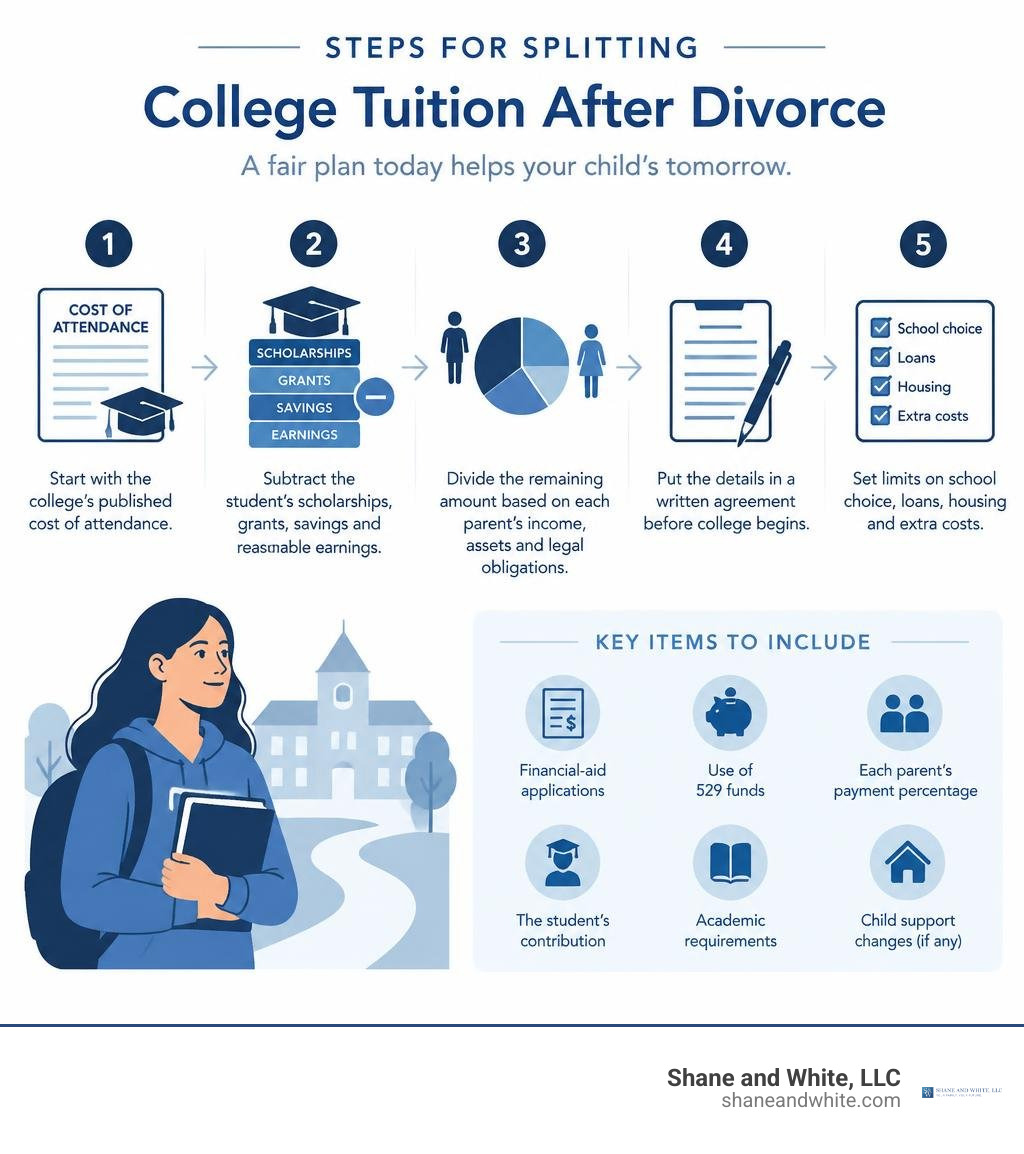
To handle divorce and college expenses fairly, start with the college’s published cost of attendance, subtract the student’s scholarships, grants, savings, and reasonable earnings, then divide the remaining amount based on each parent’s income, assets, and legal obligations. Put the details in a written agreement before college begins, including limits on school choice, loans, housing, and extra costs.
College costs involve more than tuition. They can include fees, books, room and board, transportation, and personal expenses. But parents often disagree over whether items such as sorority dues, a car, premium off-campus housing, or travel should be shared. Financial-aid rules can also produce surprises: FAFSA and many colleges using the CSS Profile may ask for different parent financial information.
A clear plan can reduce conflict and help protect your child’s education. It should address financial-aid applications, use of 529 funds, each parent’s payment percentage, the student’s contribution, academic requirements, and whether child support should change once the child lives on campus.
I am Kenneth White, Esq., a New Jersey Certified Matrimonial Law Attorney with decades of family-law experience in settlement, mediation, and litigation. I help families address divorce and college expenses with practical, detailed agreements that reduce uncertainty and avoid preventable court disputes.
Divorce and college expenses vocabulary:
Legal Frameworks Governing Divorce and College Expenses
When parents separate, one of the most contentious issues that arises years down the road is higher education funding. Unlike minor child support, which follows strict state mathematical guidelines, college contribution orders involve significant judicial discretion. Courts examine whether parents possess the financial capability to contribute without suffering undue economic hardship, balancing their current standard of living against the child’s academic aptitude.
Across the country, legal frameworks range from statutes that enforce a strict cap based on in-state public university costs to flexible equitable standards. When negotiating your settlement, understanding how to reach a fair divorce settlement early on will prevent costly enforcement battles when tuition bills arrive. Legal scholars and practitioners frequently analyze the nuances of allocating college education expenses in divorce to balance parental obligations with the child’s independent financial resources.
Judicial Formulas and Statutory Caps on Parental Contributions
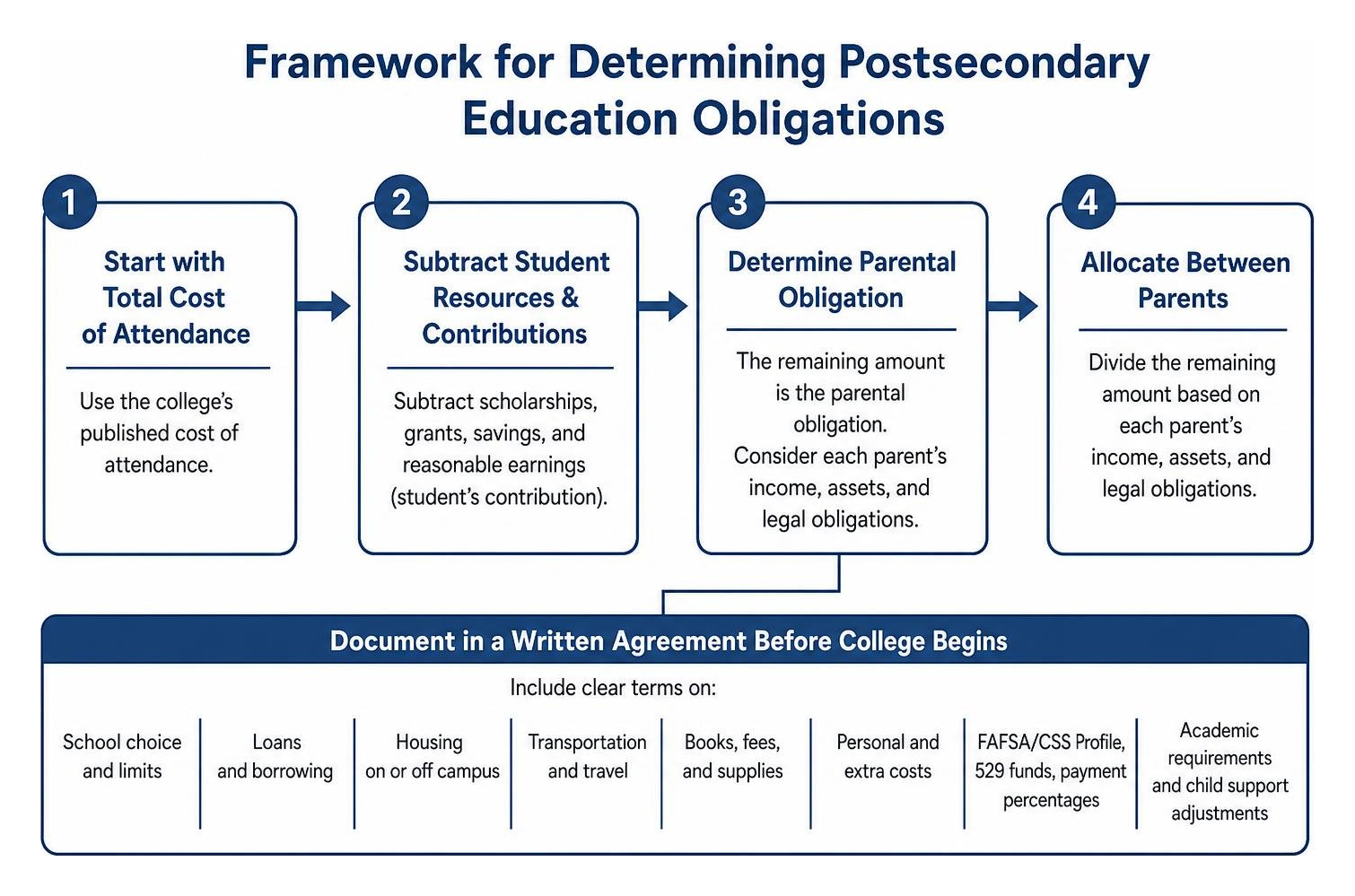
Different jurisdictions utilize varying benchmarks to calculate parental postsecondary obligations. Several states employ a structured three-step formula to establish what is equitable. Under this framework, the court first calculates the net educational cost—often pegged to the benchmark of an in-state public institution. Next, the court determines the child’s mandatory self-help contribution through grants, scholarships, personal savings, and employment earnings. Finally, the remaining balance is apportioned between the parents based on their respective incomes and net worth.
Specific statutory provisions illustrate these mechanics:
- Under Iowa Code § 598.21F, a court may order a postsecondary education subsidy only upon a showing of good cause, limiting each parent’s maximum required contribution to 33.33% (one-third) of the total cost of attendance at an in-state public university.
- Similarly, statutory frameworks like Pennsylvania Consolidated Statutes § 4327 outline how judicial authorities assess educational costs, grants, gifts, and student financial aid before establishing parental liabilities, generally terminating obligations past age 23 unless exceptional circumstances exist.
New Jersey Standards and Court Decisions
In New Jersey, the law treats higher education contributions as a shared parental obligation rather than an automatic entitlement or an absolute cutoff at age eighteen. Under the landmark precedent of Newburgh v. Arrigo, courts evaluate twelve distinct equitable factors, including:
- Whether the parent would have contributed to the college costs if they had remained with the family.
- The educational background, goals, and values of the parents.
- The child’s academic aptitude and specific goals.
- The financial resources and ability of each parent to pay.
- The availability of financial aid, grants, and federal student loans.
- The relationship between the paying parent and the child, including whether the parent was consulted during the college application and selection process.
Recent jurisprudence, such as the New Jersey Appellate Division ruling in A.K. v. M.K., underscores that communication and timely notice are vital. If a custodial parent unilaterally commits a child to an expensive private college without keeping the other parent informed or providing financial aid disclosures, the court may reduce or deny the requested contribution. Navigating these requirements requires a thorough understanding of New Jersey divorce laws and process.
Navigating FAFSA, CSS Profile, and Federal Loan Rules

Applying for student financial aid across separate households can create confusion. Federal formulas and private institutional rules calculate a family’s ability to pay using completely different criteria. Overlooking these differences can cost your family thousands of dollars in grant eligibility. A comprehensive Boston Bar Association analysis on divorce and financial aid under OBBBA highlights how recent statutory overhauls have transformed the financial landscape for separated parents.
FAFSA Simplification and the Majority Support Parent Rule
Under the updated Free Application for Federal Student Aid (FAFSA) rules, the “custodial parent” is no longer defined by where the student physically sleeps for the majority of the year. Instead, the FAFSA filing parent is defined as the biological or adoptive parent who provided the greater portion of financial support to the student during the preceding twelve months.
Key FAFSA considerations include:
- Support-Based Test: If Parent A provides 51% or more of the student’s living expenses, food, medical care, and general support, Parent A must complete the FAFSA, even if the student spent equal nights at Parent B’s residence.
- Stepparent Income: If the parent providing majority support has remarried, the new stepparent’s income and assets must be reported on the FAFSA, regardless of prenuptial agreements.
- Child Support as an Asset: Received child support is now treated as an asset on the FAFSA rather than untaxed income, which generally lessens its negative impact on aid calculations.
- CSS Profile (Institutional Methodology): Over 200 private and select public universities utilize the College Scholarship Service (CSS) Profile. Unlike the FAFSA, the CSS Profile generally requires financial submissions from both parents (including non-custodial parents) and frequently includes home equity in the family’s primary residence as an available asset.
OBBBA Federal Student Loan Limits and Parent Borrowing
Federal loan limits have shifted significantly under the One Big Beautiful Bill Act (OBBBA). In the past, parents frequently relied on open-ended Parent PLUS loans to bridge the gap between financial aid and tuition bills. Under OBBBA provisions:
- Parent PLUS loans are capped at $20,000 per academic year, with an aggregate lifetime borrowing limit of $65,000 per student.
- Public Service Loan Forgiveness (PSLF) eligibility rules for Parent PLUS borrowers have faced stricter enforcement, diminishing the ability of public-sector employees to write off high educational balances.
- Graduate student loans are subject to annual caps of $20,500 and a lifetime limit of $100,000.
Because federal parent borrowing is now capped, divorced parents who fail to plan may find themselves forced into high-interest private student loans requiring co-signers, introducing significant financial risk to both households.
Allocating Resources: 529 Plans, Student Aid, and Incidental Costs
When calculating who pays what, parties must establish the baseline figures before dividing the remainder. Below is a breakdown of how courts and settlement agreements treat standard educational line items:
| Category | Typical Essential Treatment | Notes and Guidelines |
|---|---|---|
| Tuition & Mandatory Fees | Shared proportionally | Based on net cost after scholarships and grants |
| Standard Room & Board | Shared proportionally | Capped at university dormitory and meal plan rates |
| Required Textbooks & Supplies | Shared proportionally | Documented receipts required; rental preferred |
| Off-Campus Luxury Housing | Disputed / Non-Essential | Excess over university room & board paid by student or requesting parent |
| Sorority / Fraternity Dues | Disputed / Non-Essential | Discretionary; not court-mandated unless expressly agreed |
| Personal Vehicle & Parking | Disputed / Non-Essential | Fuel, parking permits, and insurance handled individually |
| Personal Allowances & Travel | Discretionary | Addressed as discretionary allowances or covered by student earnings |
Existing educational funds, particularly Section 529 Qualified Tuition Plans, must be incorporated into the initial settlement. In the precedent Lynn Marie Larsen v. Roger Wayne Larsen, 912 N.W.2d 444 (Iowa 2018), the court examined a scenario where the family held $63,107.24 in a 529 account. The court held that dedicated education funds should be drawn down to satisfy direct college costs before assessing each parent’s out-of-pocket share. When crafting your property division, splitting retirement and investment accounts carefully ensures college funds remain preserved for their intended purpose.
Calculating Child Contributions Before Dividing Divorce and College Expenses
Before dividing tuition between households, the child must exhaust their own opportunities for self-help. Courts expect college-bound young adults to share in the investment of their higher education.
The child’s contributions typically include:
- Gift Aid: All merit-based scholarships, institutional grants, and federal Pell Grants apply directly against tuition.
- Student Loans: The child is usually expected to accept standard federal Direct Subsidized and Unsubsidized student loans (which carry student-friendly repayment terms) before parents are forced to liquidate retirement assets or seek commercial loans.
- Summer and Part-Time Wages: Courts reasonably anticipate that a student can work during summer breaks and maintain a modest part-time campus job (e.g., work-study) to cover personal spending money, books, and laundry expenses.
- Dedicated Savings: A minor percentage of the child’s independent bank accounts or UTMA/UGMA accounts may be applied toward direct educational costs.
Disputing Non-Essential and Extracurricular College Costs
Conflict frequently arises over non-academic costs. Without explicit language in a property settlement agreement (PSA), courts generally refuse to compel an objecting parent to fund discretionary lifestyle expenses.
Disputed items include:
- Greek Life: Greek membership fees, formal attire, and social dues are considered personal extracurricular choices.
- Off-Campus Housing Markups: If an apartment costs $1,800 per month while campus room and board costs $1,100, the requesting parent or student covers the difference.
- Study Abroad Programs: Unless an international semester is an accredited, mandatory component of the degree curriculum, courts view premium travel programs as discretionary.
- Vehicles and Transportation: Expenses for campus parking passes, vehicle leases, tolls, and routine auto insurance are rarely classified as mandatory educational necessities.
Interplay Between Child Support and Post-Secondary Support

A common point of confusion is whether regular child support continues unchanged when a child enters college. The short answer is no: paying full child support and full room and board results in an inequitable double-dipping scenario.
When a student moves away from home to live on campus, basic household expenses incurred by the primary custodial parent decrease. Food, utilities, and daily consumption shift to the university campus, where they are already covered by room and board payments.
For detailed information on baseline schedules, refer to our comprehensive child support guide. While some states, such as Massachusetts, permit child support to extend up to age 23 if the child remains enrolled and principally dependent, New Jersey law closely evaluates actual dependency and campus residency to determine adjustments.
Modifying Child Support Orders When College Begins
The transition to college represents a substantial change in circumstances, entitling either parent to file a motion for modification of child support.
When adjusting support obligations, courts and attorneys consider:
- Room and Board Credits: The non-custodial parent who is contributing to the child’s on-campus room and board is usually granted a credit or reduction against weekly child support.
- Fixed Home Maintenance: The primary custodial parent still incurs fixed shelter expenses (such as mortgage, property taxes, and home insurance) to preserve a residence for the student during semester breaks, holidays, and summer recesses. Child support is adjusted downward to reflect variable costs rather than eliminated entirely.
- Commuter Students: If the student commutes to college from the custodial parent’s home, basic child support remains largely intact, though adjusted to account for direct tuition outlays.
Drafting Settlement Agreements for Divorce and College Expenses
The best way to prevent future court battles is by drafting specific, clear clauses within your initial settlement agreement. When looking into dissolving marriage without excessive debt, clear educational terms remove future ambiguity.
Ensure your agreement includes these core terms:
- Consultation and Consent: Both parents must be actively consulted regarding the college application process, campus visits, and final selection before financial liability attaches.
- Financial Cap: Set a baseline standard (such as the published cost of attendance for Rutgers University or an in-state public equivalent) beyond which neither parent is obligated without written consent.
- Academic Benchmarks: The student must maintain full-time enrollment status (e.g., minimum 12 credits per semester) and maintain a minimum cumulative GPA (typically 2.5 or higher).
- Grade and Financial Aid Transparency: The student and custodial parent must provide copies of semester grade reports and institutional financial aid award letters within two weeks of receipt.
- Application Expense Limits: Cap the number of paid college applications (e.g., maximum 8 schools) and campus visits.
Frequently Asked Questions about Divorce and College Expenses
Can a parent be forced to pay for an expensive private university?
Not automatically. While courts can order parents with high net worth to fund private universities, judges evaluate the family’s economic means, standard of living, and whether attendance is academically justified over a high-quality in-state public alternative. Agreements frequently include an “in-state public cap” stating that parents will only be liable up to the cost of an in-state flagship university, leaving any balance to be funded by scholarships, the student, or the parent advocating for private enrollment.
What happens if an adult child repudiates a paying parent?
Under established family law principles, a child who completely repudiates a relationship with a parent—disowning them, cutting off communication, refusing to acknowledge them, and excluding them from the college selection process—may lose their right to compel that parent to pay for higher education. Repudiation requires clear, documented evidence that the child deliberately and voluntarily severed the bond without reasonable justification.
How does remarriage affect financial aid calculations and court-ordered tuition support?
For court-ordered support, a new spouse has no legal obligation to pay for their stepchild’s college tuition. However, a stepparent’s income may be considered indirectly if it reduces the biological parent’s household living expenses. For financial aid purposes, if the biological parent providing the majority of financial support remarries, federal rules require that stepparent’s income and assets be reported on the FAFSA.
Conclusion
Higher education planning requires clear legal foresight and a balanced approach. By establishing clear parameters regarding school selection, student self-help obligations, 529 account usage, and modified child support, you can protect your child’s academic future while preserving financial stability across both homes.
At Shane and White, LLC, our team brings more than 40 years of dedicated family-law experience to families in Edison, Metuchen, Woodbridge, New Brunswick, and throughout Middlesex County, New Jersey. Whether you are drafting a comprehensive settlement agreement or need to modify an existing support order as your child approaches high school graduation, we provide clear guidance and personalized legal counsel. Schedule a consultation with our New Jersey family law team to protect your family’s future.


