A Collaborative Divorce Attorney East Windsor Families Can Turn To
If you want to resolve a divorce outside the courtroom, start by meeting with a collaborative divorce attorney East Windsor residents can consult and ask whether both spouses are willing to negotiate openly. Each spouse has separate, specially trained counsel. Together, you work through parenting, support, property, and financial issues in private meetings, with neutral financial or child professionals when helpful.
Collaborative divorce is not simply an informal agreement. Both spouses sign a participation agreement that commits them to honest disclosure and settlement-focused problem solving. When an agreement is reached, it is prepared for Family Court approval and becomes part of the final divorce judgment.
This route can reduce conflict and give families more control over the outcome. In Connecticut, collaborative matters commonly take about 4 to 9 months, while contested litigation may take a year or longer. It is not right for every situation, especially where safety, coercion, or hidden assets are concerns, but it can offer a calmer path for spouses who can negotiate in good faith.
I am Kenneth White, Esq., a Supreme Court of New Jersey Certified Matrimonial Law Attorney with experience in family-law settlement, mediation, and court matters. As a collaborative divorce attorney East Windsor families may consider, I help clients evaluate practical options while protecting their rights and their children’s future.
Basic collaborative divorce attorney east windsor terms:
- East Windsor divorce lawyer
- family law attorney east windsor
- east windsor divorce initial consultation attorney
Key Benefits of Hiring a Collaborative Divorce Attorney East Windsor

Choosing to dissolve a marriage without stepping into a hostile courtroom environment provides immediate relief for couples who value privacy, control, and constructive dialogue. Working alongside a skilled legal team allows both parties to set aside the “winner-takes-all” mentality typical of trial litigation and instead focus on durable, practical agreements. Learning how an East Windsor divorce attorney can help at your initial consultation is often the first step toward understanding the profound difference between non-adversarial problem-solving and traditional litigation.
The collaborative model transforms the divorce landscape by delivering several critical advantages:
- Complete Confidentiality: Courtrooms are open to the public, and documents filed in contested litigation become matter of public record. Collaborative meetings happen behind closed doors, protecting your family’s personal dignity and financial details.
- Voluntary Financial Transparency: Rather than spending thousands of dollars on formal subpoenas, formal depositions, and motion practice, parties voluntarily exchange documents in good faith.
- Customized Solutions: Judges are bound by rigid statutory formulas. In collaborative practice, you and your spouse have the freedom to design creative arrangements that address your family’s unique daily schedules and financial goals.
- Cost Control: Because you are not paying attorneys to draft motions, wait in court hallways, or prepare for trial appearances, your financial resources remain preserved for your post-divorce life.
How a Collaborative Divorce Attorney East Windsor Protects Parental Rights and Child Well-Being
When children are involved, traditional litigation often takes an unnecessary emotional toll. Pitting parents against each other in court can foster resentment that lingers long after the final judgment is entered. Collaborative practice shifts the focus back to where it belongs: the long-term well-being of your children.
During collaborative discussions, parents work together—often alongside a neutral child development specialist or parenting coach—to construct a comprehensive, workable parenting plan. Rather than arguing over rigid alternating weekends dictated by an overburdened family judge, parents can tailor holiday schedules, school transportation routines, and extracurricular commitments around their children’s actual developmental needs. This cooperative structure establishes healthy communication channels early, laying a strong foundation for effective co-parenting for years to come.
Comprehensive Asset Division and Property Settlement Strategies
Dividing a lifetime of accumulated assets requires clear financial analysis rather than courtroom posturing. In a collaborative divorce, both spouses have the guidance of their respective counsel along with an agreed-upon neutral financial professional. This neutral expert reviews tax returns, assesses retirement accounts, analyzes stock portfolios, and provides objective business valuations without the bias of competing “hired gun” experts.
Real estate matters, including deciding whether to sell the family home, refinance, or structure an equitable buyout, are resolved collaboratively. Knowing how to secure your roof and rights with an East Windsor divorce housing rights lawyer ensures your residential rights and property equity remain fully protected while keeping negotiations constructive and forward-looking.
Core Solutions and Steps in the Collaborative Divorce Process

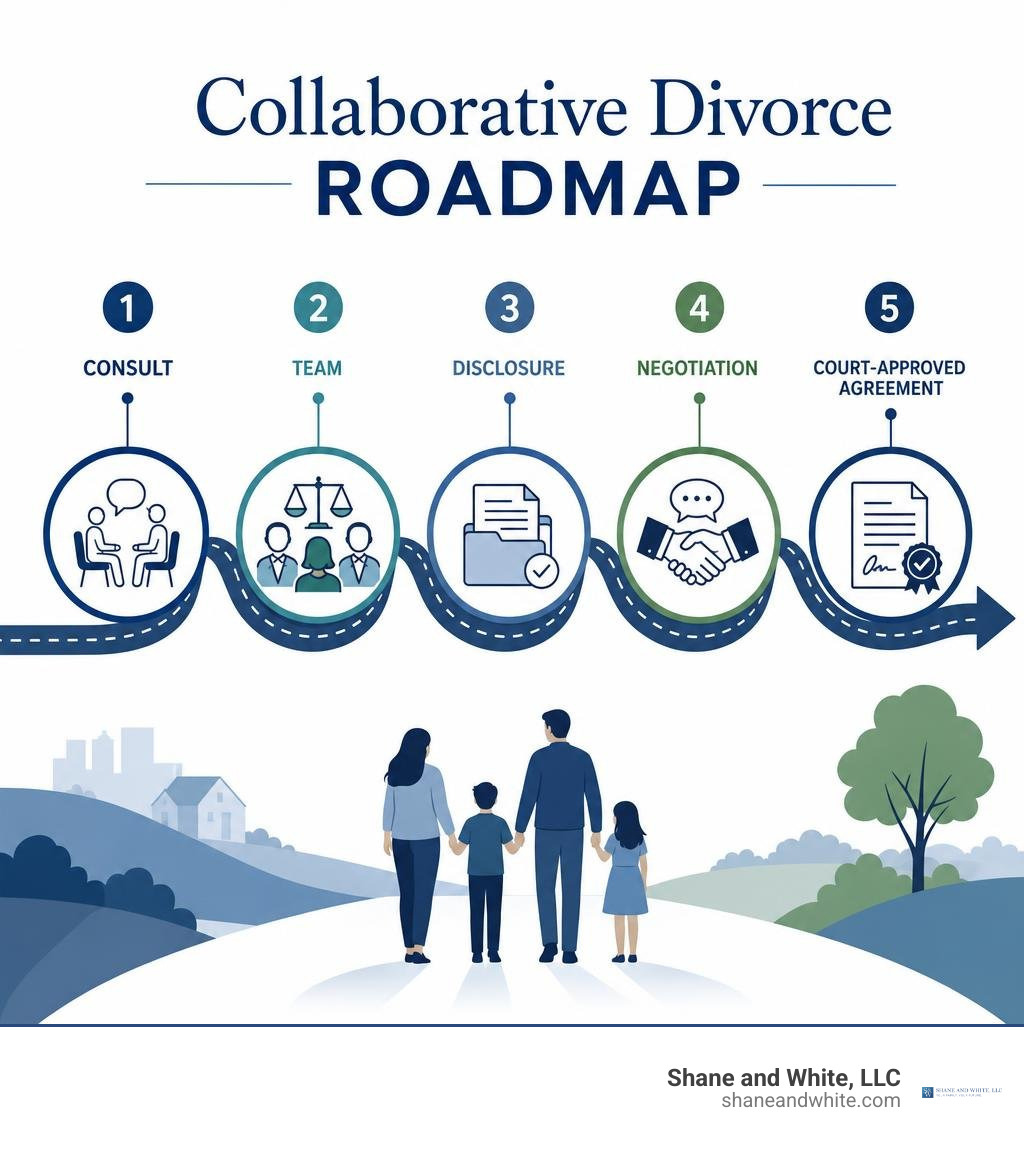
The collaborative divorce process follows a structured, step-by-step roadmap designed to maintain momentum, encourage open communication, and reach a fair settlement.
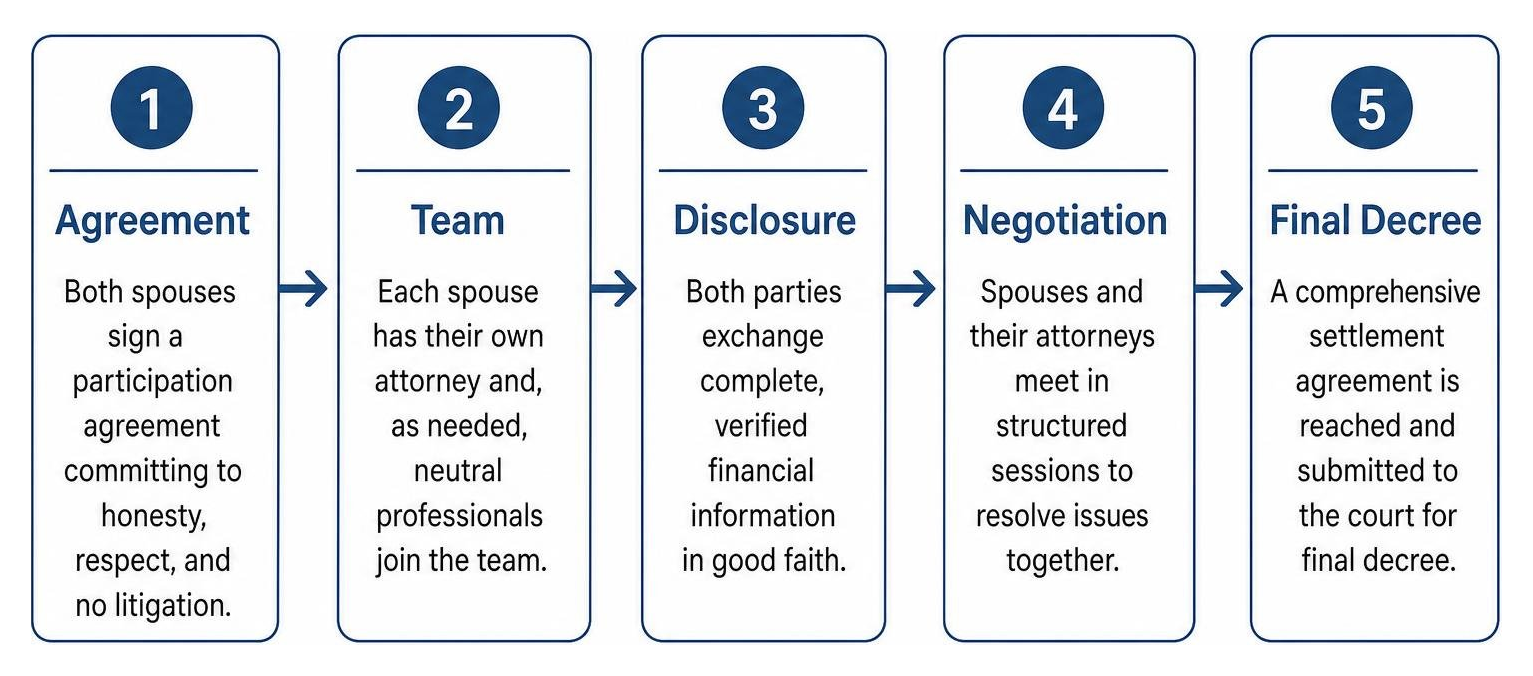
- Initial Consultations and Assessment: Each spouse meets separately with their own collaboratively trained lawyer to evaluate goals, confirm suitability for the process, and establish legal priorities.
- Signing the Participation Agreement: Both spouses and their attorneys sign a formal contract committing to honesty, full disclosure, mutual respect, and a strict pledge not to pursue litigation during negotiations.
- Forming the Neutral Team: Depending on the complexity of your marital estate and family dynamics, neutral experts such as a financial neutral or family coach are brought onto the team.
- Full Financial Disclosure: Both parties exchange complete, verified financial documentation, including tax returns, bank statements, asset ledgers, and debt records.
- Structured Joint Sessions (Four-Way Meetings): Spouses and their counsel engage in focused working sessions to methodically resolve asset distribution, support obligations, and parenting terms.
- Drafting the Marital Settlement Agreement: Counsel drafts a comprehensive legal settlement document incorporating every agreed-upon term.
- Final Court Approval: The finalized agreement is submitted to the Family Court for judicial review and entry as an enforceable, binding judgment of divorce.
Assembling the Interdisciplinary Collaborative Team
A major strength of collaborative divorce is the interdisciplinary team approach. Instead of relying solely on attorneys to manage every emotional, financial, and logistical detail at high hourly rates, the process uses specific professionals for specific tasks.
- Collaborative Attorneys: Act as independent legal advisors and settlement negotiators for each spouse, ensuring legal rights are guarded while fostering cooperation.
- Neutral Financial Professional: An accountant, CPA, or certified divorce financial analyst who compiles marital balance sheets, analyzes cash flow, evaluates tax implications, and models long-term financial scenarios.
- Divorce Coach / Mental Health Professional: Helps spouses manage emotional triggers, clarify communication, and maintain a business-like approach during negotiations.
- Child Specialist: Acts as the voice of minor children, providing neutral insights into their emotional and developmental needs to assist in building the parenting schedule.
The Disqualification Clause and Privacy Protections
The core safeguard of collaborative law is the disqualification clause. By signing the collaborative participation agreement, both attorneys agree that if either party abandons the process to initiate contested court litigation, both lawyers are automatically disqualified from further representation.
This rule creates a vital safe space for problem-solving:
- No Threat of Court Action: Neither attorney can use litigation tactics or courtroom threats to force a settlement.
- Aligned Incentives: All parties at the table—clients and professionals alike—are 100% focused on finding solutions rather than posturing for a trial judge.
- Confidential Negotiations: Settlement discussions, creative hypothetical proposals, and notes exchanged during collaborative meetings are strictly confidential and inadmissible in any future court proceedings should the process terminate.
Comparing Dispute Resolution Methods for East Windsor Couples
Choosing the right dispute resolution method depends on your family dynamics, level of communication, and specific estate complexity. Exploring collaborative divorce vs traditional litigation: which path is right for you? helps clarify these differences.
| Feature | Collaborative Divorce | Traditional Divorce Mediation | Contested Courtroom Litigation |
|---|---|---|---|
| Legal Representation | Each party has their own attorney present at all meetings | Single neutral mediator; parties may retain review counsel | Each party represented by trial counsel in an adversarial setting |
| Decision-Making Authority | Both spouses retain 100% control over the final agreement | Both spouses negotiate directly with mediator facilitation | Family Court Judge makes binding decisions after hearings |
| Average Timeline | 4 to 9 months | 3 to 6 months | 12 to 24+ months |
| Combined Cost Range | Typically $15,000 – $35,000 | Typically $5,000 – $15,000 | Often $40,000 – $100,000+ |
| Privacy Level | Completely confidential, out-of-court meetings | Completely confidential, out-of-court sessions | Public court filings, open courtroom proceedings |
| Neutral Professionals | Financial neutrals, child coaches integrated into the team | Retained ad-hoc as independent neutral experts | Competing, expensive partisan expert witnesses |
For many couples, reviewing our dedicated practice: alternative dispute resolution mediation arbitration services provides further insight into tailoring an out-of-court resolution strategy.
Selecting the Right Collaborative Divorce Attorney East Windsor for Your Family
Not every family lawyer is equipped to handle collaborative divorce. It requires specific training in interest-based negotiation, non-adversarial communication, and mediation protocols. When looking for legal counsel, consult a comprehensive guide to finding an East Windsor divorce lawyer to ensure you choose an advocate who understands the nuances of alternative dispute resolution.
Key qualifications to evaluate include:
- Formal credentialing and membership in recognized collaborative practice associations.
- At least 40 hours of mediation and dispute resolution training.
- A proven track record of resolving complex matrimonial matters without unnecessary litigation.
- Strong interpersonal chemistry and clear, transparent communication practices.
Entering the Binding Agreement in Family Court
Reaching an amicable agreement out of court does not mean skipping the formal legal protections of a standard divorce. Once you and your spouse finalize all terms, your collaborative attorneys compile them into a comprehensive Marital Settlement Agreement.
This contract is submitted to the Family Court alongside the necessary administrative paperwork. Reviewing resources on navigating tough times: your guide to East Windsor family court attorneys illustrates how these agreements transition into final judgments. A judge reviews the terms to confirm equity and fairness, incorporating the document into a final, legally binding divorce decree that carries the full authority and enforceability of any litigated court order.
Frequently Asked Questions About Out-of-Court Divorce
What happens if the collaborative divorce process breaks down?
If either party decides to withdraw from the collaborative process or chooses to initiate contested court proceedings, the collaborative process concludes immediately. Under the mandatory disqualification protocol, both collaborative attorneys and any retained neutral professionals must withdraw from the case.
Both spouses must then hire entirely new litigation counsel to represent them in court. Furthermore, all communications, offers, and settlement discussions generated during the collaborative process remain strictly confidential and cannot be entered as evidence in the litigation. This guarantees that your good-faith negotiation efforts cannot be turned against you later.
How much does collaborative divorce cost compared to traditional litigation?
A collaborative divorce generally costs between $15,000 and $35,000 in total for both spouses combined, depending on the complexity of the estate and the number of joint sessions needed. By comparison, contested courtroom litigation regularly exceeds $50,000 to $100,000 per couple due to motion practice, formal discovery disputes, court appearances, and competing expert fees.
Sharing a single neutral financial expert and resolving matters within 4 to 9 months substantially lowers the overall financial burden on the family.
How are financial disclosures handled without court orders?
In collaborative divorce, formal court-ordered discovery (such as depositions and formal subpoenas) is replaced by voluntary, complete transparency. Both parties sign a sworn Financial Affidavit detailing all income, expenses, assets, and liabilities.
Spouses routinely provide at least 24 months of bank statements, tax returns, investment portfolios, retirement summaries, and business ledgers directly to each other and the neutral financial specialist. Because intentional concealment of assets invalidates the collaborative agreement and constitutes fraud, both parties have a strong legal and financial incentive to provide complete, honest disclosures from day one.
Conclusion
Ending a marriage is a major life transition, but it does not have to be an exhausting courtroom battle. By choosing an amicable, non-adversarial path with a dedicated collaborative legal team, you retain control over your decisions, protect your children from unnecessary stress, and safeguard your marital assets.
At Shane and White, LLC, our firm brings over 40 years of dedicated family law experience to every case. We provide personalized attention, pragmatic solutions, and clear communication to help you transition into your next chapter with confidence and peace of mind.
Take the first step toward a constructive resolution today. Contact Shane and White, LLC to schedule a confidential case review with our experienced divorce and family law practice.