Understanding Divorce from Bed and Board NJ and Legal Separation
A New Jersey divorce from bed and board (divorce a mensa et thoro) is a court-ordered legal separation that divides assets, debts, and living arrangements while keeping the legal marriage intact. Unlike an absolute divorce, a bed and board divorce establishes formal physical and economic separation—including equitable distribution and support orders—without terminating the marital bond or granting the right to remarry.
While everyday conversation often refers to “legal separation,” a divorce from bed and board NJ is the closest statutory equivalent under New Jersey family law. For spouses across Middlesex County—including communities like Edison, Woodbridge, New Brunswick, and East Brunswick—understanding how this decree compares to an absolute divorce (divorce a vinculo matrimonii) or a private contractual separation agreement is essential for choosing the right legal path.
| Feature | Divorce from Bed and Board | Absolute Divorce | Separation Agreement |
|---|---|---|---|
| Marital Status | Legally Married | Fully Dissolved | Legally Married |
| Right to Remarry | No | Yes | No |
| Equitable Distribution | Yes (Court-Ordered) | Yes (Court-Ordered) | Yes (Contractual Only) |
| Court Decree Issued | Yes | Yes | No (Out-of-Court Contract) |
| Conversion to Full Divorce | Available as a matter of right | N/A | Requires filing new complaint |
| Health Insurance Continuity | Possible (Depends on plan) | Terminated upon entry of judgment | Possible (Depends on plan) |
Legal Grounds for a Divorce from Bed and Board NJ
Under New Jersey Revised Statutes Section 2A:34-3 (2025), the statutory grounds for obtaining a limited divorce are identical to those required for a standard dissolution.
You can review The Ultimate Guide To New Jersey Divorce Laws And Process to see how these causes function in general litigation. Specifically, a bed and board complaint can be based on:
- Irreconcilable Differences: A no-fault ground requiring proof that the marriage has experienced a breakdown for at least six months with no reasonable prospect of reconciliation.
- Separation: Living in separate residences for at least 18 consecutive months.
- Fault Grounds: Extreme cruelty, adultery, willful and continued desertion for 12 or more months, addiction to narcotic drugs or habitual drunkenness, institutionalization for mental illness, or imprisonment.
One critical nuance in New Jersey practice: both spouses must either consent to a bed and board divorce, or the non-filing spouse must decline to demand an absolute divorce. If one spouse files for a divorce from bed and board and the other files a counterclaim demanding an absolute divorce, New Jersey courts will generally proceed with the absolute divorce. You cannot force an unwilling spouse to remain legally tethered to the marriage if they want a complete dissolution.
Key Benefits: Healthcare, Religion, and Finances
Couples choose this path for varied and practical reasons. The most common motivations include:
- Religious and Moral Convictions: For individuals whose faith prohibits or discourages absolute divorce, a bed and board decree provides judicial orders for support and property division without violating personal conscience.
- Health Insurance Preservation: An absolute divorce is a qualifying life event that terminates a dependent spouse’s eligibility under an employer-sponsored family plan. Because a limited divorce keeps the legal marriage intact, some employer plans permit the dependent spouse to remain covered.
- Reconciliation Runway: Couples who need financial boundaries and physical space while undergoing intensive counseling often utilize this structure. It establishes stability without permanently severing the union.
- Social Security and Pension Milestones: If a couple is approaching a significant milestone—such as the 10-year marriage requirement for certain derivative Social Security benefits—a bed and board divorce can maintain the legal marital duration while settling everyday finances.
What Issues Are Resolved in a Limited Divorce Judgment?
A final judgment of divorce from bed and board issued by the Superior Court of New Jersey Family Part is not a temporary band-aid. It is a comprehensive, binding final decree. If you are wondering What To Expect When You Are Getting A Divorce, the scope of relief in a bed and board case mirrors an absolute divorce in nearly every substantive category.
The court exercises full jurisdiction to resolve:
- Formal division of all marital assets and allocation of debts
- Alimony and temporary or permanent spousal maintenance
- Child custody, legal decision-making authority, and parenting time schedules
- Child support, healthcare contribution obligations, and extracurricular expenses
- Exclusive possession of the marital home or directives for its sale
Asset Division, Alimony, and Child Support
A bed and board judgment triggers the statutory process of equitable distribution. Marital property acquired up to the date of the complaint is identified, valued, and divided. Once the court enters a judgment or incorporates a signed Property Settlement Agreement (PSA), the marital economic partnership is permanently closed.
Any property, earnings, or debts acquired by either party after the entry of the bed and board judgment belong solely to that individual. Exploring Smart Strategies To Dissolve Your Nj Marriage Without Massive Debt is just as vital in limited divorce cases as it is in absolute dissolutions, because errors in asset valuation or debt allocation remain binding.
Alimony and child support calculations follow the standard New Jersey Child Support Guidelines and statutory alimony factors under N.J.S.A. 2A:34-23. The financial support awarded is fully enforceable through the New Jersey Family Support Payment Center and the probation department.
Converting, Revoking, or Modifying the Judgment
A primary advantage of the bed and board structure in New Jersey is its procedural flexibility. Life changes, relationships evolve, and the law provides direct mechanisms to adjust your legal status as circumstances warrant.
Converting a Divorce from Bed and Board NJ to an Absolute Divorce
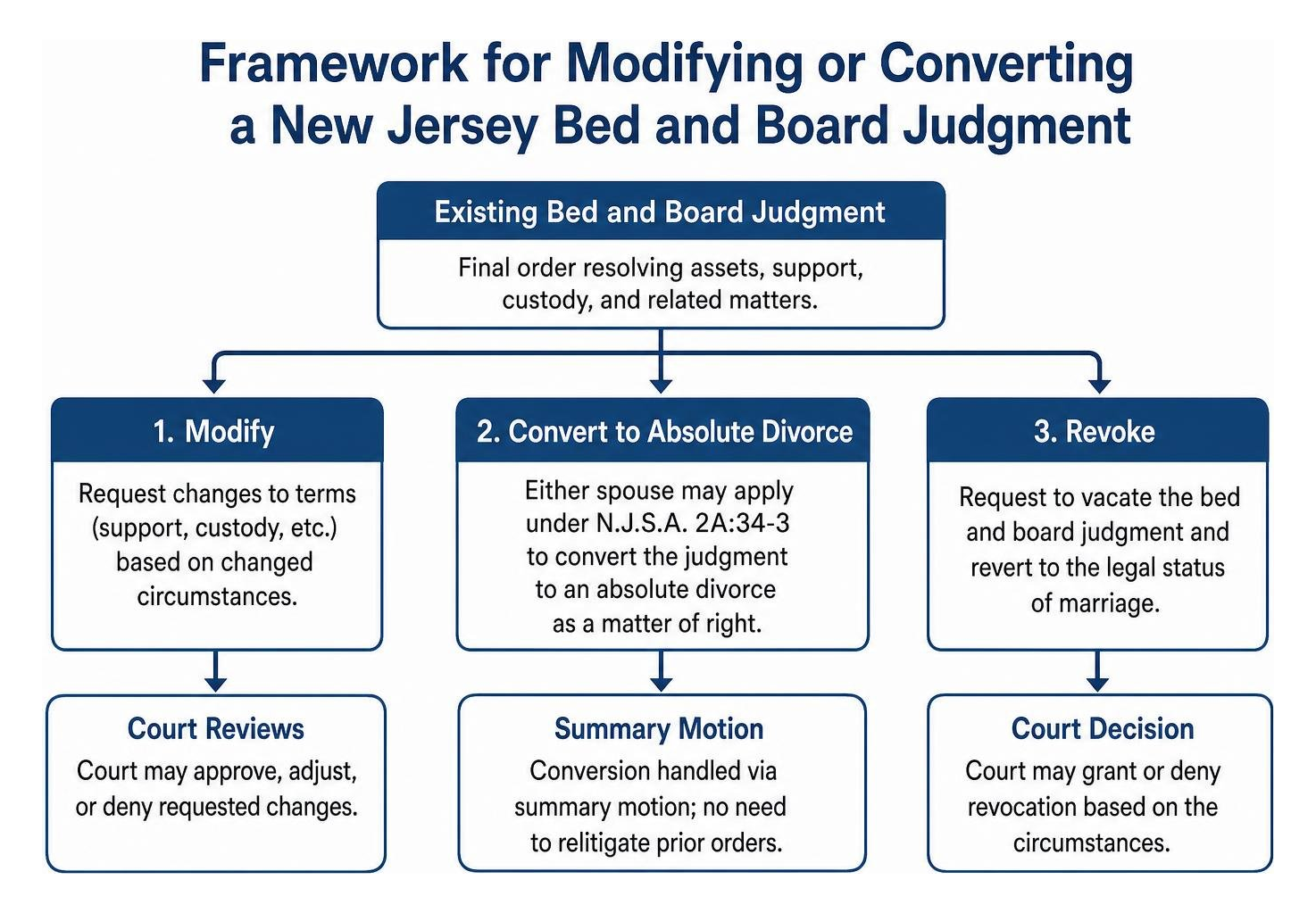
If either spouse decides that living in legal limbo no longer serves their needs, converting the judgment into a full divorce does not require relitigating asset division or custody. Under N.J.S.A. 2A:34-3, either party may apply to the court to convert the bed and board judgment into an absolute divorce from the bonds of matrimony as a matter of right.
When working alongside seasoned counsel—such as when Navigating Separation With The Best Mercer County Divorce Lawyers or our team in Middlesex County—the conversion process is handled via a summary motion. The existing financial, support, and custody terms previously ordered or agreed upon are carried directly into the Final Judgment of Absolute Divorce, saving time, stress, and litigation fees.
Reconciliation and Revocation of the Judgment
What happens if time apart heals the rift and you decide to resume your marital life? Because you never severed the underlying legal marriage, you do not need to get remarried.
Instead, the spouses can file a joint petition with the Superior Court requesting a formal revocation or suspension of the bed and board judgment. Upon entry of the order, your full marital status and reciprocal marital rights are restored.
However, couples should proceed thoughtfully: revoking the decree may reinstate intestate inheritance rights, elective share claims, and joint financial exposures unless a separate postnuptial agreement specifies otherwise.
The Filing Process and Court Requirements in New Jersey
Filing for a limited divorce follows the exact procedural pipeline as a traditional divorce action in New Jersey courts. The matter is initiated in the Superior Court of New Jersey, Chancery Division, Family Part, in the county of proper venue (typically where either party resided when the cause of action arose).

When preparing to file, working with a firm that understands the nuances of family law ensures your documents satisfy local court rules. For insight into what to look for in legal representation, see our guide on Finding The Right New Jersey Family Law And Divorce Attorney.
The initial filing requires mandatory pleadings and state forms:
- Complaint for Divorce from Bed and Board: Detailing jurisdictional facts, residency requirements (at least one spouse residing in New Jersey for 12 consecutive months), and statutory causes.
- Summons and Litigant Information Sheet: Standard administrative tracking documents.
- Certification of Insurance Coverage: Listing all existing health, life, automobile, and disability policies to prevent improper cancellation during proceedings.
- Certification of Verification and Non-Collusion: Attesting to the truth of the allegations.
- Certification of Notification of Alternative Dispute Resolution (CDR): Confirming you have been advised of mediation options.
Court fees are set by state statute: the initial complaint filing fee is $300 for the plaintiff, with an appearance or answer fee of $175 for the defendant. If child custody or parenting time is contested, both parties must pay an additional $25 parenting workshop fee and attend the mandatory seminar. Litigants with limited financial resources can apply for an indigent fee waiver.
Step-by-Step Filing Procedures and Dispute Resolution
After filing electronically through the Judiciary Electronic Document Submission (JEDS) system or filing in person, the plaintiff must complete service of process on the defendant within 60 days via a county sheriff or private process server.
Both parties must exchange a comprehensive Family Part Case Information Statement (CIS) detailing all income, past expenses, current budgets, assets, and liabilities.
New Jersey strongly encourages negotiated settlements. If disputes remain regarding finances or custody, couples are guided through several mandatory Alternative Dispute Resolution (ADR) stages:
- Custody and Parenting Time Mediation: Free, court-provided sessions to resolve parenting issues.
- Matrimonial Early Settlement Panel (MESP): Experienced volunteer family law attorneys evaluate unresolved financial issues and recommend fair settlement terms.
- Economic Mediation: Further structured mediation if MESP does not yield an agreement.
For those seeking local representation around Central Jersey, reviewing A Comprehensive Guide To Finding An East Windsor Divorce Lawyer offers helpful context on how local county courts manage these dispute tracks.
Frequently Asked Questions About NJ Bed and Board Divorce
Can I remarry after getting a divorce from bed and board in NJ?
No. You remain legally married. Entering into a new marriage while under a bed and board decree constitutes bigamy under New Jersey criminal law. To remarry, you must first file a motion to convert your limited divorce into a Final Judgment of Absolute Divorce.
Does a bed and board divorce protect me from future debts incurred by my spouse?
Yes. Once the court enters a Final Judgment of Divorce from Bed and Board (or once a comprehensive property settlement agreement is executed and filed), the marital economic partnership terminates. Any credit cards, personal loans, vehicle financing, or tax liabilities incurred by your spouse after that date are their individual responsibility.
Will my spouse definitely remain on my health insurance policy?
Not necessarily. While New Jersey law treats you as married, the governing contract is the employer’s health benefits plan. Some self-funded or private plans explicitly define an eligible spouse as one residing together in an intact marriage without any legal separation or limited divorce decree.
Before pursuing a bed and board divorce specifically for health benefits, you must obtain a copy of the Summary Plan Description (SPD) from the plan administrator or human resources department to verify how “divorce a mensa et thoro” is handled under their eligibility rules.
Conclusion: Navigating Separation and Limited Divorce in NJ
Choosing how to separate is an personal decision. A divorce from bed and board provides a valuable middle ground for couples needing legal structure, equitable asset distribution, and enforceable support orders while keeping the marriage intact for moral, financial, or personal reasons.
At Shane and White, LLC, we bring more than 40 years of collective experience to the table for families throughout Middlesex County and Central New Jersey, including Edison, Sayreville, Piscataway, North Brunswick, and Monroe. We provide the personalized attention and candid advice you need to protect your future.
If you need clarity on your separation options or require experienced New Jersey divorce representation, contact our office today to schedule a confidential consultation.