
What Wage Garnishment for Child Support Means for Your Paycheck
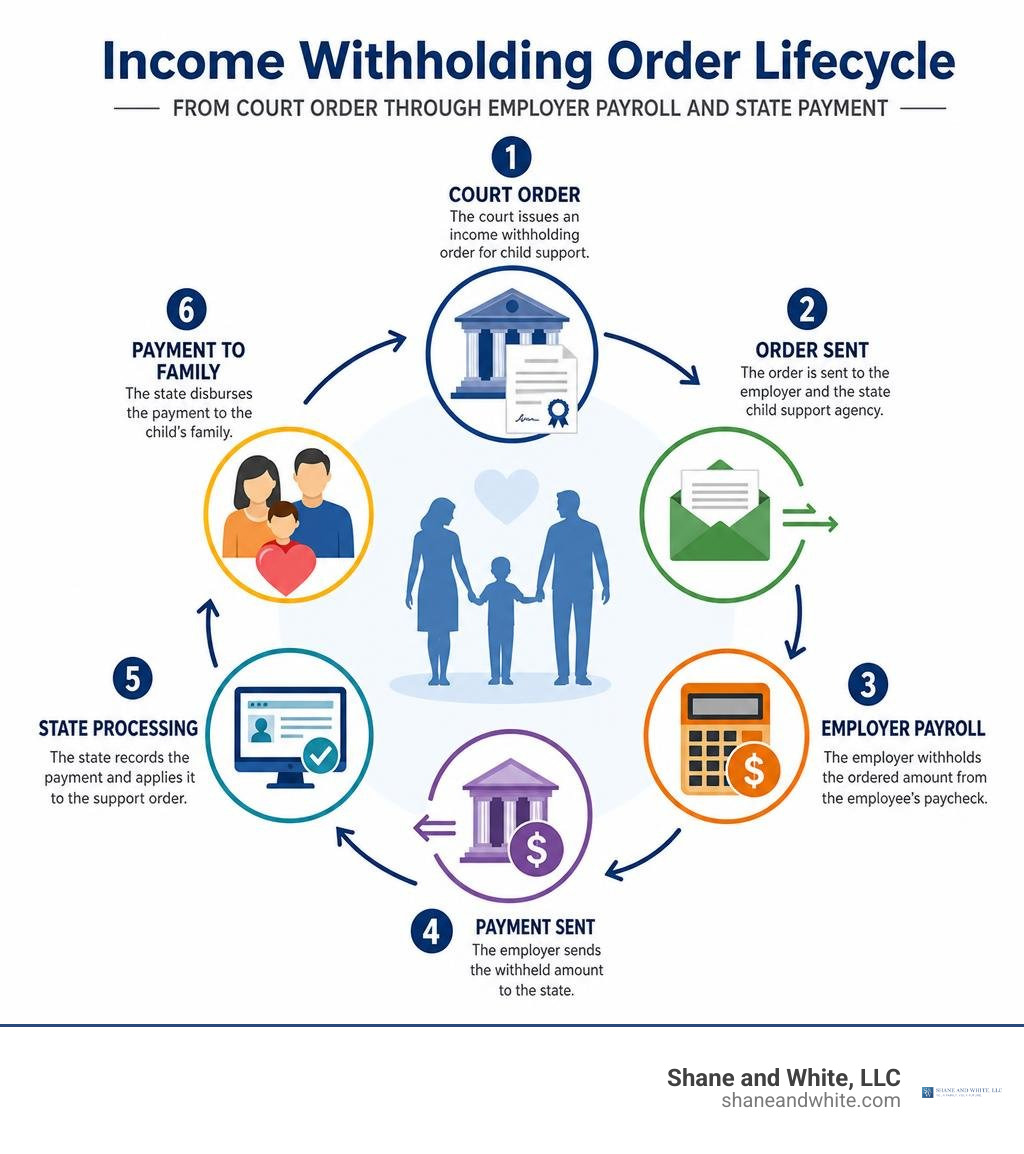
Wage garnishment for child support, often called income withholding, directs an employer to take court-ordered support from a parent’s paycheck and send it through the state payment system. It is usually automatic for new or changed support orders, not a punishment reserved only for missed payments.
If you receive a withholding notice, take these steps:
- Check your pay stubs to confirm the amount and start date.
- Keep making documented payments until payroll deductions actually begin.
- Act quickly if the amount is wrong or your income has dropped. A court modification, not simply stopping payments, is the proper way to seek relief.
About 80% of child support payments are made through wage withholding. The process can reduce missed payments and recordkeeping disputes, but it can also create real pressure when deductions begin before a parent has adjusted their budget. Federal law generally allows up to 50% to 65% of disposable earnings to be withheld for support, depending on other dependents and whether the parent is more than 12 weeks behind.
I am Kenneth White, Esq., a New Jersey Supreme Court Certified Matrimonial Law Attorney with decades of Family Court experience in Middlesex County and beyond. I help parents understand how wage garnishment child support issues fit into divorce, support, enforcement, and modification cases.
Must-know wage garnishment child support terms:
How Wage Garnishment for Child Support Works
When a judge enters a support order, state and federal laws mandate automated mechanisms to ensure payments are collected reliably. In modern family practice, wage withholding is not a punitive measure reserved solely for delinquent parents; rather, it serves as the standard administrative mechanism for nearly all ongoing obligations. When establishing child support in a divorce, the court issues a formal directive that integrates directly into your employer’s payroll operations.
The system relies on administrative coordination between the Family Part of the Chancery Division, employers, and centralized collection units. Under guidelines overseen by the Child Support Collections and Enforcement | NJ Courts system, payments deducted from an employee’s earnings are remitted directly to the State Disbursement Unit (SDU) rather than sent privately to the other parent. This centralized accounting creates an official audit trail, eliminating disputes regarding whether a payment was made on time or in full.
The Legal Framework and Standard Forms
Income withholding operates under the authority of Title IV-D of the federal Social Security Act (specifically 42 U.S.C. §§ 666(a)(1), (a)(8), and (b)(6)). To maintain nationwide uniformity across private employers, state agencies, and judicial bodies, all support withholdings must utilize the standardized, federally approved OMB Form 0970-0154, officially titled the Income Withholding for Support (IWO) order.
An IWO is comprehensive. It encompasses multiple distinct financial components beyond basic support, including:
- Basic Child Support: The primary recurring monthly or weekly obligation determined by statutory guidelines.
- Cash Medical Support: Fixed contributions toward health insurance premiums, dental coverage, or recurring medical costs.
- Child Care Obligations: Work-related daycare, after-school care, or educational supervision costs.
- Arrearage Collections: Structured payments toward past-due balances accrued prior to the order’s execution.
- Spousal Support (Alimony): Periodic alimony or unallocated maintenance obligations when combined within the child support order.
The Timeline: From Court Order to Payroll Deductions
Many parents mistakenly assume that once a judge signs an order, deductions will immediately appear on their next pay stub. In reality, administrative processing requires a structured timeline.

Upon entry of the support order, the court or enforcement agency serves the standardized IWO on the paying parent’s employer. By law, employers must begin withholding funds no later than the first pay period occurring 14 days after service of the order. Once the funds are withheld from the employee’s paycheck, the employer must remit those monies to the State Disbursement Unit within 7 business days of the actual pay date.
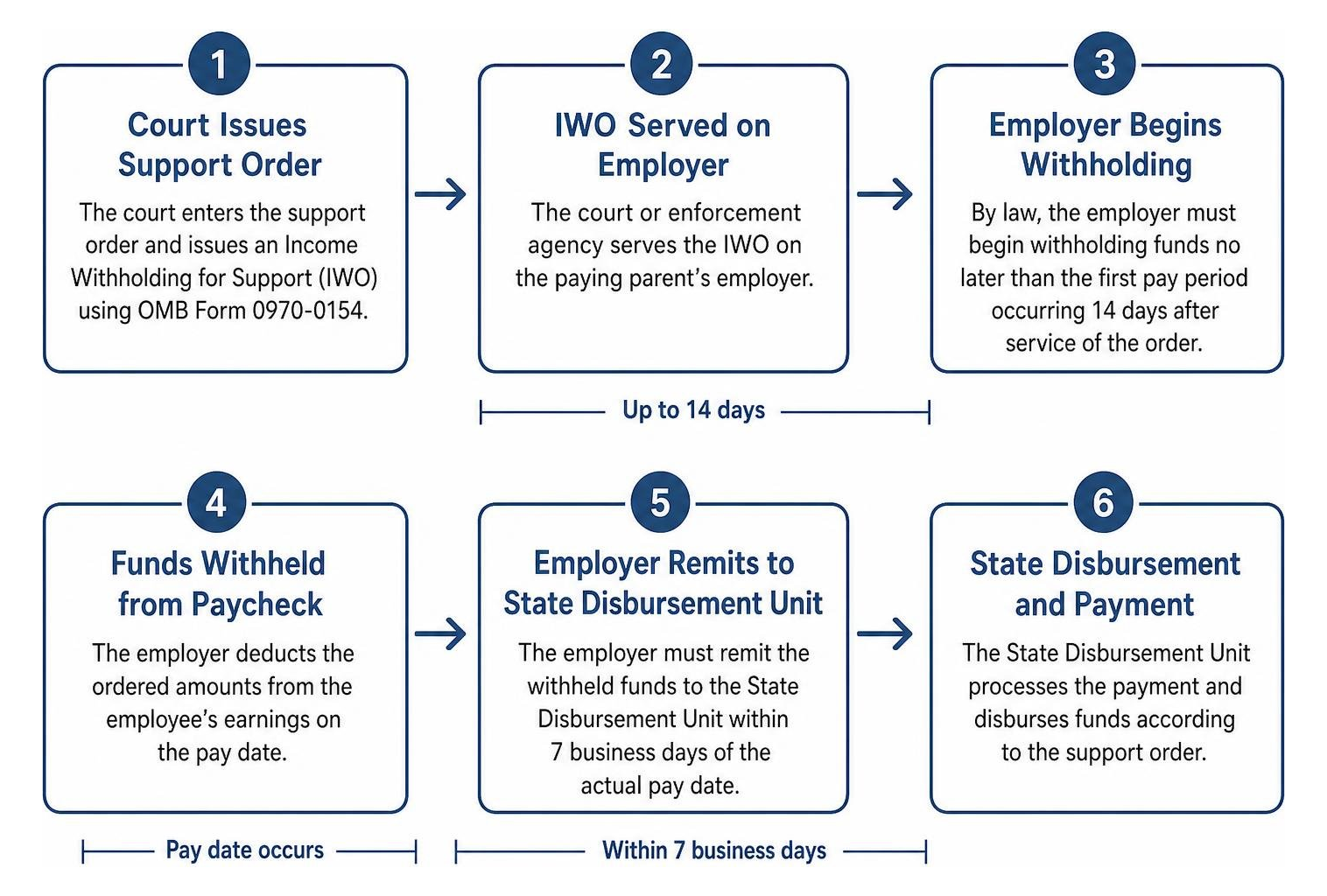
This multi-week onboarding period creates a critical legal duty for the paying parent. You remain personally responsible for making direct manual payments to the State Disbursement Unit until the employer successfully initiates payroll deductions. Assuming that payroll will handle retroactive gaps is one of the most common ways parents inadvertently fall into arrears during the first month of an active order.
Federal and State Limits on Wage Garnishment Child Support
While child support collections are aggressively enforced, the law does not permit the state or an employer to leave a paying parent without basic living funds. Federal protections established under the Consumer Credit Protection Act (CCPA), codified at 15 U.S.C. § 1673, place firm statutory caps on the maximum percentage of an individual’s earnings that can be garnished.
The Social Security Administration’s policy manual guidelines at SSA – POMS: GN 02410.215 – How Garnishment Withholding Is Calculated reflect these exact federal CCPA constraints, ensuring uniform calculation standards across public and private payroll systems.
Understanding the CCPA Percentage Tiers
Unlike commercial creditor garnishments—which are generally capped at 25% of disposable income—child support enforcement operates under significantly higher allowable thresholds. The CCPA establishes a four-tier framework that adjusts based on family responsibilities and payment history:
| Obligor Dependent Status | Arrears Less Than 12 Weeks | Arrears 12 Weeks or More |
|---|---|---|
| Supporting Another Spouse or Dependent Child | 50% Maximum | 55% Maximum |
| Single / Not Supporting Another Family | 60% Maximum | 65% Maximum |
Under this tiered framework:
- 50% Cap: Applies if the paying parent is currently supporting a second family (a spouse or dependent child other than those named in the support order) and is current on payments.
- 55% Cap: Applies to an obligor supporting another family who is 12 or more weeks in arrears.
- 60% Cap: Applies if the obligor is single with no other legal dependents and is current on payments.
- 65% Cap: The absolute legal ceiling, applied only when an obligor has no second family and has fallen 12 or more weeks behind in payments.
Calculating Disposable Earnings vs. Net Pay
A critical distinction that causes frequent confusion is the difference between net pay and disposable earnings. Statutory garnishment caps are calculated exclusively against disposable income, which is defined as gross earnings minus mandatory statutory deductions.
Mandatory deductions include:
- Federal income tax withholding
- State and local income taxes
- FICA contributions (Social Security and Medicare taxes)
- Mandatory/involuntary public pension contributions
Voluntary payroll deductions—such as elective 401(k) contributions, voluntary life insurance, charitable giving, and credit union loan payments—do not reduce disposable income for child support garnishment calculations. Consequently, garnishments are applied against a broader financial base than what you actually take home each week. Understanding these precise baseline calculations is essential, and knowing how a child support lawyer supports fathers rights and parents’ financial rights helps ensure withholding caps are strictly respected by payroll departments.
Types of Income Subject to Child Support Wage Withholding
Income withholding reaches far beyond traditional hourly wages and salaried paychecks. Under state and federal statutes, virtually all forms of periodic compensation and accumulated earnings are subject to child support garnishment.

Sources subject to withholding include:
- Traditional Earnings: W-2 salaries, overtime compensation, commissions, and tips.
- Incentive Pay: Discretionary and non-discretionary bonuses, performance incentives, and lump-sum profit-sharing payouts.
- Severance & Separation: Severance packages, accrued vacation payouts, and buyout compensations.
- State & Federal Benefits: Workers’ compensation disability checks and state unemployment benefits.
- Retirement & Pensions: Periodic distributions from private pensions, public employee retirement systems, and Title II Social Security retirement and disability benefits. (Note: Supplemental Security Income [SSI] and Medicare benefits are shielded).
- Independent Contractor Pay: Periodic compensation paid to 1099 contractors, subject to verified income execution.
Federal civil service workers and active-duty military personnel are fully subject to these enforcement mechanisms. Under 42 U.S. Code § 659 – Consent by United States to income withholding, garnishment, and similar proceedings for enforcement of child support and alimony obligations, the federal government waives sovereign immunity, requiring all military branches and federal agencies to process state child support and alimony withholding orders identically to private employers.
Priority of Child Support Over Other Garnishments
Child support wage garnishments hold a statutory “super-priority” status over virtually all other legal claims against an individual’s paycheck. When an employer receives multiple garnishment orders, child support deductions must be satisfied before any funds can be allocated toward:
- Consumer debts, personal loans, and credit card judgments
- Medical debt collections
- Private student loan garnishments
- Commercial bankruptcies or general civil judgments
The primary exception involves certain pre-existing federal tax levies served prior to the entry of the child support withholding order. When balancing family obligations alongside spousal maintenance, understanding alimony enforcement in New Jersey what you need to know and examining does alimony affect child support ensures that support calculations properly prioritize child welfare while maintaining statutory compliance across multi-obligation households.
Allocation Rules for Multiple Withholding Orders
When an employee is subject to multiple child support orders (for example, supporting children from two separate prior relationships) and their disposable earnings cannot cover the total ordered amounts within CCPA statutory limits, employers must follow specific state allocation rules:
- Current Support Takes Priority: Current child support obligations across all orders must be satisfied first before any money is applied toward past-due arrears.
- Prorated Allocation: If disposable income within CCPA caps cannot cover the full current support due on all orders, funds are allocated proportionally based on each order’s share of the total monthly obligation.
- Subordination of Spousal Support: When total funds are constrained, pure spousal support claims are subordinated until current child support duties are fulfilled.
Consequences of Non-Payment and Employer Non-Compliance
Falling behind on child support triggers an escalating array of automated administrative and judicial enforcement remedies. If you are experiencing difficulties with an ex-spouse who fails to meet their obligations, reviewing our guide on what to do if your ex stops paying child support outlines how the legal system intervenes to secure overdue support.
Unpaid child support balances accrue statutory interest and cannot be discharged in bankruptcy. Furthermore, employers who receive an IWO bear strict legal duties. An employer who knowingly ignores a valid withholding order or fails to remit deducted funds can be held directly liable for 100% of the underlying support debt, along with substantial per-day civil fines, court costs, and opposing counsel fees. Employers are also strictly prohibited by law from firing, demoting, or refusing to hire any individual due to the presence of an income withholding order.
When family obligations extend into young adulthood, such as navigating what occurs when your ex won’t pay college obligations, enforcement remedies remain available through the Family Part to ensure court-mandated educational contributions are met.
Administrative Remedies Beyond Wage Deduction
When wage garnishment alone is insufficient or payments fall into delinquency, automated administrative remedies activate:
- Tax Refund Intercepts: Federal and state income tax refunds are seized and applied directly toward outstanding arrears.
- Lottery and Jackpot Interception: State lottery winnings and casino payouts are automatically intercepted.
- Credit Bureau Reporting: Unpaid support balances are reported to major credit bureaus, impacting credit scores and loan approvals.
- License Suspensions: Accumulating substantial arrears triggers administrative suspension of driver’s licenses, commercial driver’s licenses (CDL), and state-issued professional or occupational credentials.
- Passport Denial: Under federal law, when past-due child support arrears exceed $2,500, the U.S. Department of State is notified to deny, revoke, or restrict passport applications and renewals.
- Bank Account Levies & Judicial Writs: Courts can issue writs of execution to freeze financial accounts, transferring liquid balances to satisfy arrears without granting standard debtor exemptions.
- Contempt Proceedings: Willful non-payment can lead to enforcement hearings resulting in community service or incarceration until an established purge amount is satisfied.
Modifying or Challenging a Wage Garnishment Child Support Order
A wage withholding order is tied to a baseline court judgment. An employer has no independent authority to lower your deductions simply because you tell payroll that your hours were cut. To alter the amount being withheld, you must seek formal relief through the Family Court.
If you are facing financial distress, our dedicated child support practice team can assist you in filing for a formal downward modification. Under New Jersey law (specifically the landmark standard established in Lepis v. Lepis), an obligor seeking to modify a support order must demonstrate a substantial, permanent, and involuntary change in circumstances.
Grounds for seeking support modification or challenging withholding include:
- Involuntary job loss or significant, non-temporary reduction in earning capacity
- Long-term medical disability or severe health crises preventing full-time employment
- A substantial increase in the custodial parent’s independent income
- Changes in parenting time arrangements where the child spends substantially more overnights with the paying parent
- Factual computation errors (a “mistake of fact”) regarding identity, incorrect income attribution, or inaccurate accounting of arrears
Crucially, courts cannot retroactively forgive child support arrears that accrued prior to the date you formally file a modification motion. Waiting months to request help while falling behind ensures that accumulated debt remains permanently enforceable.
Step-by-Step Process for Requesting a Court Modification
Securing a modified child support withholding order follows a structured legal pathway:
- Drafting and Filing a Formal Motion: A formal Notice of Motion for Downward Modification is filed with the Family Part of the Superior Court.
- Financial Disclosures (Case Information Statement): You must submit a fully documented, updated Case Information Statement (CIS), complete with recent pay stubs, W-2 forms, federal tax returns, and proof of job search efforts if unemployed.
- Opposing Party Response: The other parent is served and provided the statutory window to submit opposition papers or a cross-motion.
- Judicial Evaluation or Plenary Hearing: The judge reviews the financial submissions. If material facts regarding income or earning capacity are disputed, the court schedules an evidentiary plenary hearing.
- Entry of Amended IWO: If the court grants a modification, an amended Income Withholding Order is generated and served on the employer, officially adjusting future payroll deductions to the new lawful level.
Frequently Asked Questions About Wage Garnishment Child Support
What happens if my employer delays starting wage garnishment child support deductions?
If your employer experiences administrative delays in setting up payroll deductions, you remain legally obligated to make direct, documented payments to the State Disbursement Unit. Do not send cash directly to the other parent without clear written authorization or court approval, as informal payments risk being classified as non-support gifts rather than credited against your ledger. Always retain proof of payment and ensure your child support case identifier is written on all checks or electronic transfers.
Can my bank account be frozen if I already have a wage garnishment order?
Yes. Wage garnishment and bank levies are complementary, not mutually exclusive, enforcement mechanisms. If you carry accumulated child support arrears while maintaining regular payroll deductions for current support, the enforcement agency or opposing counsel can obtain a writ of execution to freeze and levy bank accounts to satisfy the overdue balance. Child support obligors do not receive standard civil debtor protections against bank account attachment for valid arrears.
How do I stop wage withholding once my child reaches emancipation age?
In New Jersey, child support does not necessarily terminate on a child’s 18th birthday if the child remains a full-time student or is disabled. However, under state statute, child support obligations generally terminate by operation of law when a child reaches 19 years of age, unless a specific court order or financial circumstance establishes an exception.
The state provides formal notice of proposed child support obligation termination prior to the termination date. Once an official order or administrative certificate of termination is issued, the state or the obligor must provide the updated directive to the employer’s payroll department to immediately cease ongoing wage deductions.
Conclusion
Navigating the rules surrounding income withholding requires balancing statutory obligations with your own long-term financial stability. Whether you are establishing an initial support framework, ensuring that withholding calculations accurately adhere to federal CCPA caps, or seeking an urgent downward modification due to unforeseen career changes, experienced legal counsel is essential.
At Shane and White, LLC, we bring over 40 years of combined family law experience to every case. Based in Edison, New Jersey, we provide clear communication and personalized representation to clients throughout Middlesex County, Mercer County, and surrounding communities. If you are dealing with complex support issues, explore our comprehensive Mercer County divorce lawyer representation to learn how our dedicated family law team can protect your income and help you maintain financial security.