Introduction
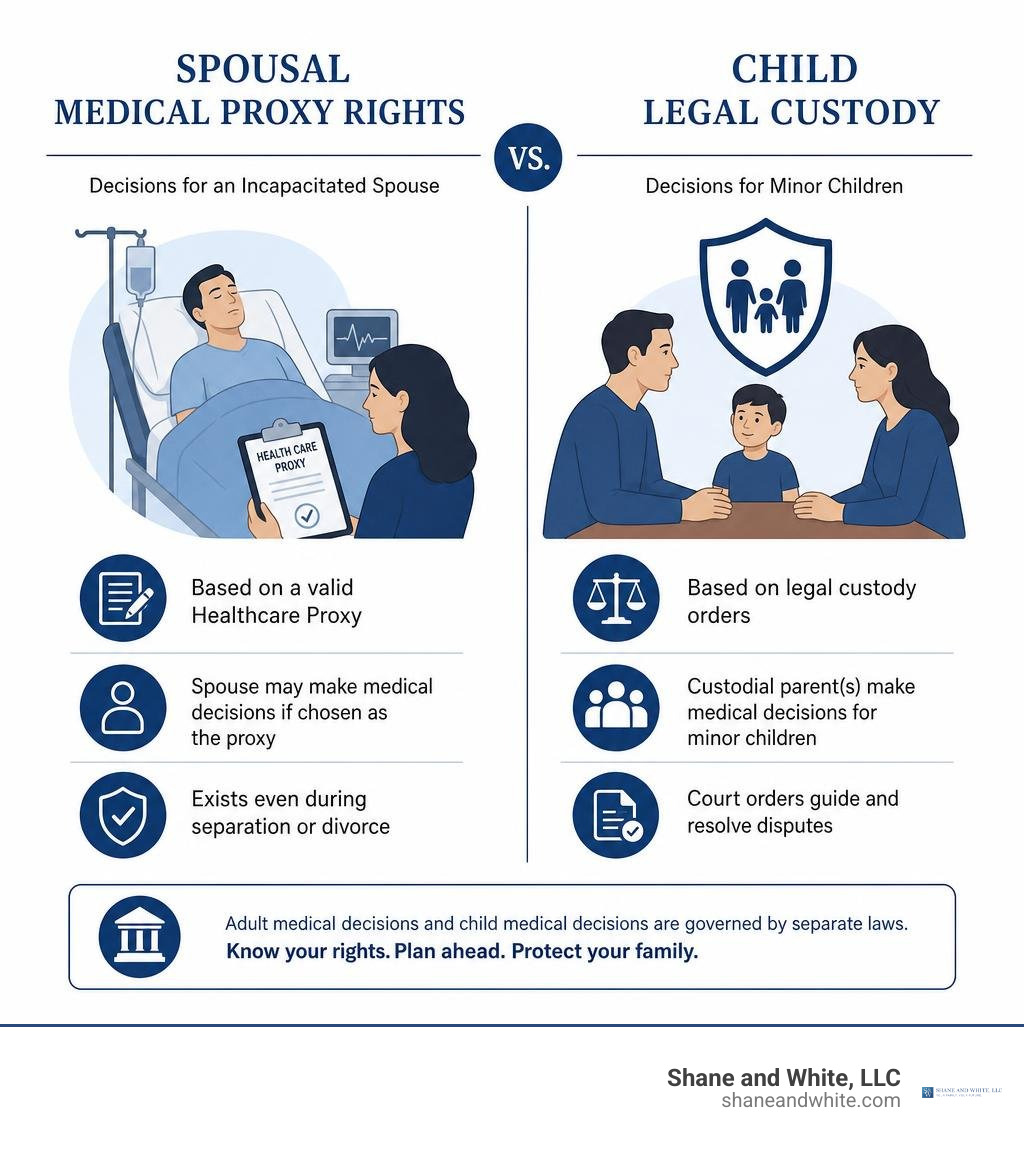
When navigating divorce and medical decisions in NJ, legal authority depends on whether the choices involve an estranged spouse or minor children. In New Jersey, an existing spousal healthcare proxy remains legally valid throughout a pending divorce until a court enters a final judgment of divorce, unless the principal formally revokes it. For minor children, parents who share joint legal custody maintain equal decision-making authority and must mutually agree on all major, non-emergency healthcare treatments. Understanding these statutory boundaries ensures critical medical choices remain focused on proper care rather than courtroom conflict.
Legal Framework for Divorce and Medical Decisions NJ
The statutory laws governing healthcare choices in New Jersey operate on distinct tracks depending on whether the decisions involve adults or minor children. For adults, the New Jersey Advance Directives for Health Care Act (N.J.S.A. 26:2H-53 et seq.) grants individuals the legal right to execute healthcare proxies and living wills, appointing a designated representative to manage their medical care if they become incapacitated.
When parties navigate The Ultimate Guide to New Jersey Divorce Laws and Process, estate planning documents and default medical authorities often get overlooked until an unexpected emergency arises.
| Situation | Status of Spousal Medical Authority | Status of Child Medical Decision-Making |
|---|---|---|
| Prior to Divorce Filing | Spouse holds primary proxy or default next-of-kin status. | Both parents share equal decision-making authority. |
| Pending Divorce (Active Case) | Existing proxies remain valid; hospital default hierarchy still prioritizes spouse unless formally contested or revoked. | Joint legal custody rules apply; parents must agree on major, non-emergency treatments. |
| Post-Judgment of Divorce | Spousal proxy is automatically revoked by law under N.J.S.A. 26:2H-57(c). | Controlled by the Marital Settlement Agreement or final custody judgment. |
Automatic Revocation Under N.J.S.A. 26:2H-57(c)
Under N.J.S.A. 26:2H-57(c), the designation of a spouse as a healthcare representative is automatically revoked upon the entry of a final judgment of divorce or legal separation. However, many people operate under the misconception that merely filing a complaint for divorce strips an estranged partner of their decision-making power.
Addressing Legal Separation Myths and Facts is essential here. In New Jersey, an ongoing divorce action or physical separation does not automatically terminate an existing proxy directive. Until the court enters a final judgment dissolving the marriage, any executed healthcare proxy designating a spouse remains legally valid unless the principal formally revokes or amends the document while possessing the requisite mental capacity.
How Pending Divorce and Medical Decisions NJ Affect Incapacitated Spouses
When an individual becomes incapacitated during active litigation without an advance directive, healthcare providers face a difficult scenario. In New Jersey, there is no rigid, codifying statutory surrogate law dictating an unyielding hierarchy. Instead, medical facilities follow common hospital protocols prioritizing the legal spouse as next-of-kin, followed by adult children and parents.
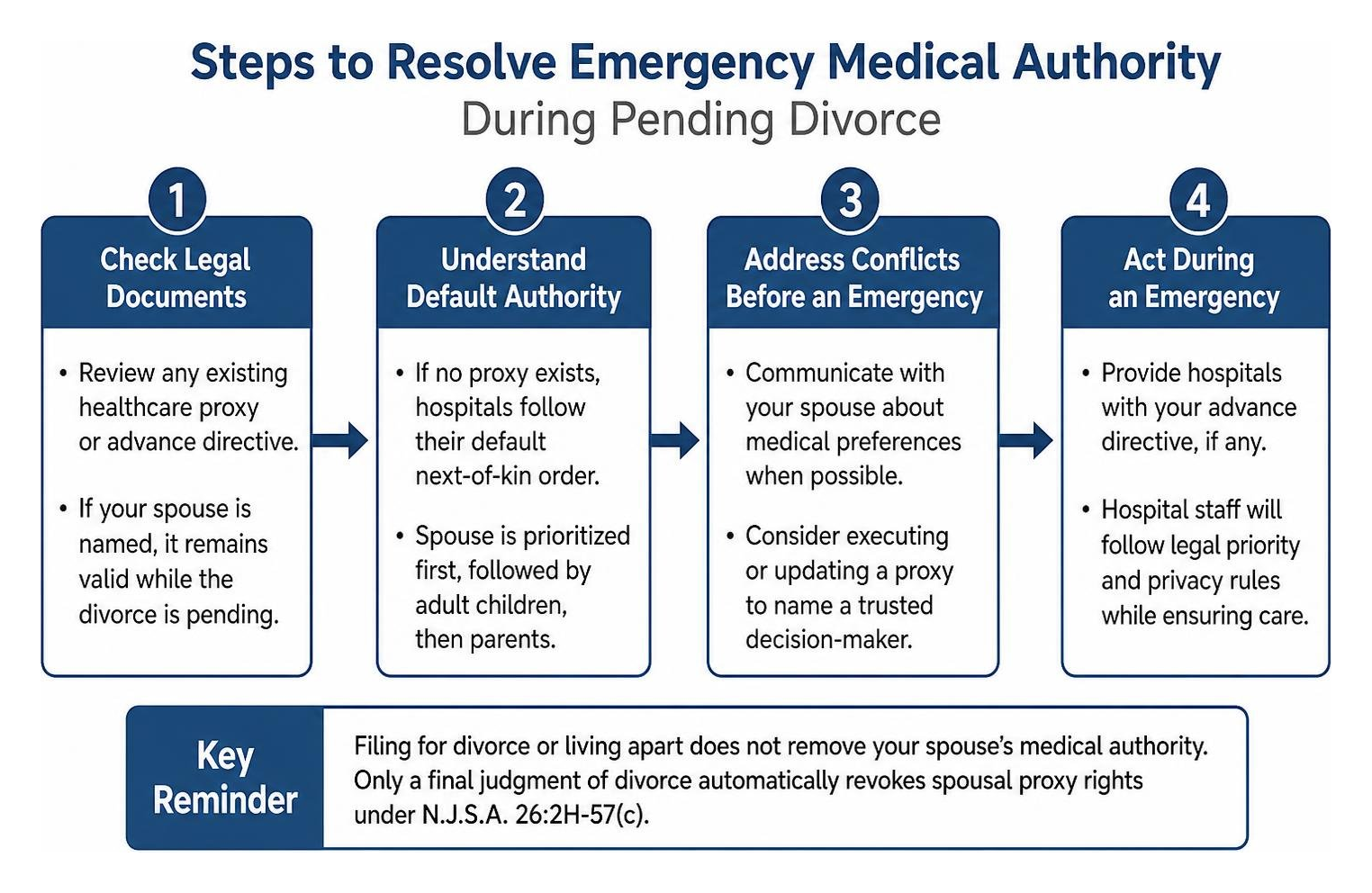
This default hierarchy can create severe conflicts if spouses are actively adverse in court. Hospital administration must balance emergency consent needs with HIPAA privacy regulations, and resources such as the New Jersey Courts Divorce Self-Help center help litigants understand procedural rights during active family part litigation.
Making Healthcare Choices for Minor Children During and After Divorce

Healthcare authority regarding minor children introduces an entirely separate set of statutory rules. The court’s primary focus is always the physical and emotional well-being of the child, requiring parents to adhere strictly to judicial standards and orders.
Joint Legal Custody and Medical Deadlocks Under N.J.S.A. 9:2-4
Under N.J.S.A. 9:2-4, New Jersey public policy favors shared parental responsibility. When parents share joint legal custody, both retain equal decision-making authority over major medical, educational, and religious decisions. Understanding What Are the Different Types of Custody and How Do They Work? is critical for preventing unilateral actions.
While day-to-day decisions (like treating a minor scraped knee or giving over-the-counter allergy medicine) rest with the parent exercising physical custody at that moment, non-emergency major treatments—such as elective surgeries, starting orthodontic care, initiating psychiatric therapy, or administering non-routine medications—require joint consultation and mutual agreement. When parents reach a total impasse, neither parent has the legal right to unilaterally override the other without court authorization through our dedicated Practice: Child Custody & Visitation processes.
Resolving Custody Disputes: Divorce and Medical Decisions NJ for Children
When a medical dispute escalates, such as debates examined in To Vaccinate Your Children or Not: That Is Part of the Question, the Superior Court of New Jersey Family Part must intervene.
A prominent example of this judicial authority is found in the A.A. v. L.A. Appellate Decision. In that case, divorced parents with joint legal custody deadlocked over whether their children should receive mandatory school immunizations. The trial court conducted a multi-day plenary hearing, evaluated pediatric testimony alongside a Guardian ad Litem (GAL) recommendation, and issued a limited modification of legal custody. Rather than stripping the opposing parent of all custody rights, the court established a specific carve-out granting one parent exclusive decision-making authority solely regarding the contested vaccines.
The Appellate Division affirmed that Family Part judges possess broad equitable authority to allocate specific medical rights to one parent when deadlock threatens a child’s health or educational continuity, always grounded in the statutory best-interest factors.
Managing Spousal Healthcare Crises and Relinquishing Decision-Making Authority

Being placed in the position of making life-or-death choices for an estranged partner while in the middle of a contested divorce is an uncomfortable, high-liability situation. An estranged spouse may fear accusations of bad faith, financial self-interest, or emotional bias from the partner’s extended family.
Filing Motions for Expedited Divorce Hearings
If you are estranged or in active litigation and your spouse suffers a severe health crisis, you can seek judicial relief to clarify or terminate your authority. Knowing When You Need the Judge to Decide an Issue: File a Motion allows you to petition the Family Part for an expedited hearing or entry of a final judgment if all economic and marital issues have been resolved.
Courts recognize significant medical crises and genuine discomfort with surrogate decision-making as good cause to expedite proceedings, especially if prolonged separation has already severed the emotional and practical marital bond.
Appointing Alternate Proxies and Guardianship in Probate Court
If the incapacitated spouse cannot sign a new Medical Power of Attorney (MPOA) or advance directive due to cognitive impairment, medical decision-making authority cannot simply be reassigned informally.
When immediate family members (such as parents or adult siblings) wish to assume decision-making responsibilities, they must file a formal complaint for guardianship in the Superior Court of New Jersey, Chancery Division, Probate Part, within the county of the incapacitated person’s residence (such as Middlesex County). In the interim, providing formal written notification to hospital administration and hospital ethics committees documenting your declination to act as surrogate allows medical providers to look to secondary family members or hospital protocols safely.
Frequently Asked Questions About Healthcare Authority in New Jersey Divorce
Does filing for divorce automatically revoke my spouse’s healthcare proxy in New Jersey?
No. Under N.J.S.A. 26:2H-57(c), automatic revocation occurs only upon the entry of a final judgment of divorce or a decree of legal separation. During the pendency of a divorce proceeding, an existing proxy remains legally operative unless the person who created it executes a formal written revocation or executes a new advance directive while mentally competent.
Can a county health department medical exemption override a family court custody order?
No. An administrative medical exemption granted by a local school board or county health department does not supersede a New Jersey Family Part judge’s custody order. In contested custody litigation, the court exercises independent jurisdiction to determine what healthcare choices serve the child’s best interests under N.J.S.A. 9:2-4, regardless of administrative certificates.
How do I remove myself from making medical choices for an estranged spouse?
To formally relinquish authority:
- Submit a formal, written statement to the hospital risk management department and treating physicians stating you decline to serve as a medical surrogate.
- Encourage the patient’s parents or adult children to petition the Chancery Division, Probate Part for legal guardianship.
- Request emergency case management relief or a status conference from your Family Part judge to address pending matrimonial ties.
Protecting Your Family’s Healthcare Rights in New Jersey
Whether you are navigating high-conflict disagreements regarding childhood medical care or need to untangle healthcare proxy designations during a separation, proactive legal planning is essential. Clearly drafted marital agreements, updated advance directives, and timely court intervention eliminate ambiguity during life’s most challenging moments.
At Shane and White, LLC, we bring more than 40 years of combined legal experience to individuals and families throughout Edison, Metuchen, Woodbridge, East Brunswick, New Brunswick, North Brunswick, Monroe, Piscataway, Sayreville, and surrounding Middlesex County communities. We offer personalized attention, deep courtroom knowledge, and clear communication to protect what matters most.
If you are facing a family transition and want to understand your legal rights, learn what are the requirements to file for divorce in New Jersey and contact our experienced team today for dedicated guidance.