
What a Mercer County Divorce Lawyer Does — and How to Find the Right One
Finding a Mercer County divorce lawyer you can trust is one of the most important decisions you’ll make during one of life’s hardest moments. Divorce touches everything — your home, your finances, your children, and your future.
Here’s a quick overview of what to know right away:
| Question | Quick Answer |
|---|---|
| Where are cases filed in Mercer County, NJ? | Superior Court, Family Part — 175 South Broad Street, Trenton |
| How long does divorce take? | A few months (uncontested) to over a year (contested) |
| What does a divorce lawyer handle? | Custody, child support, alimony, property division, and more |
| What does it cost to file? | Approximately $300 filing fee, plus attorney fees |
| Is mediation an option? | Yes — and it can cut costs by 40–60% |
Divorce in New Jersey isn’t just paperwork. It involves equitable distribution of assets, child custody decisions, support calculations, and court appearances — all governed by specific rules that vary by county.
Mercer County has its own set of judges, local procedures, and a unique mix of residents — from Princeton University families to state government employees — that make each case genuinely different.
I’m Kenneth White, Esq., a New Jersey Supreme Court Certified Matrimonial Law Attorney at Shane and White, LLC, with decades of experience serving as a Mercer County divorce lawyer and as an Early Settlement Panelist, Guardian Ad Litem, and Mediator appointed by the Family Court. Read on for everything you need to navigate your Mercer County divorce with clarity and confidence.
How a mercer County divorce lawyer Guides You Through the Legal Process
When you decide to file for divorce in Central New Jersey, the path ahead can feel like navigating an intricate maze. Having an experienced mercer County divorce lawyer by your side ensures that you do not take a wrong turn.
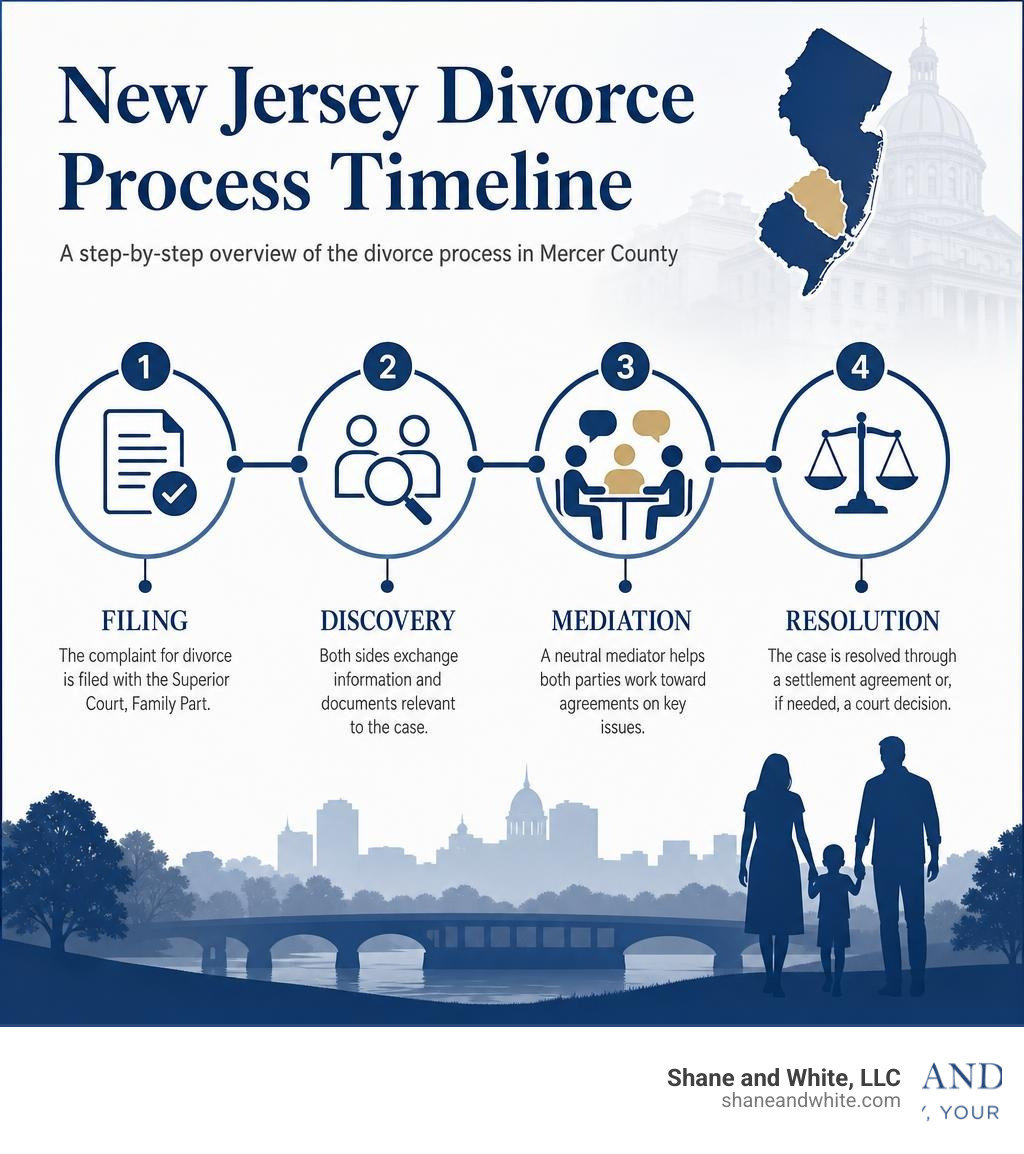
The divorce process formally begins with filing a Complaint for Divorce. In Mercer County, this complaint is filed with the Superior Court, Family Part, located at 175 South Broad Street in Trenton. This historic courthouse is where all family law matters in the county are centralized.
Currently, in July 2026, the Family Part is presided over by Judge Rodney Thompson, alongside a dedicated bench of family law judges. Navigating this court system requires a strategic approach, which generally follows these key phases:
- Filing and Service: We draft and file your complaint, which must then be formally served to your spouse.
- The Response: Your spouse has a set timeframe to file an answer or a counterclaim.
- Financial Discovery: Both parties must exchange complete financial disclosures, including tax returns, bank statements, and valuations of complex assets like pensions or real estate.
- The Early Settlement Panel (ESP): If your case does not settle during discovery, you will present your financial disputes to a panel of neutral, experienced local family law attorneys who recommend a fair compromise.
- Final Resolution: If agreement is reached, we draft a Property Settlement Agreement. If not, the case proceeds toward a trial.
For a comprehensive step-by-step breakdown of what to expect during these stages, you can read The Divorce Process Guide. Understanding these phases beforehand helps demystify the court experience and reduces the anxiety associated with litigation. To ensure you meet all foundational requirements, check out our guide on What Are the Requirements to File for Divorce in New Jersey?.
Filing Requirements and Timelines in New Jersey
To file for divorce in New Jersey, you or your spouse must have been a resident of the state for at least one consecutive year prior to filing (unless the ground for divorce is adultery, which has no residency waiting period).
Most couples in Mercer County file for a “no-fault” divorce. This is typically based on:
- Irreconcilable differences that have existed for at least six months, with no reasonable prospect of reconciliation.
- Separation of at least 18 consecutive months, where the parties live in separate residences.
Once the Complaint for Divorce is filed and served, the defendant has exactly 35 days to respond. If they fail to do so, the court may enter a default judgment.
Naturally, one of the first questions clients ask us is, “How long will this take?” The timeline varies dramatically based on whether your divorce is contested or uncontested. Uncontested divorces can be finalized in just a few months, while complex, contested cases involving high-value assets can take a year or more. You can learn more about these timelines in our article, How Long Does It Take to Get Divorced in New Jersey?.
The Role of Mediation and Settlement Conferences
We always advise our clients that court trials should be a last resort. Litigating a divorce in front of a judge is not only emotionally draining, but it is also highly expensive. Fortunately, New Jersey courts heavily emphasize alternative dispute resolution methods like mediation and settlement conferences.
Mediation is a voluntary, confidential process where a neutral third-party mediator helps both spouses negotiate mutually acceptable terms. It allows you to maintain control over the outcome rather than leaving life-altering decisions to a judge who does not know your family.
If mediation is unsuccessful, the court mandates participation in the Early Settlement Panel (ESP). This panel evaluates the financial aspects of your case and provides a non-binding recommendation. For many couples, the ESP serves as the reality check needed to reach a settlement and avoid a costly trial. Exploring these options is a core part of our family law Practice Areas, designed to protect your assets and preserve your peace of mind.

Key Differences: Mercer County, NJ vs. Mercer County, PA Divorce Procedures
It is common for people to confuse the legal procedures of Mercer County, New Jersey, with those of Mercer County, Pennsylvania, given their geographic proximity across the Delaware River. However, their court systems, filing processes, and administrative structures are entirely different.
If your divorce belongs in Pennsylvania, you must navigate a system managed by the Prothonotary office and heavily reliant on a Family Law Master. If your case belongs in New Jersey, it is handled directly within the Superior Court system.
Here is a quick comparison of the procedural differences:
| Procedural Aspect | Mercer County, New Jersey (NJ) | Mercer County, Pennsylvania (PA) |
|---|---|---|
| Filing Office | Superior Court, Family Part (Trenton) | Prothonotary Office (Mercer, PA) |
| Initial Review | Handled by Family Judges & Early Settlement Panels | Handled by a Court-Appointed Family Law Master |
| Property Division | Equitable Distribution via Judicial Review/Settlement | Equitable Distribution via Master’s Hearing & Recommendations |
| Support Disputes | Handled via NJ Child Support Guidelines & Family Court | Two-tiered system starting with a Domestic Relations Officer |
If you need specific information on the Pennsylvania court system, you can consult the Family Law resources provided by Mercer County, PA.
Pennsylvania’s Divorce Master System
In Mercer County, PA, when spouses cannot agree on how to divide their property or debts, the court does not immediately schedule a trial before a judge. Instead, a party must file a Motion for Appointment of a Master.
A Divorce Master is an experienced family law attorney appointed by the court to act as a quasi-judicial officer. The process involves:
- Pre-hearing Conference: The Master meets with both attorneys to narrow down the disputed issues.
- Master’s Hearing: If no settlement is reached, the Master conducts an evidentiary hearing, listens to testimony, and reviews financial documents.
- Master’s Report: The Master issues formal recommendations to the Judge regarding equitable distribution and alimony.
- Exceptions: If either spouse disagrees with the Master’s report, they must file formal “exceptions” within a strict timeframe to have a Common Pleas Judge review the case.
This system is governed strictly by the PA Rules of Civil Procedure and is designed to keep divorce cases out of the main courtroom unless absolutely necessary.
New Jersey’s Judicial Resolution Process
In contrast, New Jersey does not utilize a Divorce Master system. In Mercer County, NJ, your case is assigned directly to a Superior Court Judge in the Family Part from day one.
While New Jersey also uses neutral attorneys to help resolve disputes — specifically through the Early Settlement Panel (ESP) — these panels are advisory and do not hold formal evidentiary hearings or issue binding recommendations to the judge. If the ESP and subsequent custody mediation fail, your case goes directly to a trial before your assigned Superior Court judge.
This means that having a mercer County divorce lawyer who is intimately familiar with the local judges, court staff, and county-specific scheduling rules is critical to keeping your case moving forward efficiently.
Resolving Custody, Support, and Property Division
The core of any divorce case lies in resolving three critical areas: who gets the kids, how the finances are divided, and how both parties will support themselves moving forward.

Child Custody and Support Guidelines
In New Jersey, custody decisions are guided strictly by the “best interests of the child.” The court evaluates several statutory factors, including:
- The parents’ ability to agree, communicate, and cooperate on parenting matters.
- The interaction and relationship of the child with their parents and siblings.
- The stability of the home environment.
- Any history of domestic violence.
New Jersey recognizes two types of custody: legal custody (the right to make major decisions about education, health, and welfare) and physical custody (where the child physically resides). The trend in Mercer County is to award joint legal custody, ensuring both parents remain actively involved in major life decisions.
Child support is calculated using the New Jersey Child Support Guidelines, which utilize a shared-income model. This formula factors in both parents’ net incomes, the number of overnight visits the child spends with each parent, health insurance premiums, and work-related childcare costs.
Crucially, New Jersey child support laws are unique because support does not automatically end at age 18. Parents are often required to contribute to college education costs, and child support can extend through college graduation or until the child is emancipated.
Equitable Distribution and Alimony Rules
New Jersey is an “equitable distribution” state. This does not mean marital property is split 50/50; rather, it means assets and debts acquired during the marriage are divided fairly based on a variety of factors. Separate property — such as assets owned before the marriage or inherited during it — is generally exempt, provided it was not commingled.
In Mercer County, asset valuation can become highly complex. Given the local demographics, divorces often involve:
- State Pensions: Valuing and dividing pensions for the thousands of state government employees residing in Trenton and Hamilton.
- Academic Tenure & Benefits: Addressing unique compensation structures for Princeton University faculty and researchers.
- Corporate Executive Compensation: Valuing stock options, deferred compensation, and restricted stock units (RSUs) for pharmaceutical and biotech executives.
Alimony is also a major consideration and is not automatic. The court evaluates the length of the marriage, the standard of living established during the marriage, and each party’s earning capacity. The primary types of alimony in New Jersey include:
- Open Durational Alimony: Typically reserved for marriages lasting 20 years or more.
- Limited Duration Alimony: Awarded for a specific timeframe, usually for mid-length marriages.
- Rehabilitative Alimony: Designed to support a spouse while they obtain education or training to re-enter the workforce.
- Reimbursement Alimony: Awarded when one spouse supported the other through professional school or career advancement.
How to Choose and Compare Top-Rated Attorneys
Choosing the right advocate is the single most important variable in your divorce. You need an attorney who combines deep legal knowledge with a compassionate, communicative approach.
For a detailed guide on what to look for during your search, read our article on How To Choose Your Family Law Attorney.
Evaluating a mercer County divorce lawyer for Your Case
When searching for representation, it is helpful to look at reputable legal directories. For instance, Justia lists approximately 35 top-rated divorce attorneys serving Mercer County. You can explore these listings directly at Best Divorce Lawyers in Mercer County, NJ to compare attorney profiles, peer ratings, and client reviews.
When evaluating a mercer County divorce lawyer, consider the following criteria:
- Experience: Have they handled cases with assets and family dynamics similar to yours?
- Local Focus: Do they regularly appear in the Mercer County court system?
- Communication: Do they offer clear, straightforward answers, or do they hide behind legal jargon?
- Accessibility: Do they offer modern conveniences, such as video conferencing options, to accommodate your busy schedule?
The Benefits of Hiring a Local mercer County divorce lawyer
There is an old saying in the legal profession: “A good lawyer knows the law; a great lawyer knows the judge.” While the law is written on paper, how it is applied often depends on the specific judge presiding over your case.
A local mercer County divorce lawyer who regularly appears before the local bench — including Hon. Supti Bhattacharya, Hon. Jodi F. Bouer, and Hon. Christopher A. Edwards — understands each judge’s unique expectations, preferred presentation styles, and past rulings on similar issues. This local familiarity prevents procedural delays and helps shape a legal strategy tailored to the specific court handling your case.
Additionally, local attorneys maintain strong professional relationships with local mediators, forensic accountants, and custody evaluators, ensuring you have a highly qualified team supporting you. This collaborative network helps streamline the process, whether you are pursuing mediation or preparing for a trial.
Frequently Asked Questions About Mercer County Divorces
Navigating a divorce naturally brings up many questions. Below are some of the most common concerns we hear from clients in Mercer County.
How long does a divorce take in Mercer County?
The duration of a divorce depends heavily on the level of conflict between you and your spouse:
- Uncontested Divorces: If you and your spouse agree on all terms (custody, support, asset division) before filing, the process can be finalized in 2 to 4 months.
- Contested Divorces: If there are disputes that require discovery, mediation, and court appearances, a contested divorce typically takes 8 to 14 months.
- Court Backlog: That judicial vacancies and court backlogs in New Jersey can occasionally cause administrative delays, making out-of-court settlements even more attractive.
How is property divided in a New Jersey divorce?
Property is divided under the principle of equitable distribution. This means the court divides marital assets and debts in a way that is fair, but not necessarily equal. The court considers:
- The length of the marriage.
- The age and physical/emotional health of both parties.
- The income and earning capacity of each spouse.
- The contribution of each spouse to the acquisition, preservation, or appreciation of the marital property.
It is highly recommended to work with an attorney to draft a comprehensive settlement agreement rather than letting a judge make these decisions.
What other family law services are available in Mercer County?
Divorce lawyers handle far more than just the dissolution of marriage. Family law is broad and covers several vital areas of domestic relations, including:
- Domestic Violence & Protective Orders: Assisting victims of abuse in obtaining Temporary and Final Restraining Orders (TRO/FRO) to ensure their safety.
- Adoption: Helping stepparents, relatives, and adoptive parents navigate the legal process to expand their families.
- Guardianship: Securing legal authority to care for minors or incapacitated adults who cannot make decisions for themselves.
Conclusion
At Shane and White, LLC, we understand that going through a divorce is one of the most challenging experiences of your life. With over 40 years of experience, our firm is committed to providing personalized attention and clear communication to guide you through every step of the legal process.
While we are based in Edison, New Jersey, we proudly serve clients across Central New Jersey, including East Windsor, Middlesex County, and Mercer County. Whether you need a Middlesex County Divorce Lawyer or representation in East Brunswick, Piscataway, or Monroe, our team is ready to stand by your side.
If you are facing a family law transition and need a dedicated mercer County divorce lawyer, contact us today to schedule a consultation. Let us help you protect what matters most and build a secure foundation for your future. Visit our Divorce Practice Page to learn more about how we can help you.