
When a Restraining Order Changes Everything: What You Need to Know
A New Jersey restraining order attorney can make a critical difference in protecting your rights — whether you are seeking protection from abuse or defending yourself against an order that could permanently alter your life.
Here is what a New Jersey restraining order attorney can do for you:
- Explain your rights under the Prevention of Domestic Violence Act (N.J.S.A. 2C:25)
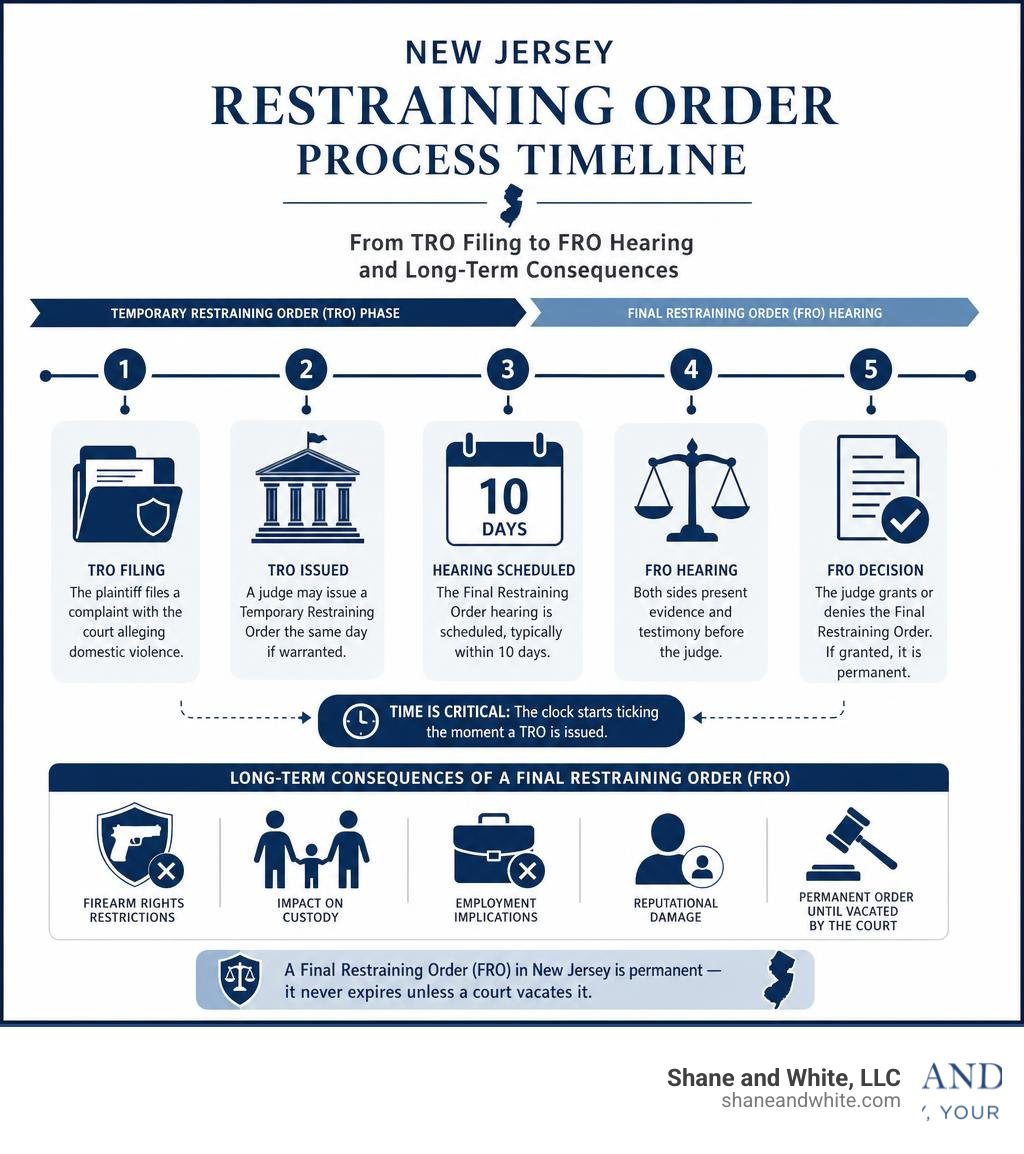
- Represent you at the Final Restraining Order hearing, which is typically scheduled within 10 days of a Temporary Restraining Order being issued
- Challenge evidence and cross-examine witnesses on your behalf
- Negotiate civil restraints as an alternative to a full hearing
- File motions to vacate or appeal an existing Final Restraining Order
- Help you avoid violations that could result in criminal contempt charges — up to 18 months in prison under N.J.S.A. 2C:29-9
New Jersey courts handle approximately 30,000–35,000 domestic violence restraining order filings every year. The stakes are high on both sides. A Final Restraining Order (FRO) in New Jersey is permanent — it never expires unless a court vacates it. It can affect your firearm rights, your custody arrangements, your employment, and your reputation.
Whether you are the one seeking protection or the one being accused, the 10-day window between a Temporary Restraining Order and a final hearing moves fast. There is very little time to prepare, and the decisions made in that window matter enormously.
I’m Kenneth White, Esq., a Supreme Court of New Jersey Certified Matrimonial Law Attorney with decades of family court experience — including domestic violence and New Jersey restraining order matters — serving clients throughout Middlesex County and beyond. At Shane and White, LLC, I bring both the legal knowledge and the personal attention that complex, emotionally charged situations like these demand.
Understanding New Jersey Restraining Orders: TRO vs. FRO
To navigate the family court system in Middlesex County or Mercer County, you must first understand that New Jersey divides restraining orders into two distinct phases: the Temporary Restraining Order (TRO) and the Final Restraining Order (FRO).
While both are civil orders handled in the Family Division of the Superior Court, they have vastly different legal standards, durations, and consequences.
| Feature | Temporary Restraining Order (TRO) | Final Restraining Order (FRO) |
|---|---|---|
| Duration | Temporary (typically lasts about 10 days until the final hearing) | Permanent (lasts forever unless formally vacated by a judge) |
| How It Is Obtained | Ex-parte (only the plaintiff speaks to the judge or domestic violence officer) | Full trial (both parties present evidence, testify, and cross-examine) |
| Standard of Proof | Good cause / immediate danger | Preponderance of the evidence (more likely than not) |
| Presence of Defendant | Not required for the initial order to be issued | Required (or must be properly served) for a trial to proceed |
| Consequences | Temporary stay-away, weapon surrender, temporary custody | Permanent registry, fingerprinting, permanent weapon ban, custody overhaul |
The legal framework governing these actions is the Prevention of Domestic Violence Act (PDVA) of 1990. Under this act, the court aims to protect victims of domestic abuse while maintaining due process.
To learn more about how these two mechanisms operate in tandem, read our guide on Temporary and Final Restraining Orders in New Jersey.
If you are seeking to understand the initial petition process, you can find official guidance through the New Jersey Courts domestic violence self-help center or by consulting with an experienced attorney.
Who Qualifies for Protection Under the PDVA?
Not every dispute or act of violence falls under the jurisdiction of the Prevention of Domestic Violence Act. To qualify for a domestic violence restraining order in New Jersey, there must be a specific relationship between the plaintiff (the person seeking protection) and the defendant (the accused).
Under the PDVA, the covered relationships include:
- Spouses or former spouses
- Current or former household members (such as roommates or live-in partners)
- Individuals who share a child in common (or are expecting a child together)
- Individuals who have had a dating relationship
Additionally, the victim must be at least 18 years of age or an emancipated minor. If there is no qualifying relationship under the PDVA, a traditional domestic violence restraining order is not the correct legal path. However, other protective measures, such as those under the Sexual Assault Survivor Protection Act (SASPA) or criminal no-contact orders, may apply.
Immediate Consequences of Being Served with a TRO
If you are served with a TRO, the consequences are immediate and severe. Do not make the mistake of thinking this is “just a civil matter” that you can handle later.
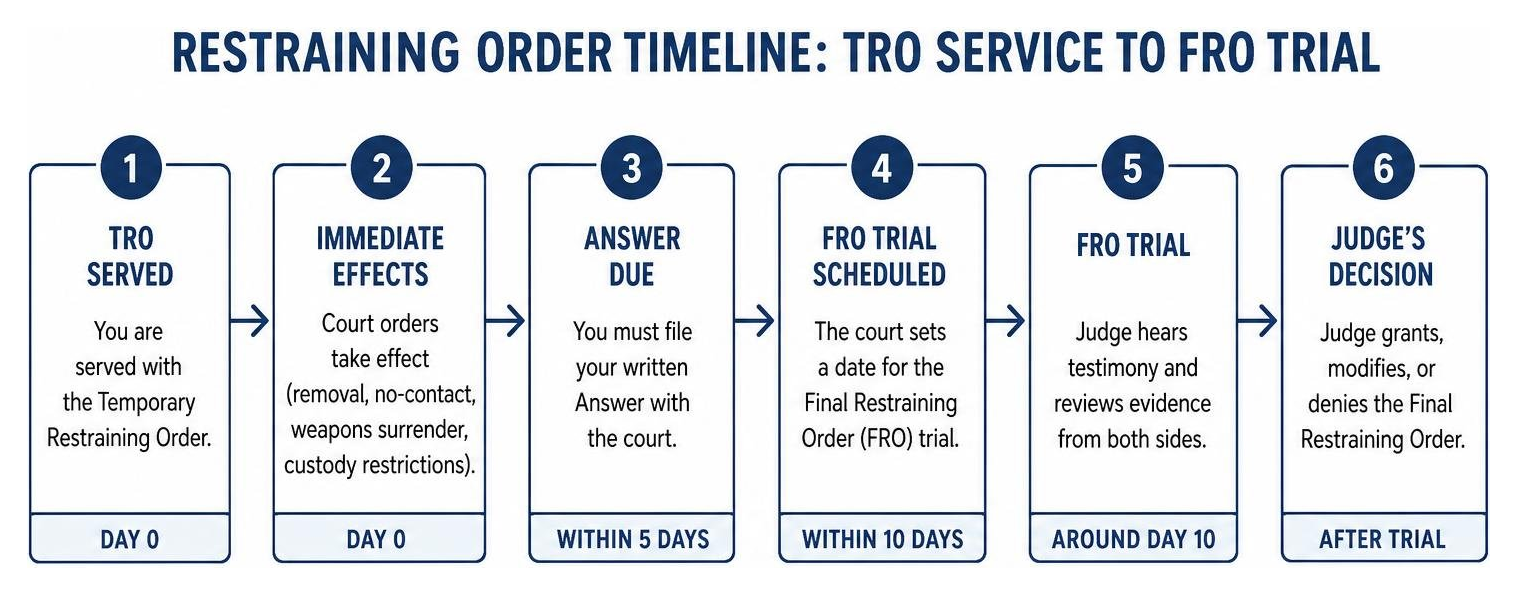
The moment local law enforcement officers serve you with a TRO in Edison, NJ, or East Windsor, NJ, the following actions typically occur:
- Immediate Removal from the Home: If you share a residence with the plaintiff, you will be ordered to leave immediately, even if your name is the only one on the deed or lease.
- Weapons Forfeiture: Law enforcement is legally required to search for and seize any firearms, permits, and other weapons in your possession for safekeeping.
- Suspension of Parenting Time: The TRO may temporarily strip you of custody and prohibit you from having contact with your children.
- Strict No-Contact Mandate: You cannot call, text, email, or message the plaintiff through third parties. Even a simple “I’m sorry” text can lead to your immediate arrest.
To understand the step-by-step progression from the moment of service to the courtroom, refer to the process flow below:
The Legal Process: From Predicate Acts to the Final Hearing
To turn a temporary order into a permanent one, the court must hold a formal FRO trial. This hearing is scheduled within approximately 10 days of the TRO’s issuance. During this trial, the judge hears testimony, evaluates physical evidence, and decides whether the plaintiff has met the legal burden of proof.
To secure an FRO, the plaintiff must prove two main elements, known as the Silver v. Silver standard:
- The Predicate Act: The plaintiff must prove, by a preponderance of the evidence, that the defendant committed one of the 19 specific predicate acts of domestic violence defined under New Jersey law. These acts include assault, harassment, stalking, terroristic threats, cyber-harassment, criminal mischief, and burglary.
- The Need for Continued Protection: Proving a predicate act occurred is not enough. The plaintiff must also prove that an ongoing restraining order is absolutely necessary to protect them from future abuse or immediate danger.
If you are facing a trial in Middlesex County, it is crucial to work with a legal team that understands local court protocols. If your case is located in Mercer County, securing experienced local defense representation can help ensure your rights are protected in the Trenton family courts.
Long-Term Consequences of a Final Restraining Order
Many people do not realize that a Final Restraining Order in New Jersey is permanent. Unlike other states where these orders expire after one to five years, a New Jersey FRO remains in place forever unless a judge formally dissolves it.
If a judge issues an FRO against you, the long-term consequences will follow you indefinitely:
- Statewide Domestic Violence Registry: You will be fingerprinted and entered into a permanent, searchable database used by law enforcement and employers.
- Permanent Firearm Ban: You will forfeit your right to own, carry, or purchase firearms, and any existing permits will be permanently revoked.
- Employment Obstacles: Background checks will reveal the restraining order, which can prevent you from obtaining jobs in healthcare, education, law enforcement, government, or corporate sectors.
- Child Custody Impact: It creates a presumption that joint custody may not be in the best interest of the child, often leading to supervised visitation or loss of custody.
To explore this topic in greater detail, read our article: Does a New Jersey Final Restraining Order Really Last Forever?.
Penalties for Violating a Restraining Order in New Jersey
Violating any provision of a restraining order — even a minor, non-violent contact provision — is treated as a criminal offense under N.J.S.A. 2C:29-9. This charge is known as Contempt of Court.
The penalties for contempt depend on the nature of the violation:
- Disorderly Persons Offense: If you make non-violent contact (such as sending a text message or showing up at a prohibited location), you face up to six months in jail and a $1,000 fine.
- Fourth-Degree Indictable Crime: If the violation involves committing a new crime (such as stalking, harassment, or assault), it is upgraded to a fourth-degree crime, carrying up to 18 months in state prison and a $10,000 fine.
- Mandatory Jail Time: Under N.J.S.A. 2C:25-30, a second or subsequent conviction for violating a restraining order carries a mandatory minimum 30-day jail sentence.
If you are facing allegations of non-compliance in Mercer County, you should speak with a qualified domestic violence defense attorney immediately to protect your liberty.
Why You Need a New Jersey Restraining Order Attorney to Protect Your Rights
Restraining order hearings are , formal trials. The rules of evidence apply, witnesses are cross-examined, and the judge makes a final, life-altering decision on the spot. Going into this environment without an experienced New Jersey restraining order attorney is incredibly risky.

An attorney will evaluate the facts of your case and build a customized strategy. In some instances where both parties want to avoid a trial, we can negotiate “civil restraints.”
This is a formal, consent-based agreement where both parties agree to stay away from each other, but without the defendant admitting to domestic violence and without the permanent consequences of an FRO (such as fingerprinting and registry placement).
If you are prepared to build a defense, you can review your options with a dedicated legal professional.
How a New Jersey Restraining Order Attorney Challenges False Accusations
Unfortunately, restraining orders are sometimes used strategically during divorce or child custody disputes to force a spouse out of the home or gain leverage. Challenging these false allegations requires careful preparation and aggressive defense strategies.
Our team works to defend clients by:
- Analyzing Digital Evidence: We collect and preserve text messages, emails, social media posts, and GPS location data to expose inconsistencies in the plaintiff’s story.
- Conducting Rigorous Cross-Examination: We question the plaintiff and their witnesses to highlight contradictions, exaggerations, or ulterior motives.
- Demonstrating Lack of Fear: We show the court that the plaintiff’s behavior (such as continuing to send friendly text messages after the alleged incident) does not align with an objective need for protection.
For residents in Middlesex County, local representation is key. You can seek guidance from a dedicated domestic violence defense lawyer who understands the local court system.
If you live in Mercer County, working with an experienced domestic violence legal representative can help ensure your defense is tailored to the local court’s expectations.
Can an FRO Be Vacated, Modified, or Appealed?
If an FRO has already been entered against you, your legal options are limited but not impossible. You cannot simply wait for it to expire, because it won’t. Instead, you must take active legal steps to challenge it.
- Filing an Appeal: If you believe the trial judge made a legal error during your FRO hearing, you can file an appeal with the Appellate Division. However, this must be filed within 45 days of the FRO’s issuance.
- Motion to Vacate (The Carfagno Motion): Under New Jersey law (Carfagno v. Carfagno), a defendant can petition the court to dissolve a restraining order if they can show “changed circumstances.” The court will evaluate 11 specific factors, including whether the victim still fears the defendant, the age and health of the parties, whether the defendant has attended counseling, and whether there have been any violations.
To learn more about the legal standards for dissolving these orders, you can research the specific statutory requirements or consult with counsel.
For more details on how our family law team approaches these cases, visit our Practice: Domestic Violence page.
Frequently Asked Questions About New Jersey Restraining Orders
How long does a Final Restraining Order last in New Jersey?
In New Jersey, a Final Restraining Order (FRO) is permanent and does not have an expiration date. It remains in effect for the rest of your life unless the plaintiff voluntarily asks a judge to dismiss it, or the defendant successfully files a motion to vacate the order based on a significant change in circumstances under the Carfagno standard.
What happens if a restraining order is violated?
Any violation of a restraining order results in an immediate arrest and a charge of criminal contempt under N.J.S.A. 2C:29-9. A first offense can result in jail time and a criminal record. A second or subsequent violation carries a mandatory minimum sentence of 30 days in the county jail.
Selecting the Right New Jersey Restraining Order Attorney for Your Case
When choosing an attorney, look for a legal team with experience in both family law and domestic violence litigation. Because these cases move quickly, your attorney must be ready to gather evidence, interview witnesses, and build a defense strategy in less than 10 days. Working with a firm that regularly practices in Middlesex County and Mercer County ensures they are familiar with local court procedures and judges.
Conclusion
Whether you need to secure protection from an abusive partner or defend your reputation and future against false accusations, you should not face the New Jersey court system alone. The decisions made during a domestic violence hearing have permanent, life-altering consequences.
At Shane and White, LLC, we have spent more than 40 years providing personalized attention and clear communication to families throughout Edison, East Windsor, and the surrounding New Jersey communities. We understand the emotional toll of these proceedings, and we are committed to defending your rights with the care and dedication your case deserves.
Do not wait until the 10-day window closes. Contact Shane and White, LLC for Domestic Violence Representation today to schedule a confidential consultation.