
What Child Emancipation Really Means — and Why It Matters
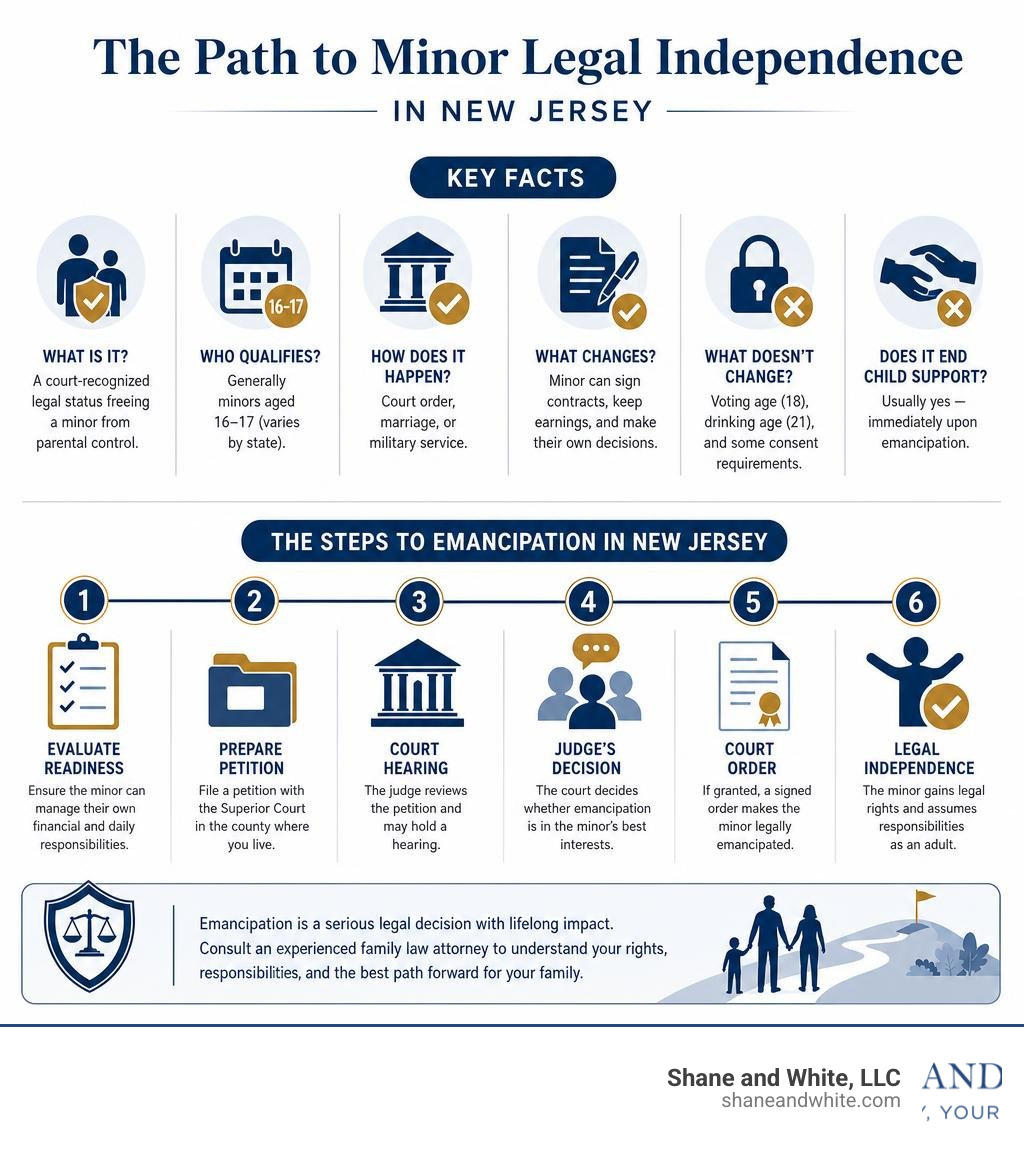
Child emancipation is the legal process by which a minor gains independence from their parents before turning 18. Here’s a quick breakdown:
| Question | Quick Answer |
|---|---|
| What is it? | A court-recognized legal status freeing a minor from parental control |
| Who qualifies? | Generally minors aged 16-17 (varies by state) |
| How does it happen? | Court order, marriage, or military service |
| What changes? | Minor can sign contracts, keep earnings, and make their own decisions |
| What doesn’t change? | Voting age (18), drinking age (21), and some consent requirements |
| Does it end child support? | Usually yes — immediately upon emancipation |
For families in New Jersey going through divorce or custody disputes, these questions carry real weight. About 1 in 5 U.S. children live in single-parent households — and for many of them, questions about legal independence, child support, and parental responsibility don’t have simple answers.
Emancipation is not just about a child “moving out.” It’s a formal legal shift with lasting consequences for both the minor and their parents. Getting it wrong — or misunderstanding how it works — can affect finances, custody, and college costs for years.
I’m Kenneth A. White, Esq., a New Jersey Supreme Court Certified Matrimonial Law Attorney at Shane and White, LLC, with decades of experience handling child emancipation matters, custody disputes, and family law cases throughout New Jersey. I’ll walk you through exactly how this process works, what the law actually says, and what your family needs to know before making any decisions.
What is Child Emancipation and How Does It Work?
To understand child emancipation, it helps to look at how the law defines a minor’s relationship with their parents. Broadly speaking, the law presumes that children under a certain age need parental guidance, financial support, and physical custody. Under this framework, parents have the right to make decisions for their children, and in turn, they carry the legal obligation to support them.
The emancipation of minors | Legal Information Institute defines this concept as a mechanism through which eligible minors are granted some or all of the rights and statuses that adults hold. When a minor is emancipated, the legal tie between parent and child is severed. The parent is no longer responsible for the child’s actions, support, or shelter, and the child gains the right to manage their own life.
While the idea of living independently sounds appealing to many teenagers, the reality is that very few actually take this path. Nationally, only about 0.2% of minors under the age of 18 pursue legal emancipation each year. However, independent living is a growing reality; back in 2022, about 4.5 million minors in the U.S. were living independently or in non-parental households. As we navigate the legal landscape of July 2026, courts continue to treat emancipation petitions with extreme care, recognizing that a teenager’s desire for independence must be balanced against their practical ability to survive in the adult world.
Emancipation vs. Reaching the Age of Majority
There is a common misconception that turning 18 is the exact same thing as being emancipated. While they share similar outcomes, they are legally distinct:
- Age of Majority: This is the age at which a person is automatically recognized as an adult by state law (usually 18). Once a minor reaches this milestone, parental control legally ends, and they automatically inherit adult rights and responsibilities.
- Emancipation: This is an intervention that occurs before the minor reaches the age of majority. It requires a specific trigger—such as a court order, marriage, or military enlistment—to grant adult status to someone who is still chronologically a minor.
In some states, like New Jersey, the distinction is even more nuanced. As we will explore later, reaching age 18 in New Jersey does not automatically end a parent’s obligation to pay child support, making the legal definition of emancipation incredibly important for local families.
The Legal Rights and Responsibilities Gained
When a minor successfully navigates the child emancipation process, they step into the legal shoes of an adult. The rights they gain are substantial and include the ability to:
- Sign Binding Contracts: Unemancipated minors cannot typically enter into legally binding contracts, such as apartment leases, car loans, or credit card agreements. An emancipated minor can.
- Consent to Medical Care: They can make their own medical, dental, and psychological treatment decisions without parental consent or notification.
- Keep and Manage Earnings: Any wages earned belong entirely to the minor, and parents lose all rights to control or access those funds.
- Sue and Be Sued: They can initiate lawsuits or be held personally liable in a court of law without needing a guardian ad litem to represent them.
- Establish Their Own Residence: They have the absolute right to choose where they live, free from parental custody and control.
However, this independence is a double-edged sword. Along with these rights comes complete financial and legal liability. If an emancipated minor fails to pay rent, they can be evicted and sued. If they commit a civil wrong, they cannot hide behind their parents’ insurance or bank accounts.
The Paths to Becoming an Emancipated Minor

A minor cannot simply declare themselves emancipated. The law requires a formal process or a specific life event to trigger this change in legal status. Generally, there are three primary paths to emancipation: a direct court order, marriage, or active military service.
The Judicial Process of Child Emancipation
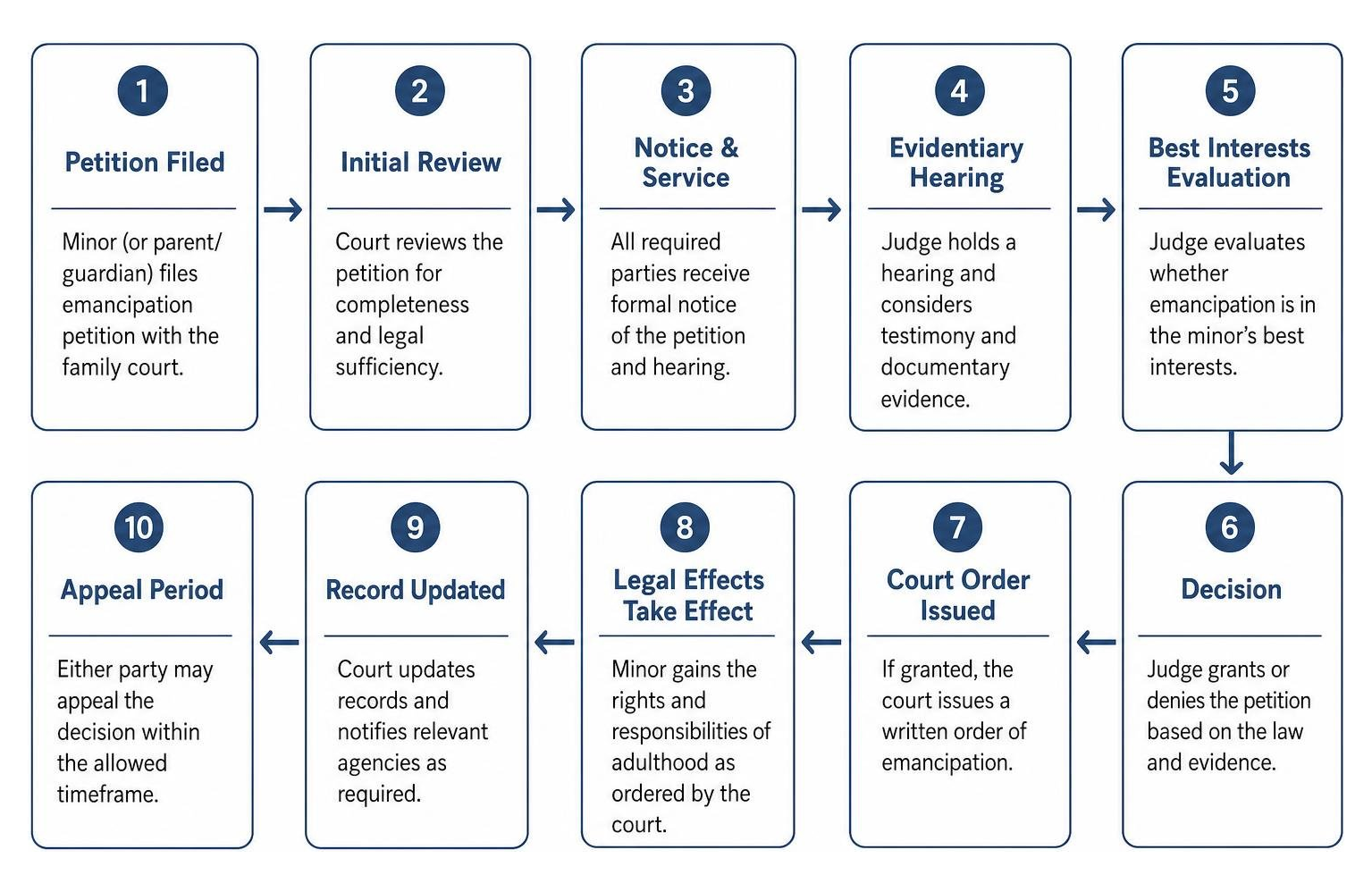
For most minors seeking independence without getting married or joining the military, obtaining a formal court order is the only path. This process requires filing a legal petition in the court of the county where the minor resides.
Because minors generally lack the legal capacity to file lawsuits on their own, the process can be procedurally complex. In many jurisdictions, a parent, legal guardian, or a court-appointed guardian ad litem (or attorney ad litem) must file the petition on the minor’s behalf or assist them through the process. Once the petition is filed, the court will schedule an evidentiary hearing.
During this hearing, the judge will review financial documents, living arrangements, and testimony to determine if the minor is truly capable of independent living. If the court is satisfied, it will issue a formal decree of emancipation, which is then recorded in the county’s public records.
Emancipation Through Marriage or Military Service
In almost every state, certain life milestones automatically trigger emancipation because they are fundamentally incompatible with parental control:
- Marriage: When a minor marries, they enter into a new legal family unit. Because a spouse carries legal duties that supersede parental authority, marriage generally results in automatic emancipation. However, states have tightened rules around underage marriage. For example, in New York and Florida, strict age limits and judicial consent requirements prevent minors from using marriage as an easy “loophole” to escape parental custody.
- Military Enlistment: Enlisting on active duty in the U.S. Armed Forces requires a commitment to the federal government that is entirely incompatible with parental control. If a minor enlists (which generally requires parental consent at age 17), they are considered emancipated by implication once they enter active duty.
State-by-State Legal Requirements and Age Limits
Because family law is governed at the state level, the rules for child emancipation vary wildly across the country. Understanding these regional differences is essential, especially for families moving between states.
| State | Minimum Age | Primary Method | Support Obligation Age | Key Distinction |
|---|---|---|---|---|
| California | 14 | Court Petition, Marriage, or Military | 18 | Very young minimum age; active petition system |
| New York | 16 | No formal court petition; fact-based status | 21 | Parents must support until 21 unless emancipated |
| Texas | 16 | “Removal of Disabilities of Minority” | 18 | Focuses on partial or general removal of legal limits |
| Florida | 16 | “Removal of Disabilities of Nonage” | 18 | Requires a parent or guardian to file the petition |
| New Jersey | N/A | Fact-based judicial determination | 19 (up to 23) | No automatic emancipation at 18; highly unique rules |
California, New York, Texas, and Florida Rules
- California: California has one of the most established and active emancipation systems in the country. Minors as young as 14 can petition the court for emancipation. In California, over 1,200 petitions for emancipation were filed in 2021, with about 65% approved by the courts. The minor must prove they are willingly living apart from their parents with parental consent, managing their own financial affairs, and earning a legal income.
- New York: New York does not have a formal court procedure where a minor can file a petition simply to be declared “emancipated.” Instead, emancipation is treated as a defense or a status determined on a case-by-case basis, often during child support disputes. Crucially, New York parents are legally obligated to support their children until age 21 unless the child becomes emancipated after turning 16 by establishing financial independence and living apart from parents.
- Texas: Texas law refers to emancipation as the “removal of disabilities of minority.” Minors must be 17, or 16 and living separate from their parents, to petition the court. The petition must show that emancipation is in the minor’s best interest and that they are entirely self-supporting.
- Florida: Under Florida Statutes Chapter 743, the process is called the “removal of disabilities of nonage.” The minor must be at least 16. Interestingly, the petition must be filed by the minor’s parents or legal guardian—not the minor alone—unless a guardian ad litem is appointed by the court to represent them.
- Virginia: For comparison, the Code of Virginia Code – Article 15. Emancipation of Minors outlines that a minor must be at least 16 and either on active military duty or living independently with parental consent while proving the capacity to manage their own financial affairs.
The Unique Landscape of Child Emancipation in New Jersey
If you live in Middlesex County, Mercer County, or anywhere else in New Jersey, the rules are entirely different. New Jersey does not have a specific statute that allows a minor to file a petition to be declared emancipated. Instead, emancipation in our state is a fact-sensitive, case-by-case determination made by the Family Part of the Superior Court.
Furthermore, New Jersey does not equate turning 18 with automatic emancipation. Under the NJ Courts glossary, emancipation is defined as the conclusion of the fundamental dependent relationship between parent and child.
In New Jersey, child support does not automatically end when a child turns 18. By law, child support and financial obligations generally terminate when a child turns 19. However, this support can be extended up to the child’s 23rd birthday if they are still enrolled in high school, attending college full-time, or have a physical or mental disability.
This means that a 21-year-old college student living in an apartment in Edison or East Windsor may still be considered legally “unemancipated” for the purpose of receiving child support and college contributions from their parents. If you are wondering how these rules apply to your specific family situation, we highly recommend reading our detailed guide on When is your child deemed emancipated? to understand how New Jersey courts handle these milestones.
Financial Impacts: Child Support, College Costs, and Parental Obligations

One of the most common reasons parents contact us at Shane and White, LLC regarding child emancipation is to understand how it impacts their financial obligations. The financial ripple effects of emancipation are massive, particularly when it comes to child support, custodial funds, and higher education.
How Emancipation Affects Child Support and Custody
Once a child is legally declared emancipated, the parental obligation to provide financial support ends immediately. The non-custodial parent is no longer required to make monthly child support payments, and the custodial parent no longer has legal custody of the child.
However, stopping child support is not automatic. If you have a court-ordered support agreement, you cannot simply stop paying when you believe your child has met the criteria for emancipation. Doing so can result in severe penalties, including wage garnishment, driver’s license suspension, and arrears. You must file a formal motion with the court to terminate child support based on the child’s changed status.
This process often intersects with other family changes. For instance, if you are revisiting your custody arrangements or adjusting to life after a split, the emancipation of an older child will alter the financial calculations for any remaining minor children. Even seasonal adjustments, such as navigating the first summer after divorce support schedules and stress, can be simplified once an older child is legally recognized as independent.
In New Jersey, the question of college expenses is another major battleground. Unlike many states where parental obligations end strictly at 18, New Jersey courts can compel divorced parents to contribute to their child’s college tuition, books, and living expenses. To find out how courts evaluate these cases and whether you are required to pay, take a look at our article: Are divorced parents obligated to contribute to college expenses?
Additionally, parents often wonder what happens to savings accounts set aside for their children. If you have established custodial accounts (like UTMA or UGMA accounts) for your child, emancipation can accelerate their access to these funds. For a clear breakdown of how these assets are treated, read our guide on What happens to custodial accounts during a divorce in New Jersey?
Partial Emancipation and Limited Parental Duties
In some complex cases, a court may find that a minor is only “partially” emancipated. This is a unique legal status where a child is deemed independent for specific purposes but remains dependent in others.
- Wage Control: A court might rule that a working teenager has the right to keep and manage their own earnings (express or implied partial emancipation) while still requiring parents to provide housing and health insurance.
- Medical Decisions: A minor might be granted the right to make their own medical decisions, yet still receive financial support from their parents.
- Specific Contracts: A court can remove a minor’s legal disabilities solely so they can execute a specific business contract or lease, leaving the rest of their minor status intact.
Partial emancipation is highly situational and requires precise legal drafting to ensure both parents and minors understand where their responsibilities begin and end.
Risks, Court Considerations, and Alternatives to Emancipation
Pursuing child emancipation is a major legal step that should not be taken lightly. Courts do not hand out adult status easily; they look closely at the minor’s life to ensure they are truly ready for the harsh realities of independence.
What Courts Look for in a Petition
When a judge reviews an emancipation petition, their primary guiding light is the best interests of the minor. To determine if emancipation is truly in the child’s best interest, the court will evaluate several key factors:
- Financial Self-Sufficiency: Can the minor actually support themselves? The minor must provide concrete proof of stable, legal income (such as pay stubs or tax documents) that is sufficient to cover rent, utilities, food, clothing, insurance, and medical care. If the minor relies on public assistance or informal “under-the-table” gigs, the court is highly unlikely to grant the petition.
- Maturity and Decision-Making: Does the minor demonstrate the mental and emotional maturity required to function as an adult? The court will look at their educational progress, criminal record, and overall stability.
- Living Arrangements: Does the minor have a safe, stable place to live? A minor who is couch-surfing or living in a highly unstable environment will not meet the court’s standards.
- Parental Consent and Family Discord: While parental consent makes the process much smoother, it is not strictly required. If parents object, the court will weigh the parents’ reasons against the minor’s evidence of independence. In cases of severe abuse or abandonment, the court may bypass parental objections entirely.
Risks and Viable Alternatives for Families
For minors, the grass is not always greener on the adult side of the fence. Studies show that emancipated minors are 30% more likely to experience financial instability compared to their peers. Without a safety net, a single job loss, medical emergency, or car breakdown can lead to homelessness or severe debt.
Because the risks are so high, families should thoroughly explore alternatives before heading to court:
- Family Counseling: If the desire for emancipation stems from family conflict or poor communication, professional mediation or family therapy is often a much healthier and cheaper solution.
- Informal Living Agreements: Parents can agree to let a mature teenager live with a trusted relative (like a grandparent, aunt, or uncle) or family friend without involving the court system.
- Kinship Legal Guardianship: If a parent is temporarily unable to care for their child, establishing a formal guardianship with another adult can provide the child with a stable home while keeping parental support obligations intact.
Frequently Asked Questions About the Process
Does having a baby automatically emancipate a minor?
No. This is one of the most common myths surrounding teen parenthood. Even if a minor under the age of 18 has a baby, they are not automatically emancipated. While the minor parent gains the legal right to make custody and medical decisions for their own child, they themselves remain a minor under the law. Their parents still have the right to legal custody of them and remain financially obligated to support them until they turn 18 or become legally emancipated through other means.
Can an emancipated minor vote or buy alcohol?
No. Emancipation grants a minor the legal status of an adult for civil and contractual purposes, but it does not override constitutional or statutory age limits. An emancipated minor must still wait until they are 18 to vote or join the military (without parental consent), and they must wait until they are 21 to buy or consume alcohol and tobacco.
Can a court reverse or cancel an emancipation order?
Yes, under specific circumstances. Because the court retains jurisdiction over minors until they reach the age of majority (18), an emancipation order can be modified or terminated prospectively. If an emancipated minor loses their job, becomes unable to support themselves, or falls victim to fraud, the court can revoke the emancipation status to protect the child’s welfare and reinstate parental support obligations.
Conclusion
Navigating the legal rules of child emancipation can feel overwhelming, especially when family relationships and financial futures are on the line. Whether you are a parent seeking to understand when your child support obligations legally end, or you are dealing with a complex custody transition, you don’t have to face these challenges alone.
At Shane and White, LLC, we have spent more than 40 years helping families in Edison, East Windsor, Middlesex County, and Mercer County find clear, practical solutions to complex matrimonial and family law issues. We pride ourselves on providing the personalized attention, clear communication, and experienced advocacy you need to protect what matters most.
If you have questions about child support, custody, or want to know exactly When is your child deemed emancipated? under New Jersey law, reach out to us today to schedule a personalized consultation. We are here to guide you every step of the way.