
When Life Changes, So Can Your Alimony — What New Jersey Residents Need to Know
Spousal support modification in New Jersey is possible when there has been a substantial, ongoing change in circumstances since the original alimony order was made.
Quick answers to the most common questions:
- Can alimony be modified in NJ? Yes — either spouse can request a change if circumstances have significantly shifted.
- What qualifies as a change? Job loss, retirement, serious illness, cohabitation, or a major income change.
- Who can request it? Either the paying spouse or the receiving spouse.
- How do you start? File a formal motion with the family court and provide financial documentation.
- Can you stop paying without a court order? No — doing so can result in enforcement action, wage garnishment, or contempt findings.
- Does remarriage end alimony? Yes, remarriage of the recipient automatically terminates alimony in New Jersey.
- Does cohabitation end alimony? It can — courts look at whether the new relationship is financially supportive.
- What about retirement? Reaching Social Security retirement age creates a legal presumption that alimony should be modified or ended.
Life after divorce rarely stays the same. Incomes go up and down. People retire. Health changes. New relationships form. And when those things happen, the alimony arrangement made during your divorce may no longer reflect reality for either spouse.
The good news is that New Jersey courts recognize this. Alimony is not set in stone. But changing it requires following the right legal process — you cannot simply stop paying or adjust the amount on your own.
I’m Kenneth A. White, Esq., a Certified Matrimonial Law Attorney with decades of experience handling spousal support modification cases in New Jersey family courts, including serving as an Early Settlement Panelist in Middlesex County since 2001. In the sections below, I’ll walk you through exactly what it takes to modify — or defend — an alimony order in New Jersey.
Understanding the Legal Grounds for Spousal Support Modification
In New Jersey, the foundational standard for modifying any support order comes from the landmark 1980 Supreme Court case Lepis v. Lepis. Under the Lepis standard, the party seeking a spousal support modification must demonstrate a “substantial and permanent change in circumstances” that occurred after the original divorce decree or property settlement agreement was finalized.
It is not enough to show that your financial situation changed for a few weeks or months. The court expects the change to be long-lasting and involuntary. If you are the paying spouse (the obligor), you must prove that your ability to pay has permanently decreased. If you are the receiving spouse (the obligee), you must show that your financial needs have significantly increased, or that the payor’s financial circumstances have vastly improved while your original needs remain unmet.
To put this in perspective, across the United States, about 10% to 15% of divorce cases involve alimony awards. Within five years of those awards, roughly 20% to 30% of parties file for a modification. When life shifts, the legal framework must adapt.

Before diving into a court battle, it is essential to understand the type of alimony you have. New Jersey recognizes several types of spousal support, including limited duration, rehabilitative, reimbursement, and open durational alimony (which replaced “permanent” alimony in 2014). To build a solid foundation on how these distinct types function under state law, you can Learn more about New Jersey alimony basics.
How Changing Jobs Triggers a Spousal Support Modification
One of the most common reasons clients visit our Edison, New Jersey office is a career transition. Whether you are climbing the corporate ladder or facing a sudden layoff, employment changes directly impact alimony.
If you involuntarily lose your job, New Jersey courts will scrutinize your efforts to find comparable employment. You cannot simply stop paying. The court will expect to see a comprehensive job search log, copies of applications, and proof that you are actively trying to mitigate your financial losses. If you voluntarily take a lower-paying job because you want a career change, the court may “impute” income to you based on your previous earning capacity, meaning they will calculate your support obligation as if you were still making your old salary.
Conversely, what happens if you land a higher-paying role? If you are the receiving spouse, a new job with a higher salary might reduce your financial “need,” potentially allowing your ex-spouse to petition for a reduction. If you want to understand how a career shift affects either side of the equation, read our detailed guides on How changing jobs affects your alimony and What a new job means for your alimony receipt.
Health Issues and Physical Disability
A sudden, severe medical condition or physical disability can instantly shatter an individual’s earning capacity. If you develop a chronic illness that prevents you from working, New Jersey family courts will consider this a valid ground to request a spousal support modification.
However, the evidentiary bar is high. You cannot simply present a note from your primary care physician stating you can no longer work. The court will require:
- Comprehensive medical records detailing the diagnosis and prognosis.
- Official documentation of government disability benefits, such as Social Security Disability Insurance (SSDI) awards.
- Vocational expert reports explaining how your physical limitations prevent you from maintaining gainful employment.
- Up-to-date financial disclosures showing the added cost of your medical treatments and insurance.
How Cohabitation and Remarriage Impact Alimony Obligations
Relationships evolve over time. When a former spouse moves in with a new partner or decides to tie the knot again, the existing alimony structure is legally impacted.

If your ex-spouse has moved in with a significant other, you may feel that continuing to pay support is unfair. To explore your options in this specific scenario, check out our resource: I want to terminate alimony because my ex has a significant other.
The Impact of Cohabitation on Support Payments
Under New Jersey’s 2014 Alimony Reform Act, cohabitation is defined as a mutually supportive, personal, and financial relationship in which a couple has undertaken duties and privileges commonly associated with marriage. They do not need to live together full-time to be legally considered cohabiting.
When evaluating a cohabitation claim, Middlesex and Mercer County courts look at several key factors:
- Financial Interdependence: Are they sharing bank accounts, credit cards, or pooling assets?
- Shared Expenses: Is one partner paying for the other’s groceries, utilities, or car payments?
- Living Arrangements: Do they share a primary residence, or does one partner spend the vast majority of their nights at the other’s home?
- Household Chores: Do they split household responsibilities and maintenance?
- Relationship Longevity: How long has the relationship lasted, and do they present themselves as a couple to family, friends, and the public?
If cohabitation is proven, the court has the authority to suspend, reduce, or completely terminate alimony payments.
Automatic Termination Upon Remarriage
Unlike cohabitation, which requires a detailed factual analysis, remarriage provides a bright-line legal boundary. Under New Jersey law, the obligation to pay alimony terminates automatically upon the remarriage of the receiving spouse.
The receiving spouse has a strict legal obligation to notify the paying spouse immediately of their remarriage. Any payments made after the date of the wedding must be returned to the payor. While the termination is automatic, it is highly recommended to file a formal Consent Order with the court to update the state’s payment registry and officially close the case file.
The Impact of Retirement on Spousal Support
Retirement is a major life milestone, but it also represents a significant drop in active income. In New Jersey, whether retirement allows you to modify or end your alimony depends largely on your age and the terms of your original divorce agreement.
Navigating these rules requires knowing the legal strategies that shape court outcomes. For an inside look at how family law judges evaluate these requests, explore the Secrets alimony attorneys know about spousal support.
Retirement at Full Social Security Age
If you retire at your “full retirement age” as defined by the Social Security Act (usually between 66 and 67, depending on your birth year), New Jersey law establishes a rebuttable presumption that your alimony obligation should terminate.
This means the court starts with the assumption that you should stop paying. However, the receiving spouse can challenge this presumption by presenting evidence of:
- A continued financial need.
- The payor’s ability to pay using other assets (such as investments, real estate, or divided pension benefits).
- An explicit agreement in the original divorce decree stating that support would continue past retirement.
The court will carefully balance the assets distributed during the divorce against each party’s current financial standing before making a final ruling.
Early Retirement and Voluntary Income Reduction
If you choose to retire early (before your full Social Security retirement age), the court will not grant an automatic presumption of termination. Instead, your early retirement will be viewed as a voluntary reduction in income.
The family court will place your decision under intense scrutiny. We must prove to the court that your early retirement was executed in “good faith” and was highly reasonable. Valid reasons for early retirement include:
- Severe physical or mental health decline making continued work impossible.
- Mandatory corporate retirement policies.
- Significant industry-wide layoffs where finding comparable work at an advanced age is highly improbable.
If the court suspects you are retiring early simply to avoid your support obligations, your modification request will be denied.
Comparing Alimony Modification Laws Across Different States
Family law is state-specific. While we practice exclusively in New Jersey, understanding how other jurisdictions handle these issues highlights the unique nature of our local statutes.
| Jurisdiction | Primary Standard for Modification | Impact of Cohabitation | Impact of Retirement |
|---|---|---|---|
| New Jersey | Substantial, permanent, and unanticipated change (Lepis standard). | Can lead to suspension, reduction, or termination based on financial interdependence. | Rebuttable presumption of termination at full Social Security retirement age. |
| Virginia | Material change in circumstances under Virginia Code § 20-109. | Cohabitation for 1+ year in a marriage-like relationship triggers mandatory termination unless unconscionable. | Attainment of full retirement age is a material change, but courts evaluate multiple factors. |
| Florida | Substantial change in circumstances or supportive relationship under Florida Statutes § 61.14. | Supportive relationship with a non-relative can shift the burden to reduce or terminate alimony. | Retirement at a customary age can justify reduction if the payor proves a reduced ability to pay. |
| Ontario | Material change in circumstances (substantial, unforeseen, and continuing). | Evaluated under the Ontario Spousal Support Advisory Guidelines. | Voluntary early retirement is heavily scrutinized; pensions already divided cannot be “double recovered.” |
The Step-by-Step Process to File a Spousal Support Modification
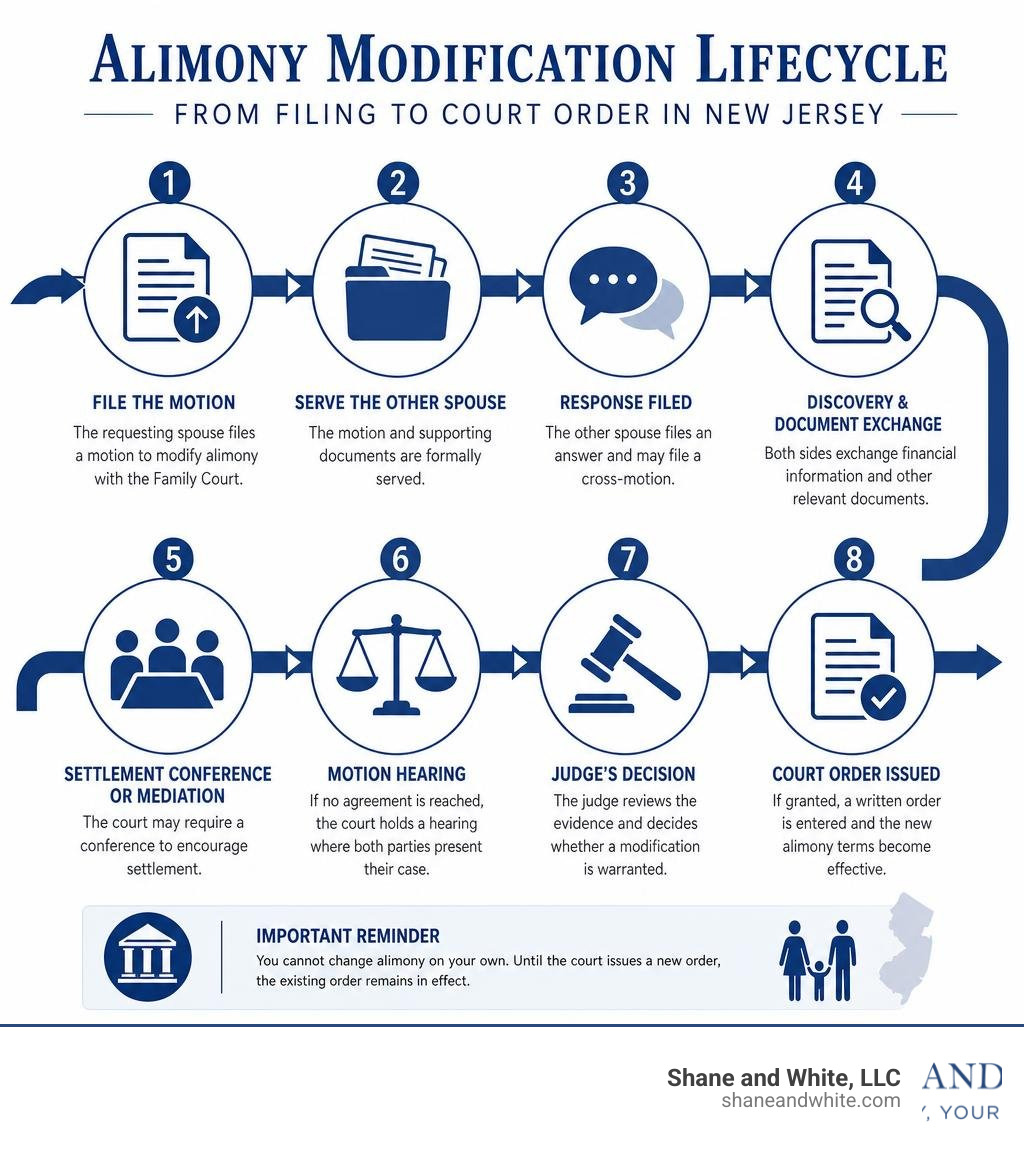
If you need to modify your alimony order in New Jersey, you must follow a precise legal procedure. Taking matters into your own hands without court approval can lead to severe legal penalties.
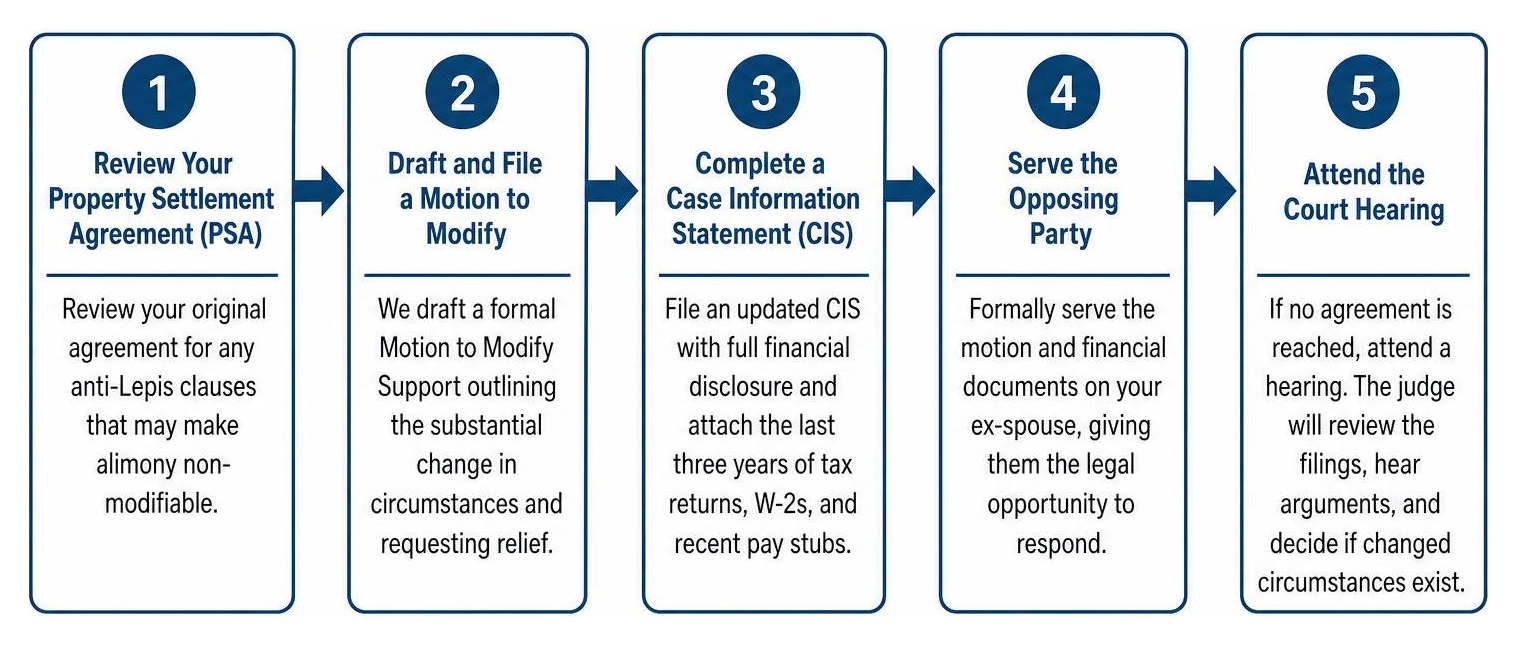
- Review Your Property Settlement Agreement (PSA): Before filing anything, we must review your original agreement. Some PSAs contain “anti-Lepis” clauses, which explicitly state that alimony is completely non-modifiable regardless of future life changes.
- Draft and File a Motion to Modify: If modification is legally permissible, we will draft a formal Motion to Modify Support. This document outlines the substantial change in circumstances and requests specific relief (reduction, suspension, or termination).
- Complete a Case Information Statement (CIS): You must complete and file an updated CIS. This is a comprehensive financial disclosure form detailing your current income, expenses, assets, and liabilities. You must attach your last three years of tax returns, W-2s, and your most recent pay stubs.
- Serve the Opposing Party: The motion and financial documents must be formally served on your ex-spouse, giving them the legal opportunity to respond.
- Attend the Court Hearing: If the parties cannot reach an agreement through mediation, you will attend a court hearing. The judge will review the filings, listen to oral arguments, and determine if a “prima facie” (at first sight) case of changed circumstances has been made.
- Obtain a Formal Court Order: If the judge agrees with your petition, they will issue a new court order reflecting the modified support terms.
Navigating this complex process on your own can be overwhelming. To understand how professional representation can safeguard your financial future, read about How an alimony attorney can change your case outcome. For step-by-step procedural assistance, you can also consult the official NJ Courts Guide to Changing a Court Order.
Frequently Asked Questions about Alimony Modification
Can I stop paying alimony unilaterally if I lose my job?
Absolutely not. This is the single most common and costly mistake obligors make. Until a New Jersey family court judge signs an order modifying or terminating your support obligation, your original order remains fully active and legally binding.
If you stop paying unilaterally, you will quickly face enforcement proceedings. The court can order wage garnishments, seize your personal assets, suspend your driver’s license, and even find you in contempt of court, which can carry jail time. If you are facing enforcement actions or want to know what steps to take next, read our guide on Alimony enforcement in New Jersey.
Can spousal support be modified retroactively?
In New Jersey, retroactive modification of support is generally limited. Under the state’s anti-retroactivity statute, child support cannot be retroactively modified prior to the date a formal motion is filed. While alimony does not have the exact same rigid statutory bar, New Jersey courts heavily favor the rule that alimony modifications are only retroactive to the date of filing the motion.
There are very rare equitable exceptions—such as if the receiving spouse actively concealed their remarriage or cohabitation—but in 99% of cases, the court will not adjust payments made before your official filing date. This is why it is absolutely critical to file your motion immediately when a financial crisis strikes.
How do second families or subsequent children affect existing alimony orders?
Under the traditional “first-family-first” philosophy, a payor’s subsequent marriage or the birth of new children does not automatically entitle them to a reduction in their existing alimony obligation to their first spouse. Your prior legal obligations take precedent.
However, New Jersey courts do not ignore the reality of second families. If the financial burden of supporting subsequent children, combined with an involuntary drop in income, creates an extreme financial hardship, the court may consider these factors as part of the overall “totality of circumstances” when determining if a modification is fair and equitable.
Conclusion
Whether you are seeking to reduce your payments due to a job loss or retirement, or you need to defend your existing support award against an ex-spouse’s modification request, you do not have to face the family court system alone.
At Shane and White, LLC, based in Edison, New Jersey, we bring over 40 years of combined legal experience to Middlesex County and Mercer County family law matters. We pride ourselves on providing the personalized attention, clear communication, and strategic advocacy you need to protect your financial well-being.
If you are ready to discuss your options and take control of your financial future, Schedule a consultation with our litigation and appeals team today.