
When a Civil Case Can Be Stopped Before It Ever Reaches Trial
A motion to dismiss a civil case is one of the most powerful tools in litigation — it can end a lawsuit before discovery, depositions, or trial ever begin.
Here’s a quick answer if that’s what you need:
A motion to dismiss asks the court to throw out a lawsuit — either because the complaint has legal defects, the court lacks jurisdiction, or another legal bar exists. It is filed before or instead of an answer to the complaint.
The most common grounds for dismissal include:
- Failure to state a legal claim (even if all facts are true, no law supports the lawsuit)
- Lack of subject-matter or personal jurisdiction
- Improper venue
- Insufficient service of process
- Expired statute of limitations
A granted motion can end the case entirely — or give the plaintiff a chance to fix their complaint and refile.
If you are a defendant in a civil lawsuit, understanding this process early can save you significant time, money, and stress. And if you are a plaintiff, knowing how courts evaluate these motions helps you build a complaint that survives a challenge.
Civil litigation is rarely simple. While roughly 95% of civil cases settle before trial, getting there often means navigating pretrial motions — including motions to dismiss — that can dramatically shape the outcome.
I’m Kenneth White, Esq., a New Jersey family law attorney certified by the Supreme Court of New Jersey as a Matrimonial Law Attorney, with extensive experience handling pretrial motions — including the motion to dismiss civil case — in family and civil proceedings. In the sections below, I’ll walk you through exactly how this process works, what the rules require, and what strategies matter most.
Understanding the Motion to Dismiss Civil Case
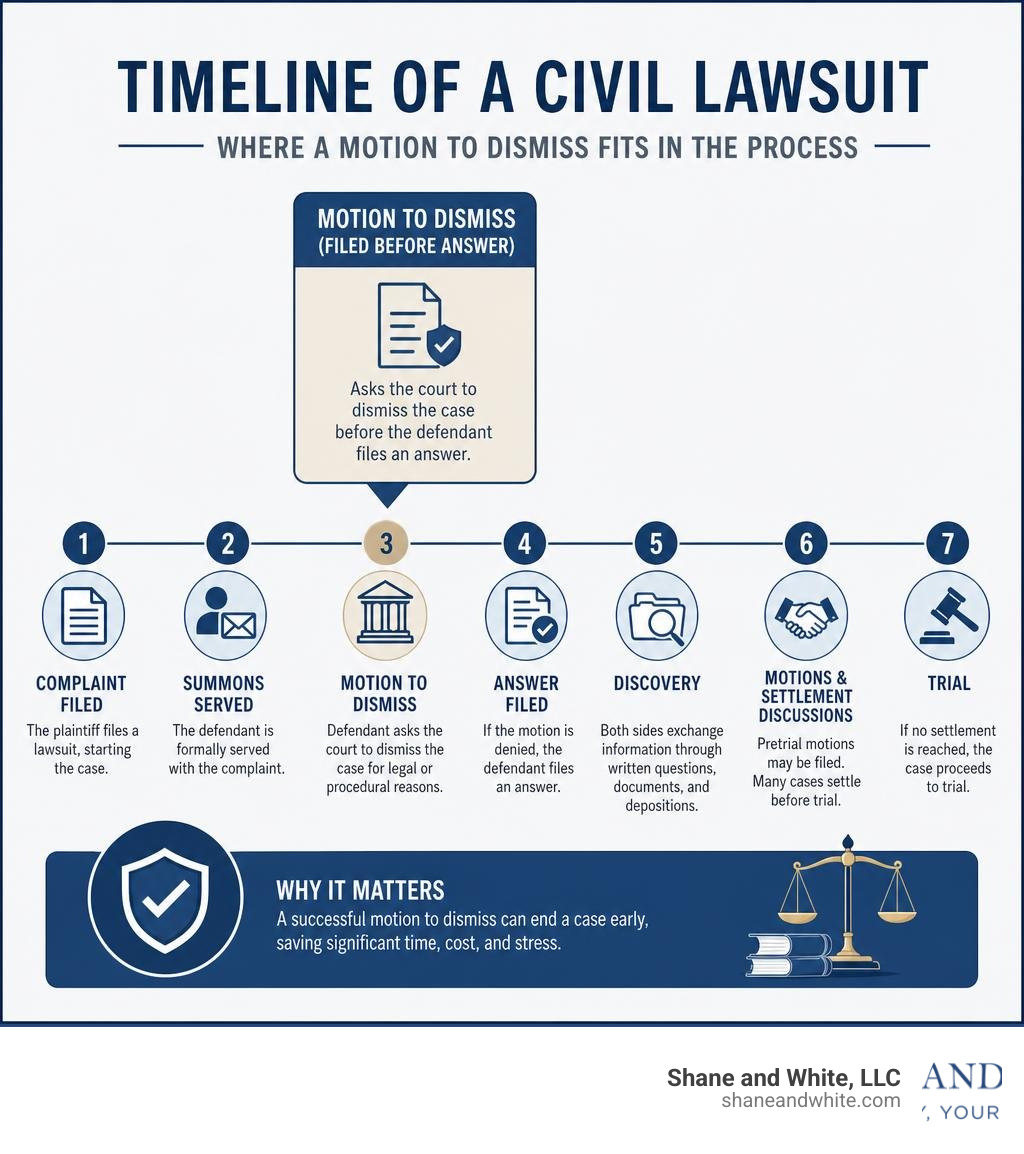
In civil procedure, a motion is simply a formal request asking a judge to make a specific ruling. When a defendant is served with a complaint, they generally have two primary pathways: file an “Answer” addressing each allegation line by line, or file a pre-answer motion to challenge the legal validity of the lawsuit itself.
The motion to dismiss civil case is the ultimate pre-answer shield. Rather than arguing over who did what, the defendant points to the complaint and says, “Your Honor, even if we assume every single word written in this complaint is 100% true, the plaintiff still does not have a valid legal claim, or this court is the wrong place to hear it.”
This motion occurs entirely within the pleading stage of litigation. Because it is filed before the defendant submits an Answer, it temporarily pauses the requirement to respond to the allegations. If the court grants the motion, the case may end right then and there. If the court denies it, the defendant must then file a formal Answer and proceed into the deeper, more expensive waters of litigation.
The Primary Purpose of a Motion to Dismiss Civil Case
The primary purpose of a motion to dismiss is to weed out legally deficient lawsuits before they consume valuable court resources and rack up thousands of dollars in legal fees for both parties. This is a concept known as judicial economy.
When evaluating a motion to dismiss—particularly one based on the failure to state a claim—courts rely on what is known as the “four corners” rule. This means the judge will look only at the document containing the complaint itself and any written instruments attached to it as exhibits. The judge will not look at outside evidence, listen to witness testimony, or consider new factual assertions.
Under the federal standard and similar state rules, such as Federal Rules of Civil Procedure Rule 12, the court must accept all factual allegations in the complaint as true and draw all reasonable inferences in favor of the plaintiff. However, the court is not required to accept legal conclusions wrapped up as factual allegations. If the facts as pleaded do not plausibly point to a violation of a recognized law, the complaint is legally insufficient and ripe for dismissal.
Voluntary vs. Involuntary Dismissal
It is also important to understand that not all dismissals are forced upon an unwilling plaintiff by a defendant. Under civil procedure rules, dismissals fall into two broad categories:
- Voluntary Dismissal: Governed by Rule 41(a) of the Federal Rules of Civil Procedure (and state equivalents), this occurs when the plaintiff chooses to withdraw their own case. This is common when the parties reach a settlement agreement out of court, or if the plaintiff realizes they filed the suit prematurely. If the defendant has not yet filed an answer or a motion for summary judgment, the plaintiff can often dismiss the case simply by filing a Notice of Dismissal. Otherwise, they must obtain a court order or a signed stipulation from the defendant.
- Involuntary Dismissal: Governed by Rule 41(b), this is a court-ordered termination of the case against the plaintiff’s wishes. This can happen because the defendant filed a successful motion to dismiss civil case, or because the plaintiff failed to prosecute the case (e.g., letting the case sit idle for months without taking action) or failed to comply with a court order.
Grounds for Dismissal Under Federal and State Rules
To successfully throw out a lawsuit, a defendant cannot simply tell the judge, “This lawsuit is unfair.” They must point to specific, legally recognized grounds for dismissal.

These grounds generally fall into two categories: technical/procedural defects (such as how the lawsuit was delivered or where it was filed) and substantive legal defects (the core legal theories of the case).
Federal Rule 12(b) Defenses
In federal courts, Rule 12(b) of the Federal Rules of Civil Procedure outlines seven specific defenses that a party can raise by motion before filing a responsive pleading:
- Rule 12(b)(1) – Lack of Subject-Matter Jurisdiction: The court does not have the constitutional or statutory authority to hear this type of case. For example, a federal court cannot hear a standard state-law divorce case unless there is a specific federal question involved.
- Rule 12(b)(2) – Lack of Personal Jurisdiction: The court does not have authority over the specific defendant. If a lifelong resident of New Jersey with no business ties to Oregon is sued in an Oregon state court, that court likely lacks personal jurisdiction.
- Rule 12(b)(3) – Improper Venue: The lawsuit was filed in the wrong geographic location.
- Rule 12(b)(4) – Insufficient Process: There is a technical defect in the summons itself (e.g., it lacks the clerk’s signature or has the wrong names).
- Rule 12(b)(5) – Insufficient Service of Process: The paperwork was not delivered to the defendant in the manner required by law (e.g., leaving a federal summons on a neighbor’s porch instead of serving it personally).
- Rule 12(b)(6) – Failure to State a Claim Upon Which Relief Can Be Granted: This is the most common ground. It argues that even if everything the plaintiff says is true, the law does not provide a remedy for what happened.
- Rule 12(b)(7) – Failure to Join a Party Under Rule 19: The plaintiff left out an indispensable party whose participation is required for the court to fairly resolve the dispute.
For those drafting these motions in federal court, the official FRCP Form 19 Template provides the precise structural layout for presenting these defenses.
State-Specific Variations: New York, Texas, and New Jersey
While federal rules set a widely respected standard, state courts have their own distinct rules and terminology. If you live or do business in the New Jersey area, or find yourself dealing with interstate disputes involving neighboring states, understanding these differences is critical.
- New Jersey: In our home state, New Jersey Court Rules govern civil and family practice. Specifically, Rule 4:6-2 is the New Jersey equivalent to federal Rule 12(b). It allows defendants to raise defenses such as lack of jurisdiction, insufficiency of process, and failure to state a claim upon which relief can be granted. New Jersey courts apply a generous standard to plaintiffs at this stage, searching the complaint in depth to see if even a suggestion of a viable claim can be found. However, if a claim is completely baseless or barred by a clear statute of limitations, New Jersey judges will not hesitate to dismiss it.
- New York: Across the river, New York civil practice relies on New York CPLR 3211. CPLR 3211(a) lists eleven specific grounds for a motion to dismiss. A key distinction in New York is the explicit inclusion of “documentary evidence” as a ground for dismissal. If a defendant has a single, indisputable document (such as a signed release or a clear contract) that completely refutes the plaintiff’s claim, they can use it to secure an early dismissal.
- Texas: Further south, the Lone Star State utilizes Texas Rule 91a, which allows for the dismissal of “baseless causes of action.” A cause of action is considered baseless under Rule 91a if it has no basis in law (the allegations, taken as true, do not entitle the claimant to relief) or no basis in fact (no reasonable person could believe the facts pleaded).
Motion to Dismiss vs. Motion for Summary Judgment
It is incredibly common for non-lawyers to confuse a motion to dismiss with a motion for summary judgment. While both can end a case early, they occur at completely different stages of the litigation process and have vastly different requirements.
A motion to dismiss is a preliminary challenge. It is decided solely on the allegations written in the complaint (the “four corners”) before the parties have spent months exchanging documents, answering written questions, and taking depositions.
In contrast, a motion for summary judgment occurs much later—usually after the discovery phase is complete. By this point, both sides have gathered all their evidence. The moving party must show the court that there is “no genuine issue of material fact” left for a jury to decide, and that they are entitled to win the case as a matter of law based on the actual evidence.
| Feature | Motion to Dismiss | Motion for Summary Judgment |
|---|---|---|
| Timing | Filed at the very start (pre-answer stage) | Filed late in the case (usually post-discovery) |
| What the Court Looks At | Only the complaint and its attachments | Depositions, affidavits, emails, and physical evidence |
| Factual Standard | Court must assume all facts in the complaint are true | Court looks at whether the actual evidence reveals a real dispute over the facts |
| Core Question | Is the complaint legally sufficient on its face? | Does the evidence show that one side must win without needing a trial? |
Procedural Steps and Timing Requirements
Timing is everything in litigation. If you miss a deadline to file a motion to dismiss civil case, you may waive some of your most powerful defenses forever.

In federal court, a defendant generally has 21 days after being served with the summons and complaint to file a responsive pleading or a motion to dismiss. If they waived service under Rule 4(d), this timeline is extended to 60 days.
In New Jersey state courts, a defendant typically has 35 days from the date of service to file an Answer or a motion under Rule 4:6-2.
Certain defenses—specifically lack of personal jurisdiction, improper venue, insufficient process, and insufficient service of process—must be raised in your very first filing. If you file an Answer or a motion to strike without raising these technical defenses, the law considers them waived. You have consented to the court’s jurisdiction, and you cannot bring up those defects later.
Conversely, defenses like lack of subject-matter jurisdiction or failure to state a claim can be raised at any point in the litigation, even during trial.
To understand the exact physical and procedural requirements for submitting these documents in New Jersey, you can review the official New Jersey Motion Filing Guide.
Key Steps to Draft and File a Motion to Dismiss Civil Case
If you and your legal team decide that a motion to dismiss is the right strategic move, the process generally involves several highly structured steps:
- Thorough Complaint Review: We carefully analyze every sentence of the complaint to identify missing elements of the claims, jurisdictional flaws, or contradictions.
- Legal Research: We search for binding case law and statutes that prove the plaintiff’s legal theories are non-existent or inapplicable to your situation.
- Drafting the Brief: We draft a persuasive legal memorandum. This document outlines the facts (as alleged by the plaintiff), explains the relevant legal standards, and systematically argues why the case must be dismissed.
- Preparing Supporting Documents: While we cannot introduce new evidence to argue the facts, we may attach crucial public records or a proposed order for the judge to sign.
- Filing and Service: The motion is filed electronically with the court clerk, the required filing fees are paid, and the paperwork is formally served on the plaintiff’s attorney.
How to Respond to a Motion to Dismiss
If you are a plaintiff and the defendant files a motion to dismiss your case, do not panic. This is a standard defensive maneuver. You have a set period (often 14 to 21 days, depending on the jurisdiction and local rules) to file an opposition brief.
Your response strategy will typically focus on showing the court that your complaint does indeed meet the “plausibility” standard required by modern pleading rules. You will argue that your factual allegations, when accepted as true, outline a clear and legally viable claim.
In many cases, the smartest response to a motion to dismiss is simply to file an Amended Complaint. Under federal and state rules, plaintiffs often have a right to amend their complaint once as a matter of course within a specific timeframe after being served with a motion to dismiss. By rewriting the complaint to clarify vague facts or add missing legal elements, you can render the defendant’s motion moot and keep your case alive.
If the motion proceeds, the judge may schedule oral arguments, allowing both attorneys to present their cases in person. The court will then apply the rigorous standard of review, ensuring that the plaintiff is given every reasonable benefit of the doubt before taking the drastic step of throwing the case out. For a detailed look at how appellate courts evaluate these standards, you can read this Third Circuit Case Example.
Frequently Asked Questions about Civil Dismissals
What is the difference between dismissal with prejudice and without prejudice?
This is the single most important distinction when a case is dismissed:
- Without Prejudice: This means the court is throwing out the current complaint because of a defect, but is leaving the door open for the plaintiff to fix the issue and try again. The plaintiff can file an amended complaint in the same case or file a brand-new lawsuit, provided the statute of limitations has not expired in the meantime.
- With Prejudice: This is a permanent, final judgment on the merits. The court is ruling that the case is dead forever. The plaintiff cannot refile the same claims against the same defendant in this court or any other court.
What happens after a motion to dismiss is granted or denied?
- If Granted (Without Prejudice): The plaintiff is usually given a specific deadline (like 14 or 20 days) to file an amended complaint correcting the flaws. If they fail to do so, the dismissal may convert to a dismissal with prejudice.
- If Granted (With Prejudice): The case is over. The plaintiff’s only remaining option is to appeal the judge’s dismissal order to a higher court.
- If Denied: The lawsuit continues. The defendant is typically given a short window (often 14 days) to file their formal Answer to the complaint, and the case moves directly into the discovery phase.
Can a plaintiff voluntarily dismiss their own case?
Yes. As mentioned earlier, a plaintiff can choose to walk away from their own lawsuit. If they do so early in the case, they can usually do it without court permission by filing a simple notice. If the case is further along, they will need to sign a stipulation of dismissal with the defendant (often as part of a settlement agreement) or ask the court for permission. Voluntary dismissals are typically entered “without prejudice” unless the paperwork explicitly states otherwise.
Conclusion
Navigating a motion to dismiss civil case requires a deep understanding of procedural rules, precise timing, and sharp legal analysis. Whether you are seeking to throw out a baseless lawsuit or fighting to protect your right to be heard in court, having experienced representation makes all the difference.
At Shane and White, LLC, we bring more than 40 years of combined legal experience to the table. Based in Edison, New Jersey, we serve clients throughout Middlesex County, Mercer County, and the surrounding areas. We specialize in family law, divorce, and related civil matters, combining deep legal expertise with personalized attention and clear, open communication.
If you are facing a legal dispute and need strategic guidance on how to move forward, you do not have to navigate the court system alone. For more insights on how to handle complex litigation steps, check out our guide: When You Need the Judge to Decide an Issue, File a Motion.
Contact us today to discuss your case and find out how we can help you build a strong, effective strategy.